←Back to blog
Revenue Intelligence & Data ToolingGuideAugust 17, 20268 min read
AI BDR Software: What It Actually Does and How to Evaluate It
AI BDR software runs the repetitive parts of business development: sourcing accounts, enriching contacts, drafting sequenced outreach, handling replies, and booking meetings with limited human input. Strong systems compress research and personalization at scale. Weak ones send mediocre email faster. Your data quality, offer, and routing decide which outcome you get.
AI BDR software runs the repetitive parts of business development: sourcing accounts, enriching contacts, drafting sequenced outreach, handling replies, and booking meetings with limited human input. Strong systems compress research and personalization at scale. Weak ones send mediocre email faster. Your data quality, offer, and routing decide which outcome you get.
Key takeaways
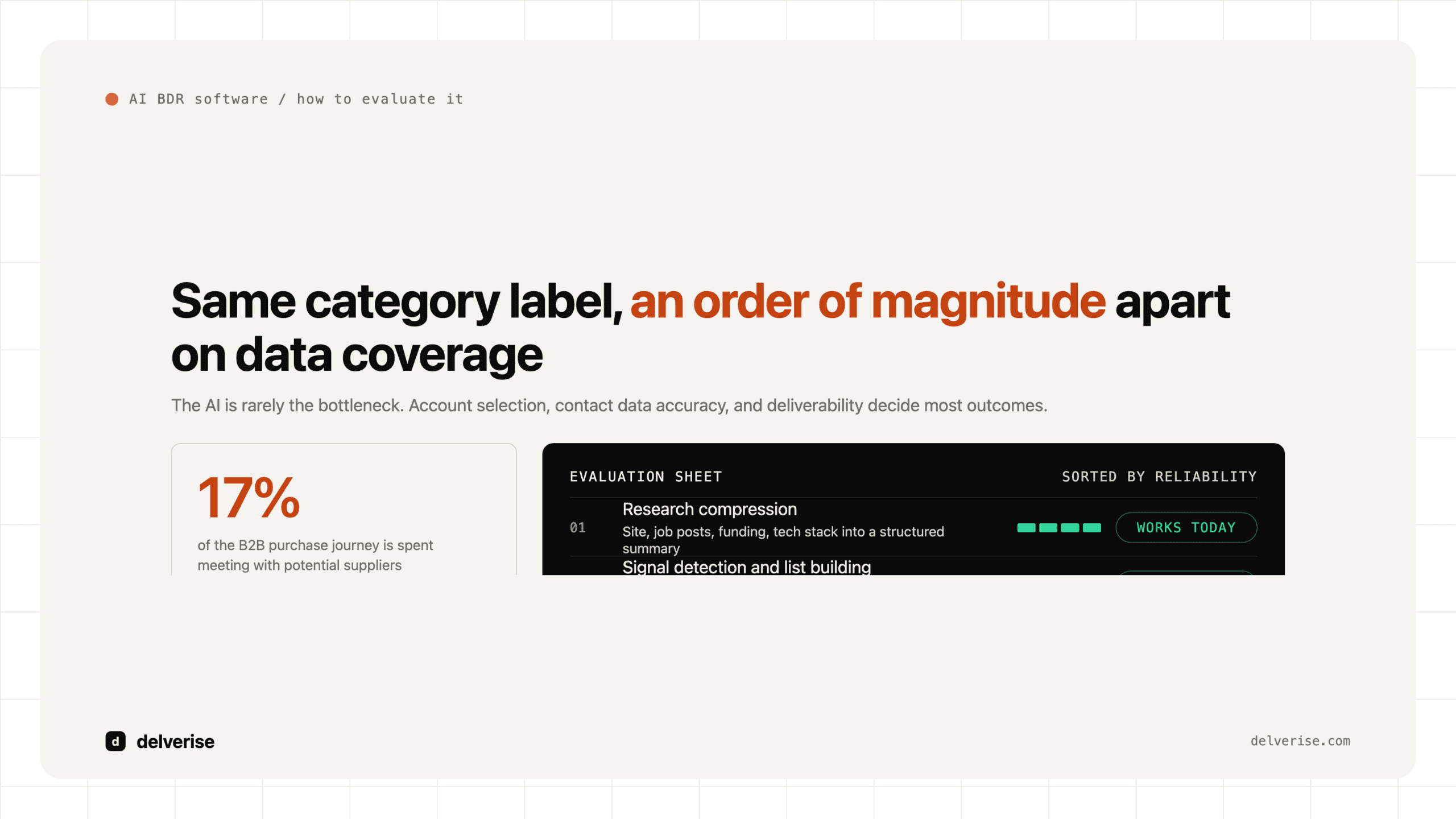
- AI BDR software is a category label, not a capability guarantee. Two products with the same positioning can differ by an order of magnitude in data coverage and reply handling.
- The AI is rarely the bottleneck. Account selection, contact data accuracy, and deliverability decide most outcomes.
- Buy a full-stack agent when your motion is simple and your ICP is broad. Build a composable stack when your qualification logic is specific to your business.
- Measure qualified meetings and pipeline per sending domain, not emails sent or “AI-personalized” volume.
- Budget for the operator. Every deployment that works has someone owning prompts, lists, and exception handling.
What is AI BDR software?
A BDR (business development representative) is the person who finds accounts, opens conversations, qualifies interest, and hands warm opportunities to an account executive. AI BDR software is the class of tools that automates some or all of that loop using large language models plus a data layer: it pulls a target list, enriches each record with firmographic and signal data, writes and sends outreach, classifies replies, and either books a meeting or escalates to a human.
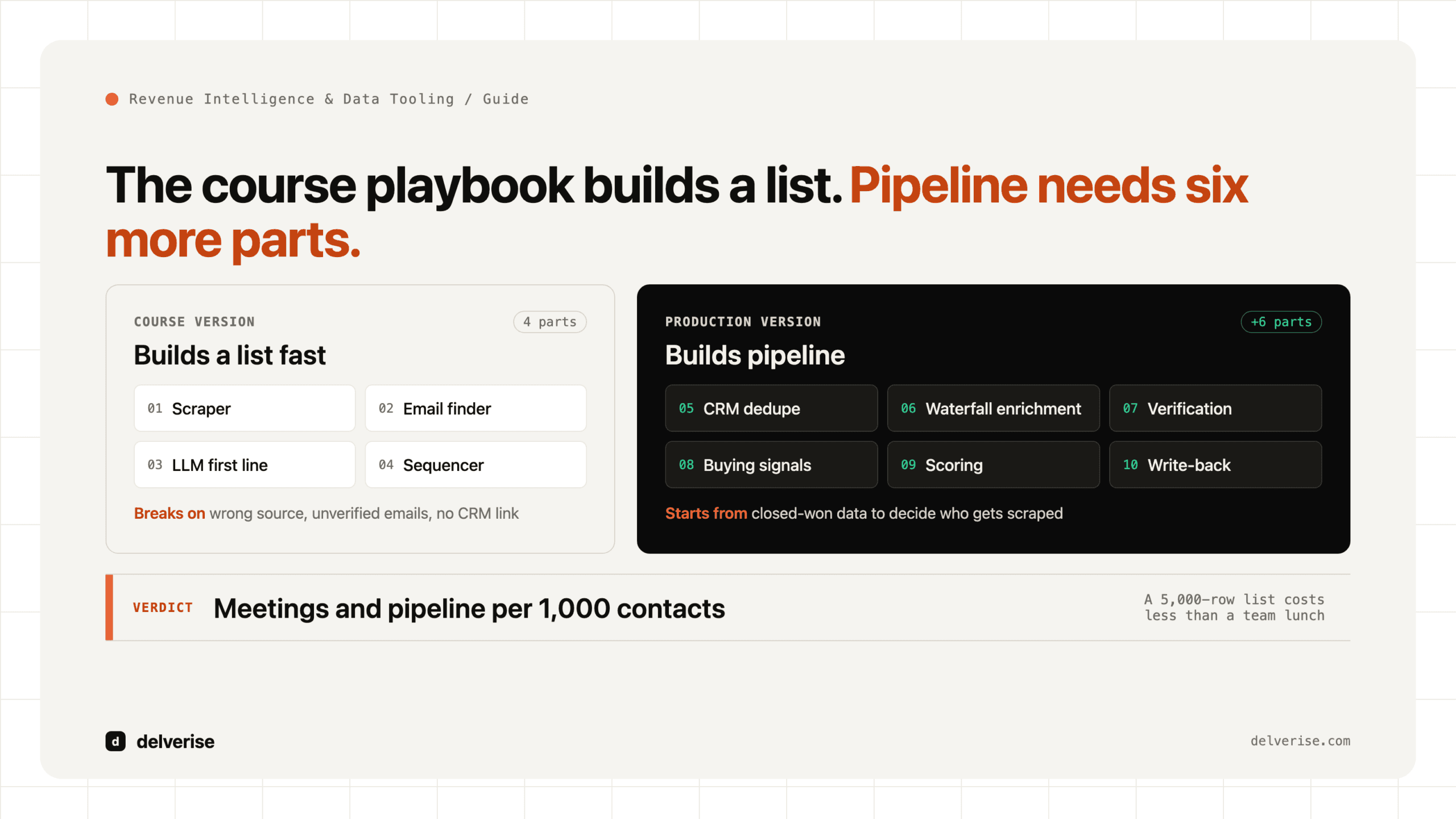
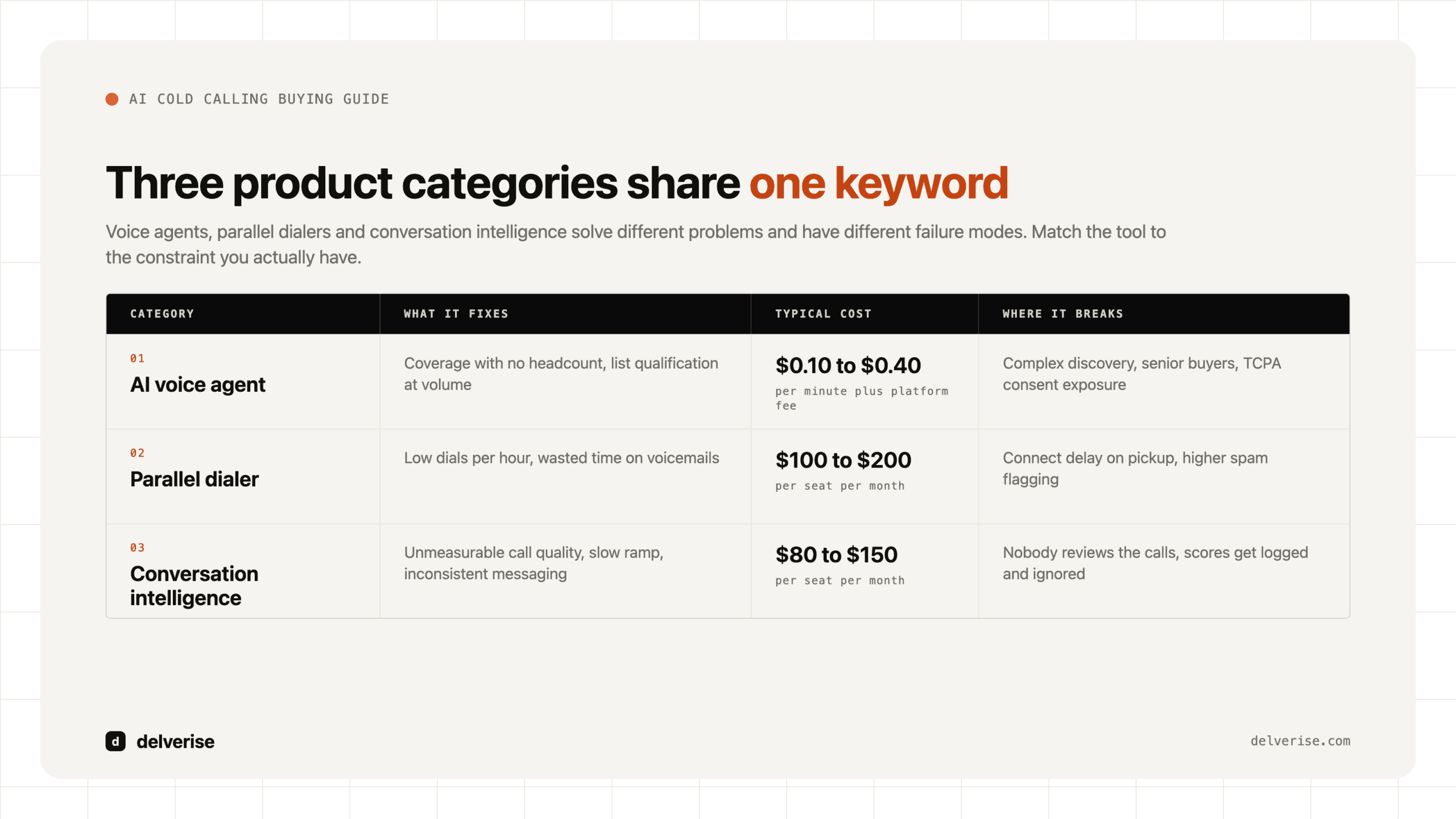
Vendors describe the same product in three different ways, which makes the category confusing to shop. Some sell an autonomous “AI SDR agent” that owns the full loop. Some sell a copilot that drafts and researches while a human stays on the send button. Some sell orchestration: the plumbing that connects your data providers, your CRM, and your sequencer, with AI applied at specific steps. All three get filed under the same search term. Our breakdown of what AI BDR actually automates and where it breaks goes deeper on the mechanics.
Why is this category getting attention now?
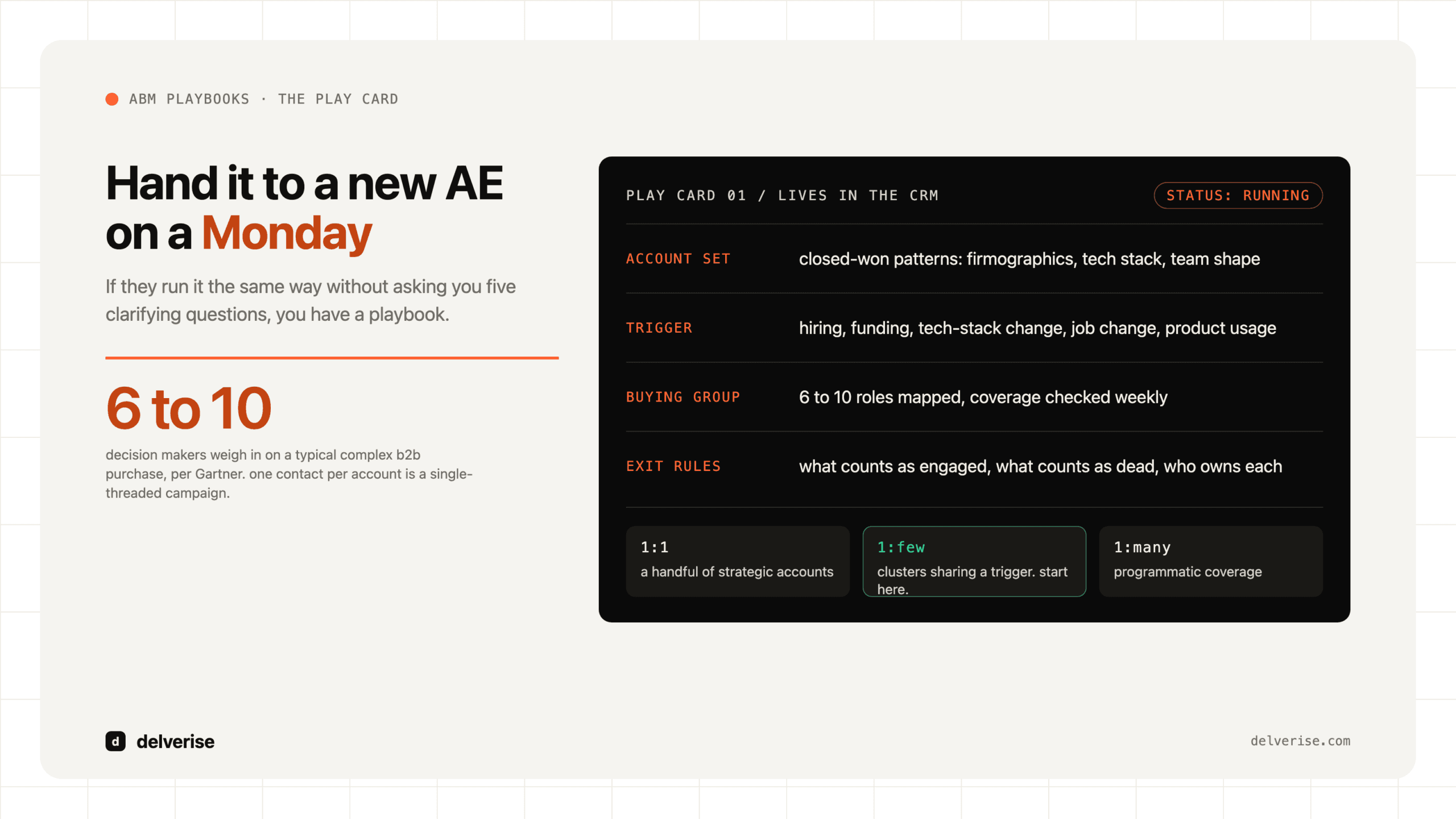
Two forces converged. Outbound response rates fell as sending volume rose, so the cost per meeting from generic sequences climbed. At the same time, buyers moved most of their evaluation off the sales call. Gartner’s research on B2B buying found that customers spend roughly 17% of their purchase journey meeting with potential suppliers, and that a typical buying group involves six to ten decision makers. McKinsey’s B2B Pulse work has consistently found buyers moving across many channels in a single purchase, mixing self-serve research, digital, and human contact.
The practical consequence for a revenue leader: outbound has to reach more people per account, with more specific relevance, at a moment when attention is scarcer. That is arithmetic no headcount plan solves cheaply. It is also exactly the shape of problem AI handles well, provided the inputs are clean.
What does AI BDR software actually automate well?
Sorted by reliability, highest first:

- Research compression. Reading a company’s site, job posts, funding history, tech stack, and reviews, then producing a structured summary. This works, and it removes the single biggest time sink in manual prospecting.
- Signal detection and list building. Turning triggers like new hires, product launches, or intent spikes into a scored account list. See what buying intent data actually changes before you pay for a signal feed.
- First-draft copy at scale. Variant generation per segment, with a real human editing the templates. Quality holds when the input research is specific.
- Reply classification and routing. Sorting interested, not now, wrong person, and unsubscribe with high accuracy, then triggering the right next step.
- Meeting booking mechanics. Calendar negotiation, rescheduling, and reminders.
Where does AI BDR software break?
The failure modes are consistent across vendors.

Contact data. Any single provider covers a fraction of your market accurately, and coverage varies wildly by geography and company size. Teams that chain multiple sources through a data enrichment waterfall get materially better hit rates than teams relying on whatever database ships inside the platform. If a vendor will not tell you their bounce rate on your ICP, run a paid pilot on your own list before committing.
Deliverability. AI makes it trivial to increase volume, and volume is what burns domains. Sending infrastructure, warmup, domain separation, and per-inbox caps matter more than copy quality once you cross a few thousand sends a month.
Qualification nuance. Models are good at “does this reply express interest” and unreliable at “is this account actually a fit for our security posture, contract size, and implementation capacity.” That logic belongs in your data layer as explicit rules, applied before the sequence starts.
Ownership gaps. Autonomous tools still generate exceptions daily. Without a named owner, the exceptions become an unread queue. If nobody in your org owns this, read who should own GTM operations before you buy anything.
Full-stack agent or composable stack?
This is the real buying decision. Everything else is feature comparison.

| Dimension | Full-stack AI BDR platform | Composable stack (data + orchestration + sequencer) | Human BDR with AI assist |
|---|---|---|---|
| Best fit | Broad ICP, simple qualification, self-serve or low-ACV motion | Specific ICP, multi-signal qualification, ACV above ~$25k | Complex enterprise deals, named accounts, multi-threading |
| Time to first meeting | 2 to 4 weeks | 4 to 8 weeks | 6 to 12 weeks including ramp |
| Cost shape | Per seat or per meeting, predictable | Credits plus build time, cheaper at volume | Salary plus tooling, highest per meeting |
| Main tradeoff | Their qualification logic, their data, limited escape hatches | Requires an operator and real ownership | Does not scale linearly with spend |
| Switching cost | High, logic lives in their platform | Low, logic lives in your CRM and workflows | Not applicable |
For most Seed to Series B teams with a differentiated ICP, the composable route wins on economics and on control. Clay is the common backbone here because it combines waterfall enrichment, AI research agents, and outbound routing in one place, with your logic stored as columns you can inspect. It carries a real learning curve and credit costs that need managing, so treat it as a system to build deliberately. If you want that built and handed over rather than learned from scratch, that is what our Clay partner work covers.
What does the math look like?
Work a concrete model before signing anything. Assume a $30k ACV, a 4,000-account addressable list, and three contacts per account.
- 12,000 contacts, 70% deliverable after verification and waterfall enrichment: 8,400 reachable.
- A 2.5% positive reply rate on well-researched, segmented outreach: 210 conversations.
- 40% of those convert to held meetings: 84 meetings.
- 25% become qualified opportunities: 21 opportunities.
- At a 22% close rate: roughly 4.6 deals, or about $138k in new ARR from one full pass of the list.
Now run it against cost. If the platform plus data plus infrastructure runs $2,500 a month and an operator spends a quarter of their time on it, you are near $60k annualized against $138k. That works, and it is tight enough that a 30% drop in data quality erases the margin. This is why the enrichment layer deserves more scrutiny than the AI copywriting demo. Sanity-check your own inputs against our AI prospecting tools buying guide and the wider AI outbound system view.
What should you verify before you buy?
- Run a paid pilot on 500 of your own accounts and measure bounce rate, not vendor-supplied coverage claims
- Read 20 AI-generated emails end to end and ask whether you would reply to any of them
- Confirm sending infrastructure: separate domains, per-inbox caps, warmup schedule, and who owns them
- Ask where qualification logic lives and whether you can export it
- Check native CRM write-back on your exact CRM, including custom objects
- Name the internal owner and the hours per week they will spend
- Agree the success metric and review date before the contract starts
How do you measure whether it worked?
Track four numbers monthly: qualified meetings held, cost per qualified meeting, pipeline created, and opportunity-to-close rate on AI-sourced deals compared with your other channels. G2’s buyer behavior research has repeatedly shown that software buyers shorten evaluation cycles when vendors reach them with relevant context, which is the mechanism you are paying for. If AI-sourced opportunities close at half the rate of inbound, the tool is producing volume without fit, and the fix is upstream in targeting rather than in the copy.
Give it two full quarters. Outbound systems compound as reply data teaches you which segments respond, and that feedback loop is the durable asset. Fast follow-up on the replies you generate often moves conversion more than any change to the sending side.
Frequently Asked Questions
Can AI BDR software replace a human BDR?
For high-volume, low-complexity motions with a broad ICP, it can cover most of the top-of-funnel work. For enterprise deals requiring multi-threading across a six to ten person buying group, it handles research and first touch while a human owns the relationship. Most teams land on a hybrid: AI handles breadth, humans handle depth on named accounts.
How much does AI BDR software cost?
Full-stack platforms typically run $1,000 to $5,000 per month, sometimes priced per meeting booked. A composable stack usually costs less in software (data credits plus orchestration plus sequencer) and more in build and operating time. Include sending infrastructure, email verification, and the operator’s hours in any comparison, since those line items decide the real cost per meeting.
Will AI-generated outbound hurt our domain reputation?
The AI itself does not. The volume it enables does, when sending is misconfigured. Use dedicated sending domains separate from your primary corporate domain, keep per-inbox daily caps conservative, verify every address before sending, and monitor bounce and spam-complaint rates weekly. Deliverability problems show up in the data two to three weeks before they show up in pipeline.
What data do we need in place before this works?
A defined ICP with explicit exclusion rules, a clean account list, verified contact data at the buying-committee level, and CRM fields that record why each account was targeted. Without that last one, you cannot tell which segments worked, and the system stops improving after the first month.
How long until we see pipeline?
First meetings usually land in weeks two to six depending on setup path. Closed revenue follows your normal sales cycle, so a 90-day cycle means the honest read on ROI arrives around month five. Judging the system on 30 days of data produces the wrong decision in both directions.
Read next