←Back to blog
Outbound & Pipeline EngineeringGuideMay 20, 202670 min read
The Complete Email Deliverability Guide
Email deliverability guide framework: four pillar framework for infrastructure, copy, and inbox placement at scale.
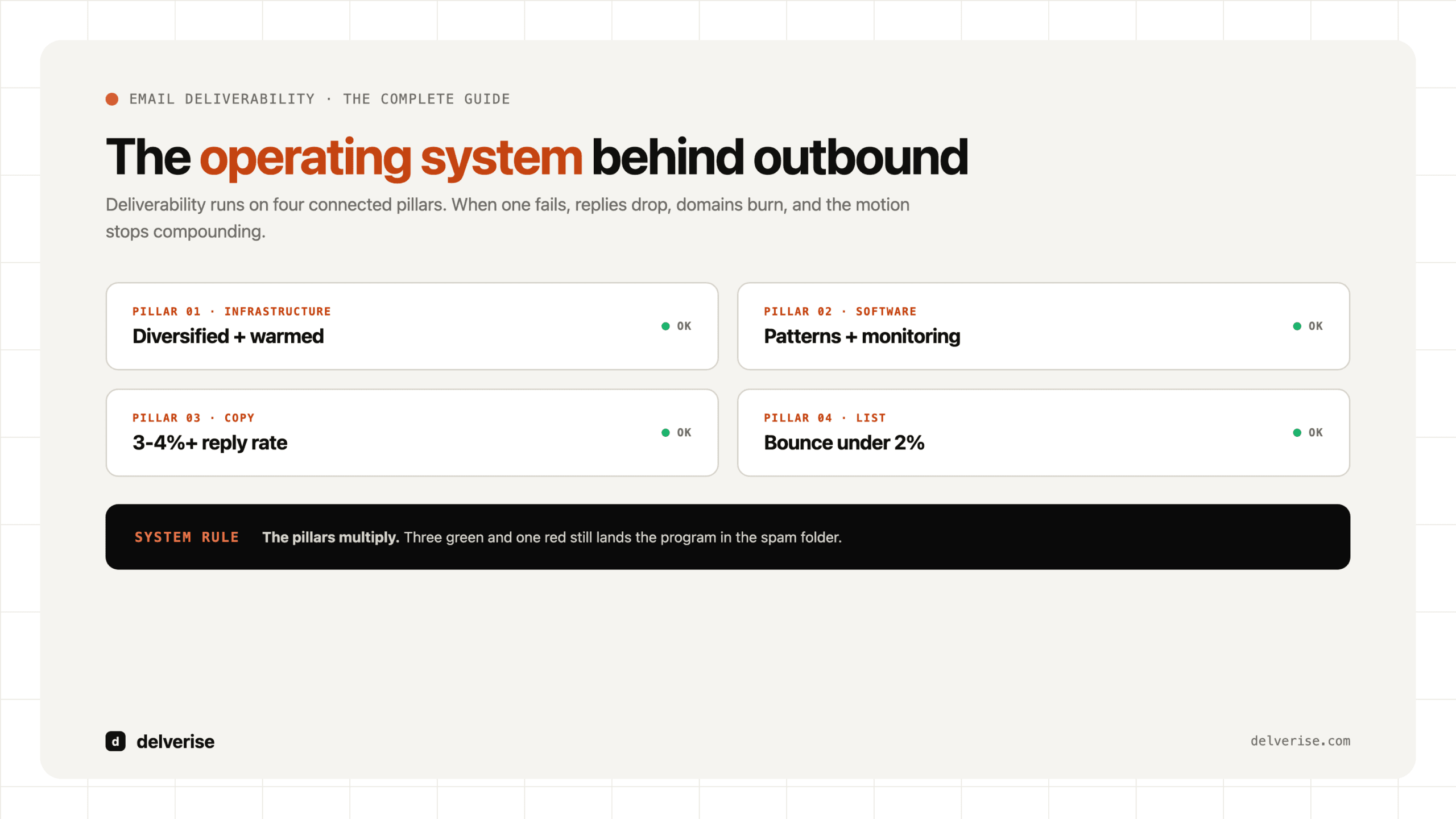
Answer: Email deliverability is the operating system behind scalable outbound. A sound program manages four connected pillars: sending infrastructure, sending software, email copy, and list quality. If one pillar fails, reply rates drop, bounce rates rise, domains burn faster, and the outbound motion stops compounding.
- Infrastructure covers domains, DNS, ESP mix, warming, and reputation monitoring.
- Software controls sending patterns, sequencing, bounce handling, and operational visibility.
- Copy creates the engagement signals inbox providers use to judge sender quality.
- List quality depends on sourcing, enrichment, verification, segmentation, and ongoing hygiene.
The practical goal is not just better inbox placement. It is an outbound system that can scale without damaging the assets it depends on.
The 4 Pillars of Email Deliverability: What a Sound System Looks Like

Email deliverability operates on four interconnected pillars, and a weakness in any single pillar quietly undermines the entire operation. The model breaks down into the infrastructure that sends, the software layer that runs the campaigns, the copy itself, and the list of leads. For a revenue leader judging whether an outbound program is built to scale, these four areas are the scorecard: infrastructure, sending software, copy, and list quality.
The questions worth asking are evaluative ones. Is the infrastructure provisioned and warmed correctly, or stretched past its safe sending volume? Does the sending platform protect sender reputation, or erode it? Is the copy written to clear spam filters at scale? Is the list sourced and verified to a standard that keeps bounce rates low? A program that scores well on three pillars while ignoring the fourth still ends up in the spam folder.
Pillar 1: Infrastructure – The Technical Foundation
Infrastructure encompasses your domains, email service providers (ESPs), IP addresses, DNS configuration, and sending setup. This pillar determines whether your emails even have the technical capability to reach inboxes. Our fieldwork consistently shows that infrastructure problems create cascading failures across all other pillars.
A critical pattern shows up across cold email infrastructure: many teams use the tools correctly from a technical standpoint, yet still implement them in the wrong way. Good infrastructure components are only the starting point, and the configuration and integration must be executed properly.
The infrastructure pillar includes domain age and reputation, ESP diversification, IP warming strategies, DNS record optimization, and sending platform selection. Each component must work in harmony with the others, and failure in one area often creates a domino effect that impacts deliverability across your entire operation.
Pillar 2: Software and Sending Technology
The software pillar covers your sending platform, warmup services, monitoring tools, and automation systems. This pillar determines how efficiently and safely you can execute your email campaigns while maintaining positive sender reputation.
Using the right sending technology is foundational. The platform a team sends on affects everything from deliverability rates to its ability to monitor and optimize performance.
Modern sending platforms must provide sophisticated features like intelligent sending delays, pattern randomization, reply detection, bounce management, and integrated warmup capabilities. The software pillar also includes your ability to monitor performance in real-time and make rapid adjustments when deliverability issues arise.
Pillar 3: Copy and Content Strategy
The copy pillar encompasses your email content, subject lines, personalization strategy, and overall messaging approach. This pillar determines how recipients and spam filters perceive and respond to your emails, directly impacting both deliverability and conversion rates.
Content quality affects deliverability in multiple ways. High-converting offers that generate positive engagement signals (replies, forwards, saves) can enable higher sending volumes while maintaining inbox placement. Conversely, content that triggers spam complaints or generates zero engagement creates negative signals that damage sender reputation.
In practice, we see that some campaigns can run unchanged for years with strong offers, while others require constant optimization. Event invitations and high-value propositions tend to perform better from a deliverability perspective because they generate genuine interest and positive engagement.
Pillar 4: List Quality and Data Management
The list pillar covers your data sources, verification processes, segmentation strategy, and ongoing list hygiene. This pillar determines whether you’re sending to valid, engaged recipients who are likely to respond positively to your outreach.
Poor list management is one of the fastest ways to destroy email infrastructure. Some teams do everything right while others get almost everything wrong, and the teams doing the wrong things burn their sending accounts extremely fast.
List quality issues manifest as high bounce rates (above 2%), low engagement rates, and increased spam complaints. A concrete example of infrastructure destruction: an account sends a hundred emails, sees close to a 0% reply rate, and keeps running that way for two weeks. Domains in that state are usually too far gone to rescue.
According to Validity’s Sender Snapshot report, ‘mailbox providers begin throttling and filtering senders once hard bounce rates cross the 2% threshold, with reputation damage compounding the longer the pattern persists.’ At delverise, we treat 2% as the hard ceiling rather than a target, because by the time you see it in your dashboard, the reputation hit is already priced in.
Actionable Takeaway Box: The 4-Pillar Assessment Checklist
- Infrastructure: Are you diversified across ESPs, domains, and platforms?
- Software: Does your sending platform provide real-time monitoring and optimization?
- Copy: Are you generating 3-4%+ reply rates consistently?
- List: Are you maintaining sub-2% bounce rates with verified data?
The Interconnected Nature of the Pillars
The critical insight from delverise fieldwork is that these pillars are not independent. They create a multiplicative effect on deliverability success. The core diagnostic challenge is quickly identifying whether the issue sits in infrastructure, copy, offer quality, list quality, or the sending workflow itself.
When deliverability problems arise, the root cause could be in any pillar, and the symptoms often appear across multiple areas. For example, a list quality problem (high bounce rates) can damage domain reputation (infrastructure), which then affects the performance of good content (copy) sent through reliable software. This interconnectedness means that optimization efforts must consider all four areas simultaneously.
This is why the four-pillar framework matters. Deliverability breaks when teams optimize isolated components while leaving the rest of the operating system weak. The goal is to manage the complete system rather than chase one-off fixes.
The most successful email operations treat the four areas as an integrated system, with regular monitoring and optimization across all areas. This systematic approach enables sustainable scaling and long-term deliverability success, while pillar-by-pillar optimization often leads to temporary improvements followed by systematic failures.
Infrastructure Strategy: The Diversification Imperative

The single most important principle in email infrastructure design is diversification, never putting all your eggs in one basket. This principle shows up consistently across delverise research and hands-on outbound system work. The reason is simple: when email providers make algorithm changes, update spam filters, or implement new restrictions, diversified operations continue functioning while concentrated setups fail completely.
Field Note:
The main thing to keep in mind is that this whole space moves like a pendulum. Conditions get harder, then easier, then harder again, and where the difficulty sits tends to shift over time.
Multi-Layer Diversification Strategy
Effective diversification operates across multiple layers of your infrastructure, creating redundancy that protects against various types of failures. We recommend diversification across five critical dimensions:
ESP Provider Diversification forms the foundation of resilient infrastructure. Rather than relying solely on Google Workspace or Microsoft 365, successful operations distribute sending across multiple email service providers. This includes Google Workspace inboxes, Microsoft/Outlook accounts, and private SMTP infrastructure. The optimal mix depends on your target audience, but we recommend maintaining capabilities across at least two major ESPs.
Outlook has been the toughest deliverability challenge of recent months. This is why ESP diversification matters: when one provider becomes difficult, you need alternatives ready to scale.
Domain Registrar Diversification protects against registrar-specific issues and provides flexibility in domain management. We recommend using at least two domain registrars, with popular choices including Pork Bun, Spaceship, and GoDaddy. This diversification ensures that domain registration issues, policy changes, or technical problems with one registrar don’t impact your entire operation.
Server and Cloud Provider Diversification extends beyond just email providers to include the underlying infrastructure hosting your domains and applications. This includes using multiple cloud providers, different data centers, and varied IP address ranges. Geographic diversification is particularly important, with Western European data centers often outperforming US-based infrastructure for certain campaigns.
DNS and Name Server Diversification involves using multiple CloudFlare accounts or different DNS providers to manage your domains. This prevents DNS-related failures from impacting your entire domain portfolio and provides additional flexibility in traffic routing and domain management.
Sending Platform Diversification means maintaining capabilities across multiple sending platforms rather than relying on a single solution. Common platforms in scaled outbound stacks include Instantly, Smartlead, Bison, Pulse Vibe, and Lemlist. Each platform has strengths in different areas, and diversification enables you to optimize for specific campaign types or quickly pivot when platform-specific issues arise.
Geographic and IP Strategy Considerations
Geographic matching between your infrastructure and target audience significantly impacts deliverability performance. Our field research consistently shows better results when IP addresses and data centers align with target geographic regions. For campaigns targeting US audiences, US-based infrastructure generally performs better, while European campaigns benefit from European data centers and IP addresses.
Interestingly, our field research suggests that Western European infrastructure often outperforms US-based infrastructure even for US-targeted campaigns. This counterintuitive finding suggests that European IP addresses may have better reputation scores or face less scrutiny from spam filters, possibly due to stricter data protection regulations that reduce spam origination from these regions.
Warning Box: Avoid These Geographic Mistakes
- Using Asian data centers for Western campaigns (consistently poor performance)
- Mismatching IP geography with target audience geography
- Ignoring time zone considerations in sending schedules
- Using VPN or proxy services that mask true geographic location
Shared vs. Dedicated IP Strategy
The choice between shared and dedicated IP addresses represents a critical infrastructure decision that affects both deliverability and operational complexity. Our operating view favors shared IPs for most use cases, contrary to common assumptions about dedicated IP superiority.
Shared IP Advantages include riding alongside legitimate business traffic, which helps hide cold email activity among transactional emails, newsletters, and other legitimate communications. Google Workspace and Microsoft 365 shared IP pools benefit from the reputation of millions of legitimate business users, making individual cold email campaigns less apparent to spam filters.
The shared IP philosophy works like this: when you send on Google or Outlook, you share IP space with legitimate business traffic, which helps blend cold email in with transactional email. This camouflage effect is particularly valuable for cold email operations that need to maintain low profiles while scaling volume.
Dedicated IP Requirements include consistent daily sending volume to maintain IP reputation, gradual volume increases following cloud provider warming schedules, and higher overall volume to justify the dedicated resource. Dedicated IPs work best for high-volume, consistent senders who can commit to daily sending and have the volume to properly warm and maintain IP reputation.
In practice, we see that dedicated IPs require more sophisticated management and are often unnecessary for most cold email operations. Unless you’re sending hundreds of thousands of emails daily with consistent volume, shared IPs typically provide better deliverability with less operational overhead.
Infrastructure Redundancy Implementation
Implementing effective infrastructure redundancy requires systematic planning and ongoing management. The goal is creating multiple independent pathways for email delivery, ensuring that problems with any single component don’t halt your entire operation.
Domain Portfolio Management involves maintaining domains across multiple registrars, with different registration dates, varied TLDs, and distributed DNS management. Successful teams maintain domain inventories that can support their sending volume for 90+ days without requiring new domain purchases, providing buffer time to address deliverability issues without rushing domain acquisition.
ESP Account Distribution requires maintaining active accounts across multiple email service providers, with proper warmup and reputation management for each. This includes Google Workspace accounts, Microsoft 365 subscriptions, and private SMTP services, each configured and warmed according to provider-specific requirements.
Platform Integration Redundancy involves configuring multiple sending platforms with your infrastructure, ensuring that you can quickly pivot between platforms when issues arise. This includes maintaining active accounts, proper integrations, and tested workflows across at least two sending platforms.
Monitoring and Alerting Systems must span your entire diversified infrastructure, providing unified visibility into performance across all ESPs, domains, and platforms. This includes deliverability testing, reply rate monitoring, bounce rate tracking, and domain reputation scoring across your complete infrastructure portfolio.
Pro Tip Box: Infrastructure Redundancy Checklist
- Maintain 2+ ESP providers with active, warmed accounts
- Use 2+ domain registrars with staggered renewal dates
- Configure 2+ sending platforms with tested integrations
- Implement monitoring across all infrastructure components
- Test failover procedures monthly to ensure redundancy works
The key delverise field insight is that infrastructure diversification goes beyond having backup options. It creates an antifragile system that becomes stronger when individual components face stress. By distributing risk across multiple providers, platforms, and geographic regions, successful email operations maintain consistent performance even as the deliverability landscape continues evolving.
Domain Strategy: Age, TLDs & Geographic Considerations

Domain strategy represents one of the highest-impact areas for deliverability optimization, with domain age emerging as a practical advantage for dramatically improving inbox placement rates. The field pattern shows that domain reputation matters more than individual inbox reputation, making domain strategy a critical leverage point for sustainable email operations.
Domain Age: The Deliverability Secret Weapon
One of the most important findings in our field research concerns the dramatic impact of domain age on deliverability performance. Our field research shows significant improvements when using aged domains compared with newly registered domains.
Field Note:
Aged domains with long, clean histories can create night-and-day differences compared with newly registered domains, especially when they are acquired carefully and parked before use.
Aged Domain Acquisition Strategy involves purchasing domains through GoDaddy Auctions using age filters to identify domains with 10, 15, or 20+ years of registration history. The process requires filtering for domains with clean histories, checking SpamHaus reputation scores (targeting scores of 3 or higher), and verifying that domains haven’t been used for spam or other problematic activities.
The economics of aged domain acquisition are compelling. Domains typically cost $1 base bid plus $10-20 for transfer and renewal fees, making them cost-competitive with new domain registration while providing substantial deliverability advantages. The key is systematic acquisition and testing rather than one-off purchases.
Domain Parking Strategy involves purchasing domains and allowing them to age further before use. Our field research shows significant deliverability improvements after parking domains for 30, 90, or 180+ day periods. This strategy requires planning ahead and building domain inventory, but the deliverability improvements often justify the additional time investment.
The parking approach works because it allows domains to establish baseline reputation scores with major email providers before being associated with cold email activity. During the parking period, domains can be configured with basic DNS records and minimal legitimate activity to establish positive baseline signals.
TLD (Top-Level Domain) Strategy and Performance
TLD selection significantly impacts deliverability performance, with clear hierarchies emerging from field testing across scaled outbound programs. Our operating view strongly favors established TLDs over newer or exotic options, with specific recommendations based on extensive performance data.
.com domains maintain their position as the gold standard for email deliverability. Across our TLD research, .com remains the safest and most effective choice. The ubiquity and trust associated with .com domains translate directly into better inbox placement rates across all major email providers.
.co domains emerge as the closest alternative to .com, with field research showing performance nearly equivalent to .com domains. The .co TLD has gained legitimacy through adoption by major technology companies and startups, creating positive associations that benefit deliverability.
.io domains perform well enough for many technology and startup use cases, though they usually do not match .com or .co performance in our field testing.
Established TLDs including .net and .org continue to provide reliable deliverability performance. These TLDs benefit from decades of legitimate use and established trust relationships with email providers, making them safe choices for most campaigns.
Geographic TLDs represent an underutilized opportunity in our field research. Country-specific TLDs like .co.uk, .de, .kr, and .fr often provide excellent deliverability performance while being less expensive than premium .com domains. These TLDs can be particularly effective when sending localized content or targeting specific geographic regions.
TLD Performance Table:
| TLD Category | Examples | Deliverability Rating | Cost | Best Use Cases |
|---|---|---|---|---|
| Premium | .com | Excellent | $$$ | All campaigns |
| Near-Premium | .co | Very Good | $$ | General business |
| Tech-Focused | .io | Good | $$ | B2B tech campaigns |
| Established | .net, .org | Good | $ | General campaigns |
| Geographic | .co.uk, .de, .fr | Very Good | $ | Localized campaigns |
| Avoid | .us, exotic TLDs | Poor | Varies | None recommended |
Warning Box: TLD Mistakes to Avoid
- .us domains consistently underperform according to SpamHaus data
- New or exotic TLDs without proven track records
- TLDs associated with spam or low-quality content
- Mismatching TLD geography with campaign targeting
Generic vs. Branded Domain Strategy
The choice between generic and branded domains involves balancing deliverability performance, operational efficiency, and client relationship considerations. The operating pattern suggests that deliverability performance differences are minimal, making operational factors the primary decision criteria.
Generic Domain Advantages include faster campaign launch capabilities, since pre-warmed generic domains are often available for immediate use. Generic domains also provide operational flexibility, allowing agencies to swap domains between clients or campaigns without branding conflicts. Cost-effectiveness is another advantage, as generic domains can be purchased in bulk and used across multiple campaigns.
Our field research suggests that generic domains show no measurable deliverability performance difference compared to branded domains when properly configured and warmed. This finding challenges common assumptions about the importance of brand alignment for technical deliverability metrics.
Branded Domain Considerations primarily affect client relationships and long-term trust building rather than technical deliverability performance. Branded domains can enhance recipient trust and reduce spam complaints when recipients recognize the sending domain as legitimate. However, in practice, we see that branded domains can also generate more spam reports if recipients don’t recognize the brand or have negative associations with it.
The practical recommendation from the field research is to start with generic domains for testing and optimization, then transition to branded domains for long-term client relationships once campaigns are proven effective. This approach maximizes operational efficiency while building toward stronger client relationships.
Domain Volume and Longevity Strategy
Domain volume strategy represents a critical balance between maximizing sending capacity and preserving domain reputation for long-term use. Our operating view strongly favors lower volume per domain to extend domain lifespan, viewing domains as valuable assets that should be preserved rather than consumed rapidly.
Domain Reputation Priority emerges as a key insight from the field research. Our fieldwork shows that domain reputation matters more than individual inbox reputation, making domain preservation a higher priority than maximizing per-domain volume. This principle guides volume distribution decisions and long-term infrastructure planning.
Volume Distribution Philosophy favors spreading volume across more domains rather than maximizing volume per domain. The recommended approach involves using more domains with lower per-domain volume rather than fewer domains with higher volume. This strategy extends domain lifespan and provides better long-term economics despite higher upfront domain costs.
Recommended Volume Limits vary across operating approaches but cluster around 50 emails per day per domain as a conservative maximum. Some operating data shows success with higher volumes (200+ emails per domain), but this requires exceptional offers, perfect infrastructure, and acceptance of shorter domain lifespans.
Pro Tip Box: Domain Longevity Optimization
- Target 50 emails/day per domain maximum for longevity
- Spread volume across more domains vs. more inboxes per domain
- Monitor domain reputation scores weekly
- Plan for 90+ day domain lifecycles
- Build domain inventory 3-6 months ahead of needs
Domain Recovery and Reputation Management
Domain recovery strategies provide options for rehabilitating domains that have experienced deliverability issues, potentially extending their useful life and reducing infrastructure costs. Our field research shows mixed but promising results with domain recovery techniques.
SpamHaus Delisting Process offers a systematic approach to domain rehabilitation. One operating dataset shows a 68.3% success rate with SpamHaus delisting requests, with processing times ranging from 24 hours to 14 days. The process involves submitting delisting forms with technical justifications or spam removal confirmations, then waiting for review and approval.
Successfully delisted domains can be parked for future use, with no apparent “residue” affecting their subsequent performance. This finding suggests that domain recovery can be a viable strategy for extending infrastructure lifespan and reducing domain acquisition costs.
Domain Parking for Recovery involves removing problematic domains from active use and allowing them to “rest” for extended periods. Our field research shows success with parking domains for 90+ days after deliverability issues, then gradually reintroducing them to active campaigns with careful monitoring.
The recovery approach requires patience and systematic tracking, but can provide significant cost savings compared to constant new domain acquisition. The key is identifying domains worth recovering versus those that should be permanently retired from email use.
The Science of Warmup: Ratios, Quality & Timing

Email warmup represents one of the most technical and nuanced aspects of deliverability optimization, with specific ratios, quality factors, and timing considerations that can make or break your email infrastructure. delverise fieldwork shows sophisticated warmup strategies that go far beyond basic “send some emails back and forth” approaches, emphasizing the importance of burying negative signals in positive warmup activity.
Warmup Volume Ratios: The 2x Rule and Variations
The foundational principle of warmup volume centers on the “2x rule”: maintaining warmup volume at twice your maximum cold sending volume. This ratio ensures that positive warmup signals consistently outweigh any negative signals generated by cold email campaigns, creating a protective buffer that maintains sender reputation.
Field Note:
“Warmup volume should equal 2x your maximum cold sending volume. If you’re sending 20 cold emails per day, you need 40 warmup emails per day to bury the negative signals in positive activity.” – delverise Field Note
The 2x Rule Implementation requires calculating your maximum daily cold email volume across all campaigns, then configuring warmup services to generate twice that volume in positive interactions. For example, an operation sending 50 cold emails per day should maintain 100 warmup emails per day across all domains and inboxes.
This ratio is based on the mathematical reality of signal processing by email providers. Cold emails typically generate neutral to negative engagement signals (low open rates, few replies, potential spam complaints), while warmup emails generate consistently positive signals (high open rates, guaranteed replies, positive engagement patterns). The 2:1 ratio ensures positive signals dominate the overall engagement profile.
Alternative Ratio Strategies provide flexibility for different operational requirements and risk tolerances. Some teams start with 2:1 ratios during initial warmup phases, then scaling down to 1:1 ratios once domains are established and performing well. This approach reduces warmup costs while maintaining adequate signal protection.
A reliable baseline is at least 10 warmup emails per day, regardless of cold sending volume. This ensures that even low-volume operations maintain consistent positive signals, while higher-volume operations scale warmup proportionally.
Dynamic Ratio Adjustment involves varying warmup ratios every 2-3 weeks to create pattern interruption and avoid algorithmic detection. Some successful teams alternate between 2:1, 1.5:1, and 1:1 ratios on rotating schedules, preventing email providers from identifying consistent patterns that might indicate artificial activity.
Warmup Quality Factors and Pool Management
Warmup quality matters as much as volume, with sophisticated operators focusing on creating genuinely human-like interactions that are indistinguishable from legitimate business communications. The goal is generating warmup activity that provides positive signals and appears completely natural to algorithmic analysis.
Message Quality Standards require warmup emails to use natural language patterns, varied conversation topics, and human-like response timing. Modern warmup services use AI to generate conversations that discuss business topics, industry trends, and professional networking in ways that mirror legitimate business communications.
Our operating approach emphasizes using text-only warmup emails rather than HTML-formatted messages, as text emails appear more natural and generate better engagement signals. HTML formatting, images, and complex layouts can trigger spam filters and reduce the effectiveness of warmup activity.
Pool Segmentation Strategy involves organizing warmup participants into different quality tiers based on their infrastructure and engagement patterns. Premium pools consist exclusively of Google Workspace and Microsoft 365 accounts with high engagement rates, while general pools include mixed infrastructure types, and basic pools handle SMTP or problematic accounts.
This segmentation ensures that high-quality domains receive warmup activity from equally high-quality sources, while preventing problematic accounts from contaminating premium warmup pools. The isolation strategy protects valuable infrastructure from potential negative signals generated by lower-quality warmup participants.
Bounce Management in Warmup requires actively monitoring and removing bouncing accounts from warmup pools. Bounced warmup emails create negative signals that can damage sender reputation, making bounce management a critical component of warmup quality control.
Warmup Quality Checklist:
- Text-only emails with natural language patterns
- AI-generated conversations covering business topics
- Pool segmentation by infrastructure quality
- Active bounce monitoring and removal
- Varied response timing and conversation length
- Regular pool quality audits and optimization
Timing and Pattern Considerations
Warmup timing strategy involves matching warmup activity to your actual sending schedule while incorporating pattern interruption techniques that prevent algorithmic detection. The goal is creating warmup activity that appears to be natural business communication rather than artificial reputation management.
Schedule Synchronization requires running warmup activity only on days when you’re sending cold emails, avoiding weekend warmup unless you’re also sending weekend campaigns. This synchronization ensures that warmup signals align with your actual sending patterns, creating a coherent engagement profile that appears natural to email providers.
We recommend matching warmup timing to your cold email sending schedule, including start times, end times, and daily volume distribution. If your cold emails send between 9 AM and 5 PM, your warmup activity should follow similar timing patterns to maintain consistency.
Pattern Interruption Techniques involve deliberately varying warmup schedules, reply rates, and conversation patterns to avoid creating detectable artificial patterns. Successful teams vary warmup reply rates between 70-75% every few weeks, adjust sending times by 1-2 hours periodically, and modify conversation topics and length regularly.
The goal is creating enough variation to appear human while maintaining enough consistency to generate reliable positive signals. Too much variation can reduce warmup effectiveness, while too little variation can trigger algorithmic detection.
Reply Rate Management involves carefully controlling warmup reply rates to maintain optimal engagement signals without appearing artificial. We typically start with 70-75% reply rates, which are high enough to generate strong positive signals but not so high as to appear obviously artificial.
Reply rate variation is crucial for long-term success. Teams that maintain exactly 75% reply rates for months often see diminishing warmup effectiveness as email providers detect the artificial consistency. Varying reply rates between 65-80% on rotating schedules maintains effectiveness while avoiding detection.
Alternative Warmup Services and Diversification
Warmup diversification involves using multiple warmup services and approaches to avoid over-reliance on any single provider or methodology. This strategy protects against warmup service issues while creating more natural and varied engagement patterns across your infrastructure.
Platform-Integrated vs. External Warmup represents a key strategic choice. Most sending platforms include integrated warmup services that are convenient and well-coordinated with campaign sending. However, we recommend supplementing platform warmup with external services to create additional diversification and pattern variation.
External warmup services like Warmup Inbox provide different participant pools, conversation patterns, and engagement signals compared to platform-integrated options. Using both approaches creates more complex and natural-appearing engagement profiles that are harder for email providers to categorize as artificial.
Warmup Service Rotation involves periodically changing warmup providers or rotating between multiple services to prevent over-reliance on any single approach. Some agencies use completely different warmup providers for different client accounts, creating unique engagement signatures for each operation.
Pro Tip Box: Advanced Warmup Diversification
- Use both platform-integrated and external warmup services
- Rotate warmup providers every 3-6 months
- Segment different client accounts across different warmup pools
- Monitor warmup effectiveness across all services
- Maintain backup warmup options for rapid deployment
Warmup Effectiveness Monitoring and Optimization
Measuring warmup effectiveness requires tracking multiple metrics across your infrastructure to ensure that warmup activity is generating the intended positive signals and supporting overall deliverability performance. Our operating approach emphasizes that warmup is not a “set it and forget it” activity but requires ongoing monitoring and optimization.
Warmup Reputation Scoring involves tracking the reputation scores provided by warmup services, with most services offering daily or weekly reputation updates for participating domains. Good reputation scores indicate effective warmup activity, while declining scores suggest the need for warmup strategy adjustments.
We recommend using warmup reputation scores as early warning indicators for deliverability issues. Significant drops in warmup reputation often precede broader deliverability problems, providing time to adjust strategies before campaign performance is affected.
Campaign Performance Correlation involves tracking the relationship between warmup activity and actual campaign performance metrics like reply rates, inbox placement, and bounce rates. Effective warmup should correlate with stable or improving campaign performance over time.
Warmup ROI Analysis considers the cost of warmup services against the value of maintained deliverability and extended domain lifespan. While warmup represents an ongoing operational cost, our field research consistently shows that proper warmup extends domain lifespan by 200-300%, making it highly cost-effective despite the monthly service fees.
The key delverise field insight is that warmup goes beyond volume. It is about creating a comprehensive positive signal environment that supports your cold email operations while appearing completely natural to email provider algorithms. Success requires attention to ratios, quality, timing, and ongoing optimization rather than simply enabling warmup services and hoping for the best.
Monitoring & Testing: Your Early Warning System

Effective monitoring and testing systems serve as the nervous system of successful email operations, providing early warning of deliverability issues before they impact campaign performance. delverise fieldwork shows that monitoring is not a passive activity but an active diagnostic and optimization process that requires systematic attention and rapid response capabilities.
Real-Time Domain Health Monitoring
Domain health monitoring represents the most critical component of deliverability oversight, as domain reputation issues can cascade across entire email operations within days or hours. We recommend implementing multi-metric monitoring systems that track domain performance across multiple dimensions simultaneously.
Warmup Reputation Scores provide the most immediate indicator of domain health, with most warmup services offering daily reputation updates that reflect how email providers are currently treating your domains. The operating pattern treats warmup reputation as a leading indicator: when warmup reputation drops, campaign performance typically follows within 24-48 hours.
The monitoring approach involves setting clear thresholds for warmup reputation scores, with most scaled operators using a simple “good equals continue, bad equals stop sending” decision framework. This binary approach prevents the analysis paralysis that can occur when trying to interpret marginal reputation changes, enabling rapid response to clear problems.
Inbox Placement Testing requires bi-weekly testing across all active domains to verify that emails are reaching primary inboxes rather than spam folders or promotional tabs. Our operating approach emphasizes that inbox placement testing should be diagnostic rather than predictive. Use tests to identify current problems rather than trying to predict future campaign performance.
The diagnostic approach is straightforward: use tests to diagnose domain reputation issues rather than to predict campaign performance. A good test score does not guarantee inbox placement, while a bad test score is a clear indicator of infrastructure problems.
Reply Rate Tracking by Domain provides the most reliable real-world indicator of deliverability performance, as reply rates directly reflect whether emails are reaching engaged recipients in primary inboxes. We recommend tracking reply rates at both domain and inbox levels, with 3-4% reply rates indicating healthy infrastructure and significant drops triggering immediate investigation.
Bounce Rate Analysis by Domain involves monitoring both overall bounce rates and bounce type patterns to identify developing issues before they become critical. We recommend removing domains with consistently high bounce rates (above 2%) and analyzing bounce types to distinguish between temporary delivery issues and permanent reputation problems.
Performance Monitoring Table:
| Metric | Monitoring Frequency | Healthy Range | Action Threshold | Response Time |
|---|---|---|---|---|
| Warmup Reputation | Daily | Good/Excellent | Fair or below | Immediate |
| Inbox Placement | Bi-weekly | 8/10+ | Below 6/10 | 24 hours |
| Reply Rates | Daily | 3-4%+ | 50% drop | Immediate |
| Bounce Rates | Daily | <2% | >3% | 24 hours |
| Domain Age | Weekly | Increasing | Reputation drop | 48 hours |
Deliverability Testing Strategy and Tool Selection
Deliverability testing strategy involves using multiple testing tools and methodologies to create a comprehensive view of domain and infrastructure performance. Our operating approach emphasizes that no single test provides complete information, making multi-tool testing essential for accurate diagnosis.
Diagnostic vs. Campaign Testing represents a crucial distinction in testing strategy. Diagnostic testing focuses on identifying infrastructure problems and domain reputation issues, while campaign testing attempts to predict actual campaign performance. We consistently recommend focusing on diagnostic testing, as it provides actionable information for infrastructure optimization.
The diagnostic approach involves using tests to answer specific questions: Is this domain properly configured? Are DNS records optimized? Is the domain reputation healthy? Are there technical issues preventing delivery? These questions have clear answers that lead to specific optimization actions.
Recommended Testing Tools include both free and paid options that provide different perspectives on deliverability performance. Mail Tester (mail-tester.com) offers comprehensive technical analysis including DNS configuration, content analysis, and reputation scoring. About My Email provides detailed delivery path analysis and reputation insights.
Email Guard and Mail Reach offer more sophisticated testing with multiple inbox providers and detailed reporting. Smartlead and Instantly provide integrated testing within their platforms, offering convenient testing workflows for users of those systems.
Testing Frequency and Methodology requires balancing comprehensive monitoring with operational efficiency. We recommend bi-weekly comprehensive testing for all active domains, with daily monitoring of key metrics like warmup reputation and reply rates. Emergency testing should be triggered by significant performance drops or infrastructure changes.
Warning Box: Testing Interpretation Mistakes
- Don’t rely on single test results for major decisions
- Good test scores don’t guarantee campaign success
- Bad test scores indicate definite infrastructure problems
- Test results can vary significantly between providers
- Focus on trends rather than absolute scores
Campaign-Level Performance Monitoring
Campaign-level monitoring involves tracking performance metrics that reflect the real-world effectiveness of your email operations, providing ground truth data that validates or contradicts testing results. Our operating approach emphasizes that campaign metrics are the ultimate measure of deliverability success.
Reply Rate Analysis serves as the primary indicator of campaign health, with consistent reply rates indicating stable deliverability and sudden drops suggesting infrastructure issues. We recommend tracking reply rates by domain, campaign type, and time period to identify patterns and isolate problems.
Reply rate segmentation enables more sophisticated analysis. Tracking reply rates by domain helps identify which domains are performing well and which need attention. Campaign type segmentation reveals whether problems are universal or specific to certain content types. Time-based analysis identifies whether issues are temporary or represent longer-term trends.
Performance Trend Analysis involves looking beyond absolute numbers to identify directional changes that indicate developing issues. A domain with 4% reply rates that drops to 3% may still be performing acceptably in absolute terms, but the trend suggests potential problems that warrant investigation.
We recommend establishing baseline performance metrics for each domain and campaign type, then monitoring for deviations from those baselines. This approach enables early detection of issues before they become critical problems.
Cross-Reference Monitoring involves comparing multiple metrics simultaneously to distinguish between infrastructure issues and campaign-specific problems. For example, declining reply rates combined with stable warmup reputation might indicate content issues, while declining reply rates with dropping warmup reputation suggests infrastructure problems.
Automated Monitoring and Alert Systems
Automated monitoring systems enable rapid response to deliverability issues by providing real-time alerts when key metrics exceed predetermined thresholds. Our operating approach emphasizes that manual monitoring is insufficient for operations managing multiple domains and campaigns simultaneously.
Multi-Platform Dashboard Integration involves aggregating data from multiple sending platforms, warmup services, and testing tools into unified dashboards that provide comprehensive visibility into infrastructure performance. This integration enables operators to monitor entire operations from single interfaces rather than checking multiple platforms individually.
The dashboard approach should include warmup reputation scores from all services, reply rates from all sending platforms, bounce rates by domain and campaign, and inbox placement test results across all testing tools. The goal is creating a single source of truth for deliverability performance.
Real-Time Domain Health Scoring involves developing composite scores that combine multiple metrics into single health indicators for each domain. These scores enable rapid assessment of domain status and prioritization of optimization efforts across large domain portfolios.
Automated Response Systems can include API integrations that automatically pause sending on domains with declining performance, switch traffic to backup domains when primary domains experience issues, and trigger additional warmup activity when reputation scores drop below thresholds.
Pro Tip Box: Advanced Monitoring Setup
- Integrate data from all platforms into unified dashboards
- Set up automated alerts for key metric thresholds
- Implement automatic domain switching for failing domains
- Track performance trends rather than just absolute numbers
- Maintain backup monitoring systems for redundancy
Emergency Response Procedures
Emergency response procedures provide systematic approaches to addressing sudden deliverability crises, enabling rapid diagnosis and resolution of critical issues. Our operating approach emphasizes that having predetermined response procedures prevents panic-driven decisions that can worsen problems.
Immediate Assessment Protocol involves rapidly determining the scope and severity of deliverability issues when problems are detected. This includes checking whether issues affect single domains or entire infrastructure, determining if problems are platform-specific or universal, and assessing whether issues are temporary or indicate systematic problems.
The assessment protocol should include running comprehensive deliverability tests on affected domains, checking bounce rates and reply rates across all campaigns, reviewing recent configuration changes that might have caused issues, and verifying that warmup services are functioning properly.
Rapid Response Actions include immediately pausing sending on severely affected domains, switching traffic to backup infrastructure, increasing warmup activity on affected domains, and implementing emergency domain rotation if necessary. The goal is stopping further damage while maintaining operational capability.
Investigation and Recovery Process involves systematically diagnosing root causes and implementing appropriate solutions. This includes determining whether issues are infrastructure-related, content-related, or external factors like ESP policy changes. Recovery actions should address root causes rather than just symptoms to prevent recurring problems.
delverise fieldwork shows that effective monitoring and testing systems do more than collect data. They create actionable intelligence that enables rapid optimization and problem resolution. Success requires systematic attention to multiple metrics, automated alerting for critical issues, and predetermined response procedures that prevent small problems from becoming operational crises.
ESP-Specific Tactics: Google vs Outlook vs SMTP
Email service provider (ESP) selection and optimization represents one of the most tactical aspects of deliverability strategy, with each major provider requiring distinct approaches, volume considerations, and technical configurations. delverise fieldwork shows significant differences in current ESP performance, with clear winners and losers in the current deliverability landscape.
Google Workspace: The Current Deliverability Leader
Google Workspace emerges from our field analysis as the most reliable and scalable option for cold email operations, with consistently better inbox placement rates and more predictable performance compared to other major ESPs. Our analysis attributes this advantage to Google’s sophisticated spam filtering that focuses on engagement signals rather than blanket restrictions.
Field Note:
“Google is generally easier to inbox than Outlook right now. We’re seeing much more consistent results with Google Workspace across all our clients and volume levels.” – delverise Field Note
Google Workspace Volume Recommendations center on conservative inbox-to-domain ratios and moderate daily sending volumes that respect Google’s infrastructure while maximizing deliverability. The operating pattern recommends 2-3 inboxes per domain as the optimal configuration, while teams still test whether inbox ratios matter as much as total domain volume.
Daily sending volume recommendations for Google Workspace range from 15-25 emails per day per inbox for standard operations, with some operating data showing success at higher volumes (up to 70 emails per day per inbox) when campaigns have exceptional offers and generate high reply rates. The key insight is that Google’s algorithms respond positively to engagement signals, enabling higher volumes for campaigns that generate genuine interest.
Google Workspace Configuration Best Practices include proper DNS record setup with SPF, DKIM, and DMARC records configured according to Google’s specifications. Our operating approach emphasizes the importance of gradual volume ramping rather than immediately jumping to maximum sending volumes, even with properly configured accounts.
Workspace-specific optimizations include using Google’s native applications (Gmail, Calendar, Drive) to generate legitimate activity signals, maintaining consistent sending patterns that align with business hours, and avoiding sudden volume spikes that might trigger algorithmic scrutiny.
Google Workspace Scaling Strategy involves horizontal scaling across multiple domains rather than vertical scaling within single domains. This approach distributes risk while maintaining the moderate per-domain volumes that Google’s algorithms prefer. We recommend building Google Workspace infrastructure in clusters of 10-20 domains with 2-3 inboxes each, enabling systematic scaling without overwhelming individual domains.
Microsoft Outlook: The Current Challenge
Microsoft Outlook represents the most challenging ESP in the current deliverability landscape, with multiple operators acknowledging difficulty achieving consistent results at scale. The field pattern is that Outlook requires “radical measures” and significantly different approaches compared to Google Workspace.
Field Note:
From a deliverability perspective, getting Outlook right has been the toughest challenge for several months running.
Outlook Scaling Difficulties stem from Microsoft’s more aggressive spam filtering and stricter volume limitations compared to Google. Several operators still report that they struggle to achieve consistent Outlook performance at scale, with some reporting that traditional approaches simply don’t work reliably with Microsoft’s current algorithms.
The honest assessment from our deliverability research is that no one has definitively “solved” Outlook deliverability at scale. While small-scale success is achievable (3.2% reply rates reported for limited volume operations), scaling Outlook operations remains problematic for most operators.
Experimental Outlook Approaches include using extremely aged domains (20+ years old), implementing very low volume per domain strategies (10-15 emails per day maximum), testing subdomain approaches for reputation isolation, and using geo-located data centers that match target audience geography.
Some operating data points to better Outlook performance with European data centers even for US-targeted campaigns, suggesting that geographic infrastructure considerations may be more important for Microsoft than for Google. However, these approaches remain experimental rather than proven strategies.
Outlook Volume and Configuration requires much more conservative approaches than Google Workspace. We recommend starting with single inbox per domain configurations, maximum 10-15 emails per day per domain, and extended warmup periods (60+ days) before beginning cold email campaigns.
Realistic Outlook Expectations involve accepting lower overall performance and higher infrastructure costs compared to Google Workspace operations. We recommend treating Outlook as a supplementary channel rather than a primary ESP, using it to diversify infrastructure while relying on Google Workspace for primary volume.
Warning Box: Outlook Reality Check
- No operating pattern reliably solves Outlook at scale yet
- Traditional approaches often fail with Microsoft’s algorithms
- Requires significantly more conservative volume approaches
- Higher infrastructure costs for equivalent volume
- Best used as diversification rather than primary ESP
SMTP Infrastructure: The High-Volume Alternative
Private SMTP infrastructure provides an alternative to hosted ESP solutions, offering greater control over sending infrastructure and potentially higher volume capabilities for operators with the technical capability to manage dedicated systems properly.
Dedicated vs. Shared IP Considerations represent the primary strategic choice in SMTP infrastructure design. Dedicated IPs provide complete control over sender reputation but require consistent daily sending volume to maintain IP reputation according to cloud provider warming schedules.
In practice, we see that dedicated IPs work best for high-volume, consistent senders who can commit to daily sending and have the volume to properly warm and maintain IP reputation. Shared IPs often provide better results for smaller operations by leveraging the reputation of other legitimate senders sharing the same IP space.
SMTP Volume Scaling Strategies enable higher per-domain volumes compared to hosted ESPs, with some operating data showing success with 10+ inboxes per domain and total domain volumes exceeding 200 emails per day. However, these volumes require exceptional infrastructure management and perfect execution across all deliverability pillars.
The SMTP approach involves using more inboxes per domain with lower sends per inbox (5 emails per day per inbox), maintaining maximum 50 emails per domain per day for sustainable operations, and implementing sophisticated monitoring to detect reputation issues before they become critical.
Azure and Cloud Provider Considerations include respecting tenant sending limits, requesting limit increases when needed rather than pushing maximum rates, and following gradual ramp-up schedules required by cloud providers. Our research specifically identifies Azure IPs as effective for SMTP operations.
SMTP Infrastructure Management requires significantly more technical depth than hosted ESP solutions. This includes managing IP warming schedules, monitoring sender reputation across multiple metrics, handling bounce processing and feedback loops, and maintaining compliance with cloud provider policies.
Pro Tip Box: SMTP Success Factors
- Requires consistent daily sending to maintain IP reputation
- Best for high-volume operations with strong technical operations
- Follow cloud provider warming schedules religiously
- Monitor IP reputation across multiple blacklists
- Maintain backup IP pools for reputation issues
ESP Diversification and Hybrid Strategies
ESP diversification represents the most sophisticated approach to email infrastructure, combining multiple ESPs to create resilient operations that can adapt to changing deliverability landscapes and ESP-specific issues. Our deliverability research treats diversification as essential for sustainable operations.
Multi-ESP Portfolio Management involves maintaining active, warmed infrastructure across multiple ESPs simultaneously rather than relying on any single provider. This approach provides operational flexibility when ESP-specific issues arise and enables optimization based on campaign type and target audience characteristics.
The diversification strategy should include Google Workspace for reliable baseline performance, Microsoft Outlook for audience diversification despite current challenges, and SMTP infrastructure for high-volume capabilities when technical depth is available.
Traffic Distribution Strategies involve allocating sending volume across ESPs based on current performance, target audience characteristics, and campaign requirements. We recommend starting with 60-70% Google Workspace, 20-30% other ESPs, and adjusting based on performance data and deliverability trends.
ESP-Specific Campaign Optimization enables matching campaign types to ESP strengths. Google Workspace performs well for most B2B campaigns, Outlook may work better for certain enterprise audiences despite general challenges, and SMTP infrastructure can handle high-volume campaigns that require maximum sending capacity.
Failover and Backup Strategies provide operational continuity when primary ESPs experience issues or policy changes. This includes maintaining warmed backup infrastructure across multiple ESPs, implementing rapid traffic switching capabilities, and having predetermined procedures for ESP migration when necessary.
Technical Configuration Across ESPs
Technical configuration requirements vary significantly across ESPs, with each provider having specific requirements for DNS records, authentication protocols, and sending patterns. Proper configuration is essential for achieving optimal performance with any ESP.
DNS Record Optimization includes implementing SPF records that authorize sending IPs, DKIM signatures that verify message authenticity, and DMARC policies that specify how to handle authentication failures. Each ESP has specific requirements and recommendations for these records.
Authentication Protocol Implementation involves configuring proper authentication across all ESPs to ensure messages pass technical validation checks. This includes SPF alignment, DKIM signing with appropriate key lengths, and DMARC policy configuration that balances security with deliverability.
Sending Pattern Optimization requires adapting sending schedules, volume distribution, and timing patterns to each ESP’s preferences and limitations. Google Workspace tolerates more aggressive sending patterns, while Outlook requires more conservative approaches, and SMTP infrastructure depends on specific provider requirements.
Rate Limiting and Throttling involves respecting each ESP’s sending limits and implementing appropriate delays between messages. We recommend minimum 9-minute delays between emails (up from previous 5-minute recommendations), with 5-minute randomization on top of base delays.
The key delverise field insight is that ESP selection and optimization is not a one-time decision but an ongoing strategic process that requires continuous monitoring, testing, and adaptation. Success requires understanding each ESP’s current strengths and limitations, implementing appropriate technical configurations, and maintaining diversified infrastructure that can adapt to changing deliverability landscapes.
Advanced Strategies: Subdomain Testing & Recovery Tactics
Advanced deliverability strategies push beyond conventional approaches to explore emerging tactics and recovery methods that can provide competitive advantages or rescue failing infrastructure. delverise fieldwork shows several experimental approaches that show promise while acknowledging the inherent risks of unproven strategies.
Subdomain Strategy: The Emerging Frontier
Subdomain strategy represents one of the most intriguing experimental approaches covered in this framework, with potential to dramatically reduce domain costs while providing reputation isolation benefits. However, the strategy remains largely unproven at scale, requiring careful testing and validation.
Historical Context and Current Developments reveal that subdomains traditionally shared reputation with their parent domains, making them ineffective for reputation isolation. However, recent operating reports suggest that subdomain reputation isolation may be becoming more effective, potentially due to changes in how email providers evaluate subdomain relationships.
The theoretical advantage of subdomain strategy is significant: instead of purchasing multiple domains at $10-20 each, operators could potentially use multiple subdomains from a single domain purchase, dramatically reducing infrastructure costs while maintaining reputation isolation between campaigns.
Experimental Implementation Approaches involve testing subdomain performance across different email providers to determine whether reputation isolation is actually occurring. This includes creating multiple subdomains from aged parent domains, implementing separate warmup strategies for each subdomain, and monitoring performance independently to verify isolation.
The testing methodology requires careful control groups comparing subdomain performance to traditional domain approaches, tracking reputation scores independently for each subdomain, and monitoring whether negative signals on one subdomain affect others or the parent domain.
Risk Assessment and Validation Requirements emphasize that subdomain strategy should be treated as experimental rather than proven. We recommend limiting subdomain testing to small percentages of overall infrastructure while maintaining traditional domain approaches for primary operations.
Warning Box: Subdomain Strategy Risks
- Unproven at scale – requires extensive testing
- May not provide actual reputation isolation
- Could concentrate risk in parent domains
- Limited data on long-term effectiveness
- Should supplement, not replace, traditional domain strategies
Domain Recovery and Rehabilitation Strategies
Domain recovery strategies provide systematic approaches to rehabilitating domains that have experienced deliverability issues, potentially extending infrastructure lifespan and reducing ongoing domain acquisition costs. Our deliverability research reports mixed but promising results with various recovery techniques.
SpamHaus Delisting Process offers the most systematic approach to domain rehabilitation, with one operating dataset showing a 68.3% success rate across multiple delisting attempts. The process involves submitting delisting requests through SpamHaus’s official channels, providing technical justifications or evidence of spam removal, and waiting for review periods that range from 24 hours to 14 days.
The delisting process requires documenting the steps taken to address whatever issues caused the listing, providing evidence that problematic content or configurations have been removed, and demonstrating that the domain is now being used for legitimate purposes. Success rates appear to be higher when specific technical issues can be identified and resolved.
Successfully delisted domains can be parked for future use without apparent negative residue affecting their subsequent performance. This finding suggests that SpamHaus delisting can provide genuine rehabilitation rather than just temporary relief, making the effort worthwhile for valuable domains.
Domain Parking for Reputation Recovery involves removing problematic domains from active use and allowing them to “rest” for extended periods while their reputation scores gradually improve. Our field research shows success with parking domains for 90+ days after deliverability issues, then gradually reintroducing them to active campaigns.
The parking strategy works because it allows negative signals to fade from email provider memory while preventing additional negative signals from accumulating. During parking periods, domains should maintain basic DNS configuration and minimal legitimate activity to prevent them from appearing abandoned.
Gradual Reintroduction Protocols provide systematic approaches to bringing recovered domains back into active use without immediately triggering the same issues that caused their original problems. This includes starting with very low volumes, implementing extended warmup periods, and carefully monitoring performance during the reintroduction phase.
Pro Tip Box: Domain Recovery Best Practices
- Document all recovery efforts for future reference
- Park recovered domains for 90+ days before reuse
- Start reintroduction with 10-20% of previous volume
- Monitor recovery domains more closely than new domains
- Maintain detailed records of what recovery methods work
Advanced Content Strategy Integration
Content strategy integration recognizes that deliverability and conversion optimization are interconnected, with high-converting offers enabling higher sending volumes while poor offers accelerate infrastructure degradation. delverise fieldwork shows sophisticated approaches to aligning content strategy with deliverability optimization.
Offer Quality Impact on Infrastructure Longevity demonstrates that campaigns with strong value propositions and high reply rates can sustain higher sending volumes while maintaining good deliverability. Our field research shows that some campaigns with exceptional offers can run unchanged for 2+ years, while others require constant optimization and infrastructure rotation.
Event invitations represent a particularly effective content category from a deliverability perspective, as they rarely trigger spam complaints and often generate positive engagement signals. High-value business propositions that solve genuine problems also tend to perform better from both conversion and deliverability perspectives.
Engagement Signal Optimization involves crafting content that generates positive engagement signals (replies, forwards, saves) that improve sender reputation over time. This includes creating content that encourages responses, avoiding content that triggers spam complaints, and optimizing subject lines for both open rates and spam filter avoidance.
Our operating approach emphasizes that content quality can sometimes overcome technical limitations, with exceptional offers enabling successful campaigns even with suboptimal infrastructure. Conversely, poor content can destroy even perfectly configured infrastructure through negative engagement signals.
Content Testing for Deliverability Impact involves systematically testing how different content approaches affect deliverability metrics in addition to conversion rates. This includes A/B testing subject lines for spam filter performance, monitoring reply rates by content type, and tracking spam complaint rates across different messaging approaches.
Advanced Monitoring and Automation Systems
Advanced monitoring systems go beyond basic metric tracking to implement sophisticated automation and predictive analytics that enable proactive deliverability management. Our fieldwork points to monitoring approaches that anticipate problems before they become critical.
Predictive Analytics for Domain Health involves analyzing historical performance data to identify patterns that precede deliverability issues. This includes tracking correlation between warmup reputation changes and subsequent campaign performance, identifying early warning signals that predict domain degradation, and developing predictive models that enable proactive intervention.
Automated Response Systems can include API integrations that automatically pause sending on domains with declining performance, switch traffic to backup domains when primary domains experience issues, trigger additional warmup activity when reputation scores drop, and implement emergency domain rotation procedures without manual intervention.
Multi-Platform Data Integration involves aggregating performance data from multiple sending platforms, warmup services, and testing tools into unified analytics systems that provide comprehensive visibility into infrastructure performance. This integration enables sophisticated analysis that wouldn’t be possible with platform-specific data.
Real-Time Optimization Algorithms can automatically adjust sending volumes based on performance metrics, redistribute traffic across domains based on current health scores, modify warmup ratios in response to reputation changes, and implement dynamic delay adjustments based on ESP feedback.
Compliance and Relationship Management
Advanced compliance and relationship management strategies involve building direct communication channels with email service providers and maintaining transparent, legitimate business practices that support long-term deliverability success.
ESP Communication Channels include establishing direct relationships with Google and Microsoft compliance teams, maintaining documentation of legitimate business use cases, implementing transparent sending practices that demonstrate compliance with ESP policies, and proactively communicating with providers about high-volume sending plans.
Volume Transparency and Compliance involves being upfront with ESPs about sending volumes and business models rather than trying to hide cold email activity. Some operating data shows better long-term results with transparent approaches that position cold email as legitimate business development rather than attempting to disguise it as other types of communication.
Documentation and Audit Trails include maintaining comprehensive records of all deliverability optimization efforts, documenting compliance with relevant regulations (CAN-SPAM, GDPR, etc.), keeping detailed logs of infrastructure changes and their impacts, and preparing documentation that can be provided to ESPs if requested.
The advanced strategies in this framework represent the edge of deliverability optimization, with many approaches still being tested and validated. Success with advanced strategies requires careful experimentation, detailed monitoring, and willingness to abandon approaches that don’t prove effective. The key insight is that advanced strategies should supplement, not replace, proven fundamental approaches to deliverability optimization.
Implementation Roadmap: 30-60-90 Day Plan
Implementing comprehensive email deliverability optimization requires systematic progression through foundational setup, optimization phases, and advanced scaling strategies. delverise fieldwork shows that rushing implementation often leads to infrastructure problems that take months to resolve, making careful phased implementation essential for long-term success.
Foundation Building (Days 1-30)
The foundation phase focuses on establishing diversified infrastructure, implementing basic monitoring systems, and creating the operational framework necessary for sustainable email operations. This phase prioritizes getting the fundamentals right rather than maximizing immediate sending volume.
Infrastructure Diversification Setup begins with establishing accounts across multiple email service providers rather than relying on any single ESP. This includes setting up Google Workspace accounts across 2-3 domains, establishing Microsoft 365 accounts for diversification, and evaluating SMTP infrastructure options if strong technical operations are available.
The diversification strategy should extend beyond ESPs to include using 2+ domain registrars for domain portfolio management, establishing multiple CloudFlare accounts for DNS management, and setting up accounts with 2+ sending platforms to ensure operational flexibility.
Domain Portfolio Development involves purchasing initial domain inventory using the aged domain strategies covered in this framework. This includes searching GoDaddy auctions for aged domains with 10+ year histories, testing potential domains on SpamHaus before purchase to ensure clean reputation scores, and implementing domain parking strategies for domains that will be used in future phases.
The initial domain portfolio should include 10-20 domains distributed across multiple registrars, with varied TLDs emphasizing .com and .co domains, and staggered registration/renewal dates to avoid concentration risk. Geographic TLD testing can begin with small numbers of country-specific domains for future experimentation.
Basic Monitoring Implementation establishes the measurement systems necessary for ongoing optimization and problem detection. This includes configuring deliverability testing routines using tools like Mail Tester and About My Email, setting up reply rate tracking by domain and campaign, implementing bounce rate monitoring with automated alerts, and establishing baseline performance metrics for all domains.
Warmup Service Configuration involves selecting and configuring warmup services that will support your infrastructure throughout its lifecycle. This includes choosing between platform-integrated and external warmup services, configuring 2:1 warmup ratios as the starting point, setting up pool segmentation to match infrastructure quality, and implementing pattern interruption schedules to avoid algorithmic detection.
Actionable Takeaway Box: Week 1-2 Priorities
- Set up accounts with 2+ ESPs and 2+ sending platforms
- Purchase 10-20 aged domains from GoDaddy auctions
- Configure basic DNS records (SPF, DKIM, DMARC) for all domains
- Implement deliverability testing routine with 2+ tools
Week 3-4 Priorities
- Begin warmup for all domains with 2:1 ratios
- Set up monitoring dashboards for key metrics
- Test initial campaigns with very low volume (5-10 emails/day per domain)
- Document baseline performance metrics for all infrastructure
Optimization and Scaling (Days 31-60)
The optimization phase focuses on refining infrastructure performance, implementing advanced monitoring systems, and beginning systematic scaling based on performance data. This phase emphasizes data-driven optimization rather than aggressive volume increases.
Performance Analysis and Optimization involves analyzing the performance data collected during the foundation phase to identify top-performing domains, ESPs, and configurations. This includes tracking reply rates by domain to identify consistent performers, analyzing inbox placement test results to optimize technical configurations, monitoring warmup reputation scores to refine warmup strategies, and identifying patterns that correlate with better deliverability.
The optimization process should include A/B testing different sending delays and timing patterns, experimenting with different warmup ratios and services, testing various content approaches for deliverability impact, and optimizing DNS configurations based on testing results.
Advanced Monitoring Implementation builds on basic monitoring to create sophisticated early warning systems and automated optimization capabilities. This includes integrating data from multiple platforms into unified dashboards, implementing automated alerting for key metric thresholds, setting up trend analysis to identify developing issues before they become critical, and creating automated response procedures for common problems.
Geographic and ESP Optimization involves analyzing performance differences across geographic regions and ESP configurations to optimize infrastructure allocation. This includes testing European vs. US data centers for different campaign types, optimizing ESP mix based on target audience characteristics, experimenting with different inbox-to-domain ratios, and refining volume distribution across infrastructure components.
Volume Scaling Strategy implements systematic volume increases based on performance data rather than arbitrary targets. This includes gradually increasing volume on top-performing domains, maintaining conservative volumes on experimental infrastructure, implementing volume distribution strategies that prioritize domain longevity, and monitoring performance impacts of volume increases.
Pro Tip Box: Optimization Phase Success Metrics
- 90%+ of domains maintaining 3%+ reply rates
- Inbox placement tests scoring 8/10+ consistently
- Warmup reputation scores remaining in “good” range
- Bounce rates staying below 2% across all domains
Advanced Implementation (Days 61-90)
The advanced implementation phase focuses on sophisticated optimization techniques, experimental strategies, and building systems for long-term scalability. This phase assumes that foundational systems are working well and can support more aggressive optimization efforts.
Advanced Strategy Testing involves implementing experimental approaches covered in this framework while maintaining proven infrastructure as a safety net. This includes testing subdomain strategies with small portions of infrastructure, experimenting with domain recovery techniques on previously problematic domains, implementing advanced content optimization based on deliverability impact, and testing geographic TLD strategies for specific campaign types.
Automation and Scaling Systems focus on building systems that can support larger operations without proportional increases in management overhead. This includes implementing automated domain rotation systems, setting up predictive analytics for domain health monitoring, creating automated response systems for common deliverability issues, and building systems for rapid infrastructure scaling when opportunities arise.
Long-Term Infrastructure Planning involves building systems and processes that support sustainable growth over 6-12 month periods. This includes developing domain acquisition and aging strategies for future needs, planning ESP diversification for different market segments, creating backup and redundancy systems for critical infrastructure, and implementing compliance and documentation systems for regulatory requirements.
Performance Optimization and Refinement focuses on extracting maximum performance from established infrastructure through sophisticated optimization techniques. This includes implementing dynamic volume allocation based on real-time performance, optimizing warmup strategies based on accumulated performance data, refining content strategies based on deliverability impact analysis, and implementing advanced monitoring that enables proactive optimization.
Ongoing Maintenance and Evolution (Days 90+)
Long-term success requires treating deliverability optimization as an ongoing discipline rather than a one-time implementation project. delverise fieldwork shows that the email deliverability landscape continues evolving, requiring continuous adaptation and optimization.
Continuous Monitoring and Optimization involves maintaining systematic attention to performance metrics and implementing ongoing improvements based on performance data and industry changes. This includes weekly performance reviews across all infrastructure components, monthly optimization cycles that implement improvements based on data analysis, quarterly strategic reviews that assess overall infrastructure effectiveness, and annual planning cycles that anticipate industry changes and growth requirements.
Industry Adaptation and Evolution requires staying current with changes in ESP policies, spam filtering algorithms, and industry best practices. This includes monitoring operator discussions and industry publications for emerging trends, testing new strategies and tools as they become available, adapting infrastructure and strategies based on ESP policy changes, and maintaining relationships with other practitioners for knowledge sharing.
Scaling and Growth Management involves systematically expanding infrastructure and capabilities to support business growth while maintaining deliverability performance. This includes planning infrastructure expansion 3-6 months ahead of needs, implementing systems that can support 2-3x current volume without major changes, maintaining domain inventory and aging strategies for future growth, and building team capabilities and documentation for operational scaling.
Risk Management and Contingency Planning focuses on protecting against various types of infrastructure failures and industry changes. This includes maintaining backup infrastructure across multiple ESPs and platforms, implementing rapid response procedures for major deliverability crises, planning for ESP policy changes and algorithm updates, and maintaining compliance with evolving regulatory requirements.
Implementation Success Checklist:
30-Day Milestones:
- Diversified infrastructure across 2+ ESPs and platforms
- 10-20 aged domains with clean reputation scores
- Basic monitoring and alerting systems operational
- Warmup services configured with 2:1 ratios
60-Day Milestones:
- Performance optimization based on 30 days of data
- Advanced monitoring with automated alerting
- Systematic volume scaling based on performance
- Geographic and ESP optimization implemented
90-Day Milestones:
- Experimental strategies tested with small infrastructure portions
- Automation systems reducing manual management overhead
- Long-term infrastructure planning and acquisition strategies
- Performance optimization extracting maximum infrastructure value
This implementation roadmap emphasizes that sustainable deliverability success requires patience, systematic implementation, and ongoing optimization rather than quick fixes or aggressive scaling. Success comes from building robust systems that can adapt to changing conditions while maintaining consistent performance over time.
Tools & Platforms Directory
Across our outbound operating stack, we evaluate dozens of tools and platforms to understand the current email deliverability technology landscape. This directory organizes tools by category and includes operating notes about strengths, limitations, and optimal use cases for each platform.
Sending Platforms: The Command Centers
Sending platforms serve as the central command centers for email operations, providing campaign management, automation, monitoring, and optimization capabilities. We use multiple platforms simultaneously to preserve operational flexibility and avoid single points of failure.
Instantly is one of the most widely used cold email sending platforms. It provides comprehensive campaign management, integrated warmup services, advanced automation, and recently launched an AI co-pilot feature that analyzes campaigns and provides optimization recommendations.
The platform’s strengths include extensive integration capabilities, sophisticated automation features, comprehensive analytics and reporting, and strong customer support infrastructure. Instantly works well for both agencies and individual operators, with pricing that scales based on usage volume.
Smartlead is a strong fit when teams need advanced testing capabilities, sophisticated automation, comprehensive monitoring and analytics, and integration with multiple warmup services. The platform is particularly useful for deliverability testing integration and campaign optimization workflows.
Bison is a reliable platform choice with a narrower role in the operating stack. The platform serves mid-market teams effectively with standard campaign management and automation capabilities.
Pulse Vibe and Lemlist are viable platform options in a competitive landscape where multiple platforms offer similar core capabilities. The right choice usually comes down to feature requirements, pricing, and integration needs.
Apollo serves dual roles as both a sending platform and data provider, offering integrated prospecting and outreach capabilities that can simplify operations for users who need both data and sending capabilities in a single platform.
Platform Selection Criteria Table:
| Platform | Best For | Key Strengths | Pricing Model | Field Rating |
|---|---|---|---|---|
| Instantly | Agencies & Scale | Automation, Support, AI Features | Usage-based | Highly Recommended |
| Smartlead | Testing & Optimization | Advanced Testing, Analytics | Usage-based | Recommended |
| Bison | Mid-Market Operations | Reliability, Standard Features | Usage-based | Solid Choice |
| Apollo | Integrated Prospecting | Data + Sending Combined | Subscription | Specialized Use |
| Lemlist | Small to Medium Operations | User Experience, Templates | Subscription | Alternative Option |
Infrastructure Providers: The Foundation Layer
Infrastructure providers supply the fundamental email sending capabilities that power all campaigns, including inbox provisioning, domain management, and technical configuration services. Our research covers several leading infrastructure providers with different specializations and approaches.
Aero Send specializes in private SMTP infrastructure with Azure-based hosting, targeting teams that need maximum control over their sending infrastructure. The platform launched recently after 12 months of development and focuses on high-quality private infrastructure.
Mail Run provides Azure-based automated infrastructure with emphasis on high-volume operations. The platform pairs automated provisioning with practical experience in scaling high-volume sending.
Otto Up operates as a certified Instantly partner while providing infrastructure services, combining platform depth with infrastructure provisioning. The dual role provides integrated support for Instantly users who need infrastructure services.
Smartlead provides managed sending infrastructure with automated inbox rotation, built-in warmup, and a unified master inbox for handling replies at scale. Its subscription model and large pool of connected mailboxes make it a common foundation for teams that want sending capacity without assembling the stack themselves.
Apollo.io pairs a verified contact database with native sequencing and sending, so prospecting data and outreach run on one platform. For teams that want list quality and deliverability handled together, it removes a handoff between data and sending tools.
Email Infrastructure and Tooling Comparison:
| Provider | Specialization | Core Capability | Pricing Model | Volume Focus |
|---|---|---|---|---|
| Aero Send | Private SMTP | Azure-Based Private | Premium | High Volume |
| Mail Run | Automated Setup | Azure Automation | Usage-Based | High Volume |
| Otto Up | Instantly Integration | Certified Partner Inboxes | Per-Inbox | All Volumes |
| Smartlead | Managed Sending | Inbox Rotation + Warmup | Subscription | All Volumes |
| Apollo.io | Data + Engagement | Verified Data + Sequencing | Subscription | All Volumes |
Domain and Registration Services
Domain acquisition and management represents a critical component of email infrastructure, with specific services providing advantages for different domain strategies and requirements.
GoDaddy Auctions serves as the primary source for aged domain acquisition, with filtering capabilities that enable identification of domains with 10, 15, or 20+ year histories. The auction system provides access to domains with established age and reputation advantages at competitive prices.
Pork Bun receives recommendations as a reliable domain registrar with competitive pricing and good management interfaces. The platform provides standard domain registration and management services with emphasis on user experience and pricing transparency.
Spaceship is another reliable registrar option that provides diversification from GoDaddy for teams that want to spread domain portfolios across multiple registrars for risk management.
CloudFlare serves dual roles as DNS management provider and CDN service, with common operating guidance to use using multiple CloudFlare accounts to diversify DNS management and avoid single points of failure.
Testing and Monitoring Tools
Deliverability testing and monitoring tools provide the measurement capabilities necessary for ongoing optimization and problem detection. We use multiple tools simultaneously to create comprehensive monitoring coverage.
Mail Tester (mail-tester.com) receives universal recommendations as a comprehensive testing tool that provides technical analysis, content evaluation, and reputation scoring. The free tool offers sufficient capabilities for most testing needs while providing detailed diagnostic information.
About My Email provides detailed delivery path analysis and reputation insights, offering more sophisticated analysis than basic testing tools. The platform helps diagnose complex deliverability issues that require detailed technical investigation.
Email Guard and Mail Reach offer more advanced testing capabilities with multiple inbox provider testing and detailed reporting. These paid tools provide more comprehensive testing for teams that need detailed analysis across multiple ESPs.
SpamHaus serves as the primary domain reputation checking service, providing reputation scores that help evaluate domain quality before purchase and monitor domain health over time. The platform also provides delisting services for domain recovery efforts.
Testing Tool Comparison:
| Tool | Type | Cost | Best Use Case | Field Rating |
|---|---|---|---|---|
| Mail Tester | Basic Testing | Free | Regular Monitoring | Essential |
| About My Email | Advanced Analysis | Paid | Problem Diagnosis | Recommended |
| Email Guard | Comprehensive Testing | Paid | Detailed Analysis | Professional |
| Mail Reach | Multi-ESP Testing | Paid | ESP Comparison | Advanced |
| SpamHaus | Reputation Checking | Free | Domain Evaluation | Essential |
Warmup Services and Reputation Management
Warmup services provide the positive engagement signals necessary for maintaining sender reputation and supporting cold email operations. We use multiple warmup services simultaneously for diversification and pattern variation.
Platform-Integrated Warmup services from Instantly, Smartlead, and other sending platforms provide convenient warmup capabilities that are well-coordinated with campaign sending. These services offer the advantage of seamless integration and coordinated timing with actual campaigns.
Warmup Inbox serves as the primary external warmup service used in many diversified warmup stacks, providing warmup capabilities independent of sending platforms. External warmup services enable diversification and pattern variation that can improve overall warmup effectiveness.
Warmup Service Selection Criteria include pool quality and participant infrastructure, pattern variation and conversation quality, integration capabilities with sending platforms, pricing models and volume scalability, and reputation monitoring and reporting capabilities.
Data and Enrichment Services
Data quality directly impacts deliverability through bounce rates and engagement signals, making data providers a critical component of the email infrastructure stack.
Clay receives specific mention as a data enrichment platform that can improve data quality and reduce bounce rates. Data enrichment services help ensure that email addresses are valid and up-to-date before campaigns launch.
ZoomInfo and Apollo serve as comprehensive data providers offering both prospecting and enrichment capabilities. These platforms provide large databases of business contacts with various filtering and targeting options.
List Verification Services (various providers mentioned) provide email address validation that helps maintain low bounce rates and protect sender reputation. Regular list verification is essential for maintaining infrastructure health.
Analytics and Management Tools
Advanced analytics and management tools enable sophisticated monitoring and optimization across complex email operations with multiple platforms and infrastructure components.
Ops can function as a centralized data platform that aggregates performance data from multiple sending platforms and infrastructure providers. Centralized analytics enable comprehensive performance monitoring across complex operations.
Custom Tracking Solutions developed by individual operators provide specialized monitoring and optimization capabilities tailored to specific operational requirements. These solutions often integrate multiple data sources and provide automated optimization capabilities.
Slack Integrations and Private Support Channels provide communication and support infrastructure that enables rapid response to deliverability issues and coordination across team members.
Supporting Tools and Utilities
Various supporting tools provide specialized capabilities that enhance email operations without serving as primary platforms.
Papaparse provides CSV processing capabilities for list management and data manipulation. Proper list processing helps maintain data quality and reduce technical issues.
API Integration Tools enable custom integrations between platforms and automated response systems that can improve operational efficiency and response times.
The comprehensive tool ecosystem demonstrates that successful email deliverability requires coordination across multiple specialized platforms rather than relying on any single solution. The key insight is that tool selection should prioritize diversification and integration capabilities rather than seeking single platforms that claim to provide all necessary capabilities.
Emergency Procedures & Troubleshooting
Email deliverability crises can develop rapidly, with domain reputation issues cascading across entire operations within hours. delverise fieldwork shows that having predetermined emergency procedures prevents panic-driven decisions that often worsen problems while enabling rapid response that can minimize damage and restore operations quickly.
Immediate Crisis Response Protocol
When deliverability metrics show sudden, significant declines, immediate response actions can prevent minor issues from becoming operational disasters. The operating pattern emphasizes stopping further damage as the first priority, followed by systematic diagnosis and recovery.
Immediate Assessment Actions begin with rapidly determining the scope and severity of the crisis. This includes checking whether issues affect single domains or entire infrastructure, determining if problems are platform-specific or universal across all ESPs, assessing whether issues are temporary fluctuations or systematic problems, and verifying that monitoring systems are functioning correctly and providing accurate data.
The assessment should be completed within 15-30 minutes to enable rapid response decisions. Delayed assessment often leads to continued damage while problems compound across infrastructure components.
Emergency Stopping Procedures involve immediately pausing sending on severely affected domains to prevent further reputation damage. This includes stopping all cold email campaigns on domains with warmup reputation scores dropping to “poor” or “bad” ranges, pausing sending on domains with reply rates dropping below 1% suddenly, immediately stopping campaigns on domains with bounce rates exceeding 5%, and switching traffic to backup infrastructure while investigating problems.
Traffic Switching and Backup Activation enables continued operations while addressing problems with primary infrastructure. This includes activating pre-warmed backup domains that have been maintained for emergency use, switching sending platforms if problems appear to be platform-specific, redistributing volume across healthy domains in the infrastructure portfolio, and implementing emergency domain rotation procedures if necessary.
Communication and Documentation during crises ensures that all stakeholders are informed and that lessons learned can be applied to prevent future occurrences. This includes notifying team members and clients about infrastructure issues and expected resolution timelines, documenting all actions taken during the crisis for post-incident analysis, maintaining detailed logs of performance metrics during the crisis period, and preparing status updates for ongoing communication during extended recovery periods.
Systematic Diagnosis and Root Cause Analysis
Effective crisis resolution requires systematic diagnosis that identifies root causes rather than just treating symptoms. delverise fieldwork shows that rushed diagnosis often leads to incorrect solutions that waste time and resources while failing to address underlying problems.
Infrastructure vs. Content vs. External Factor Analysis provides a framework for categorizing potential root causes and directing investigation efforts efficiently. Infrastructure issues include domain reputation problems, ESP-specific delivery issues, DNS configuration problems, and sending platform technical issues. Content issues involve spam filter triggers in email content, subject line problems that increase spam classification, and offer quality issues that generate negative engagement signals.
External factors can include ESP policy changes that affect delivery algorithms, industry-wide deliverability issues affecting multiple operators, target audience changes that affect engagement patterns, and competitive factors that influence recipient behavior.
Performance Data Analysis involves examining multiple metrics simultaneously to identify patterns that indicate specific problem types. Declining warmup reputation combined with stable reply rates might indicate ESP algorithm changes, while declining reply rates with stable warmup reputation could suggest content or offer quality issues. Sudden bounce rate increases typically indicate list quality problems or technical configuration issues.
Technical Configuration Verification includes checking DNS records (SPF, DKIM, DMARC) for all affected domains, verifying that sending platform configurations haven’t changed, confirming that warmup services are functioning properly, and ensuring that no recent infrastructure changes could have caused the issues.
Timeline Analysis involves identifying when problems began and correlating timing with recent changes to infrastructure, content, or external factors. This analysis often reveals the specific trigger that caused deliverability issues, enabling targeted solutions rather than broad infrastructure changes.
Recovery and Restoration Procedures
Recovery procedures focus on systematically restoring infrastructure performance while implementing improvements that prevent similar issues from recurring. delverise fieldwork shows that recovery should be gradual and carefully monitored rather than attempting to immediately return to previous volume levels.
Gradual Volume Restoration involves slowly increasing sending volume on recovered infrastructure while monitoring performance metrics to ensure that problems don’t recur. This includes starting with 10-20% of previous volume levels, increasing volume by 25-50% weekly if performance remains stable, monitoring all key metrics during volume increases, and being prepared to reduce volume again if performance degrades.
Infrastructure Rehabilitation may involve implementing domain recovery procedures for affected domains, switching to backup infrastructure while primary infrastructure recovers, implementing additional warmup activity to rebuild reputation scores, and making technical configuration changes that address identified root causes.
Process Improvement Implementation ensures that lessons learned during the crisis are incorporated into ongoing operations to prevent similar issues. This includes updating monitoring thresholds based on crisis experience, implementing additional backup procedures for identified vulnerabilities, improving response procedures based on what worked and what didn’t during the crisis, and training team members on updated emergency procedures.
Preventive Measures and Risk Mitigation
The most effective approach to deliverability crises is preventing them through robust infrastructure design, comprehensive monitoring, and proactive risk management. delverise fieldwork shows that prevention is always more cost-effective than crisis response and recovery.
Infrastructure Redundancy and Backup Systems provide the foundation for crisis prevention and rapid recovery. This includes maintaining backup domains that are warmed and ready for immediate use, diversifying infrastructure across multiple ESPs and platforms to prevent single points of failure, implementing automated failover systems that can switch traffic when problems are detected, and maintaining backup warmup services and monitoring tools.
Early Warning Systems and Proactive Monitoring enable detection of developing issues before they become crises. This includes setting conservative alert thresholds that trigger investigation before problems become severe, implementing trend analysis that identifies gradual degradation patterns, monitoring external factors like ESP policy changes that could affect operations, and maintaining regular testing schedules that identify problems early.
Regular Infrastructure Health Audits involve systematic evaluation of all infrastructure components to identify potential vulnerabilities before they cause problems. This includes monthly reviews of domain performance and reputation scores, quarterly assessments of ESP performance and diversification strategies, annual evaluations of overall infrastructure design and risk management, and ongoing optimization based on performance data and industry changes.
Crisis Simulation and Response Training ensures that team members can respond effectively when real crises occur. This includes conducting quarterly crisis simulation exercises, training team members on emergency procedures and decision-making protocols, testing backup systems and failover procedures regularly, and updating emergency procedures based on simulation results and industry best practices.
Emergency Response Checklist:
First 15 Minutes:
- Assess scope: single domain or infrastructure-wide?
- Check monitoring systems for accurate data
- Pause sending on severely affected domains
- Activate backup infrastructure if necessary
First Hour:
- Complete systematic diagnosis of root causes
- Implement traffic switching to healthy infrastructure
- Document all actions taken and metrics observed
- Communicate status to stakeholders
First 24 Hours:
- Implement targeted solutions based on root cause analysis
- Begin gradual recovery procedures for affected infrastructure
- Monitor recovery progress with detailed metrics
- Plan process improvements based on lessons learned
First Week:
- Complete infrastructure recovery and performance validation
- Implement process improvements to prevent recurrence
- Conduct post-incident analysis and documentation
- Update emergency procedures based on experience
These emergency procedures emphasize that deliverability crises are inevitable in large-scale email operations, but their impact can be minimized through preparation, rapid response, and systematic recovery procedures. The key insight is that crisis management is a core competency for successful email operations rather than an occasional necessity.
FAQ: Answers to Common Questions
Our deliverability research surfaces several controversial topics and common misconceptions about email deliverability. This FAQ section addresses the most frequently asked questions with direct answers from delverise field research and scaled outbound operating patterns.
Infrastructure and Setup Questions
Q: Is the 3-5 inbox per domain rule still necessary?
A: The answer is mixed on this traditional rule. Several operators question whether inbox ratios matter as much as total domain volume, with some reporting success using 10+ inboxes per domain for SMTP infrastructure while maintaining lower per-inbox volumes. The key insight is that domain reputation appears to matter more than individual inbox reputation. However, for Google Workspace, we still recommend 2-3 inboxes per domain as a conservative approach that has proven effective.
Q: Should I use dedicated or shared IPs for cold email?
A: Shared IPs are recommended for most cold email operations. Our operating view favors shared IPs because they allow you to “ride alongside legitimate business traffic” and hide cold email activity among transactional emails and newsletters. Dedicated IPs require consistent daily sending volume to maintain reputation and are generally unnecessary unless you’re sending hundreds of thousands of emails daily with consistent volume.
Q: How important is domain age really?
A: Domain age can create night-and-day differences in deliverability performance. Domains with 20+ year histories show dramatic improvements compared to new registrations. The economics are compelling: aged domains cost only $1 base bid plus $10-20 transfer fees from GoDaddy auctions, making them cost-competitive with new domains while providing substantial deliverability advantages.
Q: Do I need to use branded domains or can I use generic domains?
A: Generic domains show no measurable deliverability performance difference compared to branded domains when properly configured. We recommend starting with generic domains for testing and optimization, then transitioning to branded domains for long-term client relationships. Generic domains provide faster campaign launch capabilities and operational flexibility without sacrificing technical performance.
Volume and Scaling Questions
Q: What’s the maximum volume I can send per domain per day?
A: Recommended operating ranges span 50 emails per day per domain for conservative longevity-focused approaches to 200+ emails per domain for aggressive high-volume operations. Our operating view favors the conservative approach (50 emails per day per domain maximum) because it extends domain lifespan and provides better long-term economics despite higher upfront domain costs. Some operating data shows success with 1000+ emails per domain, but this requires exceptional offers and infrastructure while accepting shorter domain lifespans.
Q: Is it better to use more domains with lower volume or fewer domains with higher volume?
A: Our operating view strongly favors more domains with lower volume per domain. This approach extends domain lifespan, provides better long-term economics, reduces risk concentration, and aligns with the principle that domain reputation matters more than inbox reputation. The strategy involves spreading volume across more domains rather than maximizing volume per domain.
Q: How long should domains last before replacement?
A: Successful teams target 90+ day domain lifecycles for sustainable operations. Domains lasting only 1-2 weeks indicate fundamental problems with infrastructure, content, or list quality that need immediate attention. The goal is building domain inventory and aging strategies that support 3-6 month planning horizons rather than constant emergency domain replacement.
Warmup and Reputation Questions
Q: What warmup ratio should I use?
A: The standard recommendation is the “2x rule”: warmup volume should equal twice your maximum cold sending volume. For example, if you’re sending 20 cold emails per day, maintain 40 warmup emails per day. Some teams start with 2:1 ratios and scale down to 1:1 over time, while others suggest varying ratios every 2-3 weeks for pattern interruption. The minimum baseline is 10 warmup emails per day regardless of cold sending volume.
Q: Do I need warmup if I’m sending low volume?
A: Yes, warmup is essential regardless of volume. delverise fieldwork shows that warmup provides positive engagement signals that protect against negative signals from cold email campaigns. Even low-volume operations benefit from warmup because it establishes positive baseline reputation with email providers before cold email activity begins.
Q: Should I use platform-integrated warmup or external services?
A: We recommend using both for diversification and pattern variation. Platform-integrated warmup provides convenience and coordination with campaign sending, while external warmup services create additional diversification and different engagement patterns. Using multiple warmup approaches creates more natural and varied engagement profiles that are harder for email providers to categorize as artificial.
ESP and Platform Questions
Q: Which ESP is best for cold email right now?
A: Google Workspace is currently the most reliable and scalable option according to our deliverability research. Our field research shows that “Google is generally easier to inbox than Outlook right now” with more consistent results across clients and volume levels. Microsoft Outlook is acknowledged as the most challenging ESP currently, with operators still struggling to achieve consistent results at scale. SMTP infrastructure can work for high-volume operations but requires significant technical depth.
Q: Can anyone actually get Outlook working at scale?
A: The honest operating view is that no one has definitively “solved” Outlook deliverability at scale. While small-scale success is achievable (3.2% reply rates reported for limited volume), scaling Outlook operations remains problematic for most operators. We recommend treating Outlook as a supplementary channel for diversification rather than a primary ESP for high-volume operations.
Q: Should I use multiple sending platforms?
A: Yes, we recommend platform diversification. Maintaining capabilities across 2-3 sending platforms provides operational flexibility when platform-specific issues arise, enables optimization for different campaign types, and prevents single points of failure. We recommend platforms like Instantly, Smartlead, and Bison as reliable options with different strengths.
Technical and Advanced Questions
Q: Do subdomains work for reputation isolation?
A: Subdomain strategy remains experimental with mixed results. Historically, subdomains shared reputation with parent domains, but recent operating reports suggest this may be changing. We recommend treating subdomain strategy as experimental, limiting testing to small infrastructure portions while maintaining traditional domain approaches for primary operations. More testing and validation are needed before subdomains can be recommended as proven strategies.
Q: Can I recover domains that have been blacklisted?
A: Domain recovery is possible with systematic approaches. In one operating dataset, SpamHaus delisting requests succeeded 68.3% of the time, with processing times ranging from 24 hours to 14 days. Successfully delisted domains can be parked for future use without apparent negative residue. Domain parking for 90+ days after deliverability issues also shows promise for reputation recovery.
Q: How important are geographic considerations?
A: Geographic matching between infrastructure and target audience significantly impacts performance. US infrastructure generally works better for US audiences, while European infrastructure often outperforms US infrastructure even for US campaigns. We recommend avoiding Asian data centers for Western campaigns and considering geographic TLDs (.co.uk, .de, .fr) as underutilized opportunities.
Monitoring and Testing Questions
Q: How often should I test deliverability?
A: We recommend bi-weekly comprehensive deliverability testing for all active domains, with daily monitoring of key metrics like warmup reputation and reply rates. Emergency testing should be triggered by significant performance drops or infrastructure changes. The key is using tests for diagnosis rather than prediction. Good test scores don’t guarantee campaign success, but bad scores indicate definite infrastructure problems.
Q: What metrics matter most for monitoring?
A: Reply rates (3-4%+ for healthy infrastructure) serve as the primary real-world indicator of deliverability performance. Warmup reputation scores provide early warning indicators, while bounce rates (sub-2%) indicate list quality and technical configuration health. Our operating approach emphasizes monitoring trends rather than absolute numbers and tracking performance by domain rather than just overall campaign metrics.
Q: Should I rely on deliverability test scores?
A: Use deliverability tests for diagnosis, not prediction. A perfect 10/10 test score doesn’t guarantee inbox placement, but a poor 0-5/10 score definitely indicates infrastructure problems that need attention. We recommend using multiple testing tools simultaneously and focusing on identifying specific technical issues rather than trying to predict campaign performance.
Myth-Busting Section
Myth: There’s a silver bullet solution for deliverability
Reality: Every durable deliverability program shows that deliverability requires multiple factors working together across infrastructure, software, copy, and list quality. Success comes from systematic optimization across all areas rather than any single fix.
Myth: Higher volume always means better economics
Reality: Lower volume per domain often provides better long-term economics through extended domain lifespan. Our operating view favors domain longevity over short-term volume maximization.
Myth: Expensive tools guarantee better deliverability
Reality: Tool selection matters less than proper implementation and ongoing optimization. Many successful operations use combinations of free and paid tools rather than relying on expensive single solutions.
Myth: Deliverability is set-and-forget
Reality: Successful deliverability requires ongoing monitoring, testing, and optimization. The email landscape changes constantly, requiring continuous adaptation and improvement.
Myth: Scaled operators agree on best practices
Reality: delverise fieldwork shows that specific tactics vary, while the underlying principles stay consistent. Success requires testing and optimization rather than blindly following any single operator’s playbook.
The FAQ section makes clear that email deliverability remains a complex, evolving discipline where fundamental principles matter more than specific tactics. The operating view emphasizes systematic approaches, continuous optimization, and realistic expectations rather than seeking simple solutions to complex challenges.
Key Takeaways & Next Steps
This guide distills delverise research, outbound infrastructure work, and cold outreach operating experience into a practical framework for sustainable email deliverability.
Universal Principles That Drive Success
Our deliverability research points to several fundamental principles that transcend specific tactics and remain relevant regardless of changing ESP algorithms or industry trends.
Diversification is Non-Negotiable emerges as the single most important strategic principle. Every successful operation maintains diversification across ESPs, domains, platforms, and geographic regions. This is about more than having backup options. It is about creating antifragile systems that become stronger when individual components face stress. Teams that survive algorithm changes and policy updates are the ones that never put all their eggs in one basket.
Domain Reputation Trumps Everything represents a paradigm shift from traditional thinking about inbox-level optimization. Our field research consistently shows that domain reputation matters more than individual inbox reputation, making domain strategy and longevity the highest leverage points for optimization. This insight drives volume distribution decisions, infrastructure investment priorities, and long-term planning strategies.
Education and Continuous Learning Are Competitive Advantages because the deliverability landscape changes every 3-6 months. The teams that succeed long-term are those who treat deliverability as a discipline requiring ongoing study and adaptation rather than a one-time setup task. Information becomes outdated quickly, making continuous learning essential for maintaining competitive advantage.
Volume Control Enables Longevity challenges the common assumption that maximum volume equals maximum profit. Our operating view strongly favors lower volume per domain to extend domain lifespan, viewing domains as valuable assets that should be preserved rather than consumed rapidly. This principle drives infrastructure design decisions and operational strategies.
Systematic Monitoring Prevents Crises because deliverability problems compound rapidly when left unaddressed. The most successful operations implement comprehensive monitoring systems that detect issues before they become critical, enabling proactive optimization rather than reactive crisis management.
The Implementation Hierarchy: Where to Start
For teams implementing these strategies, the fieldwork reveals a clear hierarchy of priorities that maximizes impact while minimizing risk and complexity.
Start with Infrastructure Diversification because it provides the foundation for everything else. Set up accounts with 2+ ESPs, register domains across multiple registrars, and establish relationships with 2+ sending platforms before focusing on optimization tactics. This foundation enables rapid pivoting when specific components face issues.
Implement Domain Strategy Next because aged domains provide immediate deliverability advantages that compound over time. Begin purchasing aged domains from GoDaddy auctions, implement domain parking strategies for future inventory, and establish domain aging processes that support 3-6 month planning horizons.
Configure Comprehensive Monitoring before scaling volume because you need measurement systems to guide optimization decisions. Implement deliverability testing routines, set up automated alerting for key metrics, and establish baseline performance measurements across all infrastructure components.
Optimize Warmup Strategies to provide the positive signal foundation that supports cold email operations. Configure 2:1 warmup ratios, implement pattern interruption schedules, and diversify warmup services to create natural engagement patterns.
Scale Volume Systematically based on performance data rather than arbitrary targets. Start with conservative volumes, monitor performance impacts of increases, and prioritize domain longevity over short-term volume maximization.
Advanced Strategies for Competitive Advantage
Once foundational systems are working effectively, advanced strategies can provide competitive advantages and operational efficiencies that separate sophisticated operations from basic implementations.
Geographic Optimization involves matching infrastructure geography to target audience locations while testing counterintuitive approaches like European infrastructure for US campaigns. This optimization can provide significant performance improvements for teams willing to test beyond conventional wisdom.
ESP-Specific Optimization requires developing specialized approaches for Google Workspace (current leader), Microsoft Outlook (current challenge), and SMTP infrastructure (high-volume option). Success requires understanding each ESP’s current strengths and limitations rather than applying universal approaches.
Predictive Analytics and Automation enable proactive optimization and rapid response to developing issues. Advanced teams implement systems that predict domain health degradation, automatically adjust sending volumes based on performance, and provide early warning of deliverability issues before they impact campaigns.
Content Strategy Integration recognizes that deliverability and conversion optimization are interconnected. High-converting offers enable higher volumes while maintaining good deliverability, while poor offers accelerate infrastructure degradation regardless of technical optimization.
Measuring Success: Key Performance Indicators
Success in email deliverability requires tracking multiple metrics that provide early warning of issues and validate optimization efforts.
Domain Health Indicators include reply rates of 3-4%+ for healthy domains, inbox placement test scores of 8/10+ consistently, bounce rates below 2% across all campaigns, and domain longevity of 90+ days for sustainable operations.
Operational Efficiency Metrics include time to campaign launch under 48 hours with pre-warmed domains, zero single points of failure across infrastructure, cost per qualified reply optimized through longer domain life, and scaling efficiency that enables volume increases without proportional deliverability loss.
Strategic Resilience Measures include infrastructure diversification across multiple providers, backup systems that can handle 100% of volume if needed, monitoring systems that detect issues within 24 hours, and recovery procedures that restore operations within 48 hours of major issues.
Your Next Actions: The 30-Day Quick Start
Based on this deliverability framework, here’s your immediate action plan for the next 30 days:
Week 1: Foundation Setup
- Register accounts with Google Workspace and one alternative ESP
- Set up accounts with 2 sending platforms (Instantly and Smartlead recommended)
- Purchase 5-10 aged domains from GoDaddy auctions using age filters
- Configure basic DNS records (SPF, DKIM, DMARC) for all domains
Week 2: Monitoring and Testing
- Implement deliverability testing routine using Mail Tester and About My Email
- Set up warmup services with 2:1 ratios across all domains
- Configure basic monitoring for reply rates, bounce rates, and warmup reputation
- Test initial campaigns with 5-10 emails per day per domain
Week 3: Optimization and Scaling
- Analyze performance data from week 2 to identify top-performing domains
- Implement geographic optimization based on target audience location
- Begin systematic volume increases on best-performing infrastructure
- Set up backup domains and emergency procedures
Week 4: Advanced Implementation
- Diversify warmup services and implement pattern interruption
- Test advanced strategies like geographic TLDs or subdomain approaches
- Implement automated monitoring and alerting systems
- Plan infrastructure expansion for months 2-3
Long-Term Success Strategies
Sustainable email deliverability success requires treating it as an ongoing discipline rather than a one-time setup project.
Continuous Education and Adaptation involves staying current with ESP policy changes, algorithm updates, and industry best practices. Monitor platform updates, test emerging tactics carefully, and keep a feedback loop between campaign performance and infrastructure decisions.
Infrastructure Evolution and Scaling requires planning infrastructure expansion 3-6 months ahead of needs, implementing systems that can support 2-3x current volume without major changes, and maintaining domain inventory and aging strategies for future growth.
Risk Management and Contingency Planning includes maintaining backup infrastructure across multiple ESPs and platforms, implementing rapid response procedures for major deliverability crises, and planning for ESP policy changes and algorithm updates.
Performance Optimization and Innovation involves testing new strategies and tools as they become available, implementing advanced monitoring and automation systems, and continuously optimizing based on performance data and industry changes.
The Competitive Advantage of Systematic Implementation
The email deliverability landscape rewards systematic, disciplined approaches over quick fixes and silver bullet solutions. The teams that succeed long-term implement comprehensive systems, maintain diversified infrastructure, and treat deliverability as a core competency requiring ongoing attention and optimization.
Your competitive advantage comes from implementing proven strategies more systematically and consistently than your competitors, not from knowing secret tactics that others don’t. The framework in this guide provides the roadmap. Your success depends on disciplined execution and continuous optimization.
The email deliverability game is winnable, but it requires treating it as a sophisticated discipline rather than a tactical afterthought. Start with the fundamentals, build systematic processes, and optimize continuously. Teams that follow this approach consistently achieve the sustainable, scalable deliverability success that enables long-term business growth.
Need the outbound system behind deliverability? delverise builds AI outbound and CRM enrichment systems that connect list quality, data enrichment, sequencing, deliverability monitoring, routing, and reporting into one operating model. Explore AI Outbound, CRM Enrichment, Clay Systems, and GTM Engineering, or apply to work with us.
Ready to implement these strategies? Start with the 30-day quick start plan above, and remember that sustainable success comes from systematic implementation rather than rushing to advanced tactics. The foundation you build in the first 30 days will determine your success over the next 12 months.
This guide is based on delverise field research and hands-on outbound system work across infrastructure, sending software, copy, list quality, monitoring, and campaign operations.
Frequently Asked Questions
What are the 4 pillars of email deliverability?
The four areas are infrastructure, software, copy, and list quality. Infrastructure covers your domains, ESPs, IP addresses, and DNS configuration. Software refers to your sending platform, warmup services, and monitoring tools. Copy encompasses email content, subject lines, and personalization strategy. List quality covers data sources, verification, and ongoing hygiene. These pillars are interconnected and create a multiplicative effect, so weakness in any single pillar can undermine your entire operation.
What bounce rate indicates poor email list quality?
Bounce rates above 2% signal poor list quality and threaten your sender reputation. Poor list management is one of the fastest ways to destroy email infrastructure: sending 100 emails with close to a 0% reply rate over two weeks will burn accounts extremely fast. Maintaining sub-2% bounce rates with verified data is the benchmark to hold to, alongside consistent engagement signals like 3-4% reply rates to preserve infrastructure health.
Why does email infrastructure require diversification?
Diversification across ESPs, domains, and platforms prevents cascading failures that can take down your entire operation. Our fieldwork consistently shows that infrastructure problems create domino effects impacting deliverability across every campaign. Many teams implement tools correctly from a technical standpoint but still fail because configuration and integration are not executed properly. Spreading risk across multiple providers and domain pools protects sender reputation when issues hit one segment of your stack.
How does email copy affect deliverability rates?
Copy quality directly impacts deliverability by generating engagement signals that spam filters and ESPs interpret as sender trust. High-converting offers that produce replies, forwards, and saves enable higher sending volumes while maintaining inbox placement. Content triggering spam complaints or zero engagement damages sender reputation. In practice, we see that event invitations and high-value propositions tend to perform better because they generate genuine interest. Some campaigns run unchanged for years with strong offers, while weak content requires constant optimization.
What features should a modern cold email sending platform have?
Modern sending platforms must provide intelligent sending delays, pattern randomization, reply detection, bounce management, and integrated warmup capabilities. Real-time performance monitoring is essential so operators can make rapid adjustments when deliverability issues arise. Using the right sending technology is critical. The platform choice affects everything from deliverability rates to your ability to optimize campaigns, making software one of the four foundational pillars of deliverability success.
Read next