←Back to blog
Revenue Intelligence & Data ToolingGuideJuly 28, 20268 min read
AI Email Lead Generation: What Actually Works in B2B SaaS
AI email lead generation uses machine learning to source, research, and message prospects at scale: pulling accounts from firmographic and intent data, enriching contacts, drafting personalized copy, and routing replies to humans. It produces pipeline when the data layer is accurate and the offer is sharp. It produces spam complaints when teams add volume on top of a weak list.
AI email lead generation uses machine learning to source, research, and message prospects at scale: pulling accounts from firmographic and intent data, enriching contacts, drafting personalized copy, and routing replies to humans. It produces pipeline when the data layer is accurate and the offer is sharp. It produces spam complaints when teams add volume on top of a weak list.
Key takeaways
- The constraint in most AI email programs is data quality and offer clarity, and adding send volume makes both problems louder.
- AI is strongest at research and synthesis (reading a 10-K, a job posting, a product changelog) and weakest at judgment about whether a company should care at all.
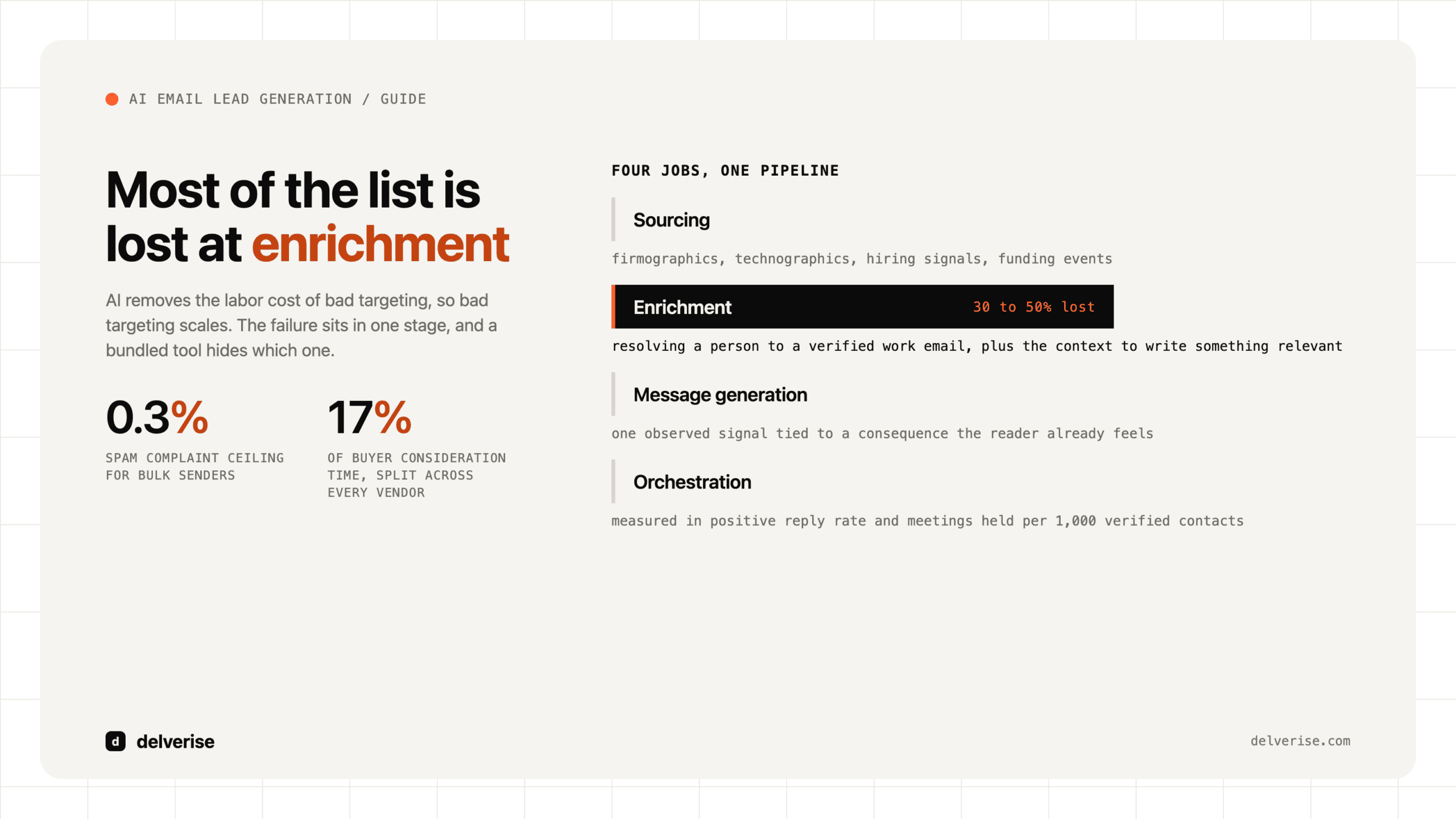
- Deliverability is now an engineering requirement. Google and Yahoo’s bulk sender rules made authentication, one-click unsubscribe, and a spam complaint rate under 0.3% table stakes for anyone sending at scale.
- Measure positive reply rate and meetings held per 1,000 verified contacts. Open rates became close to useless after Apple Mail Privacy Protection began pre-fetching images.
- The durable asset is the system: a data pipeline, a scoring model, a sending infrastructure, and a feedback loop. Tools get swapped; the system compounds.
What is AI email lead generation, exactly?
AI email lead generation is the practice of using large language models and machine learning across the outbound email workflow rather than in a single step. In practice that means four distinct jobs:

- Sourcing: building a target list from firmographics, technographics, hiring signals, funding events, and product usage data.
- Enrichment: resolving a company and a person to a verified work email, plus the context needed to write something relevant. Enrichment is the step where most programs quietly lose 30 to 50 percent of their list.
- Message generation: turning that context into a short, specific email that a busy operator would answer.
- Orchestration: sequencing, throttling, reply classification, and handoff to a human.
Vendors sell all four as one product. Buying them as one product is where teams get trapped, because the failure in your program almost always sits in one specific stage, and a bundled tool gives you no way to fix that stage independently.
Why do AI email campaigns stop working after the first month?
Three reasons, in order of frequency.

The list was never right. A model trained to write a compelling email will write a compelling email to a company that has no reason to buy. AI removes the labor cost of bad targeting, so bad targeting scales. Gartner’s research on B2B buying found that buyers spend only about 17% of their consideration time meeting with potential suppliers, and that time is split across every vendor they evaluate. Your email is competing for a very small slice of attention, and relevance is the only thing that wins it.
The personalization is cosmetic. “I saw you’re hiring three SDRs” is a fact retrieval, and buyers now recognize the pattern. Useful personalization connects an observed signal to a specific consequence the reader already feels. That requires knowing your ICP’s operating problems well enough to encode them, which is a positioning exercise before it is a prompt engineering exercise.
Deliverability degrades silently. Reply rates drop, and the team assumes the copy got stale. Often the mail is landing in spam. Since Google and Yahoo tightened bulk sender requirements in 2024, senders need SPF, DKIM, and DMARC configured, one-click unsubscribe on marketing mail, and spam complaint rates held below 0.3%. Domain reputation degrades over weeks, so the symptom shows up long after the cause.
We covered the adjacent version of this failure pattern in our breakdown of AI BDRs, where autonomous agents hit the same wall for the same reason.
Which parts of the workflow should AI actually own?
A practical division of labor, based on where models are reliable today:
| Stage | Who should own it | What breaks if you get it wrong |
|---|---|---|
| Account selection | Human-defined rules, AI-assisted scoring | You scale outreach to companies with no trigger to act. Volume rises, reply rate falls. |
| Contact discovery and verification | AI/automation, fully | Bounce rates above 3% damage domain reputation across every campaign you run. |
| Research and context gathering | AI, fully | Reps spend 20 minutes per account and cover 15 accounts a week. |
| Message angle and offer | Human | Fluent, generic email. Fluency is not the scarce input anymore. |
| Copy drafting from a fixed angle | AI, with human-approved templates | Off-brand claims, hallucinated details about the prospect’s business. |
| Reply classification and routing | AI, with human review of edge cases | Interested replies sit unanswered. Speed of response is a strong predictor of qualification, per the lead response research published in HBR. |
| Conversation and qualification | Human | You lose the deal at the moment it became real. |
The pattern: AI owns the volume-bound work, and humans own the judgment-bound work. That split holds up better than any specific tool recommendation, and it survives model upgrades.
What does the math actually look like?
Here is a modeled quarter for a Series A SaaS company with a $30,000 average contract value. The numbers are illustrative, chosen to sit inside normal ranges for a mid-market motion.

- 2,000 contacts sourced against a defined ICP
- 1,640 survive verification and enrichment (82% usable)
- 1.2% positive reply rate across a three-touch sequence = 20 conversations
- 60% convert to a held meeting = 12 meetings
- 25% become qualified opportunities = 3 opportunities
- 33% close = 1 deal, $30,000
Now run the two levers. Doubling volume to 4,000 contacts costs more credits, more sending domains, and more deliverability risk, and it produces roughly two deals if nothing else degrades. Something usually degrades. Improving the positive reply rate from 1.2% to 2.0% by tightening the ICP and sharpening the offer produces the same result with no additional infrastructure and no added reputation risk.
That is the whole argument for treating this as a systems problem. The list quality lever compounds; the volume lever fights against you. If your match rates are the binding constraint, chaining multiple data providers in sequence is the standard fix, and we walk through the mechanics in our guide to waterfall enrichment.
What does the stack look like when it is built properly?
Four layers, each independently replaceable:
1. Data layer. A source of truth for accounts and contacts, with enrichment running on a schedule rather than at campaign time. Clay is the common choice here because it chains providers and runs AI research per row, which means your match rate is a function of your waterfall design rather than any single vendor’s coverage. Honest tradeoff: it takes real configuration work, and credit costs climb fast if the enrichment order is not tuned. Teams that want the build done properly can see how we approach it on our Clay implementation page.
2. Scoring layer. A model or rule set that ranks accounts by observable buying signals so your best contacts get the most human attention. Lead scoring built on real intent is what keeps AI-generated volume from drowning your reps.
3. Sending layer. Separate domains for outbound, warmed inboxes, per-inbox volume caps, and continuous deliverability monitoring. This is infrastructure, and it deserves the same rigor as any production system.
4. Feedback layer. Reply data, meeting outcomes, and closed-won attributes flowing back into the scoring model. Without this loop, the program is a static list generator that gets worse every quarter.
Most teams have layer three and a piece of layer one. The gap is usually two and four, which is also where a GTM engineering approach earns its keep. If you are still deciding which tools belong in the stack at all, our buyer’s guide to AI sales tools covers the evaluation criteria that matter.
How should a revenue leader measure this?
Four metrics, tracked weekly:
- Positive reply rate per 1,000 verified contacts. The single best measure of list-plus-offer quality.
- Meetings held per 1,000 verified contacts. Filters out polite replies that go nowhere.
- Bounce rate and spam complaint rate per sending domain. Your early warning system, checked before reply rates move.
- Opportunity-to-close rate on AI-sourced pipeline versus other channels. If it lags badly, your targeting is loose regardless of how good the top-of-funnel numbers look.
Skip open rates. Apple Mail Privacy Protection pre-loads tracking pixels for a large share of consumer and prosumer mail clients, so opens now measure image loading behavior more than human interest.
Frequently Asked Questions
Is AI email lead generation just cold email with better copy?
Copy generation is the smallest part of it. The meaningful application is at the data and research layer: resolving accounts, chaining enrichment providers for higher match rates, reading public signals at scale, and scoring which accounts deserve human attention. Better copy on a poorly built list changes very little.
Will AI-written emails get flagged as spam?
Filters classify on sending reputation, authentication, engagement, and complaint rates rather than on whether a model wrote the text. AI-written email gets flagged when it drives complaints and non-engagement, which is a targeting and relevance outcome. Fix authentication and list quality first, then worry about phrasing.
How long before an AI email program produces pipeline?
Plan for two to four weeks of domain warmup before meaningful volume, then a full sales cycle before you can judge opportunity quality. Reply signal arrives in weeks; revenue signal arrives in quarters. Teams that judge the program on month-one reply rates usually kill something that was about to work, or scale something that was about to break.
Should we hire SDRs or build the system first?
Build enough of the system that a rep’s day is spent in conversations rather than in research and list building. Hiring reps into a broken data layer means paying salary for work software should be doing. Our breakdown of what each go-to-market role actually owns covers the sequencing in detail.
What does this cost to run at a realistic scale?
For 2,000 to 3,000 verified contacts per quarter, expect enrichment credits, verification, sending infrastructure across several domains, and an orchestration tool. The larger cost is the build: designing the waterfall, the scoring logic, and the feedback loop. That build is a one-time investment that keeps returning, which is why it belongs on the systems side of your budget rather than the headcount side.
Read next