←Back to blog
Revenue Intelligence & Data ToolingGuideJuly 3, 20267 min read
Apollo Email Finder: Accuracy, Limits, and Real Costs (2026)
The Apollo email finder is a feature inside Apollo.io that returns verified business email addresses for a named contact or company. It matches a person’s name and employer against Apollo’s B2B contact database, then runs deliverability checks before releasing the address. Revenue teams use it to build outbound lists at scale instead of sourcing contacts one at a time.
The Apollo email finder is a feature inside Apollo.io that returns verified business email addresses for a named contact or company. It matches a person’s name and employer against Apollo’s B2B contact database, then runs deliverability checks before releasing the address. Revenue teams use it to build outbound lists at scale instead of sourcing contacts one at a time.
Key takeaways
- The Apollo email finder pulls from a single large database, so it works well for mainstream roles and mid-market companies, and thins out for niche titles, small businesses, and non-US regions.
- Email accuracy depends on how fresh the underlying record is. Industry research consistently finds B2B contact data decays by roughly a quarter to a third every year, which quietly erodes any single-source list.
- Credits, not seats, drive the real cost. A team exporting thousands of contacts a month usually lands on a higher plan than the sticker price suggests.
- For serious outbound volume, most Seed to Series B teams pair Apollo with a waterfall enrichment step to lift match rates and protect sender reputation.
- The finder is one input into a revenue system. The value comes from what happens after the email lands: routing, scoring, sequencing, and measurement.
What is the Apollo email finder and how does it work?
Apollo.io is a B2B prospecting platform that combines a contact database, a Chrome extension, and a sales engagement layer. The email finder is the piece that resolves a person to a deliverable work email. You give it identifying signals, a name plus a company domain, a LinkedIn profile, or a list of accounts, and it returns the best matching address it holds.
Under the hood, two things happen. First, a match: Apollo looks up the person in its database of hundreds of millions of contacts. Second, a verification pass that pings mail servers and applies pattern logic to flag whether the address is likely to bounce. Verified emails get a higher confidence label; guessed or catch-all addresses get flagged so you can decide whether to send.
You can run the finder three ways: manually through the web app or extension for one-off lookups, in bulk by uploading a list of names and companies, or programmatically through the API when you want enrichment to happen inside your own workflows. The API path is where most GTM engineering teams operate, because it lets Apollo feed a CRM or an orchestration tool without anyone touching a spreadsheet. If you are mapping out that kind of build, our guide to the MarTech stack for Series A startups covers where a data source like this fits.

How accurate is Apollo email finder data?
Accuracy is the question every buyer actually cares about, and the honest answer is that it varies by segment. For common commercial roles at US mid-market and enterprise companies, verified match rates are strong and bounce rates stay low. For founder-led small businesses, non-US regions, technical or highly specialized titles, and recently changed jobs, coverage drops and you see more catch-all or unverifiable results.
The deeper issue is decay. People change jobs, companies rebrand, and email formats shift after acquisitions. A database is a snapshot, and any snapshot ages. This is why a name that verified cleanly last quarter can bounce today. Treating a single vendor as ground truth is where a lot of cold email programs quietly damage their sender reputation, because every bounce signals to mailbox providers that the sender is careless.
Gartner’s research on the digital B2B buying journey found that buyers spend only about 17% of their total purchase time meeting with potential suppliers, and that time is split across every vendor in the deal. When you get so few live conversations, sending to a stale or wrong address wastes one of your scarcest assets. Clean data is a prerequisite for the whole motion, which is why we treat it as a system concern rather than a tooling afterthought in our work on CRM enrichment.
What does Apollo email finder actually cost?
Apollo publishes per-seat plans, including a free tier, but the number that governs your bill is credits. Every email or phone number you export or enrich consumes credits, and plans cap how many you get per month. A two-person team doing light prospecting can live comfortably on a lower plan. A team running structured outbound across several thousand contacts a month tends to burn through credits fast and moves up a tier, or buys credit top-ups.
The practical takeaway for a revenue leader is to budget on volume, not headcount. Estimate monthly contacts touched, multiply by your export and enrichment behavior, and compare that against credit allowances before you commit. Underpricing this line item is a common reason outbound budgets slip in the first quarter of a build.
Apollo email finder vs a waterfall enrichment approach
Single-source finders and multi-provider waterfalls solve the same problem at different levels of rigor. A waterfall queries several data vendors in sequence, stopping at the first that returns a verified match, so coverage compounds across sources. Here is how the two compare for a B2B revenue team.

Many teams start with Apollo alone and add a waterfall once volume justifies it. Tools like Clay make this practical by chaining Apollo with other providers and only paying for the source that wins each row. Our breakdown of Clay email enrichment waterfall strategies walks through how to build that sequence, and the Clay alternatives comparison maps the wider category if you want options.
Where does the email finder fit in a real revenue system?
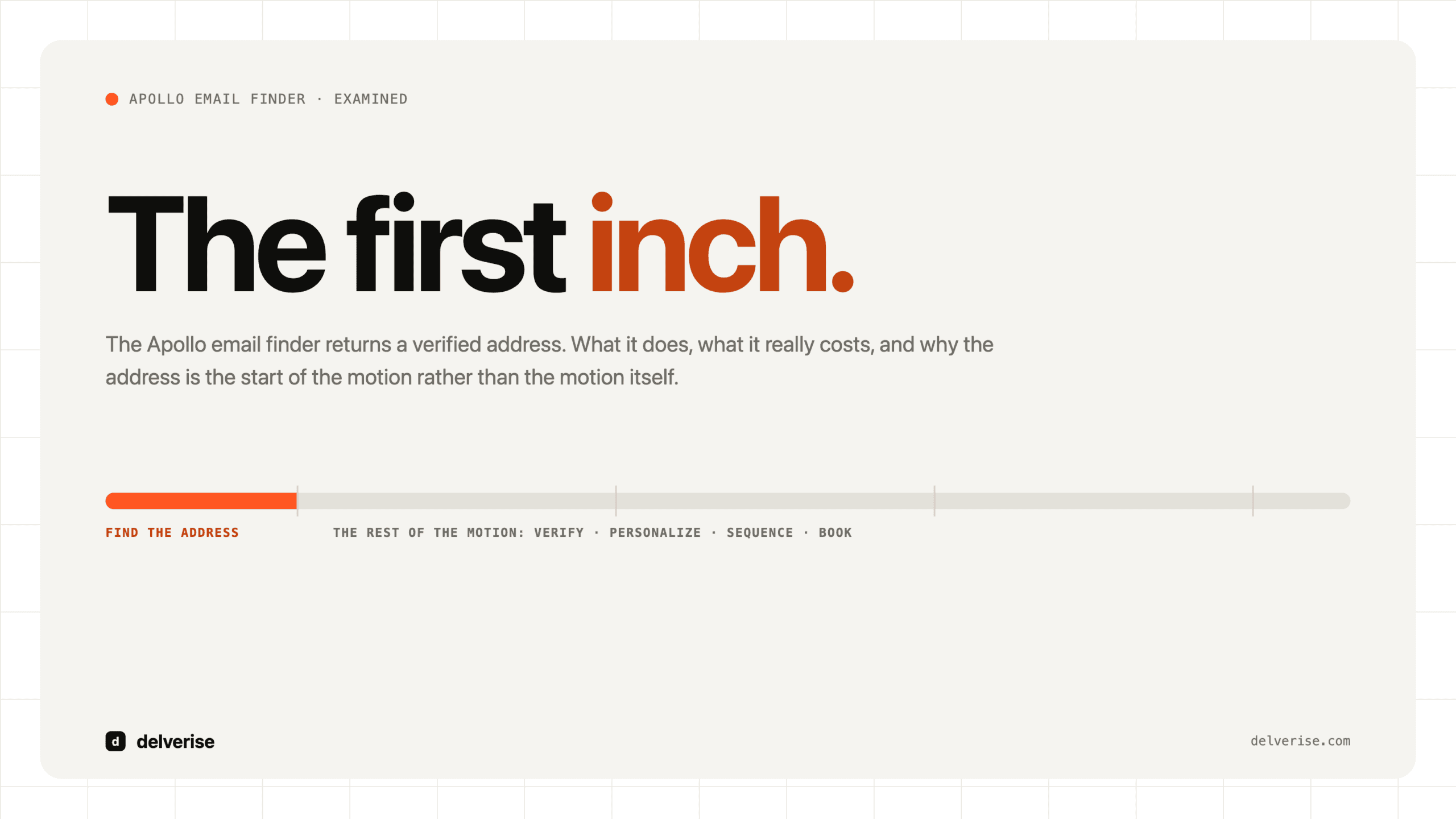
Finding an email is the first inch of a much longer motion, and the return on that inch depends entirely on what follows. A verified address does nothing until it enters a system that routes the contact to the right owner, scores it against your ideal customer profile, sequences the outreach, and measures what converts. When founders tell us outbound “isn’t working,” the data source is rarely the root cause. The break is usually downstream in routing or measurement.

McKinsey’s research on B2B sales has repeatedly shown that buyers now move fluidly across digital and human channels and reward sellers who show up with relevance. That relevance starts with segmentation and scoring, not with volume. A clean email plus sharp lead scoring beats a huge unscored list every time, because your reps spend their limited hours on accounts most likely to buy.
This is why we treat the finder as one component inside AI-driven outbound. The email finder handles identity resolution. Enrichment adds firmographic and intent signals. Scoring ranks the output. A sales engagement platform delivers the sequence, and analytics closes the loop so you can see which segments actually produce revenue. If you are assembling that motion, our guide to sales engagement platforms for startups and the wider lead generation platforms comparison both go deeper on the layers that sit around the data source.
Should your team build outbound on Apollo?
For a Seed to Series B company with a focused ICP and a lean budget, Apollo is a reasonable foundation. It gives you database access, a finder, and a sending layer in one place, which shortens time to first campaign. The risk is treating it as the whole system. As you scale, plan for three things: a verification standard so you protect deliverability, a waterfall step to lift coverage in weaker segments, and a measurement layer so you know which contacts turn into pipeline.
The teams that get durable results from any email finder are the ones who design the surrounding system deliberately, with clear ownership of data quality, routing, and reporting. That design work is where a data tool turns into a revenue engine.
Frequently Asked Questions
Is the Apollo email finder free?
Apollo offers a free plan with a limited monthly credit allowance, which is enough to test the finder and run light prospecting. Serious outbound volume consumes credits quickly, so most revenue teams move to a paid tier or buy credit top-ups once they scale exports and enrichment.
How accurate are the emails Apollo returns?
Accuracy is high for mainstream commercial roles at US mid-market and enterprise companies, and lower for small businesses, niche titles, non-US regions, and people who recently changed jobs. Because B2B data decays by roughly a quarter to a third each year, always send to verified addresses and monitor bounce rates closely.
Does using Apollo comply with GDPR and privacy rules?
Apollo provides tooling to support compliance, including opt-out handling, but responsibility for lawful outreach sits with the sender. If you prospect into the EU or UK, confirm your legal basis, honor removal requests promptly, and document your process. Treat any data vendor’s coverage as a starting point for your own compliance review.
How does Apollo compare to Clay for finding emails?
Apollo is a single database with a built-in finder and sending layer, which makes it fast to start. Clay orchestrates many data providers in a waterfall, including Apollo, and only charges for the source that returns a match. Teams often use Apollo early, then add Clay when volume and coverage gaps justify the extra setup.
Can the Apollo email finder connect to my CRM and outbound stack?
Yes. Apollo integrates with common CRMs and offers an API, so enrichment can run inside your workflows rather than in a spreadsheet. The value comes from wiring it into routing, scoring, and sequencing so every verified contact flows into a system that measures conversion, which is the core of any GTM engineering build.
Read next