←Back to blog
Revenue Intelligence & Data ToolingGuideJuly 12, 20267 min read
AI BDR: What It Actually Automates and Where It Breaks
An AI BDR is software that automates the work a business development rep once did by hand: researching accounts, building lists, enriching contact data, writing personalized messages, and sending sequenced outreach. It runs on your CRM and data tools, executes rules you define, and books meetings or hands warm replies to a human closer. It scales volume, not judgment.
An AI BDR is software that automates the work a business development rep once did by hand: researching accounts, building lists, enriching contact data, writing personalized messages, and sending sequenced outreach. It runs on your CRM and data tools, executes rules you define, and books meetings or hands warm replies to a human closer. It scales volume, not judgment.
For a founder or revenue leader weighing whether to buy one, the useful question is narrower than “does AI BDR work.” It is: which parts of the outbound motion can you safely hand to a machine, and which parts still need a person or a well-engineered system behind them? This guide answers that directly.
What is an AI BDR, in plain terms?
A BDR (business development representative) sits at the top of the funnel. Their job is to find accounts that fit your ideal customer profile, reach the right people, and start enough conversations to keep the pipeline full. An AI BDR performs those same steps through a mix of large language models, data enrichment, and automated sending.
Most tools marketed as AI BDRs bundle four capabilities:
- Account and contact sourcing from a data provider or your own list
- Enrichment: appending emails, titles, firmographics, and signals like funding or hiring
- Message generation: drafting emails and LinkedIn notes tuned to each contact
- Sequencing and sending: multi-step, multi-channel cadences with reply detection
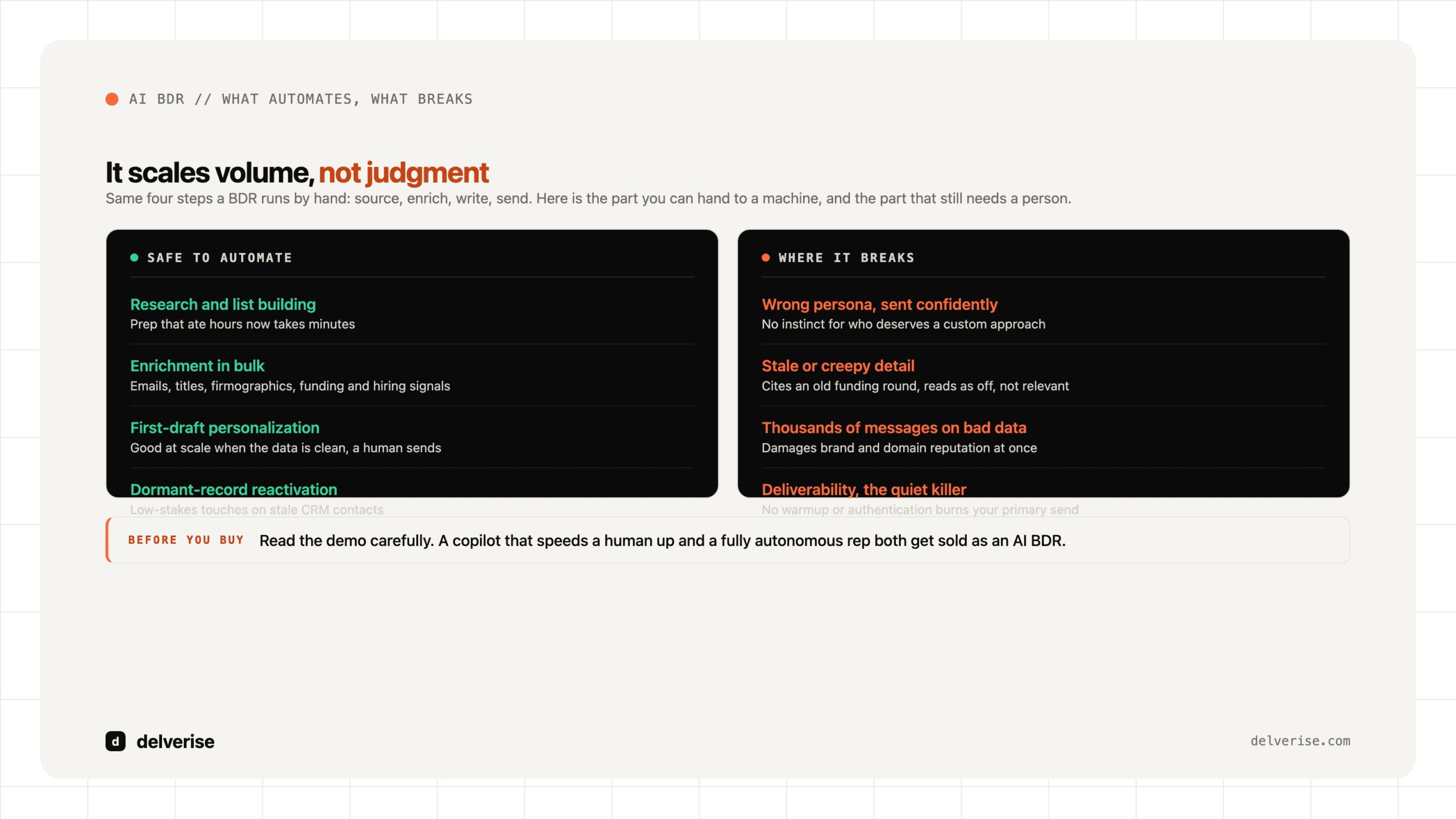
The category is young and the labels are loose. Some vendors sell a fully autonomous “digital rep.” Others sell a copilot that speeds up a human. Both get called an AI BDR, so read the demo carefully before you assume what you are buying.
What can an AI BDR actually do well today?
The honest answer: the mechanical, high-volume steps. Research and list building that used to eat hours now takes minutes. Enrichment that a rep would do tab by tab runs in bulk. First-draft personalization at scale is genuinely good when the underlying data is clean.

This matters because rep time is expensive and mostly spent on preparation. Research from CSO Insights and similar sales-productivity studies has long shown that sellers spend well under half their week actually selling, with the rest lost to admin, data entry, and prospecting prep. An AI BDR attacks exactly that overhead. When it works, your human team spends more time in live conversations and less time assembling lists.
The strongest current use cases are:
- Enriching and de-duplicating inbound leads before they hit a rep
- Building targeted account lists from intent or firmographic signals
- Drafting personalized first-touch copy a human reviews and sends
- Running low-stakes reactivation on dormant CRM records
If you want the deeper mechanics of stacking these steps into one pipeline, we cover it in AI lead generation automation.
Where does an AI BDR break?
It breaks at judgment and at data quality. An AI BDR will confidently email the wrong persona, cite a stale funding round, or personalize on a detail that reads as creepy rather than relevant. It has no instinct for when an account is worth a custom approach versus a templated one. And it will happily send thousands of messages built on bad data, which damages your domain reputation and your brand at the same time.

Deliverability is the quiet killer. Volume without warmed domains, proper authentication, and inbox rotation lands you in spam folders and can burn your primary sending domain. The infrastructure decisions here carry more weight than the AI itself. Our breakdown of sales engagement platforms gets into the sending mechanics that determine whether any of this reaches a human.
The second failure mode is targeting. Gartner’s research on B2B buying has repeatedly found that buyers spend only a small fraction of the purchase journey with any single vendor’s reps, and most of their time researching independently. An AI BDR that floods the wrong accounts does not fix that. It makes you noise. Precision in who you contact matters more than how many you contact, which is why lead scoring should sit upstream of any automated sending.
AI BDR vs. human BDR vs. hybrid: which fits?
The framing that helps most buyers is not “replace the human.” It is “which layer of the job goes to software.” Here is a practical comparison.

| Dimension | Human BDR | Fully autonomous AI BDR | Hybrid (AI drafts, human decides) |
|---|---|---|---|
| Cost per month | $6k to $10k loaded | $1k to $5k in tooling | $2k to $6k plus part of a rep |
| Volume ceiling | Low, capped by hours | Very high | High |
| Personalization depth | High when motivated | Shallow to medium | High |
| Judgment on edge cases | Strong | Weak | Strong |
| Brand and deliverability risk | Contained | High if ungoverned | Contained |
For most Seed to Series B teams, the hybrid model wins. Software handles sourcing, enrichment, and first drafts. A human owns targeting decisions, final send approval on high-value accounts, and every live reply. You get the volume without handing your brand to an unsupervised machine.
What does a worked example look like?
Say you sell a $20k ACV product to heads of RevOps at Series A SaaS companies. A well-built AI BDR workflow runs like this:
- Pull companies that raised a Series A in the last six months and show hiring signals for revenue roles
- Enrich each account with the RevOps decision-maker and a verified email through a waterfall of data sources
- Generate a first email that references the specific signal, the raise, or the open role
- Route accounts over a set intent threshold to a human for manual review, send the rest through an automated cadence
- Push every reply into your CRM and alert a rep to take the conversation live
The enrichment step is where quality is won or lost. Waterfall enrichment, where you try one data provider, then fall back to the next until you get a verified result, is the pattern that keeps bounce rates low. Tools like Clay made this approach accessible to non-engineers by chaining dozens of providers in one table. We detail the method in Clay email enrichment strategies.
Building and maintaining that end-to-end system is the hard part, and it is where implementation help pays for itself. The tools are commodity. The engineering that connects them into a reliable, governed pipeline is the durable advantage.
Should you buy an AI BDR or build the system?
Buying a single AI BDR product gives you a fast start and a fixed set of behaviors. Building a system with your own tools gives you control over data quality, targeting logic, and how outputs flow into your CRM and reporting. Most teams that scale outbound successfully end up with the second, because the first rarely fits a specific ICP or sales motion cleanly.
The decision comes down to three questions. Do you have clean, current data on your target market? Do you have the infrastructure to send at volume without burning domains? Do you have someone who owns the targeting and the replies? If the answer to any is no, the tool alone will underperform, and the gap is a systems problem worth solving first. Our AI outbound hub covers how these pieces connect.
McKinsey’s work on sales automation has found that a meaningful share of sales tasks can be automated with current technology, yet the gains show up only when automation is wired into an operating process rather than bolted on. That is the whole game with an AI BDR. The software is ready. The system around it usually is not.
Frequently Asked Questions
Can an AI BDR fully replace a human BDR?
Not reliably today. It replaces the mechanical parts of the role: research, list building, enrichment, and first-draft copy. Judgment on targeting, edge cases, and live conversations still needs a person. Teams that treat it as a full replacement tend to see brand and deliverability damage before they see pipeline.
How much does an AI BDR cost?
Tooling typically runs $1k to $5k per month depending on data volume and seats, well below the $6k to $10k loaded cost of a human rep. Factor in the setup and ongoing management, though. An unmanaged tool that sends bad messages costs more than its price in reputation.
Will an AI BDR hurt my email deliverability?
It can, if you send high volume without warmed domains, proper SPF, DKIM, and DMARC authentication, and inbox rotation. Deliverability is an infrastructure problem that sits underneath the AI. Solve it before you scale send volume, or your messages never reach an inbox.
What data do I need before deploying one?
A clearly defined ideal customer profile, verified contact data for that profile, and a scoring method to prioritize accounts. An AI BDR amplifies whatever targeting you give it. Feed it a vague ICP and it will scale your worst outreach faster than your best.
Is an AI BDR right for a Seed-stage startup?
It can be, for enrichment and first-touch drafting where the volume savings are real. Full autonomous sending is riskier early, when every prospect impression counts and your domain reputation is young. Start with the copilot model and expand automation as your data and infrastructure mature.
Read next