←Back to blog
Revenue Intelligence & Data ToolingGuideSeptember 11, 20267 min read
AI Generated Leads: What They Actually Are and How to Make Them Convert
AI generated leads are prospects that an AI system finds, researches, scores, and often contacts, using models that read firmographic, technographic, and behavioral signals instead of a static list pull. In B2B SaaS they perform when AI handles research and prioritization inside a tightly defined ICP. They degrade fast when teams point them at raw volume.

AI generated leads are prospects that an AI system finds, researches, scores, and often contacts, using models that read firmographic, technographic, and behavioral signals instead of a static list pull. In B2B SaaS they perform when AI handles research and prioritization inside a tightly defined ICP. They degrade fast when teams point them at raw volume.
Key takeaways
- The real gain from AI is research and prioritization at scale. The volume gain is secondary and easy to misuse.
- Lead quality is capped by data quality. A weak ICP definition plus stale contact data produces confident, well-written outreach to the wrong people.
- The highest-return AI work happens before the first email: account selection, signal detection, contact mapping, and message context.
- Gartner’s research puts B2B buying groups at six to ten decision makers, so “a lead” is rarely one person.
- Measure meetings held and pipeline created per 1,000 contacts touched. Raw MQL counts hide the damage.
What are AI generated leads?
The term bundles three separate jobs, and most confusion in buying decisions comes from treating them as one product.

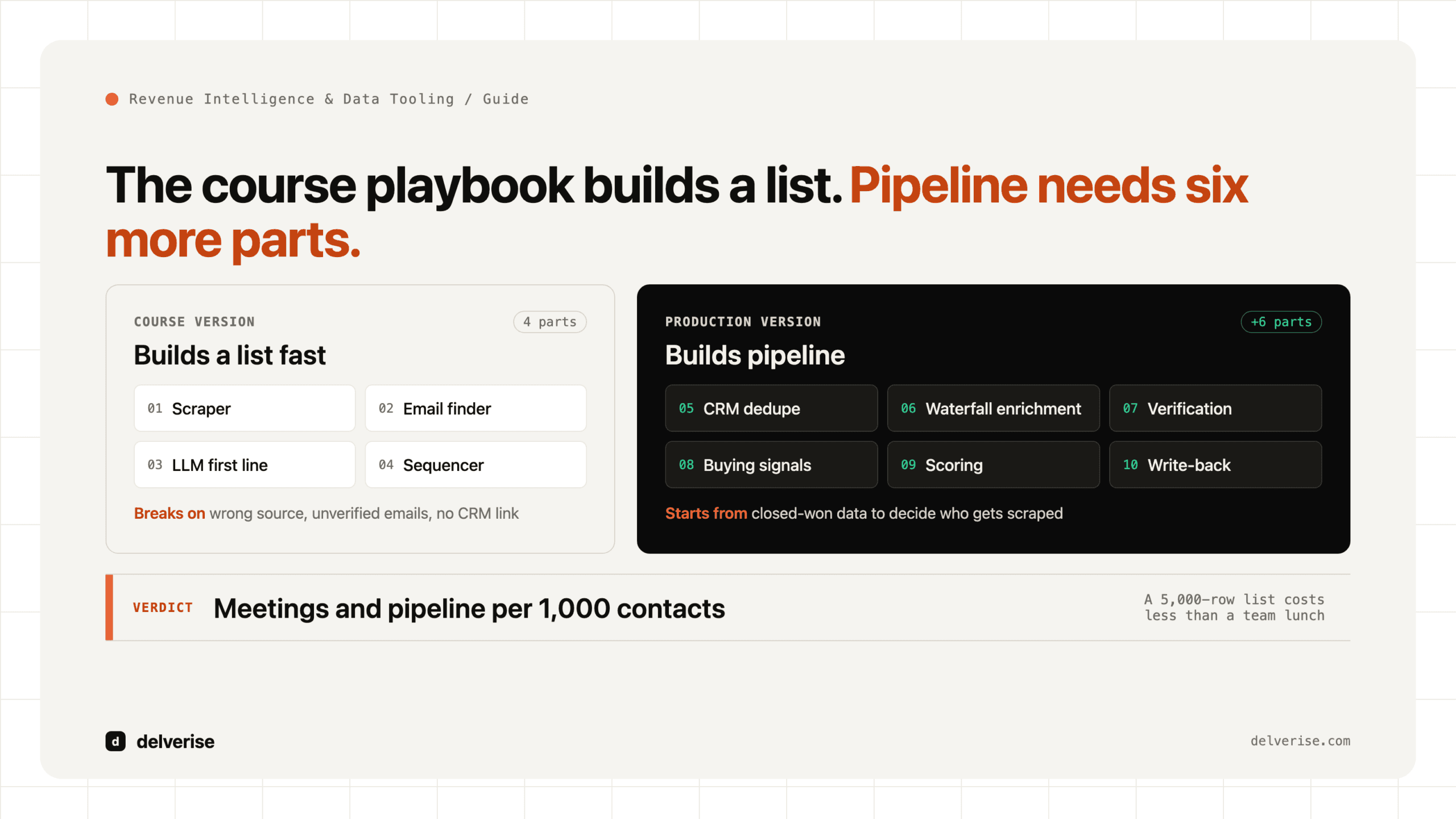
Sourcing is AI identifying accounts and people who match a pattern: companies hiring for a role, using a competing tool, opening a new office, or posting a specific job description. Enrichment and scoring is AI reading public and licensed data to build a picture of each account, then ranking it against your ICP (ideal customer profile: the account type where you win most often and churn least). Engagement is AI drafting and sequencing the actual outreach.
Vendors sell all three under the same headline. The economics differ sharply. Sourcing and enrichment compound, because the output is an asset your team keeps using. Engagement is consumable, because a sent email is spent. Our breakdown of what AI powered lead generation actually automates goes deeper on that split, and lead gen data covers the underlying inputs.
Where does AI actually improve lead quality?
Four places, in rough order of return.

Research at scale. A rep can properly research maybe 15 accounts a day. An AI pipeline can read a company’s careers page, product changelog, funding history, and earnings language across 3,000 accounts overnight, then summarize the two facts that matter for your pitch. That gap is the whole argument.
Signal detection. Static lists go stale the moment they’re pulled. Signal-driven systems watch for the event that creates a buying window: a new VP of Sales, a Series A close, a headcount jump in a specific function, a competitor’s pricing change. Timing beats targeting most of the time.
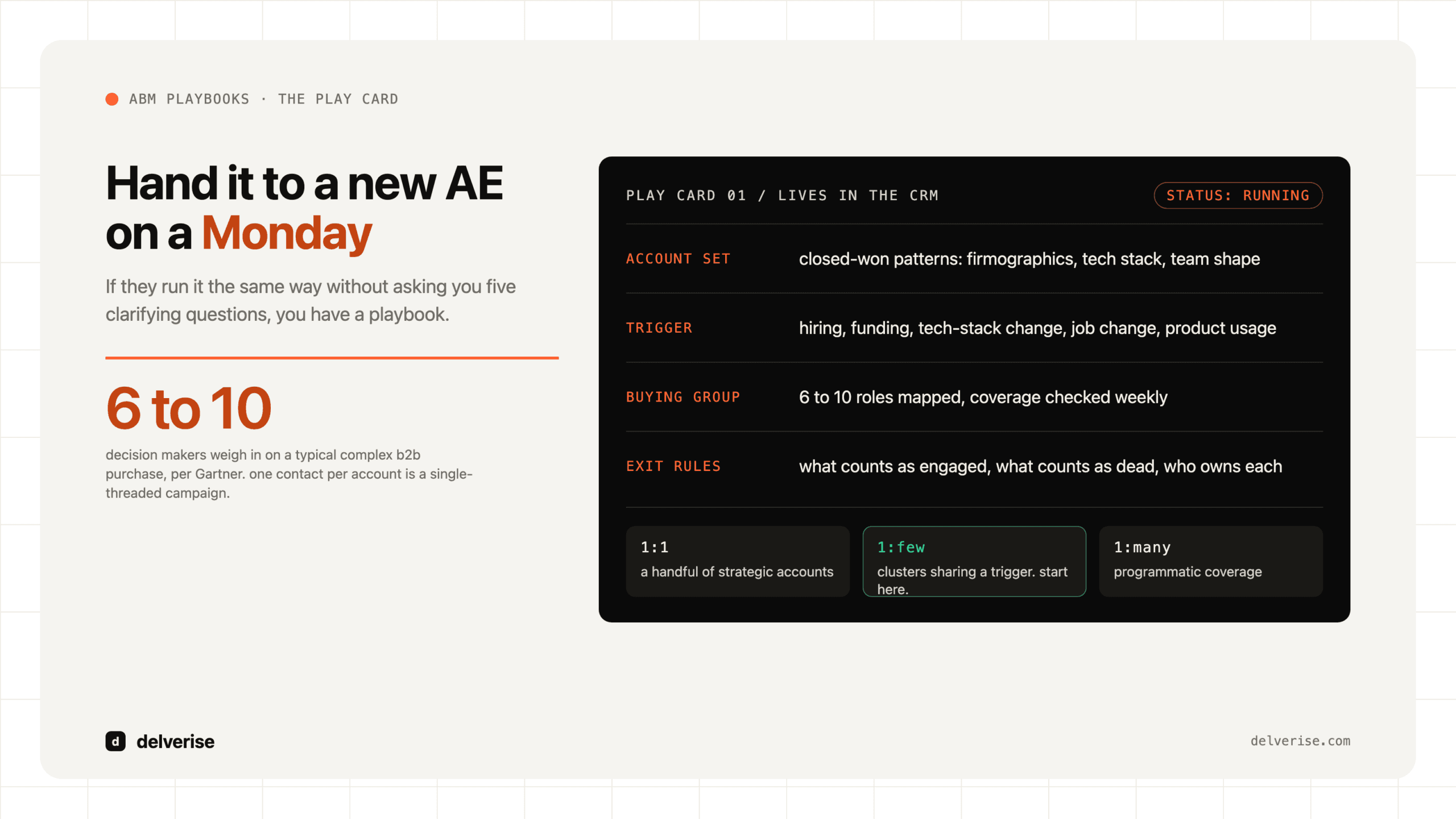
Buying group mapping. Gartner has found that B2B buying groups typically involve six to ten decision makers, and that buyers spend only about 17% of the total purchase journey meeting with potential suppliers at all. AI is good at mapping who sits in that group and what each one cares about, which turns one “lead” into a coordinated account play. Our guide to B2B prospecting covers how that sequencing works in practice.
Message context. AI writes mediocre copy and excellent context. The winning pattern is a human-authored message structure with AI supplying the specific, verifiable observation that earns the reply. The mechanics are in our cold email template breakdown.
Why do most AI generated leads underperform?
Four failure modes account for nearly all of it.
The ICP is defined by firmographics alone. “Series A to B SaaS, 50 to 200 employees, US” describes 40,000 companies. It says nothing about the pain that makes someone buy. Working ICP definitions include a trigger condition and a disqualifier, both of which a system can check.
The contact data is stale. B2B contact records decay meaningfully every year through job changes alone. AI applied to decayed data produces personalized emails to people who left 14 months ago. Verification belongs upstream of the AI layer, and our review of B2B email list providers explains how to buy that properly.
Volume becomes the KPI. The moment a team can generate 10x the contacts, deliverability and brand damage arrive quietly and take months to reverse. McKinsey’s B2B Pulse research has consistently found buyers moving across roughly ten channels in a single purchase journey, which means a bad first impression on one channel is rarely contained to that channel.
There’s no feedback loop. If closed-won and closed-lost outcomes never flow back into the scoring model, the system learns nothing. This is the single most common gap we fix when we take over an existing stack.
What does a working AI lead system look like?
| Layer | What AI handles well | Where it breaks | Keep human |
|---|---|---|---|
| Account selection | Filtering thousands of accounts against multi-variable criteria | Judging strategic fit or partner conflicts | The ICP definition itself |
| Signal detection | Monitoring hiring, funding, tech changes, and content continuously | Distinguishing a real trigger from noise without labeled examples | Deciding which signals count |
| Contact mapping | Finding and verifying the buying group across titles | Org charts in flat or unusual structures | Champion vs. economic buyer calls |
| Research and context | Reading and summarizing public sources per account | Hallucinating specifics when sources are thin | A citation rule: no claim without a source field |
| Copy and sequencing | Variant generation, timing, channel orchestration | Tone, positioning, anything requiring taste | Message structure and the offer |
| Routing and follow-up | Enrichment on inbound, instant routing, CRM hygiene | Handling ambiguous or multi-thread replies | The conversation once someone responds |
Most teams assemble this from a data layer, an orchestration layer, and a CRM. Clay has become the default orchestration layer because it chains multiple data providers with waterfall enrichment and runs AI research per row, which is exactly the research-at-scale job described above. It has honest tradeoffs: credit costs climb quickly without discipline, and it rewards teams who think in systems. delverise is a Clay First 100 Solutions Partner, and our Clay implementation page covers how we build these. Alternatives exist, and the right call depends on your existing GTM tech stack.
How do the economics actually work?
Run the arithmetic before you buy anything. Here is the model, with placeholder inputs you should replace with your own.
Start with 4,000 accounts matching your firmographic filter. Apply two signal filters and you might keep 400. Map three contacts per account and you have 1,200 people. Enrichment and AI research at roughly $0.15 per contact across the waterfall costs about $180. If 4% book a meeting, that’s 48 meetings for $180 in data cost plus tooling and human review time.
Now change one variable. Skip the signal filters and send to all 4,000 accounts at three contacts each. You spend $1,800 on data, burn 12,000 sends, and if reply rate drops to 1% because the timing is arbitrary, you get 120 meetings at ten times the cost, with materially worse meeting quality and a damaged sending domain. The unit economics of AI generated leads live almost entirely in the filtering step.
How should you measure AI generated leads?
Four metrics, reviewed monthly:
- Meetings held per 1,000 contacts touched. Held, not booked. No-show rate tells you whether targeting was real.
- Qualified pipeline per data dollar. This exposes tools that generate activity without revenue.
- Data accuracy rate. Sample 50 records a month and check them by hand. Anything under 90% verified means your AI layer is amplifying errors.
- Time from signal to first touch. Buying windows close. Measure it in hours.
Also track win rate on AI-sourced deals against your baseline. If it’s lower, your scoring model is optimizing for reachability instead of fit.
What should you build first?
In this order:
- Write an ICP definition with a trigger condition and an explicit disqualifier
- Pick two or three signals you can actually detect from public data
- Fix contact data verification before adding any AI layer on top
- Build one enrichment and research workflow for one segment, and measure it for 30 days
- Wire closed-won and closed-lost data back into scoring
- Only then expand to more segments, channels, or volume
Teams that follow this sequence get compounding returns because each layer improves the next. Teams that start with engagement get a fast, expensive lesson in deliverability. If you’re weighing whether to build this internally or bring in outside help, our comparison of hiring a GTM consultant versus building in-house lays out the honest tradeoffs, and the GTM engineering page covers how delverise builds these systems end to end.
Frequently Asked Questions
Are AI generated leads better than leads from a purchased list?
They come from the same underlying data providers in most cases. The difference is filtering and timing. A purchased list gives you contacts that match a static filter. An AI system gives you contacts that match a filter plus a trigger event, with research attached to each one. If your AI system skips the trigger and the research, you’ve paid more for the same list.
Can AI agents run the whole lead generation process without a human?
Sourcing, enrichment, scoring, and drafting can run unattended with good guardrails. The reply is where humans need to take over, because that’s where the deal starts and where a wrong answer costs real money. Our piece on AI agents for lead generation covers the specific breakpoints.
How much should a Seed to Series B company spend on this?
Data and tooling for a working system typically lands between $1,500 and $5,000 per month at that stage, depending on volume and how many providers you run in the waterfall. The larger cost is the engineering time to design and maintain it. Budget for the build, then the tools.
Do AI generated leads hurt email deliverability?
The AI itself is neutral. The volume it enables is the risk. Deliverability breaks when send volume outpaces domain reputation and reply rates fall below roughly 2%. Cap sends per mailbox, verify every address, and treat a falling reply rate as a targeting alarm.
What’s the fastest signal of whether an AI lead system is working?
Positive reply rate in weeks two through four. If personalized, signal-triggered outreach performs the same as your generic baseline, the research layer is producing generic observations, and the fix is in the source data rather than the copy.
Read next