←Back to blog
Revenue Intelligence & Data ToolingGuideSeptember 2, 20268 min read
AI Sales Lead Generation: What It Actually Automates in B2B SaaS
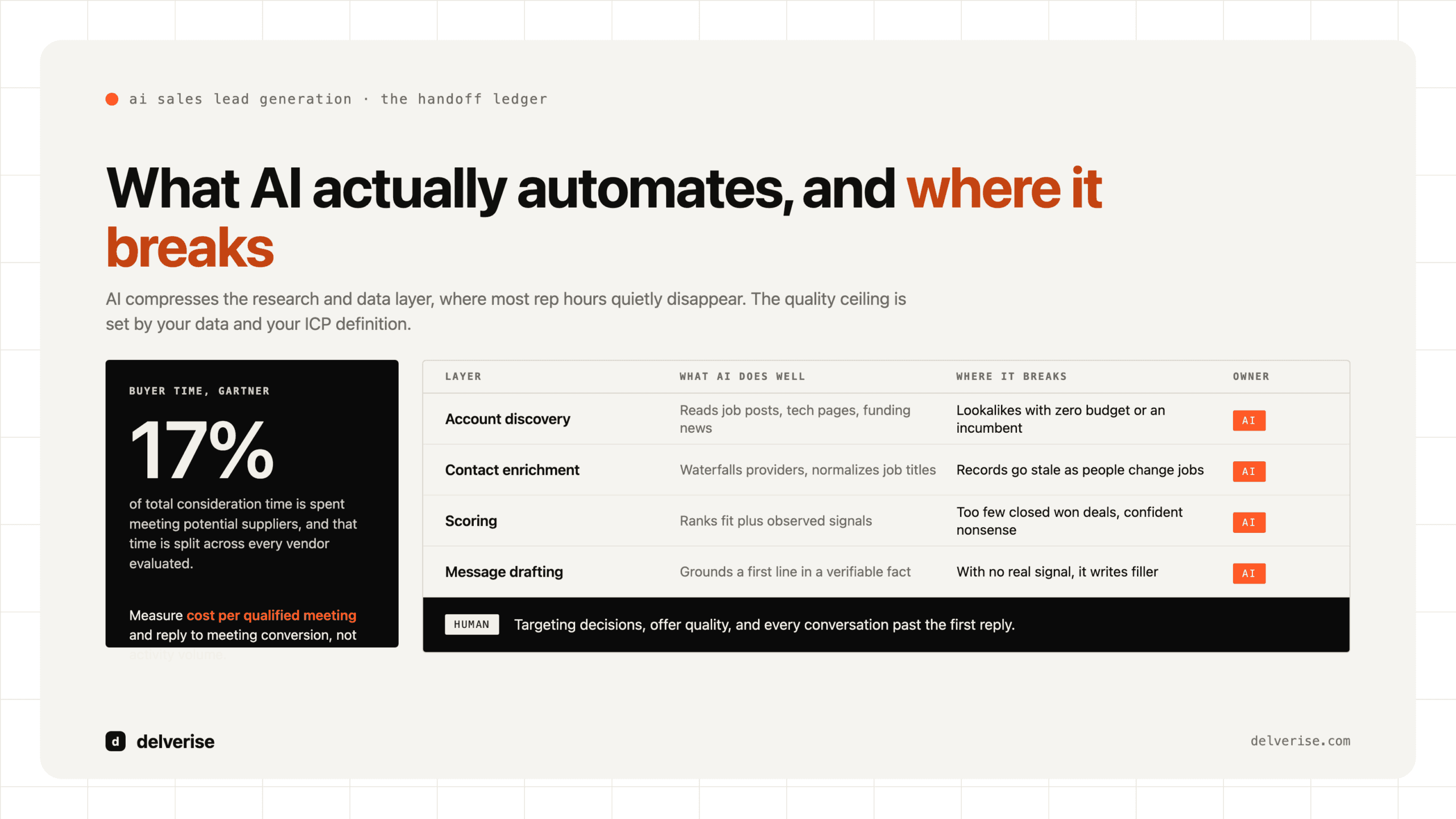
AI sales lead generation uses machine learning and large language models to find, prioritize, enrich, and contact potential buyers with far less manual work. In B2B SaaS it automates research, list building, data enrichment, scoring, and first-touch messaging. Humans still own targeting decisions, offer quality, and every conversation past the first reply.
AI sales lead generation uses machine learning and large language models to find, prioritize, enrich, and contact potential buyers with far less manual work. In B2B SaaS it automates research, list building, data enrichment, scoring, and first-touch messaging. Humans still own targeting decisions, offer quality, and every conversation past the first reply.
Key takeaways
- AI compresses the research and data layer of lead generation, where most rep hours quietly disappear.
- The quality ceiling is set by your data and your ICP definition, so bad inputs produce faster bad output.
- Personalization at scale works when the AI reads a real signal. Generic AI-written flattery performs worse than a plain, direct message.
- Measure cost per qualified meeting and reply-to-meeting conversion, not activity volume.
- Most teams get more value from fixing enrichment and routing than from adding another AI writing tool.
What is AI sales lead generation?
AI sales lead generation is the use of AI models to run the steps that sit between “we know who we sell to” and “a qualified buyer replied.” That includes finding accounts that match your ideal customer profile (ICP), the written description of the companies and roles most likely to buy and stay, then enriching those accounts with firmographic and behavioral data, scoring them, drafting outreach, and routing the responses.

Two things are worth separating. Deterministic automation moves data between systems on fixed rules. AI adds judgment-like steps: reading a careers page and deciding whether a company is hiring for a function you serve, classifying an inbound reply as interested or dismissive, or summarizing ten pages of a 10-K into one line a rep can use. Both belong in a working system, and confusing them is why many teams overpay for AI where a simple rule would do.
The market pressure behind all of this is real. Gartner’s research on the B2B buying journey found that buyers spend roughly 17% of their total consideration time meeting with potential suppliers, and that time is split across every vendor they evaluate. When your window with a buying group is that narrow, the quality of your targeting and your first message matters more than the number of touches you can fire off.
What does AI actually automate, step by step?
Here is the honest breakdown by layer, including where each one falls apart.

| Layer | What AI does well | Where it breaks |
|---|---|---|
| Account discovery | Finds lookalikes, reads job posts, tech pages, funding news, and product changelogs to surface accounts matching a described trigger | Confuses surface similarity with buying readiness. A company that looks like your best customer may have zero budget or an incumbent contract |
| Contact data and enrichment | Waterfall enrichment across multiple providers, fills missing emails, titles, and phone numbers, and normalizes job titles into consistent roles | Contact records go stale quickly as people change jobs. Coverage in non-US markets and non-tech verticals is much weaker than vendor demos suggest |
| Scoring and prioritization | Ranks accounts on fit plus observed signals, so reps work the top of a list instead of the middle | Fit models trained on too few closed-won deals produce confident nonsense. You need meaningful outcome data first |
| Message drafting | Writes a first line grounded in a specific, verifiable fact and adapts a proven structure to a persona | Without a real signal to reference, it writes filler. Buyers recognize AI-generated compliments instantly |
| Reply handling and routing | Classifies replies, books meetings from positive responses, suppresses sequences on out-of-office and job changes | Misreads sarcasm, soft interest, and multi-threaded replies. Every misroute costs a real opportunity |
Discovery and enrichment are where AI pays for itself fastest. If your team is still building lists by hand, start there. Tools like Clay sit in this layer and orchestrate multiple data providers plus AI research agents into one table, which removes the tab-switching that eats a rep’s morning. For a deeper comparison of what these systems find and how to evaluate them, see our breakdown of what an AI lead finder actually does and how to judge the data underneath it in lead gen data for B2B revenue teams.
What does a working system look like end to end?
Here is a concrete, illustrative build for a Series A company selling a $30k ACV product to RevOps leaders. The arithmetic is a planning model, not a case study.

- Define the trigger. Companies of 100 to 500 employees running Salesforce, that posted a RevOps or Sales Ops role in the last 60 days. Roughly 2,000 accounts qualify.
- Enrich and verify. Waterfall email enrichment across two or three providers, then verification. Expect 60% to 75% usable contact coverage, so call it 1,300 reachable accounts with two contacts each.
- Research with AI. One agent per account pulls the job post, the tech stack evidence, and the last funding event, then writes a one-sentence “why now” line. Cost is cents per account, not dollars.
- Draft and sequence. A fixed message structure with one AI-generated variable that references the actual trigger. Structure stays human-authored, and only the evidence changes.
- Route replies. Classification into interested, referral, not now, and never, with the first two going to a human within the hour.
At a 4% positive reply rate on 2,600 contacts, that is around 100 conversations and perhaps 30 to 40 booked meetings from one cycle. The work that used to take an SDR team weeks runs in a day, and the human time shifts to the conversations themselves. That last part is the actual point: AI buys back the hours reps spend on research so they spend them on selling.
The structure of the message still decides your reply rate. Our guide to the best cold email template for B2B SaaS covers what holds up once volume increases.
Where does AI lead generation break?
Four failure modes account for most disappointing results.
Garbage ICP, faster. AI executes whatever definition you give it. A vague ICP produces a large, expensive list of accounts that will never buy. Tighten the definition before you scale volume.
Signal-free personalization. An AI that reads a homepage and compliments the mission is writing noise. Ground every personalized line in something specific and checkable: a hiring pattern, a product launch, a compliance deadline, a stack change.
Deliverability collapse. More sending capacity plus low-relevance messages is the fastest way to burn a domain. Volume without relevance shortens the life of your entire outbound channel.
Broken plumbing. If enriched data never reaches the CRM cleanly, or duplicate accounts multiply, the system generates work instead of pipeline. Fixing this layer, covered in our CRM enrichment approach, usually returns more than any new tool.
There is a buyer-experience argument here too. HBR’s research on B2B purchase decisions found that customers who experienced the buying process as easy were substantially more likely to buy a larger package with less regret. Every extra unqualified touch you send makes buying feel harder, which is a direct cost to deal size.
How should you measure it?
Activity metrics inflate the moment you add AI, so they stop being useful. Track these instead:
- Cost per qualified meeting. All tooling, data, and human time divided by meetings that pass a qualification bar. This is the number that survives a board conversation.
- Reply-to-meeting rate. If replies rise while meetings stay flat, your targeting is off and your copy is doing the work.
- Data accuracy. Bounce rate and title-match rate, sampled monthly. Anything above 3% bounce means your enrichment layer needs attention.
- Meeting-to-opportunity rate. The honest check on whether AI-sourced meetings are as good as rep-sourced ones. Compare cohorts.
- Pipeline per rep hour. The efficiency claim behind the whole project, stated plainly.
Should you build this in-house or bring in help?
Build in-house when you have someone who owns the system full-time, your ICP is stable, and your CRM data is already clean. That person needs to be technical enough to work with APIs and enrichment logic, and senior enough to say no to a bad list.
Bring in outside help when the failure is architectural: enrichment that does not reach the CRM, attribution nobody trusts, or three tools doing overlapping jobs. That work is a GTM engineering problem, and it compounds once it is built correctly. The tradeoffs are laid out in go-to-market consultant vs building in-house, and if Clay is the center of your build, our Clay implementation page covers what a production setup involves.
Before you spend a dollar on new tooling, run this check:
- Your ICP is written down with hard filters, not adjectives
- You know your current bounce rate and title-match accuracy
- Closed-won data is clean enough to train or sanity-check a fit score
- Sending infrastructure is separated from your primary domain
- One named person owns the system end to end
- You can state your current cost per qualified meeting
Frequently Asked Questions
Does AI lead generation replace SDRs?
It replaces the research and list-building portion of the SDR job, which is often half the week. Teams that keep their SDRs and redeploy those hours into calls, multithreading, and follow-up see better results than teams that cut headcount and let the AI run unsupervised.
How much does an AI lead generation system cost to run?
For a Series A team, budget $1,500 to $5,000 per month across data providers, enrichment orchestration, sending infrastructure, and AI credits. Costs scale with contacts enriched rather than seats, so tight targeting directly lowers spend.
Will AI-written emails hurt our domain reputation?
The writing itself is neutral. Reputation damage comes from low relevance at high volume, which produces spam complaints and low engagement. Keep sending volume per inbox conservative, verify every address, and suppress unresponsive contacts aggressively. Our guide to email prospecting as a system covers the operational side.
How long before we see pipeline from this?
Plan on two weeks to build and one full sales cycle to judge quality. You will see reply data in days and meeting quality in weeks, but opportunity-to-close data takes as long as your normal cycle. Judging the system on week-one reply rates leads to premature changes.
Do AI agents handle the whole workflow autonomously?
Not yet, and treating them as autonomous is where teams get burned. They work well as bounded workers on defined tasks with human review at the decision points. We covered the specifics in AI agents for lead generation, including the handoffs that still need a person.
Read next