←Back to blog
Revenue Intelligence & Data ToolingGuideSeptember 11, 20268 min read
ChatGPT Prompts for Sales: Which Ones Actually Produce Pipeline
ChatGPT prompts for sales are structured instructions that turn a language model into a repeatable step in your revenue process: account research, outbound drafting, call summarization, qualification scoring. The prompts that produce pipeline share one trait. They carry specific context pulled from your CRM and their output lands somewhere a named person owns.

ChatGPT prompts for sales are structured instructions that turn a language model into a repeatable step in your revenue process: account research, outbound drafting, call summarization, qualification scoring. The prompts that produce pipeline share one trait. They carry specific context pulled from your CRM and their output lands somewhere a named person owns.
Key takeaways
- A prompt without account context produces generic output. Context, meaning real firmographic and behavioral data about the buyer, does more work than clever instruction wording.
- Copy-paste prompt libraries decay fast because they live in a doc instead of a workflow. The value comes from running a prompt a thousand times, not once.
- The highest-return sales prompts are research and summarization tasks, where the model reads more than a human has time to read.
- The lowest-return prompts are unedited outbound email generation, which is how most teams end up with worse reply rates than they had before.
- Measure prompt output the way you measure a rep: accepted rate, downstream conversion, and time saved per account.
What separates a good sales prompt from a bad one?
Most prompt lists circulating in sales communities look like this: “Act as an expert SDR and write a cold email to a VP of Engineering about our observability platform.” That prompt has no information the model did not already have. It returns something that reads fine and converts poorly, because every competitor using the same prompt gets the same output.

A production-grade sales prompt has four parts:
- Injected context. Specific data about this account: recent funding, headcount change, tech stack, a hiring signal, a product launch, a line from the last call transcript.
- A defined role and constraint set. Who the model is writing for, what it must avoid, what length, what tone, and what it should do when the data is thin.
- An output schema. Named fields the model must return, so the result can be written back to a CRM field instead of sitting in a chat window.
- A confidence or abstain path. Explicit permission to return “insufficient signal” instead of inventing a reason to reach out.
That last part matters more than founders expect. A model asked to find a compelling trigger event will always find one, including when none exists. The abstain path is what keeps a hallucinated reason out of a live email.
Which sales tasks are actually worth prompting?
Not every task benefits equally. Here is how the common ones sort out.

| Task | Return | What it needs to work | Where it breaks |
|---|---|---|---|
| Account research and summarization | High | Scraped site copy, job posts, filings, news | Stale sources; no recency filter |
| Call summary and next-step extraction | High | Clean transcript, defined output fields | Multi-speaker calls with poor diarization |
| Lead qualification scoring | High | Agreed ICP criteria and labeled examples | Scoring on data the model cannot see |
| Discovery prep and question generation | Medium | Deal history plus persona pain map | Reps ignore it under time pressure |
| Cold email drafting | Medium | Strong per-account context, human review | Sent unedited at volume |
| Forecast commentary | Low to medium | Trustworthy pipeline hygiene first | Bad CRM data in, confident narrative out |
The pattern across the high-return rows: the model reads a volume of unstructured text no human would read for a $30k deal, then compresses it into a field. Reading and compressing is where language models are genuinely strong. Persuading a skeptical VP is where they are weakest, and where your reps still earn their comp.
This maps to a broader point we have made about where AI moves revenue in B2B sales: the wins concentrate in preparation and routing, and the losses concentrate in anything that touches the buyer without a human in the loop.
What does a production sales prompt actually look like?
Here is a worked example for account research, the single highest-return prompt for most Seed to Series B teams. Assume you have already pulled the account’s website copy, their last two quarters of job postings, and their CRM record.

Prompt: “You are a research analyst supporting a B2B SaaS sales team selling data infrastructure to mid-market engineering orgs. Below is the company website copy, 14 recent job postings, and our CRM record for this account. Return exactly five fields: (1) primary evidence this company has the problem we solve, quoting the source text; (2) the likely economic buyer’s title based on the job postings; (3) one specific operational change in the last 6 months; (4) a one-sentence relevance statement a rep could say on a call; (5) confidence, high / medium / low. If the evidence for field 1 is weaker than a direct quote, return ‘insufficient signal’ for every field and stop.”
Run that once in a chat window and you get a useful summary of one account. Run it as a column across 2,000 accounts with the source data enriched automatically and you have a research function. Tools like Clay exist to do exactly that: enrich a list from multiple data providers, then run a prompt per row with that enriched data injected. The honest tradeoff is cost and ownership. Credits add up quickly at volume, and a table with fifteen enrichment columns and no owner becomes an expensive mess within a quarter. Teams that want the workflow built and maintained rather than assembled ad hoc can see how we approach Clay implementation.
The same architecture applies whether you run it in Clay, n8n, or a script against the API. The prompt is a small part. The enrichment layer feeding it is most of the work.
Why do prompt libraries stop working after a month?
Three reasons, and all of them are structural.
The prompt lives in a doc. A Notion page of 40 prompts gets used enthusiastically for two weeks and then abandoned, because copy-pasting into a chat window is slower than the old habit. Prompts that survive get embedded in the tool the rep already opens.
Nobody owns output quality. When a prompt starts returning weaker research because a data source went stale, there is no alert and no reviewer. Quality drifts silently until a rep quotes something wrong on a call and trust collapses across the whole team.
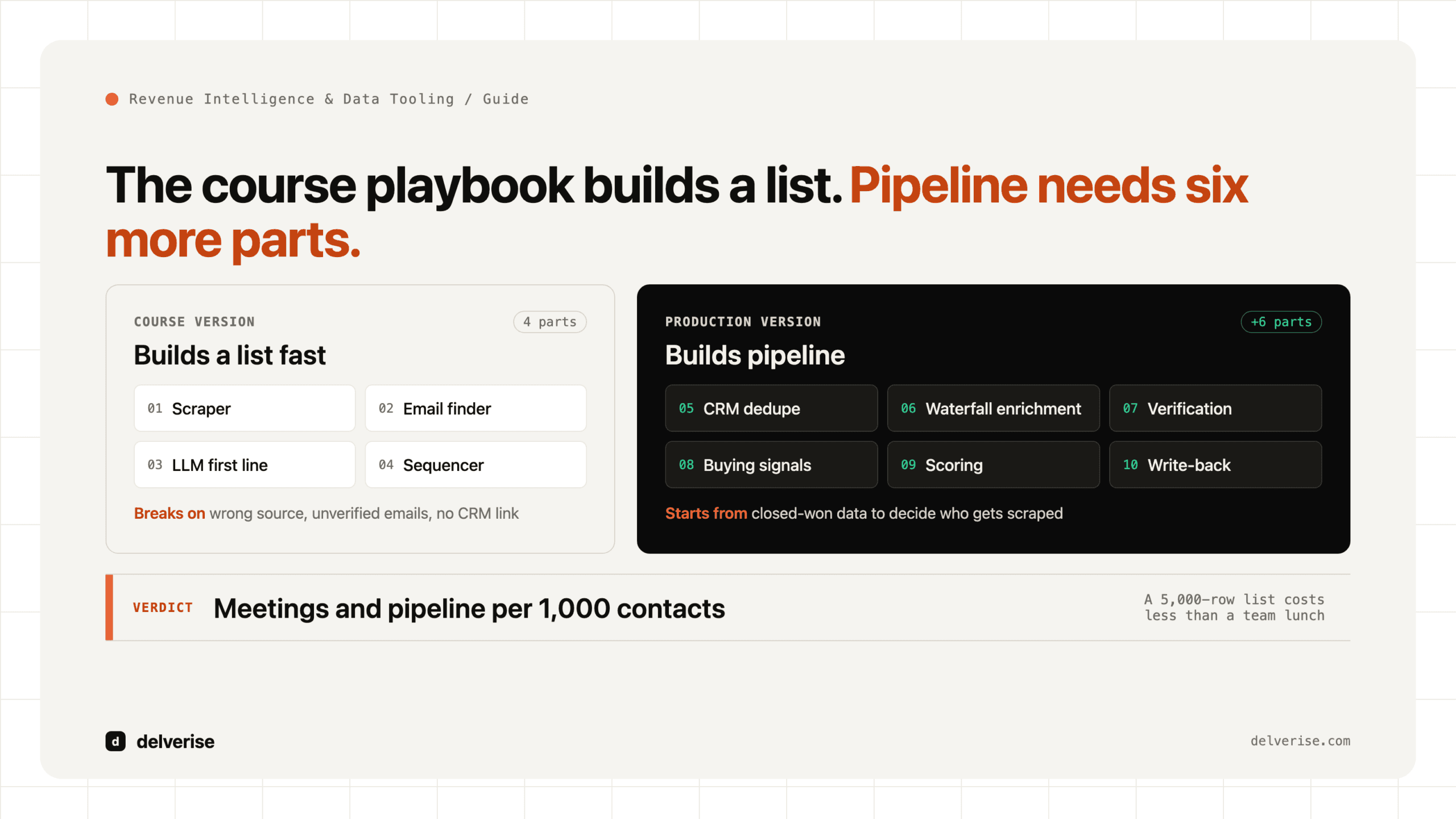
The underlying data was never fixed. A prompt that scores leads against your ICP, your ideal customer profile, needs the account’s headcount, funding stage, and tech stack to be present and current. If 40% of your records are blank, the model guesses. We have written about the six foundation pieces under every revenue stack for a reason: prompting sits on top of the data layer and inherits every flaw in it.
Where does prompting end and system building start?
Prompting is where a rep experiments. System building starts the moment you want the same output for every account, every day, without anyone remembering to do it.
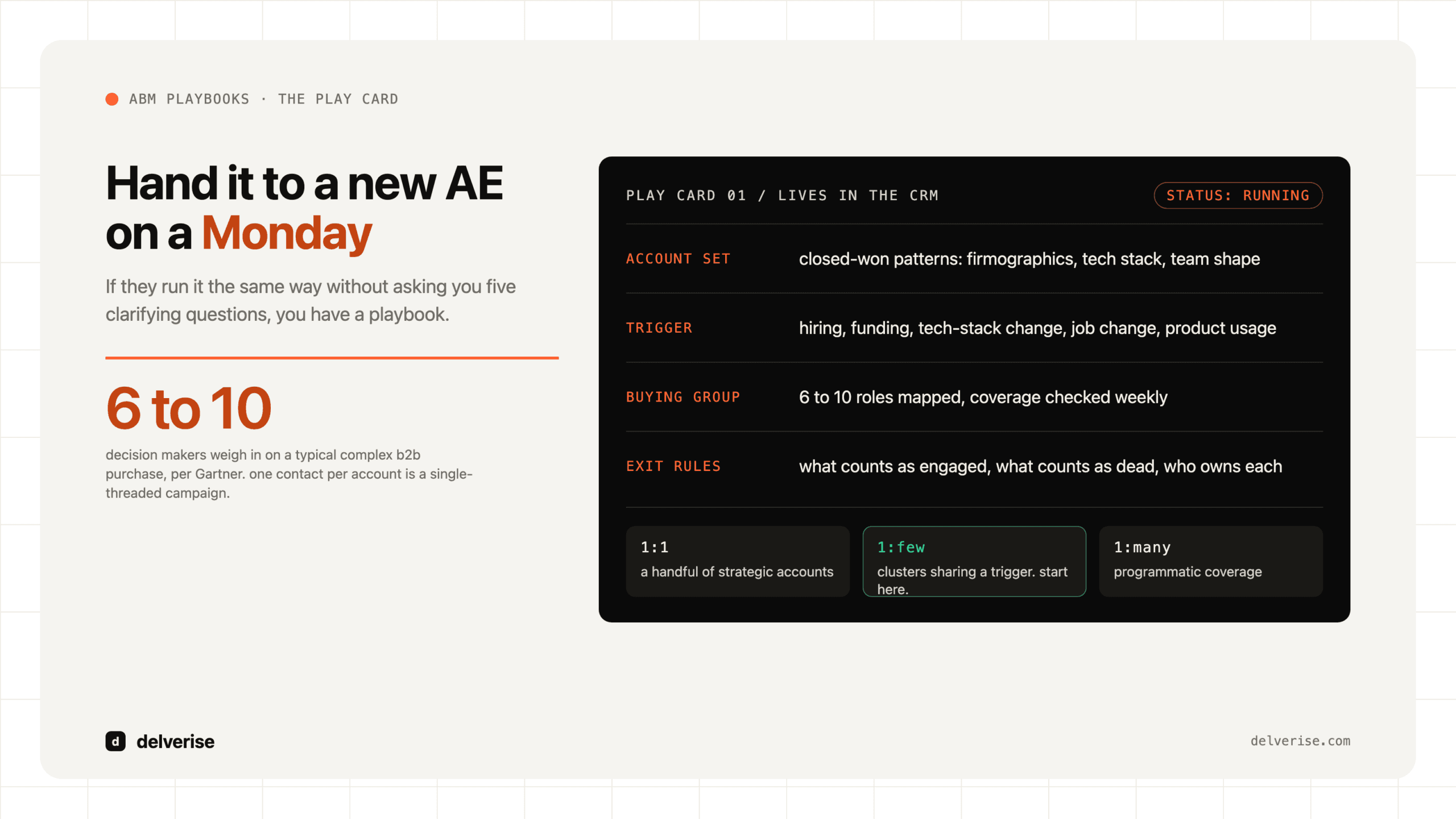
The transition looks like this: a prompt becomes a workflow when it has a trigger (new account enters a segment), a data contract (these five fields must be populated before it runs), a destination (this CRM field, this Slack channel), and a review loop (someone reads a sample weekly). That is the difference between a productivity tip and an asset that compounds. It is also the core of GTM engineering as a discipline: building revenue workflows as systems with owners, monitoring, and defined outputs.
The buying context makes this worth doing well. Gartner’s research on B2B buying has consistently found that buyers spend a small minority of their purchase journey with any supplier’s sales reps, roughly 17% across all vendors under consideration, and only a fraction of that with any single one. McKinsey’s B2B Pulse research points the same direction, with buyers now moving across many channels before and between conversations. When your reps get a handful of real interactions per deal, the preparation quality behind each one carries disproportionate weight. That is what these prompts should be buying you.
How should you measure whether sales prompts are working?
Track three things and ignore the rest:
- Acceptance rate. What percentage of generated research summaries or email drafts do reps use without heavy editing? Below 60% and your context layer is too thin.
- Downstream conversion delta. Compare reply and meeting rates on accounts that went through the prompted workflow against a holdout that did not. Run it for at least four weeks.
- Minutes returned per account. If the workflow saves 12 minutes of research per account and you touch 400 accounts a month, that is 80 hours of selling time recovered. Price that against your fully loaded rep cost.
A quick readiness check before you invest in this:
- Your CRM has current firmographic data on at least 80% of target accounts
- One named person owns output quality and reviews samples weekly
- Prompts run inside the tool reps already use, not a separate chat window
- Every generated field has a source citation a rep can check in under 30 seconds
- You have a holdout group to measure against
If three or more of those are unchecked, fix the data and ownership first. The prompt engineering will take an afternoon once the foundation holds. Teams working through this often start with what AI lead qualification actually scores and where AI creates revenue in sales versus where it breaks.
Frequently Asked Questions
Are ChatGPT prompts good enough for writing cold emails at scale?
For volume sending without review, no. Reply rates drop when every message carries the same generated structure, and spam filters increasingly catch templated patterns. Generated first drafts with per-account research injected and a rep editing the opening line perform well. The research step is where the model earns its keep. See our breakdown of what actually works in B2B cold email.
Which model should we use for sales workflows?
For research and summarization at volume, a mid-tier model handles most of the load at a fraction of the cost. Reserve a frontier model for tasks where reasoning quality visibly changes the output, like multi-source qualification scoring or synthesizing a complex call. Test both on 50 real accounts and compare acceptance rates before committing.
Do we need a dedicated tool, or is ChatGPT enough?
ChatGPT is enough for testing and for one-off deep research on a strategic account. Once you want the same output across hundreds of accounts on a schedule, you need something that can enrich data, run the prompt per record, and write results back to your CRM. That is the point where a workflow tool or a custom pipeline pays for itself.
How do we stop the model from making things up about accounts?
Require quoted source text for any claim, give the model an explicit abstain option, and show the citation to the rep in the same field as the output. Prompts that ask for a compelling reason without an evidence requirement will always produce one. Sample 20 outputs a week and check the quotes against the sources.
Who should own this inside a Seed to Series B company?
RevOps, meaning the function that owns revenue systems and data, if you have it. Otherwise the person who owns the CRM. The failure mode is treating prompts as an individual rep habit, which means quality varies by rep and nothing compounds. One owner, one library, one review cadence.
Read next