←Back to blog
Revenue Intelligence & Data ToolingGuideNovember 17, 20267 min read
Best B2B Email List Providers: How Revenue Leaders Should Actually Choose One
The best B2B email list providers for most SaaS teams come down to four shapes: Apollo for breadth at low cost, Cognism for compliant European coverage, ZoomInfo for enterprise depth and intent, and Clay for assembling lists from many sources at once. The right pick depends on your ICP geography, seniority, and verification discipline.
The best B2B email list providers for most SaaS teams come down to four shapes: Apollo for breadth at low cost, Cognism for compliant European coverage, ZoomInfo for enterprise depth and intent, and Clay for assembling lists from many sources at once. The right pick depends on your ICP geography, seniority, and verification discipline.
Key takeaways
- No single provider has good coverage everywhere. Geography and seniority determine who wins for your ICP, so test against your own accounts before signing.
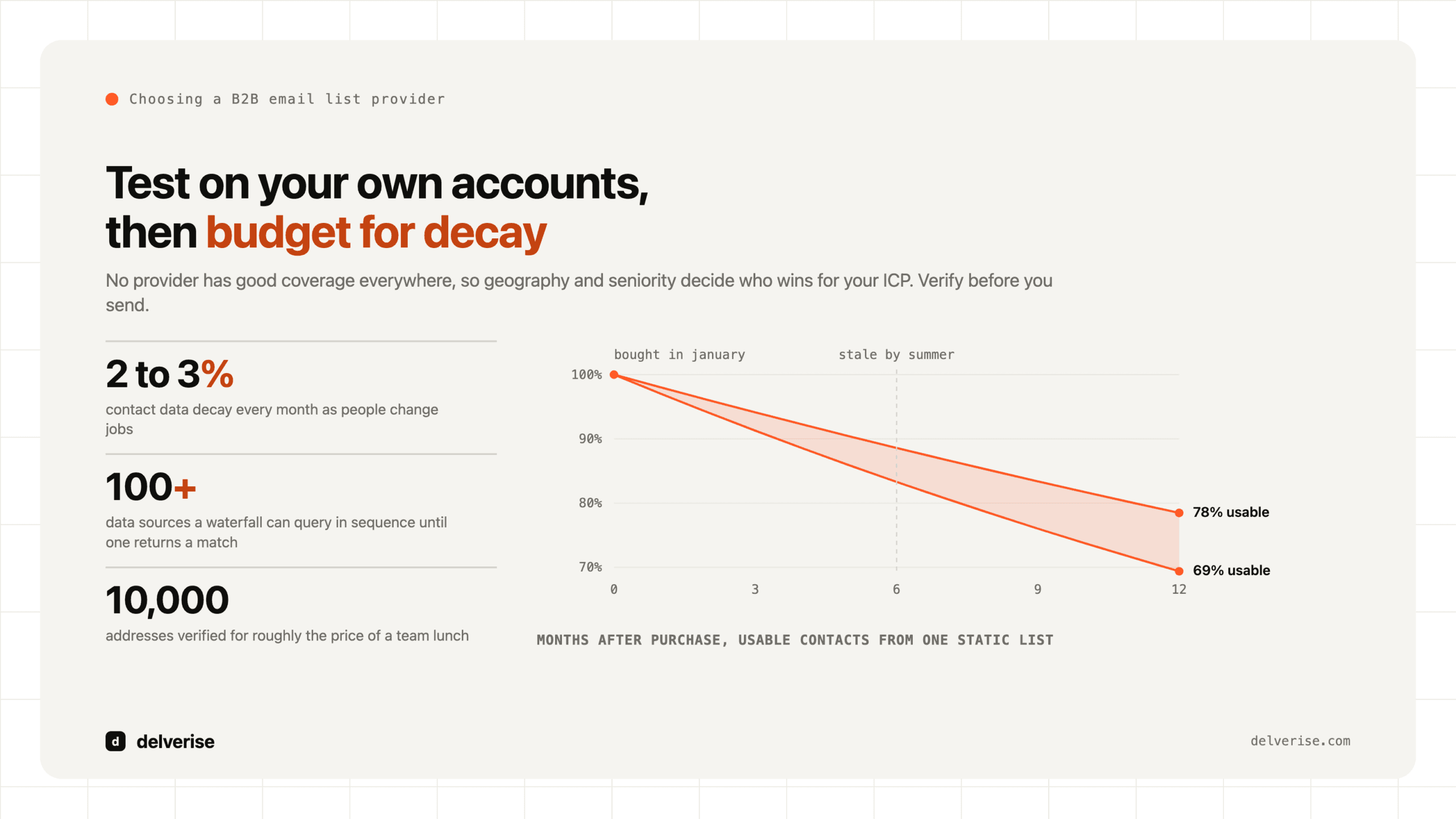
- Waterfall enrichment (querying several data sources in sequence until one returns a match) usually beats a single-vendor contract on both coverage and cost per usable contact.
- Email verification is cheap insurance. Verifying 10,000 addresses costs roughly the price of a team lunch and protects domain reputation worth far more.
- Compliance is a purchasing requirement in the EU and UK, not a legal footnote. Ask for the notification process in writing.
- A list is an input. The system around it, routing, sequencing, CRM hygiene, and attribution, decides whether the data becomes pipeline.
What is a B2B email list provider?
A B2B email list provider sells access to a database of business contacts: name, title, company, work email, and often direct dial, LinkedIn URL, and firmographics. Most modern vendors sell subscription access with credit limits rather than a one-time CSV. That distinction matters. Static purchased lists decay fast, and widely cited industry estimates put B2B contact data decay somewhere around two to three percent per month as people change jobs, meaning a list bought in January is meaningfully stale by summer.

Three categories get conflated in buying conversations. Databases (ZoomInfo, Apollo, Cognism, Lusha) maintain their own contact records. Enrichment and waterfall tools (Clay, Clearbit inside HubSpot) sit on top of many sources and fill gaps on records you already have. Intent platforms (Bombora, 6sense, Demandbase) tell you which accounts are researching your category, then hand off to a contact source for the actual people.
Which B2B email list providers are worth evaluating?
| Provider | Best fit | Coverage strength | Pricing shape | Honest tradeoff |
|---|---|---|---|---|
| Apollo.io | Seed to Series A teams running high-volume outbound | Broad US and global SMB/mid-market, weaker on enterprise and EU mobile | Low per-seat tiers with credit allowances | Accuracy varies by segment; verify before sending |
| ZoomInfo | Teams selling enterprise deals in North America | Deepest US org charts, direct dials, intent and technographics | Annual contracts, typically the highest spend in this set | Cost and contract terms; often oversized for early-stage teams |
| Cognism | Teams selling into the UK, DACH, and wider EMEA | Strong European coverage and phone-verified mobile data | Annual platform fee plus data package | US coverage is competitive but not category-leading |
| Clay | Teams building targeted lists from many signals | Aggregates 100+ data providers into one waterfall | Credit-based, scales with usage | Requires someone who can build the workflows |
| Lusha / LeadIQ | Reps prospecting live inside LinkedIn | Good point-of-need capture, lighter bulk export | Per-seat with credit caps | Built for individual workflows more than list programs |
| Ocean.io / UpLead | Lookalike account building and smaller verified pulls | Niche firmographic targeting, real-time verification | Mid-market monthly plans | Smaller databases than the majors |
G2’s sales intelligence category alone lists hundreds of vendors, and review scores cluster tightly enough that they rarely settle a decision. Treat them as a shortlist filter, then run your own test.
How do you test data quality before you sign?
Run the same test against every finalist. Pull a sample of 300 to 500 contacts that match your exact ICP, same titles, same company size band, same countries. Then measure four things: match rate (how many of your target accounts returned any contact), coverage depth (contacts per account at the seniority you sell to), accuracy (verified deliverable addresses), and title precision (how many records have a current, correct role).

A vendor that returns 80 percent match rate with sloppy titles will damage reply rates more than a vendor at 60 percent with clean ones. Personalization fails loudly when you address a VP of Marketing who left fourteen months ago.
- Test 300+ records per vendor against your real ICP, not their demo list
- Verify every sample through a third-party tool and compare bounce rates side by side
- Check a random 25 records manually against LinkedIn for title accuracy
- Ask for written detail on how EU and UK contacts are sourced and notified
- Confirm export rights, credit rollover, and what happens to your data at renewal
- Price the annual contract against cost per usable contact, not cost per record
What does a list actually cost per usable contact?
Here is the math most teams skip. Say you need 10,000 contacts a year across your ICP. Vendor A charges $14,000 and delivers 91 percent verified-deliverable records. Vendor B charges $7,000 and delivers 72 percent. Vendor A costs $1.54 per usable contact. Vendor B costs $0.97. B looks like the winner.

Now add the second-order costs. Those 2,800 bad records from B, if they enter your sending pool unverified, push bounce rates well past the two percent threshold that inbox providers tolerate, which risks the deliverability of every campaign on that domain. Verification closes most of the gap: at roughly $0.004 per email, cleaning 10,000 records costs about $40. So B stays cheaper on price, provided you always verify and provided its coverage on your specific accounts holds up. That last condition is what your sample test answers.
The number that actually matters is cost per booked meeting, and data is rarely the largest term in that equation. Copy, offer, and sequencing move it more. We break that side down in cold email templates for B2B SaaS.
Should you buy a list or build one continuously?
Buying makes sense when your ICP is large, well-defined by firmographics, and stable. Building makes sense when your best accounts are identified by behavior or context that no database field captures: hiring for a specific role, running a particular tech stack, recently funded, expanding into a new region.
Most Series A and B teams end up running both. A core database subscription handles bulk coverage, and a build layer handles the high-intent segments. Clay is the common choice for that build layer because it runs waterfall enrichment across many providers and lets you attach signals before a contact ever reaches a sequence. The tradeoff is real: it rewards teams with someone who can design the workflows, and it sits idle otherwise. delverise builds these systems as a Clay solutions partner when a team wants the output without staffing the build.
Signal-based list building also fits how buying now works. Gartner’s research on B2B buying found that a typical purchase involves a buying group of six to ten decision makers, and that buyers spend only a small share of the total cycle meeting with suppliers at all. A list of one contact per account structurally cannot reach that group. Plan for three to five contacts per target account and treat the account as the unit of targeting.
What breaks after you buy the data?
Data quality problems usually surface downstream. Records land in the CRM without owner assignment. Duplicates accumulate because there is no matching rule on domain. Enrichment runs once at import and never refreshes, so job changes go unnoticed. Sequences fire against contacts who already sit in an open opportunity.
Fixing that is a systems problem, covered in our guides on CRM enrichment and outbound sales automation. McKinsey’s ongoing B2B research consistently finds buyers moving across many channels before they talk to a rep, which means the same contact record has to stay accurate across email, ads, and self-serve touches at once. One stale record creates several bad experiences.
Before adding a data vendor, confirm the foundation underneath it holds: defined ICP, clean CRM object model, working routing, and measurable attribution. Our post on the six foundation pieces under every revenue stack covers the sequence, and how to get B2B leads covers where purchased data fits against inbound and referral sources.
Frequently Asked Questions
Is buying a B2B email list legal?
In the US, CAN-SPAM permits cold commercial email if you identify yourself, include a valid physical address, and honor opt-outs promptly. In the EU and UK, GDPR requires a lawful basis, usually legitimate interest, plus a documented notification process, and some markets like Germany apply stricter consent standards in practice. Ask any EU-focused vendor exactly how it notifies contacts and get the answer in writing.
Which provider has the best European data?
Cognism is generally the strongest on EMEA coverage, particularly for phone-verified mobile numbers and DACH markets, and it maintains a documented GDPR notification process. Apollo and ZoomInfo both cover Europe, though depth thins outside the largest markets. Test against your actual target countries rather than trusting regional claims.
How many contacts per account should we target?
Three to five contacts at your target seniority, spanning the functions that would sit in the buying group. Single-threaded outreach fails when the internal champion goes quiet or leaves, and Gartner’s buying-group research suggests most deals involve well more than one stakeholder.
Do we still need a separate email verification tool?
Yes. Even vendors that advertise verified data return some stale records, and verification costs a fraction of a cent per address. Run every list through a dedicated verifier before it enters a sequence, and re-verify anything older than 60 days.
What should a Series A team budget for this?
A workable range is $8,000 to $25,000 per year for a primary database plus a build or enrichment layer, depending on seat count and geography. Spending above that rarely pays back until outbound is already producing predictable meetings and the constraint has shifted from data coverage to capacity.
Read next