←Back to blog
Revenue Intelligence & Data ToolingGuideNovember 17, 20268 min read
What Is a BDR Agent? How AI BDR Agents Actually Work in B2B SaaS
A BDR agent is software that performs business development rep work autonomously: finding accounts that match your ICP, researching them, identifying buying signals, and drafting or sending outbound messages. Modern BDR agents use LLMs to handle research and copy, then hand qualified replies to a human seller who runs the conversation.
A BDR agent is software that performs business development rep work autonomously: finding accounts that match your ICP, researching them, identifying buying signals, and drafting or sending outbound messages. Modern BDR agents use LLMs to handle research and copy, then hand qualified replies to a human seller who runs the conversation.
Key takeaways
- A BDR (business development representative) opens new conversations with cold accounts. A BDR agent does the mechanical parts of that job at machine scale: list building, research, signal monitoring, message drafting, follow-up sequencing.
- The quality ceiling of any BDR agent is set by your data, not by the model. Bad account data produces fluent, confident, irrelevant emails faster than a human ever could.
- Agents are strongest on research and personalization at volume. Humans stay stronger on judgment calls, multi-threading, and anything requiring a real-time read of the buyer.
- Measure a BDR agent on qualified pipeline per dollar and per domain, never on activity volume. Volume is the one metric an agent will always win and the one that means the least.
- Most teams get more out of an agent layer inside their existing stack than out of a standalone “AI SDR” product that owns its own data and sending infrastructure.
What does a BDR agent actually do?
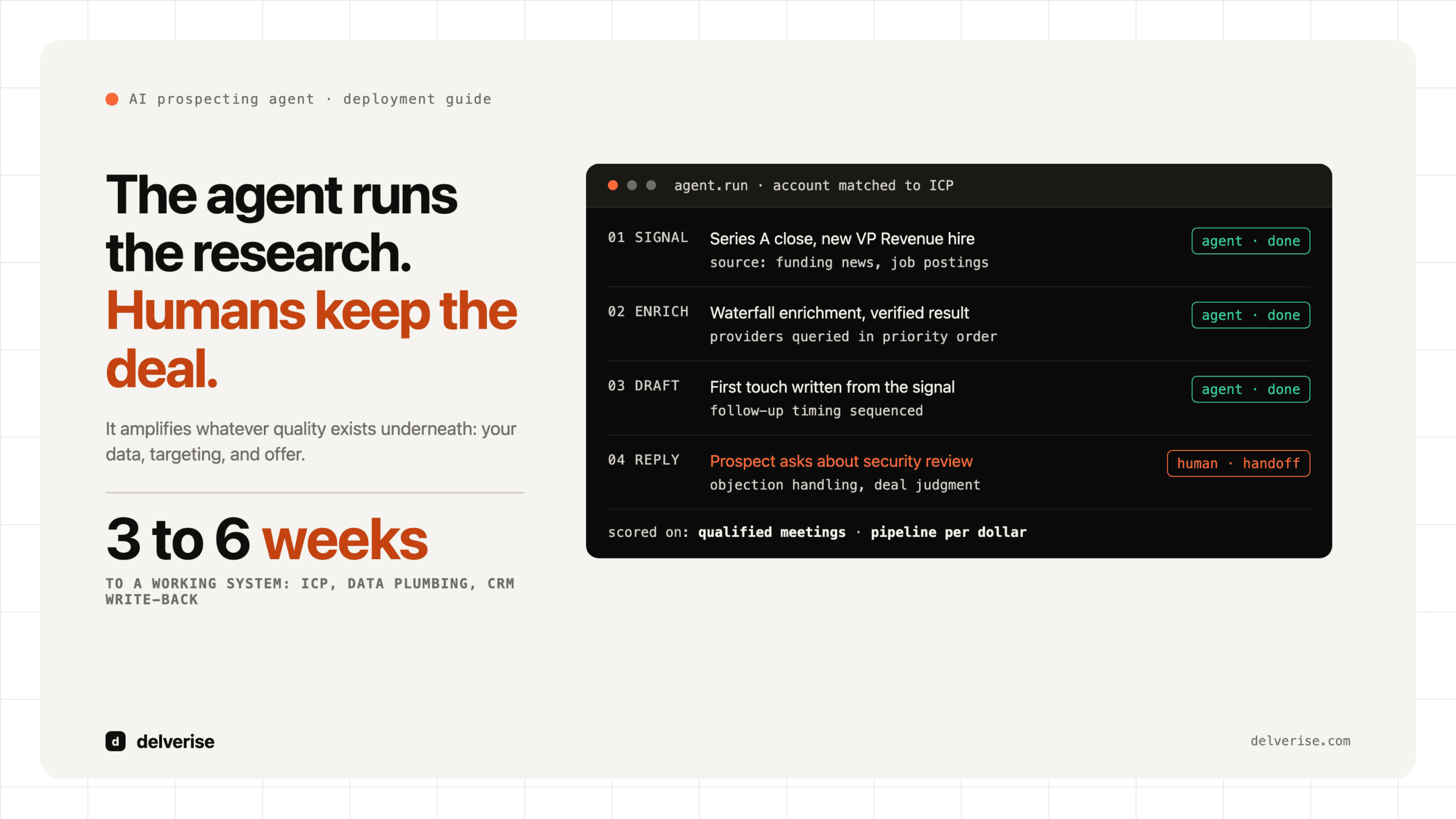
Strip the marketing away and a BDR agent executes a chain of four tasks that a human rep does manually.
Account selection. It pulls companies from a database or your CRM, filters them against your ideal customer profile (ICP), and ranks them. The good implementations score on fit signals you define: headcount in a specific function, tech stack, funding stage, geography.
Research. It reads job postings, 10-Ks, product changelogs, LinkedIn activity, review sites, and press coverage, then extracts the handful of facts that would make an outbound message land. This is the task where agents genuinely outperform people, because it is expensive in human hours and cheap in tokens.
Message generation. It writes the first-touch email or call script using those facts, following whatever voice and structure you give it. Output quality tracks input quality closely, which is why the structural patterns that book meetings matter more than the model you pick.
Sequencing and follow-up. It sends, waits, follows up, detects replies, classifies them (interested, referral, not now, unsubscribe), and either books a meeting or routes the thread to a human.
Some agents also handle calls. The voice side of this category is less mature than the email side, and the gap between a demo and a live conversation with an annoyed VP is still wide.
How is a BDR agent different from a human BDR?
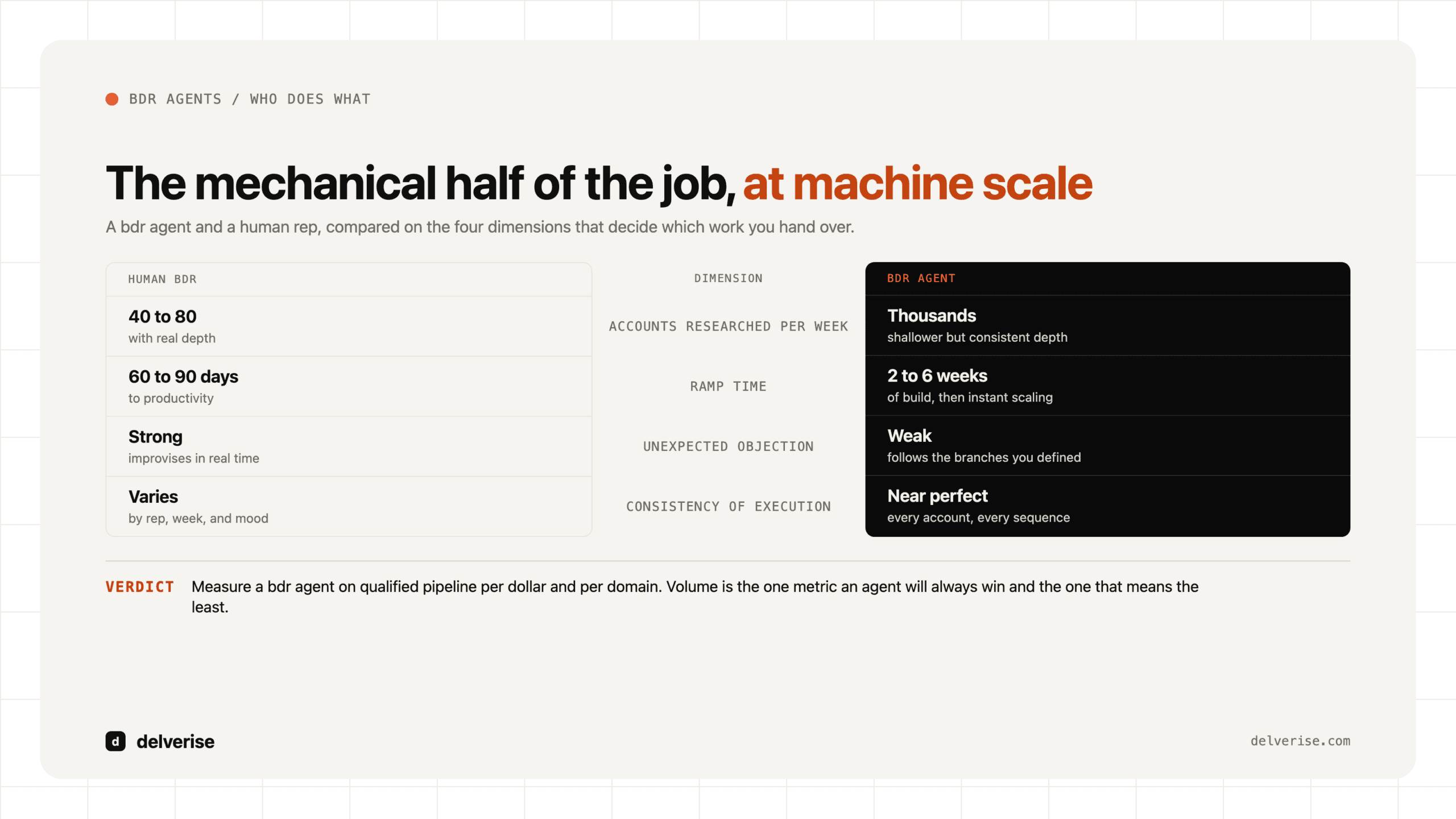
The honest comparison is not flattering to either side in all categories.

| Dimension | Human BDR | BDR agent |
|---|---|---|
| Accounts researched per week | 40 to 80 with real depth | Thousands, with shallower but consistent depth |
| Ramp time | 60 to 90 days to productivity | 2 to 6 weeks of build, then instant scaling |
| Cost shape | Fixed salary plus variable comp | Mostly variable: tokens, data credits, sending infrastructure |
| Handling an unexpected objection | Strong, improvises in real time | Weak, follows the branches you defined |
| Multi-threading a buying committee | Strong with coaching | Can enumerate contacts, struggles to sequence them politically |
| Consistency of execution | Varies by rep, week, and mood | Near perfect, including when the logic is wrong |
| Learning from a lost deal | Absorbs context others miss | Only learns what you explicitly feed back |
That last row is the one buyers underweight. An agent repeats your assumptions at volume. If the assumption is wrong, you will burn domains before you notice. We cover what one human rep realistically produces in a month in our breakdown of the outbound SDR role, which is the right baseline to compare any agent against.
Why do most BDR agents underperform?
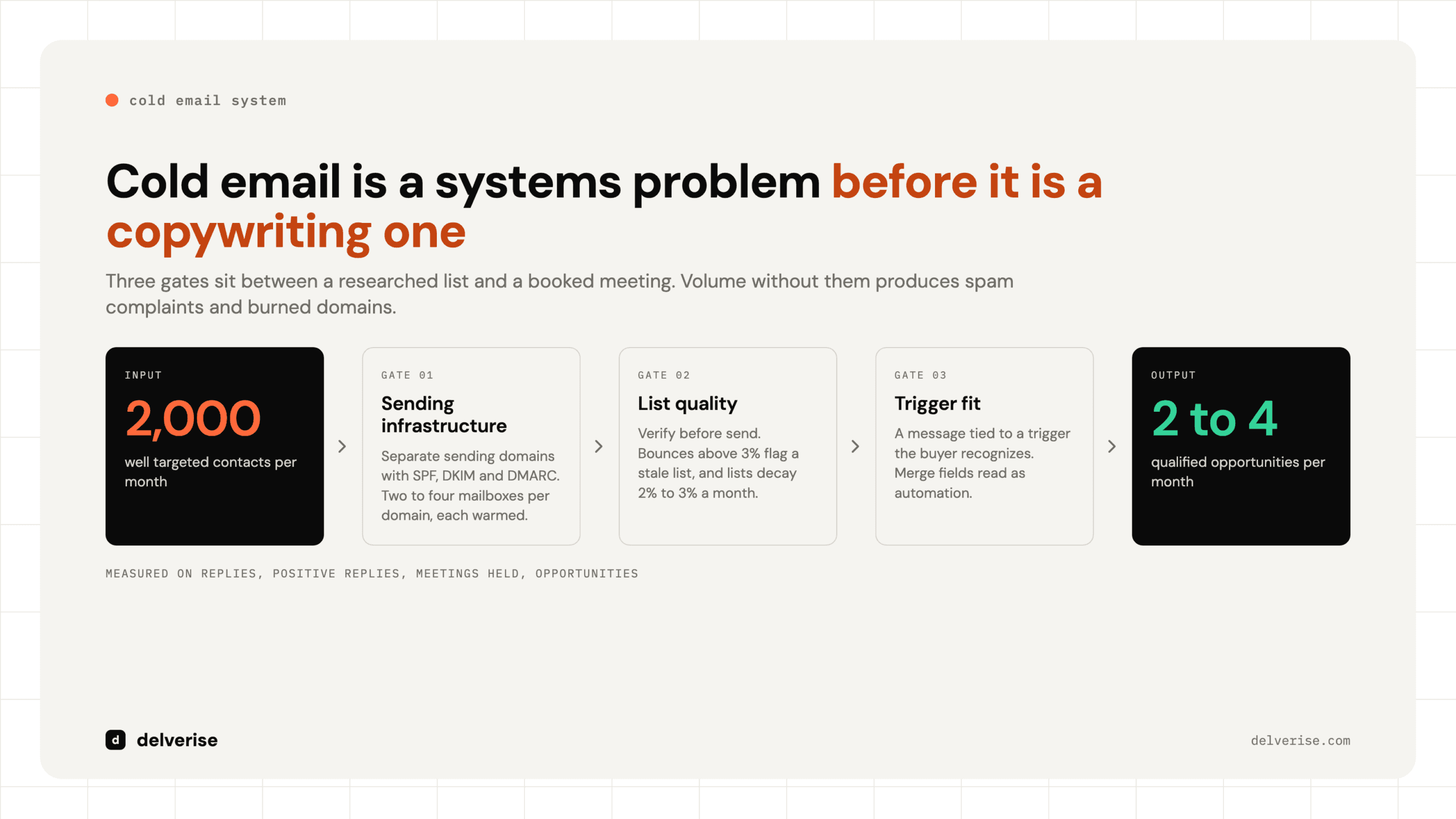
Three reasons, in order of how often we see them.

The data layer is thin. An agent that only knows a company’s name, industry, and headcount will write a generic email with one personalized clause bolted on. Buyers pattern-match that instantly. The fix is enrichment depth before message generation, which is why CRM and enrichment work usually has to land before the agent does.
There is no real trigger. Sending to a static list on a schedule is a volume play dressed up as intelligence. Agents earn their cost when they watch for events: a new VP of Sales, a pricing page change, a competitor integration going live, a hiring spree in a function you serve.
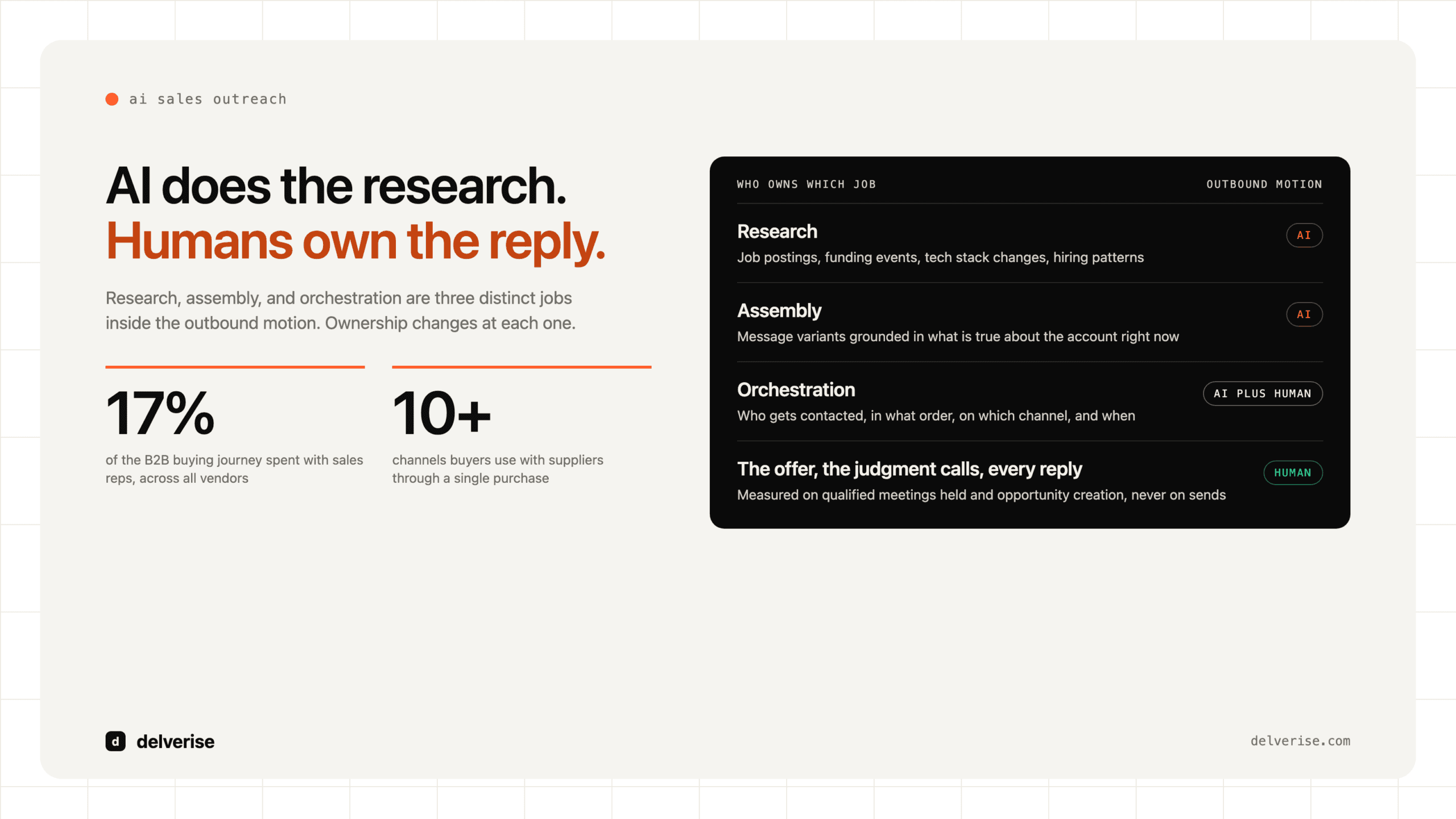
Nobody owns the handoff. Gartner’s research on the B2B purchase journey found that buyers spend only about 17% of their total buying time meeting with potential suppliers, and a fraction of that with any single vendor. The agent can generate the opening. The 17% still belongs to a person, and if that person is not staffed, primed, and fast, the meetings die.
It is also worth remembering who is on the other end. Research from Gartner’s CEB group, published in HBR, found that the typical B2B buying group runs 6 to 10 decision makers, each arriving with information they gathered independently. McKinsey’s work on B2B buying behavior found buyers now move across roughly 10 channels in a single decision journey. A single-threaded email agent is playing a small part in a large, noisy process.
What does a working BDR agent look like in practice?
Here is a concrete build we would consider healthy for a Series A B2B SaaS company selling a $25k ACV product.

The agent monitors 3,000 ICP-fit accounts continuously for four defined triggers. In a given month, roughly 4% of those accounts fire a trigger, which is 120 accounts. For each one, the agent identifies three relevant contacts, giving 360 people. It drafts a first touch grounded in the specific trigger plus two follow-ups, and a human reviews a 10% sample before anything sends.
At a 2.5% positive reply rate on a well-triggered, well-enriched list, that produces about 9 qualified conversations per month from one agent, at a marginal cost measured in hundreds of dollars rather than thousands. Compare that against the fully loaded cost of a single rep, and the math works. Push the same agent to 10,000 untriggered accounts and reply rate collapses, spam complaints rise, and the domain reputation damage costs more than the pipeline gained.
Volume is the variable that quietly destroys these systems. Precision is what makes them pay.
What should you have in place before deploying one?
- A written ICP with disqualifying criteria, not only qualifying ones
- Enrichment coverage above 80% on the fields your messaging actually depends on
- Dedicated sending domains, warmed, separate from your corporate domain
- A defined trigger set with an owner who reviews whether each trigger still correlates with wins
- A reply classification path and a human who picks up interested replies within an hour
- Closed-loop reporting from agent-sourced meeting to closed revenue, in the CRM
That last item is where most teams lose the thread. If agent-sourced pipeline is not attributed cleanly, you cannot tell whether the agent is producing revenue or producing noise, and your forecast inherits the ambiguity.
Should you buy a BDR agent or build the workflow yourself?
Packaged “AI SDR” products are fast to start and opaque to debug. They own the data, the logic, and often the sending infrastructure, which means when reply rates drop you have limited visibility into why. They fit teams with a simple ICP and no internal technical capacity.
The composable path uses a data and orchestration layer you control. Clay is the common choice here: it handles waterfall enrichment across many providers, runs AI research columns against your own prompts, and pushes clean records into your CRM or sequencer. You keep ownership of the logic, the scoring, and the data, and you can change any step without a vendor ticket. The tradeoff is real: this approach needs someone who can build and maintain it, which is the work delverise does on our Clay implementation engagements.
A reasonable rule: if your ICP has one shape and your message has one angle, buy. If you sell into multiple segments with different triggers, build the layer, because the packaged tools will force you into their abstraction. Either way, decide what stays human before you automate anything, using the same logic as any other outbound automation decision.
How do you know it is working?
Track four numbers monthly: qualified meetings sourced, cost per qualified meeting, reply-to-meeting conversion, and deliverability health (bounce rate, spam complaint rate, domain reputation). Ignore emails sent, accounts researched, and any metric the agent controls directly.
Then run the harder check quarterly. Pull every opportunity the agent sourced and compare win rate and ACV against your human-sourced cohort. If agent-sourced deals win at half the rate, the targeting logic is wrong and the volume is hiding it. Pairing the agent with proper AI lead qualification on the inbound side gives you a cleaner read on whether the fit criteria themselves hold up.
Frequently Asked Questions
Will a BDR agent replace our SDR team?
It replaces a large share of the manual research and drafting hours, which changes what you hire for. Teams that get this right usually run fewer, more senior reps who handle replies, discovery, and multi-threading, with agents doing the top-of-funnel mechanics underneath them. Headcount goes down or stays flat while coverage goes up.
How much does a BDR agent cost to run?
Packaged products typically price per seat or per meeting booked, often in the range of a junior rep’s salary. A composable build costs data credits, LLM tokens, sending infrastructure, and the engineering time to build and maintain it. The marginal cost per account touched is usually low; the fixed cost is the person who owns the system.
Do prospects know they are talking to an AI agent?
Often, yes, and increasingly so as pattern recognition improves. The messages that survive are the ones grounded in a specific, verifiable fact about that company and that person. Generic personalization tokens are now a signal of automation rather than a disguise for it. Assume your buyer can tell and write something worth reading anyway.
Can a BDR agent work without a CRM?
It can send email without one. It cannot tell you whether it worked. Without closed-loop data from meeting to closed revenue, you are optimizing reply rate, which correlates weakly with pipeline quality. Get the foundation pieces in place first.
What is a realistic timeline to first pipeline?
Two to six weeks for the build, depending on enrichment depth and how many triggers you define, plus three to four weeks of warming and iteration before reply rates stabilize. Expect the first month of output to be diagnostic rather than productive. Teams that judge an agent on week two usually kill something that would have worked by week eight.
If you want this built as a system you own rather than a tool you rent, delverise designs and implements AI outbound infrastructure end to end: data layer, trigger logic, agent orchestration, and the reporting that proves what it produced.
Read next