←Back to blog
Revenue Intelligence & Data ToolingGuideNovember 18, 20268 min read
Cold Call Practice AI Free: What the Free Tools Actually Teach Your Reps
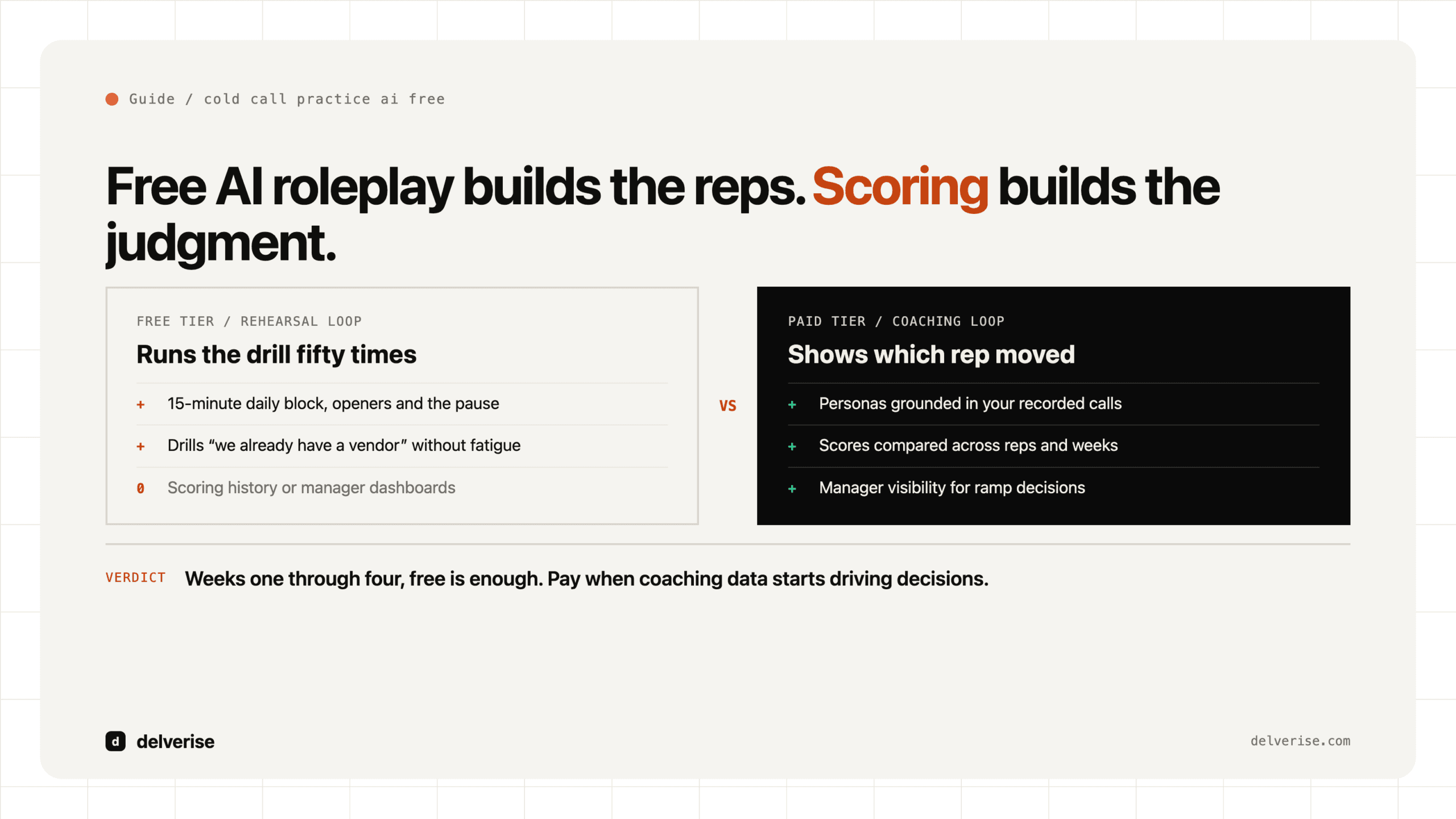
Free AI cold call practice means using an AI voice or chat agent to roleplay a prospect so reps rehearse openers, objections, and discovery before they dial real accounts. Free tiers and general-purpose AI models handle rehearsal volume well. Paid tiers add scoring, call-library grounding, and manager visibility. Start free, pay when coaching data starts driving decisions.
Free AI cold call practice means using an AI voice or chat agent to roleplay a prospect so reps rehearse openers, objections, and discovery before they dial real accounts. Free tiers and general-purpose AI models handle rehearsal volume well. Paid tiers add scoring, call-library grounding, and manager visibility. Start free, pay when coaching data starts driving decisions.
Key takeaways
- Free AI roleplay is good at reps and volume. It is weak at judgment, because a model that has never heard your buyers will invent objections your buyers do not have.
- The cheapest usable setup for most Seed to Series B teams: a general-purpose AI voice model, a written persona brief per segment, and a 15-minute daily rehearsal block.
- Scenario realism comes from your data, not from the tool. Feed the model real account context, real objections from recorded calls, and real pricing pushback.
- Free tiers rarely include scoring history or manager dashboards, which is exactly the part a VP Sales needs to make ramp decisions.
- Practice improves connect-to-conversation conversion. It does not fix a bad list, a broken dialer, or a weak offer.
What is AI cold call practice, exactly?
An AI cold call practice tool generates a synthetic buyer: a persona with a role, a company context, a mood, and a set of objections. The rep dials in or opens a browser tab, delivers an opener, and the AI responds in character. Some tools run text-only. The better ones run full voice with interruption handling, so a rep experiences the thing that actually kills cold calls, which is being cut off eight seconds in.

Two capabilities separate a rehearsal toy from a coaching system. The first is grounding: whether the AI persona is built from your recorded calls and your ICP, or from generic sales-training data. The second is scoring: whether the session produces a structured evaluation a manager can compare across reps and across weeks.
Free products almost always deliver the first loop and skip the second. That is a reasonable trade if you know you are making it.
Is free AI cold call practice actually good enough?
For an SDR in weeks one through four, yes. Early ramp is about muscle memory: getting the opener out cleanly, holding the pause, handling “we already have a vendor” without freezing. A general-purpose model in voice mode will run that drill fifty times without getting tired or getting annoyed. No manager has that patience.
It stops being good enough at the point where you need to know which rep is improving and which behavior moved. Gong’s analysis of large call samples has consistently shown that small, measurable behaviors separate successful cold calls from failed ones: the specific opener used, how much the buyer talks, how objections get acknowledged before they get answered. You cannot manage those behaviors from a tool that keeps no history.
There is a second limit worth naming. Gartner’s research on B2B buying found that customers spend only around 17% of their total purchase journey meeting with potential suppliers, and when they are evaluating several vendors, the time any one supplier gets shrinks to a sliver of that. Your rep gets a very short window. Practicing a polished thirty-second frame matters more than practicing a full pitch, and generic AI personas tend to reward the long pitch because they are too polite to hang up.
How do the free options compare?
| Approach | Real cost | Strongest at | Where it breaks |
|---|---|---|---|
| General-purpose AI voice model with a custom persona prompt | Free tier, or roughly $20 per user monthly on a paid plan | Unlimited reps, fast persona edits, natural interruptions | No scoring history, persona drifts over long sessions, no manager view |
| Dedicated AI roleplay platform, free trial or limited free tier | Free for a capped number of sessions, then per-seat | Structured scorecards, call grading, ramp tracking | Free tier usually caps sessions before a habit forms; grounding on your calls is a paid feature |
| Recorded real-call review | Free if your dialer already records | Highest realism, exposes actual objection language | Requires call volume you may not have yet; heavy manager time per rep |
| Manager or peer roleplay | Free in cash, expensive in calendar time | Judgment, tone, real-time correction | Does not scale past a few reps; quality varies with the manager’s day |
Most teams under 15 reps should run the first and third rows together and skip the rest until a coaching bottleneck appears. Check current free-tier terms before you commit a team to any vendor, because caps in this category change often.

How do you make a free AI persona realistic?
Realism is a data problem. A model with no context invents a plausible-sounding VP of Engineering who objects to things your real buyers never mention. Fix that with three inputs.

- Pull the ten most recent recorded cold calls and transcribe the first 90 seconds of each. Extract the exact objection wording, not paraphrased versions.
- Write one persona brief per segment: title, company size, current stack, what they are measured on, their two most common brush-offs, and what would actually earn a second meeting.
- Add live account context: recent funding, hiring signals, tooling changes, so the rep practices the version of the call where research matters.
That third input is where most teams stall, because pulling signals per account by hand does not scale. This is the natural place for Clay, which assembles account research and enrichment into structured columns your team can read before a call. If you want that research flowing into personas, scenario libraries, and pre-call briefs automatically, delverise builds those pipelines as part of Clay implementation work. The same data that makes a roleplay realistic also makes the real call better, which is the point.
What does a practical weekly practice loop look like?
Here is the arithmetic on a six-rep team, using round numbers you should replace with your own.
Six SDRs each make 60 dials a day. At a 5% connect rate, that is three live conversations per rep per day, or 18 across the team. If practice moves connect-to-meeting conversion from 8% to 11%, which is a realistic delta for openers and early objection handling, the team goes from roughly 7 meetings a week to roughly 10. Over a quarter, that is about 39 extra meetings. At a 25% meeting-to-opportunity rate and a $30K average contract value, the practice loop is worth meaningful pipeline against a cost of zero dollars and 15 minutes a day.
The loop itself:
- Monday: manager picks one scenario theme for the week, for example the “send me an email” brush-off.
- Daily: each rep runs three AI roleplays against that theme before their first dial block.
- Wednesday: each rep submits one real recorded call for the same scenario.
- Friday: 20-minute team review comparing what the AI persona did against what the real buyer did, and updating the persona brief accordingly.
That last step is what keeps the personas honest over time. Skip it and the practice environment slowly diverges from the market.
Where does practice stop being the problem?
Before you invest in rehearsal, confirm the constraint. Practice helps when reps connect with the right people and lose them in the first minute. Practice does nothing for a list of wrong-fit accounts, a dialer with poor answer rates, or leads that sit untouched. Harvard Business Review’s study of lead response times found that companies responding to inbound leads within an hour were roughly seven times more likely to have a real conversation with a decision maker than those who waited even one hour longer. If your response times are slow, routing beats roleplay every time.
McKinsey’s B2B Pulse research also found buyers now move across roughly ten channels during a purchase decision, which means the cold call is one touch inside a sequence rather than the whole motion. Rehearsing calls while the rest of the sequence stays broken produces sharper reps and flat pipeline. Our guides on the outbound funnel and what to automate versus keep human cover the surrounding system, and the outbound SDR role breakdown sets realistic expectations for what one rep produces.
When should you pay for a roleplay platform?
Three signals, any one of which justifies the spend:
- You are hiring more than four reps a quarter and ramp time is a forecast input. Scoring history turns ramp from a feeling into a number you can put in a model, which matters for revenue forecasting.
- Your managers spend more than five hours a week on call review. Automated grading returns that time.
- You need certification before a rep touches named accounts, which is common in regulated or enterprise-heavy motions.
Absent those, the free setup is genuinely fine, and the money is better spent on data quality or dialer performance. If you are evaluating dedicated tooling, our buying guide to AI cold calling software covers the category honestly, including where these products oversell. For the broader system view, the AI outbound hub lays out how practice, data, sequencing, and routing fit together.
Frequently Asked Questions
Can ChatGPT or Claude replace a dedicated cold call practice tool?
For rehearsal volume and persona flexibility, yes. Voice mode in a general-purpose model handles interruptions, objections, and tone well, and you can rewrite the persona in seconds. What you lose is structured scoring, session history, and manager reporting. Teams with fewer than 10 reps rarely miss those in the first six months.
How much practice actually changes performance?
Short and frequent beats long and rare. Three 5-minute roleplays a day against one specific scenario outperforms a 90-minute monthly session, because cold call performance is a reflex under pressure rather than a knowledge test. Measure the change at the connect-to-meeting conversion rate, not at the dial count.
Will AI personas teach reps bad habits?
They can. An ungrounded model is agreeable, stays on the phone too long, and accepts weak value statements. Counter it by writing hostility into the persona brief explicitly, instructing the model to hang up on vague openers, and validating every persona against recorded real calls each week.
Does this work for AE discovery calls too?
Yes, and the return is often higher because discovery calls are longer and mistakes are more expensive. The persona brief needs more depth: budget authority, competing priorities, incumbent vendor, and a realistic evaluation timeline. Our post on sales prompts that produce pipeline includes patterns that transfer directly.
What should a revenue leader measure to know it is working?
Track three numbers before and after: connect-to-conversation rate, conversation-to-meeting rate, and time-to-first-meeting for new hires. If practice is working, the second and third move within four to six weeks. If they stay flat, the constraint sits in your list, your offer, or your dialing infrastructure, and more practice will not reach it.
Read next