←Back to blog
Revenue Intelligence & Data ToolingGuideSeptember 10, 20268 min read
Outbound Sales Automation: What to Automate and What to Keep Human
Outbound sales automation is the use of software and workflows to run the repeatable parts of outbound: sourcing accounts, enriching contact data, scoring fit, sequencing messages, routing replies, and logging activity in the CRM. It compresses the manual work around a conversation so reps spend their hours on the conversation itself.
Outbound sales automation is the use of software and workflows to run the repeatable parts of outbound: sourcing accounts, enriching contact data, scoring fit, sequencing messages, routing replies, and logging activity in the CRM. It compresses the manual work around a conversation so reps spend their hours on the conversation itself.
Key takeaways
- Automation multiplies whatever quality of targeting you already have. Bad list plus automation equals bad list at volume.
- The highest-return layer to automate first is data: account sourcing, enrichment, and fit scoring. Sending tools come later.
- Message strategy, objection handling, and multi-threading into a buying committee stay human, with software handling the prep and the follow-through.
- Measure outbound automation on meetings held and pipeline per rep, not on emails sent or tasks completed.
- A working system needs owned infrastructure, clean CRM object design, and a feedback loop from closed-won data back into targeting.
What does outbound sales automation actually automate?
It helps to split outbound into layers, because teams often buy a tool for one layer and expect it to fix another.

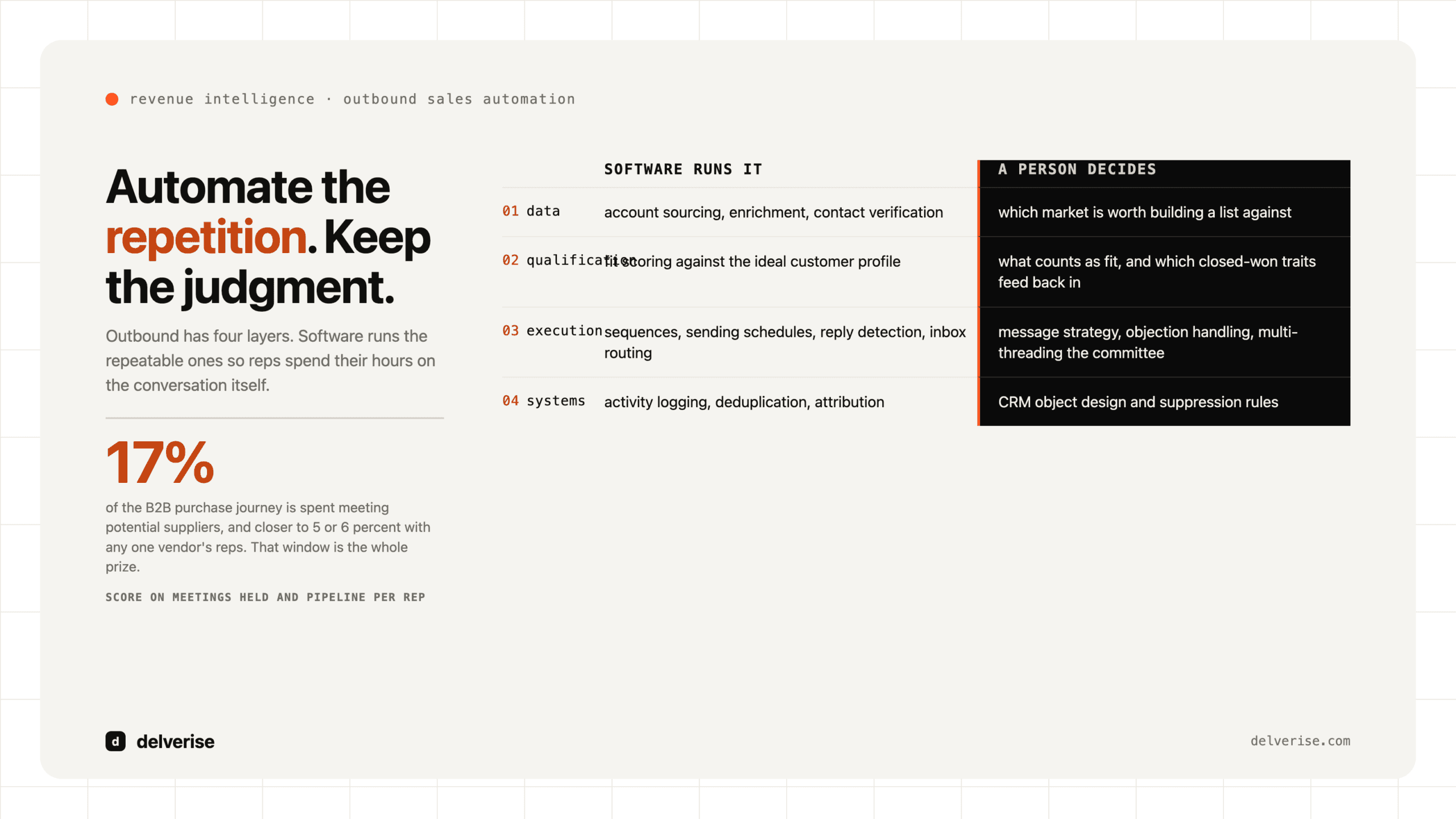
The data layer covers building your target account list, finding the right people inside those accounts, enriching them with firmographic and technographic signals, and verifying contact details. Enrichment means appending attributes you did not have, such as headcount growth, funding stage, hiring signals, or installed software.
The qualification layer turns those attributes into a decision. A fit score ranks accounts against your ideal customer profile so reps work the top of the list first. This is where most automation projects earn or lose their return, and it is worth reading our breakdown of what AI lead qualification actually scores before you wire anything up.
The execution layer is the part most people picture: sequences, sending schedules, LinkedIn touches, call tasks, reply detection, and inbox routing.
The systems layer is the plumbing underneath, meaning CRM object design, activity logging, deduplication, suppression rules, and attribution. It is invisible until it breaks, at which point every number in your board deck becomes unreliable.
Why do most outbound automation stacks stall?
In our experience auditing revenue stacks, stalled programs almost always trace back to the data layer. A team buys a sequencing platform, imports a list bought from a database with 30 percent decay, and sends 4,000 emails into a market that was never scored for fit. Reply rates come back under one percent, domains take reputation damage, and the tool gets blamed.
The second common failure is treating volume as the strategy. Gartner’s research on B2B buying found that buyers spend only around 17 percent of their total purchase journey meeting with potential suppliers, and closer to five or six percent with any one vendor’s reps when several vendors are in play. That small window is the entire prize. Automation should be pointed at earning it, not at consuming it with generic sends.
The third failure is a broken feedback loop. If your closed-won accounts never flow back into your scoring model, the system keeps targeting the same profile it started with, including the parts that were wrong.
Which parts of outbound should stay human?
The useful question is which decisions require judgment and which require repetition. Repetition automates well. Judgment does not.

| Activity | Automate fully | Assist with software | Keep human |
|---|---|---|---|
| Account sourcing and list building | Yes | ||
| Contact enrichment and email verification | Yes | ||
| Fit and intent scoring | Yes | ||
| First-touch personalization | Yes, from structured signals | ||
| Message strategy and positioning | Yes | ||
| Sequence execution and follow-up timing | Yes | ||
| Reply classification and routing | Yes, with human review of edge cases | ||
| Discovery calls and objection handling | Yes | ||
| Multi-threading a buying committee | Yes, software surfaces the map | ||
| CRM hygiene and activity logging | Yes |
Gartner also puts the typical B2B buying group at six to ten people. Software can tell a rep who those ten people are, what each one cares about, and when a new one appears in the deal. The conversation with each of them belongs to the rep. If you want the human side of that equation costed out, our piece on what one outbound SDR actually produces covers the benchmarks.
What does the math look like in practice?
Here is an illustrative model for a Series A team with three reps. The numbers are directional, and you should rebuild the same table with your own conversion rates.

Before automation: each rep spends roughly 60 percent of the week on research, list building, and CRM admin. That leaves about 14 selling hours. Across three reps they touch 900 contacts a month at a 2 percent positive reply rate, producing 18 meetings booked, 13 held, and around 7 qualified opportunities.
After automating the data and systems layers: research and admin drop to about 25 percent of the week. Contact volume stays roughly flat at 950, because the goal was quality rather than throughput. Fit scoring raises the positive reply rate to 3.5 percent, producing 33 meetings booked, 25 held, and about 14 qualified opportunities.
Same headcount, same send volume, roughly double the opportunity count. The gain came from working a better-ordered list with more hours available to work it. This is why we push clients toward the data layer first: it changes the numerator and the denominator at once. The structural version of this argument sits in our guide to building an outbound funnel that converts.
How should you sequence the build?
Order matters more than tool choice. A reasonable build sequence for a Seed to Series B team:
- Define the ICP in machine-readable terms: firmographic ranges, disqualifiers, and three to five buying signals you can actually source.
- Fix CRM object design first, so accounts, contacts, opportunities, and activities relate cleanly and reporting survives contact with reality.
- Stand up sending infrastructure properly: separate domains, warmed inboxes, correct SPF, DKIM, and DMARC records, and conservative per-inbox volume.
- Build the enrichment and verification waterfall so a contact passes through multiple providers before it costs a send.
- Score and tier the account list, then route tier one to human-led sequences and lower tiers to lighter-touch programs.
- Instrument the funnel end to end before scaling volume, including reply classification, meeting-held tracking, and source attribution.
- Close the loop: pipe closed-won and closed-lost attributes back into the scoring model on a monthly cadence.
Steps two and three are the ones teams skip, and they are also the ones that quietly cap every later step. Our overview of the six foundation pieces under every revenue stack is a good self-diagnostic before you commit budget.
What should you look for in tooling?
Be honest about the tradeoffs. Sequencing platforms like Outreach, Salesloft, and Apollo differ mostly in CRM depth, admin control, and price per seat. Any of them will send email competently. The differentiator is what feeds them.
For the data layer, Clay has become the default choice for teams that want to combine many data providers, run enrichment waterfalls, and apply AI research inside a spreadsheet-style interface. It is genuinely strong at that job. The honest tradeoff is that it rewards operator skill: an untrained team can burn credits fast and end up with columns nobody trusts. Teams that get value from it either hire for that skill or bring in help to design the tables and the credit logic. delverise is a Clay First 100 Solutions Partner, and our Clay implementation page covers how we approach that build.
Cheaper stacks work too. Apollo plus a verification service plus a well-configured CRM covers a lot of ground at Seed stage. The trap to avoid is buying an expensive platform to compensate for an undefined ICP. If you are still comparing categories, our guide to picking an AI prospecting tool lays out the evaluation criteria, and the broader AI outbound page shows how the layers connect.
How do you know it is working?
Activity metrics tell you the machine is running. Outcome metrics tell you it is producing. Track both, and hold the team to the second set.
- Bounce rate under two percent. Anything higher means your verification step is failing and your domains are at risk.
- Positive reply rate by tier. If tier one and tier three perform identically, your scoring model has no signal in it.
- Meetings held, not meetings booked. The gap between the two is a data quality and expectation-setting problem.
- Speed to first touch on inbound-triggered outbound. Research published in Harvard Business Review on online lead response found that firms making contact within the first hour were several times more likely to reach a qualifying conversation than those that waited longer, and dramatically more likely than those that waited a day.
- Pipeline per rep per quarter, trended over three quarters. This is the number that survives a board meeting.
One caution on channel expectations. McKinsey’s B2B Pulse research has found that buyers now move across roughly ten channels during a purchase, up from about five a decade ago. An email-only outbound motion is fighting that behavior. The sequences that hold up combine email, phone, LinkedIn, and warm paths, with automation handling the orchestration and the rep handling the moments that matter.
Frequently Asked Questions
Is outbound sales automation still effective given how saturated inboxes are?
Yes, with a narrower definition of effective. Broad, low-relevance sending has collapsed in performance and now carries deliverability risk. Tightly scored lists with signal-based messaging still produce reliable meeting volume. The teams struggling are usually running a 2019 playbook at 2026 send volumes.
How much does it cost to build an outbound automation system?
Tooling for a three-rep team typically lands between $1,500 and $5,000 per month depending on seat count, enrichment credits, and CRM tier. The larger cost is the build itself: ICP definition, CRM architecture, infrastructure setup, and workflow design. Budget six to ten weeks for a first working version, whether you build it internally or bring in outside engineering.
Should we hire an SDR or build the automation first?
Build the data and systems layers first, then hire. An SDR dropped into an unstructured stack spends most of the week doing manual research, which is the expensive way to buy a contact list. With the foundation in place, the same hire starts producing conversations in their first month. Our comparison of building in-house versus bringing in outside help works through the decision.
Can AI write the outbound messages?
AI is good at assembling a first draft from structured inputs: a research summary, a relevant trigger, a proof point matched to the segment. It is poor at deciding what your differentiated claim should be. Keep positioning and message strategy with humans, then use AI to produce variants at volume and to classify replies.
What is the first thing to fix if our current outbound is underperforming?
Pull your last 500 sends and check three things: bounce rate, whether the accounts actually match your closed-won profile, and whether reply outcomes are logged anywhere you can query. Most teams find the problem in one of those three before they need to touch the sequence copy at all.
Read next