←Back to blog
Growth & Demand GenerationGuideSeptember 11, 20268 min read
How to Get B2B Leads: A Revenue Leader’s Guide to Building the System
To get B2B leads, narrow your ICP until you can name the accounts, build one acquisition channel at a time until it produces predictably, qualify on observed behavior instead of form fills, and route every lead through a tracked path to closed revenue. Volume comes second. A system that attributes pipeline comes first.

To get B2B leads, narrow your ICP until you can name the accounts, build one acquisition channel at a time until it produces predictably, qualify on observed behavior instead of form fills, and route every lead through a tracked path to closed revenue. Volume comes second. A system that attributes pipeline comes first.
Key takeaways
- Lead volume is a downstream result. The upstream inputs are ICP precision, channel fit, and routing speed.
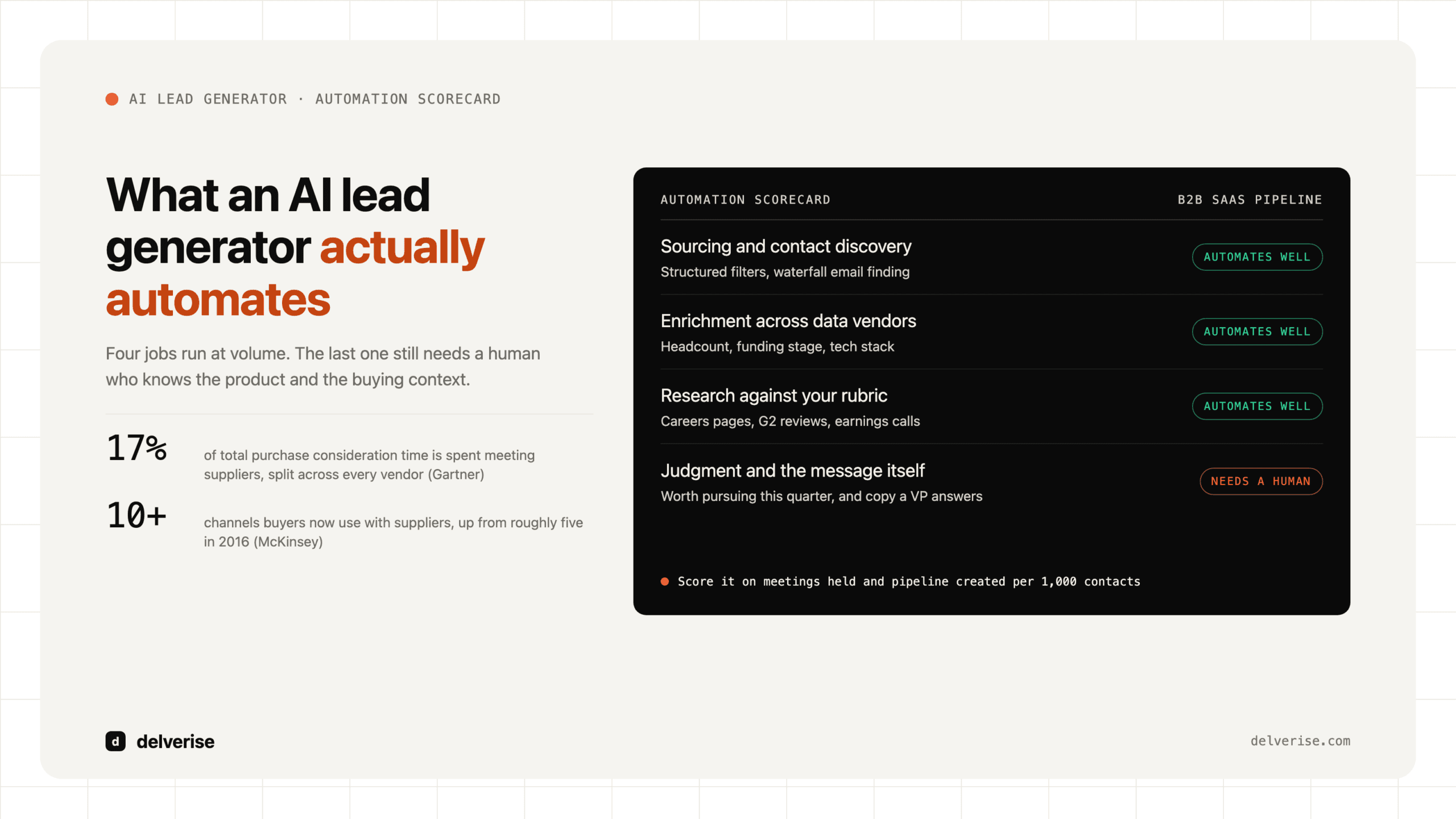
- Gartner’s research on B2B buying found that buyers spend only about 17% of their purchase journey meeting with potential suppliers, split across every vendor they consider. Your window is small, so qualification accuracy matters more than raw reach.
- Most Seed to Series B teams can run one channel well. Running four badly produces less pipeline than running one properly.
- Do the arithmetic backward from your ARR target before choosing a channel. Some targets are mathematically impossible for outbound given a small addressable market.
- The failure mode is almost never “we need more leads.” It is that leads arrive, sit, get scored wrong, and die in a CRM nobody trusts.
What actually counts as a B2B lead?
A lead is a person at an account matching your ICP who has taken an action indicating they might buy. That definition rules out a lot of what gets counted. An ebook download from a student, a webinar registrant from a company one-tenth your smallest customer, a scraped email with no expressed interest: those are contacts, and treating them as leads corrupts every conversion rate downstream.

Three terms worth defining before you build anything, because teams use them loosely and then argue about numbers:
- MQL (marketing qualified lead): a contact whose behavior and firmographics cross a threshold your team agreed on. Useful only if sales accepts the threshold.
- SQL (sales qualified lead): a lead a rep has spoken with and confirmed has budget, authority, need, and a timeline worth pursuing.
- Qualified opportunity: a deal with a next step on the calendar and an identified economic buyer. This is the only number your board should care about.
Gartner also found that a typical complex B2B purchase involves six to ten decision makers. So a single “lead” is rarely a buyer. It is an entry point into a buying group, and your system should treat it that way by enriching the account, not just the contact. That account-level view is the difference between a contact list and a pipeline. We cover the mechanics of scoring in AI lead qualification.
Which channels actually produce B2B leads?
There are six that consistently work for B2B SaaS. Each has a different time-to-first-lead, a different scaling constraint, and a different way of breaking.

| Channel | Time to first qualified lead | Scales with | Where it breaks |
|---|---|---|---|
| Outbound email and LinkedIn | 2 to 6 weeks | Data quality, sending infrastructure, relevance of the offer | Small TAM, generic messaging, domain reputation collapse |
| SEO and content | 4 to 9 months | Topical depth and publishing consistency | Writing for practitioners when you sell to executives |
| Paid search | Days | Budget, but only where commercial-intent search volume exists | Category has no search demand yet; CAC exceeds LTV quietly |
| Partnerships and co-marketing | 1 to 4 months | Number of partners with overlapping ICP | No incentive structure, so partners never actually refer |
| Product-led signups | Immediate, if the product supports it | Free-tier value and activation rate | Self-serve users who never map to a buying group |
| Events and community | Weeks to months | Founder time and reputation | Does not scale past the founder without a system behind it |
McKinsey’s B2B Pulse research found buyers now use around ten channels across a purchase decision, roughly double what it was a decade ago. That does not mean you should run ten channels. It means the buyer will encounter you in places you do not control, so the channels you do control need to be unmistakably consistent in message.
How do you choose which channel to build first?
Work backward from the arithmetic, then check whether the market supports it.

Worked example. A Series A SaaS company sells at a $24,000 ACV and needs $1.2M in net new ARR next year. That is 50 new customers.
- Close rate from qualified opportunity: 20%. So 250 qualified opportunities are needed.
- First meeting to qualified opportunity: 45%. So roughly 555 first meetings.
- If outbound is meant to carry 40% of that, outbound owes 222 meetings a year, about 19 a month.
- At a 1.5% contacted-to-meeting rate, that requires roughly 1,240 contacts reached per month, or ~15,000 a year.
- At three contacts per account, that is 5,000 distinct accounts touched annually.
Now the check that most teams skip: does the ICP contain 5,000 accounts? If the honest answer is 1,200, outbound cannot carry 40% of the number without burning the entire market in a quarter. The plan has to change, either by widening the ICP deliberately, raising ACV, or shifting share to a channel with different math. Running the numbers first is what separates a plan from a hope. If outbound does clear the math, building the outbound funnel properly is the next step.
A rough heuristic by stage: under $1M ARR, founder-led outbound plus community usually wins because it produces learning alongside leads. Between $1M and $5M, one systematized channel plus early SEO. Past $5M, add a second channel only once the first has a stable cost per opportunity for two consecutive quarters.
Why do most B2B lead generation efforts stall?
Four causes, in roughly the order we see them.
The ICP is a paragraph, not a list. “Mid-market fintech companies with a compliance problem” is a positioning statement. An ICP is a queryable definition: employee count band, funding stage, tech stack signals, hiring patterns, region. If your data team cannot turn the ICP into a filter, campaigns will target by vibe.
Routing is slow. The classic Harvard Business Review lead response study found that firms responding within an hour were vastly more likely to have a meaningful conversation than those responding even a few hours later, and the dropoff after 24 hours was severe. Speed is an infrastructure problem, solved with routing rules and alerting, not with reminders to reps.
Scoring encodes the wrong thing. Points for email opens and page views measure curiosity. Points for pricing page visits from a director-level title at an account with three other engaged contacts measure buying. Most scoring models never get rebuilt after the first version.
Nobody owns the handoff. Marketing counts MQLs, sales counts opportunities, and the gap between them is where leads go quiet. This is a structural issue, which is why we treat it as part of designing the GTM function itself rather than as a campaign problem.
The Gartner and HBR work on buyer enablement points the same direction: buyers who found supplier-provided information genuinely helpful for making progress were dramatically more likely to buy a larger deal with less regret. Helpfulness in the sales process is a lead generation input, because it changes what happens to every lead you already have.
What has to be true before you scale spend?
Before adding budget or headcount to any channel, confirm every one of these:
- The ICP is written as a set of queryable filters, and someone can pull the target account list on demand
- Every lead source writes to the CRM with a consistent source field, no exceptions
- Median lead response time is measured and sits under one hour during business hours
- You can state cost per qualified opportunity by channel for last quarter without building a spreadsheet from scratch
- Sales and marketing have signed off on the same MQL definition within the last six months
- Disqualified leads have a documented reason code, and someone reviews the distribution monthly
- Nurture exists for leads that are qualified but not ready, with an owner and a re-entry trigger
If three or more of those are false, more leads will make things worse by adding load to a system that already loses what it receives. The fix order is data foundation, then routing, then volume. We walk through the underlying layers in the six pieces under every revenue stack, and the nurture layer specifically in how to choose a lead nurturing tool.
What does the finished system look like?
A working B2B lead engine has five connected parts: an account list built from queryable ICP criteria, enrichment that keeps that list current, one or two acquisition channels producing at a known cost per opportunity, qualification logic that scores on buying behavior, and routing that puts qualified leads in front of a human quickly with full context attached.
Each part is ordinary on its own. The value sits in the connections, because that is where leads leak. Building those connections is GTM engineering work, and it is what delverise gets hired to do: design the system, instrument it, and hand over something the revenue team can run without a vendor in the loop.
Frequently Asked Questions
How many B2B leads do I need per month?
Calculate it backward rather than benchmarking it. Divide your ARR target by ACV to get required customers, divide by close rate for opportunities, then by your meeting-to-opportunity rate. That gives the meeting count each channel owes you. A monthly lead number copied from another company tells you nothing, because it encodes their ACV and their conversion rates.
Is outbound still effective for B2B SaaS?
Yes, with two conditions. Your addressable market must be large enough to sustain the contact volume the math requires, and your messaging must reference something specific about the account. Generic sequences at high volume damage sending domains and produce reply rates below the threshold where the channel pays for itself. Volume without relevance is the reason outbound gets declared dead every eighteen months.
Should we hire an SDR or build the system first?
Build enough of the system that a new rep can produce inside two months. That means a target account list, working data, sequencing infrastructure, and a qualification standard. Hiring a rep into an empty stack means paying a salary while they build spreadsheets. Our breakdown of what one SDR realistically produces covers the expected output range.
How long before a new channel produces pipeline?
Paid search can produce leads within days but takes a quarter to reach a defensible cost per opportunity. Outbound typically shows signal in four to six weeks. SEO and content usually need six to nine months before organic traffic converts at any meaningful volume. Fund each channel for its actual maturation window or you will kill it right before it works.
What is the single highest-impact fix for a stalled pipeline?
Measure lead response time and cost per qualified opportunity by source. Most teams cannot produce either number quickly, and both usually reveal that the problem sits in handling existing demand rather than in generating new demand. Fixing routing is faster and cheaper than launching another channel.
Read next