←Back to blog
Revenue OperationsGuideSeptember 2, 20265 min read
Do We Have the Right Foundation Pieces in Place? The Six Pieces Under Every Revenue Stack
You got the CRM. Now you have to figure out how to set it up. If you are the first growth hire at an early-stage B2B company, this is the week the job changes shape. You were hired to build pipeline, and suddenly you are hands on keyboard inside a system you have never configured, asking three questions that sound simple and are anything but. Do we have the right foundation pieces in place? Are we using the right tools? Will any of this hold once sales is actually running on top of it?
You got the CRM. Now you have to figure out how to set it up.
If you are the first growth hire at an early-stage B2B company, this is the week the job changes shape. You were hired to build pipeline, and suddenly you are hands on keyboard inside a system you have never configured, asking three questions that sound simple and are anything but. Do we have the right foundation pieces in place? Are we using the right tools? Will any of this hold once sales is actually running on top of it?
This post is a straight answer to the first question: what the foundation pieces of a revenue stack actually are, the order they should go in, and how to tell where you stand before anything breaks in front of a customer.
What “foundation pieces” actually means
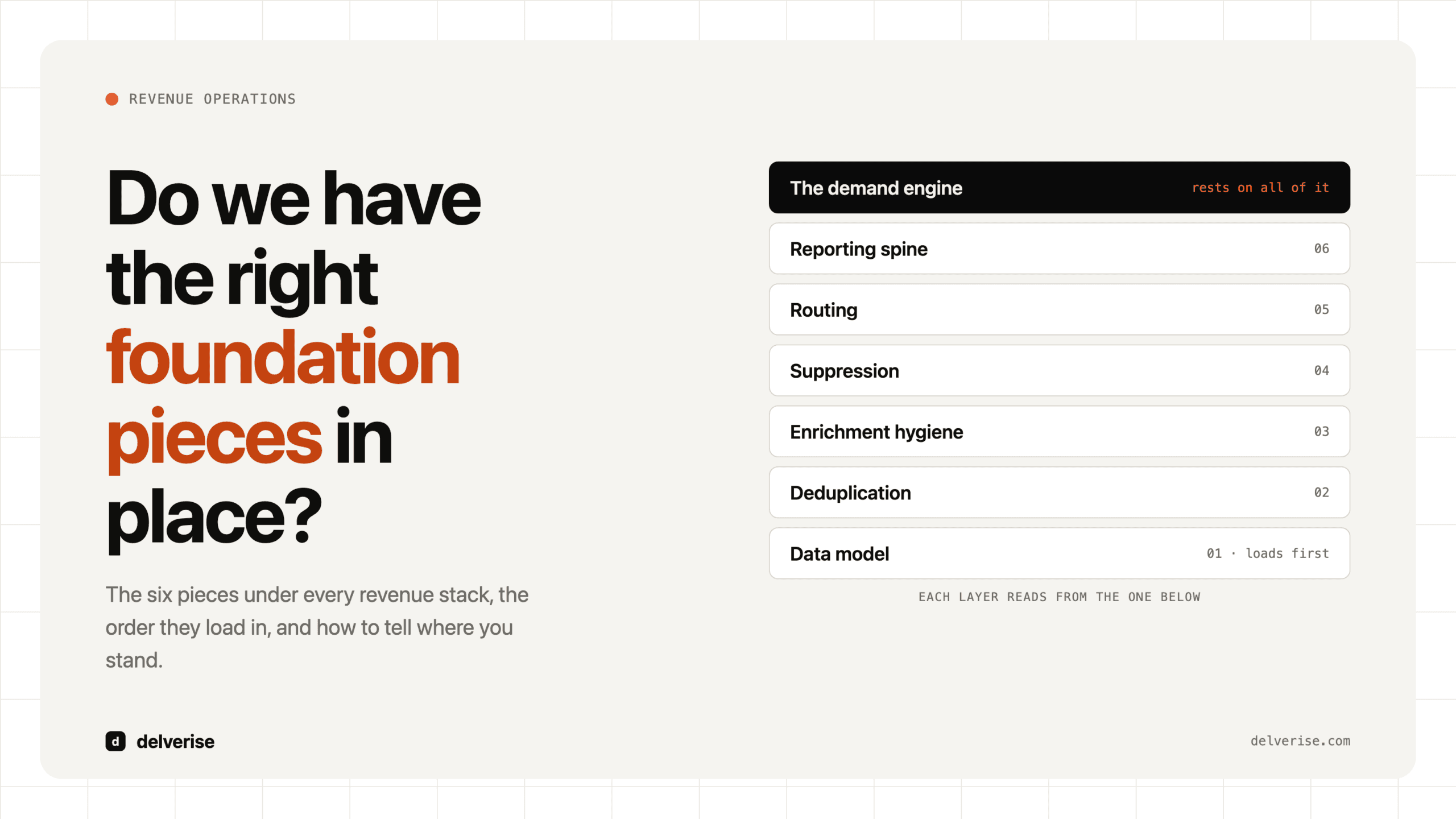
Strip away the tool logos and every early-stage revenue stack rests on six pieces. Each one has a specific way of failing quietly.
1. The data model. What a lead is, what an account is, what a qualified opportunity is, and which fields carry that truth. When this is undefined, every tool you add later invents its own version, and no two systems agree on what a customer looks like.
2. Deduplication. The rules that stop the same person existing three times under three spellings. Duplicates are how one prospect gets two different emails in the same week, and how your reply rates become fiction.
3. Enrichment hygiene. Where firmographic and contact data comes from, how fresh it has to be, and what happens when providers disagree. Stale enrichment is how you congratulate someone on a job they left a year ago.
4. Suppression and do-not-contact logic. The list of people and companies who must never hear from you: customers, partners, opt-outs, open deals. This is the piece nobody thinks about until the CEO asks why a current customer got a cold email.
5. Routing. What happens to a lead in the sixty seconds after it arrives. Who owns it, what enriches it, what notifies whom. Unrouted leads do not fail loudly. They just age until they are worthless.
6. The reporting spine. One set of numbers everything else reads from. If pipeline is counted three ways in three tools, every meeting starts with an argument about whose number is real.

Notice what is missing from that list: sequencers, dialers, intent data, AI SDRs. All of that sits on top. None of it fixes what sits underneath.
The pattern that breaks stacks
Here is the pattern we see over and over. The demand engine gets built first, because the demand engine is the exciting part. Outbound sequences, a content calendar, maybe paid experiments. The foundations underneath become the afterthought.
Then the pipeline starts depending on them.
The sequence tool sends to duplicates. The enrichment data drifts stale. A customer lands in a cold campaign because no suppression list exists. The board asks for pipeline by source and three tools give three answers. Every one of those failures traces back to a foundation piece that was skippable on day one and load-bearing by month four.
The unglamorous half of every GTM stack is the data layer underneath it. It is usually what is quietly broken, and it is the part nobody wants to own.
The order that works
Foundations have a load order, because each layer reads from the one below it.
Data model first. Definitions before tools. An afternoon of writing down what a lead, an account, and a qualified opportunity mean saves months of retrofitting.
Hygiene second. Dedup rules and enrichment standards, while the database is still small enough to clean in a day. Every week you wait, the mess compounds.
Suppression third, before any outbound leaves the building. A suppression list built after your first bad send is an apology. Built before, it is a system.
Routing fourth. Once leads exist and are clean, define what happens to them automatically. Speed to a real owner beats almost any tool upgrade.
Reporting last, on purpose. Reports built on an undefined data model report noise with confidence. Build the spine after the definitions it reads from exist.
If you are doing these in a different order, you are not wrong, you are normal. Most teams build in the order things become urgent, which is roughly the reverse of the order above. The cost of the reverse order is that every layer has to be rebuilt once the layer below it finally gets defined.
How to tell where you stand
You do not need an audit to get a first read. Three checks, ten minutes each.
Pull twenty random contacts and count how many exist more than once. Ask three people what a qualified lead is and count the different answers. Find your one report of record for pipeline, and if the phrase “report of record” makes you wince, that is the answer.
For a structured version of the same exercise, the GTM Stack Diagnostic is free and takes a few minutes. It scores your revenue engine the way we would on day one: what is in place, what is missing, and what to fix first.
When to get help, and what kind
Plenty of first growth hires can lay these foundations themselves, and some genuinely enjoy it. If that is you, the load order above is the whole playbook. Start at the data model and work up.
The people who reach out to us usually say some version of the same thing: we would love somebody technical that is in the weeds. Someone who has stood these foundations up before, who can look at where you are and say what to fix, in what order, and then actually build it rather than leave a slide deck behind.
That is the shape of help worth paying for at this stage. An operator who works inside the systems, not a strategy engagement that ends where the configuration work begins. It is also, for what it is worth, the shape of what we build: the data layer, the hygiene, the gates, the routing, and the reporting spine, handed over documented and running.
The foundation questions feel like they can wait. They are the cheapest they will ever be to answer right now, while the database is small, the tooling is young, and nothing is depending on the answers yet. Ask them before the pipeline does.
Read next