←Back to blog
Revenue Intelligence & Data ToolingGuideNovember 16, 20268 min read
B2B Cold Email: How to Build a System That Actually Books Meetings
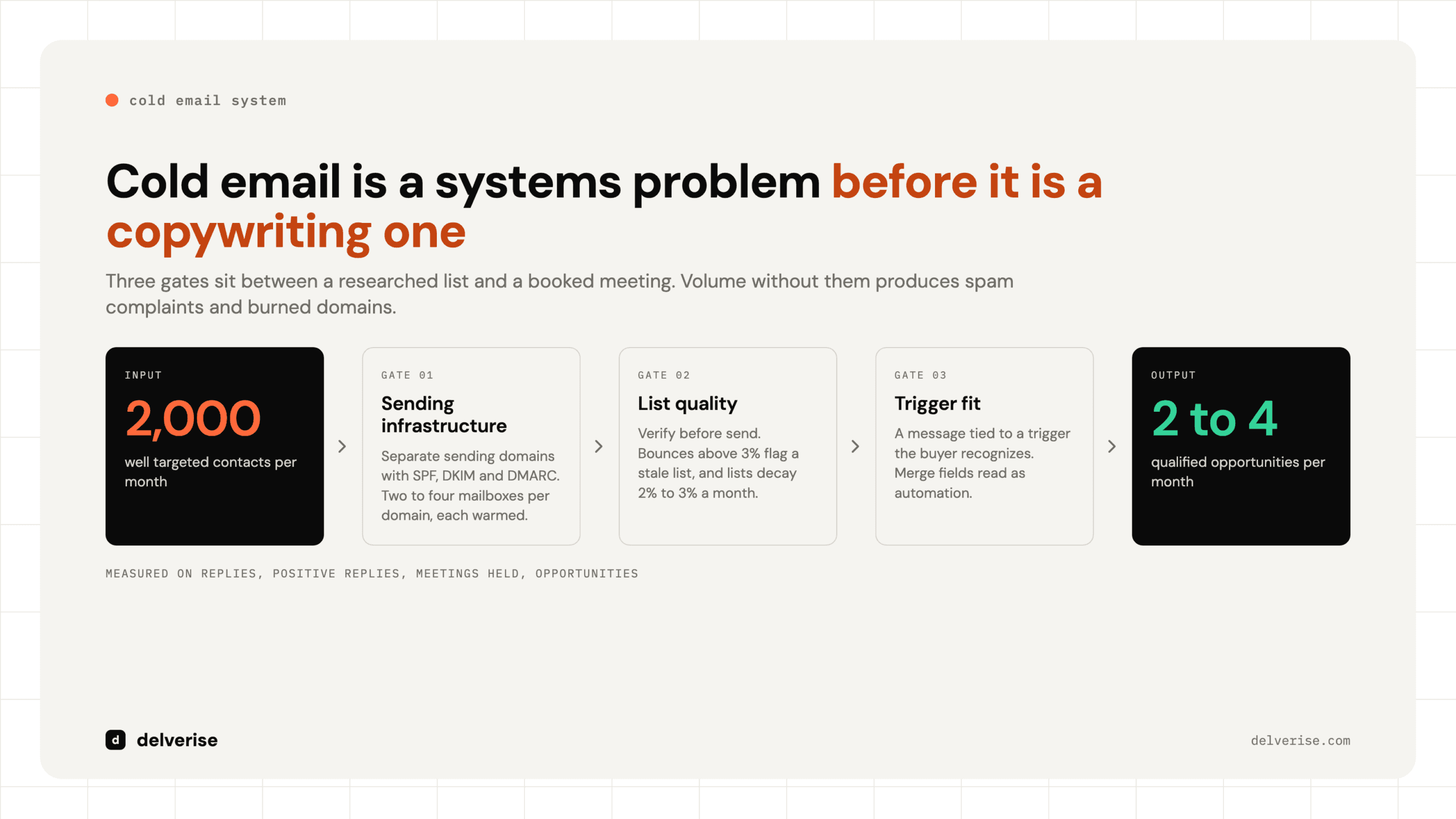
B2B cold email is unsolicited outbound email sent to a researched list of potential buyers to start a sales conversation. It works when three things hold: clean sending infrastructure, a tightly defined target list, and a message tied to a trigger the buyer recognizes. Volume without those three produces spam complaints and burned domains.
B2B cold email is unsolicited outbound email sent to a researched list of potential buyers to start a sales conversation. It works when three things hold: clean sending infrastructure, a tightly defined target list, and a message tied to a trigger the buyer recognizes. Volume without those three produces spam complaints and burned domains.
Key takeaways
- Deliverability is an engineering problem. Authentication, domain separation, and per-inbox volume caps decide whether anything else you do matters.
- List quality drives more variance in results than copy does. A precise list with a mediocre email beats a broad list with a great one.
- Open rate is a broken metric since Apple’s Mail Privacy Protection began pre-loading images. Measure replies, positive replies, meetings held, and opportunities.
- Expect roughly 2 to 4 qualified opportunities per 2,000 well-targeted contacts per month. Anyone promising ten times that is selling volume.
- Cold email is one channel inside a buying process that runs across many. Treat it as an entry point into a sequence that includes calls, LinkedIn, and content.
Does B2B cold email still work in 2026?
Yes, with a narrower margin for error than five years ago. Two forces compressed it. Filtering got stricter: in February 2024 Google and Yahoo began requiring bulk senders to authenticate with SPF and DKIM, publish a DMARC record, offer one-click unsubscribe, and keep spam complaint rates below 0.3%. At the same time, the volume of automated outbound rose sharply, so buyers pattern-match and delete faster.

The buyer side still favors the channel. Gartner’s research on B2B buying found that customers spend only a small share of the buying journey with sales reps at all, and far less with any single supplier. McKinsey’s B2B Pulse work found that buyers now routinely use ten or more channels when evaluating suppliers. Email remains the cheapest way to appear in that set at the moment a buyer starts looking. The job is to be the credible message in a crowded inbox, which is a systems problem before it is a copywriting problem.
Why do most B2B cold email programs fail?
Four failure modes account for nearly all of it.

Sending from the primary domain. One aggressive campaign can damage the reputation of the domain that carries your invoices, product notifications, and support replies. Recovery takes months.
Unverified lists. Bounces above 3% signal a purchased or stale list to mailbox providers. Verification before send is non-negotiable, and lists decay at roughly 2% to 3% per month as people change roles.
Personalization theater. Merge fields that pull a company name into a generic sentence read as automation. Buyers can tell, and the reply rate shows it.
No owner. Outbound programs get assigned to a rep who already carries quota, so infrastructure monitoring, list refresh, and copy iteration happen whenever there is spare time. There is never spare time. This is the gap GTM engineering exists to close.
What does the sending infrastructure need to look like?
Deliverability means the percentage of your sends that reach the primary inbox rather than spam or promotions. Build for it before you write a single line of copy.

Buy separate sending domains that look like your brand, for example getyourcompany.com or yourcompany-mail.com, and redirect them to your main site. Configure SPF, DKIM, and DMARC on each. Create two to four mailboxes per domain, warm each one for three to four weeks, and cap daily first-touch volume at 20 to 30 sends per inbox. Keep first emails plain text with no tracking pixel and no link, because both depress inbox placement.
The arithmetic matters for planning. A program touching 2,000 new contacts a month with a three-email sequence sends roughly 6,000 emails. At 25 sends per inbox across 22 working days, each mailbox handles about 550. That is eleven mailboxes, which means three or four domains. Budget for that before you commit to a pipeline number.
- Separate sending domains registered and redirecting to the main site
- SPF, DKIM, and DMARC verified on every sending domain
- Every mailbox warmed for at least three weeks before live sends
- Daily per-inbox cap set at 30 or below and enforced by the sequencer
- Email verification running on every list before upload, bounce target under 2%
- Weekly inbox placement test across Gmail, Outlook, and one corporate filter
- Spam complaint rate monitored in Google Postmaster Tools, target under 0.1%
How should you build the target list?
Start with an ideal customer profile that is specific enough to disqualify. Firmographics alone (industry, headcount, revenue) produce lists that are too broad. Add signals that indicate the problem exists right now: a new VP of Sales hired in the last 90 days, a job posting for a RevOps role, a recent funding round, a specific integration or technology in the stack, hiring velocity in a department you serve.
This is where Clay earns its place in most stacks. It waterfalls across multiple data providers for emails and firmographics, pulls signals from job boards and websites, and runs enrichment logic that would otherwise be a manual research task. The honest tradeoffs: credit consumption grows quickly once you enable AI research columns, and the platform rewards someone who understands data modeling. Teams that treat it as a list-buying tool overpay and underuse it. delverise is a Clay Solutions Partner and builds these workflows as production systems, which you can read about on the Clay partner page.
Whatever tooling you pick, the operating rule stays the same: a list of 200 accounts you can describe precisely will outperform 5,000 you cannot. For the wider sourcing picture, see our guide on how to get B2B leads and the practical limits of AI generated leads.
What should the email actually say?
Keep the first touch under 90 words and make one ask. Open with the observation that qualified the account, state the problem it usually causes in language the buyer would use, and close with a low-friction question. Skip the feature list, the company boilerplate, and any sentence that begins with “I wanted to reach out.”
Write to the outcome the person owns. A VP of Sales cares about ramp time and coverage. A CFO cares about payback period. A Head of RevOps cares about the reporting mess that makes forecasting unreliable, which is a thread worth pulling if you also sell against forecast accuracy problems. Two or three follow-ups spaced four to seven days apart, each adding a new piece of information rather than repeating the ask, captures most of the remaining response. Our breakdown of cold email templates for B2B SaaS covers the structures that hold up in testing.
Speed on the reply side is worth as much as the copy. The Harvard Business Review study on lead response time found that companies responding within an hour were several times more likely to qualify a lead than those waiting even a few hours. Route positive replies to a human immediately.
What numbers should a revenue leader hold the team to?
Here is a worked example for a program targeting 2,000 verified contacts per month in a well-defined segment. Rates reflect what a competently run program achieves, and they are conservative on purpose.
| Stage | Monthly volume | Rate | What breaks it |
|---|---|---|---|
| Verified contacts in ICP | 2,000 | Baseline | Segment too broad to write to |
| Delivered to primary inbox | 1,840 | 92% | Missing authentication, cold domains |
| Total replies | 74 | 4% of delivered | Generic copy, wrong persona |
| Positive replies | 18 | 25% of replies | Value claim the buyer does not own |
| Meetings booked | 11 | 60% of positive | Slow follow-up, scheduling friction |
| Meetings held | 8 | 75% of booked | No confirmation sequence |
| Qualified opportunities | 3 | ~40% of held | Meetings booked on curiosity alone |
Three opportunities a month from 2,000 contacts sounds modest until you multiply it by average contract value and annualize it. It also sets an honest bar: if your team promised 20 meetings a week from a single sender, the math was never there. Track reply rate and positive reply rate weekly, and opportunity conversion monthly. Leave open rate out of the dashboard entirely, since privacy-protection features inflate it well past anything decision-useful.
What should be automated, and what stays human?
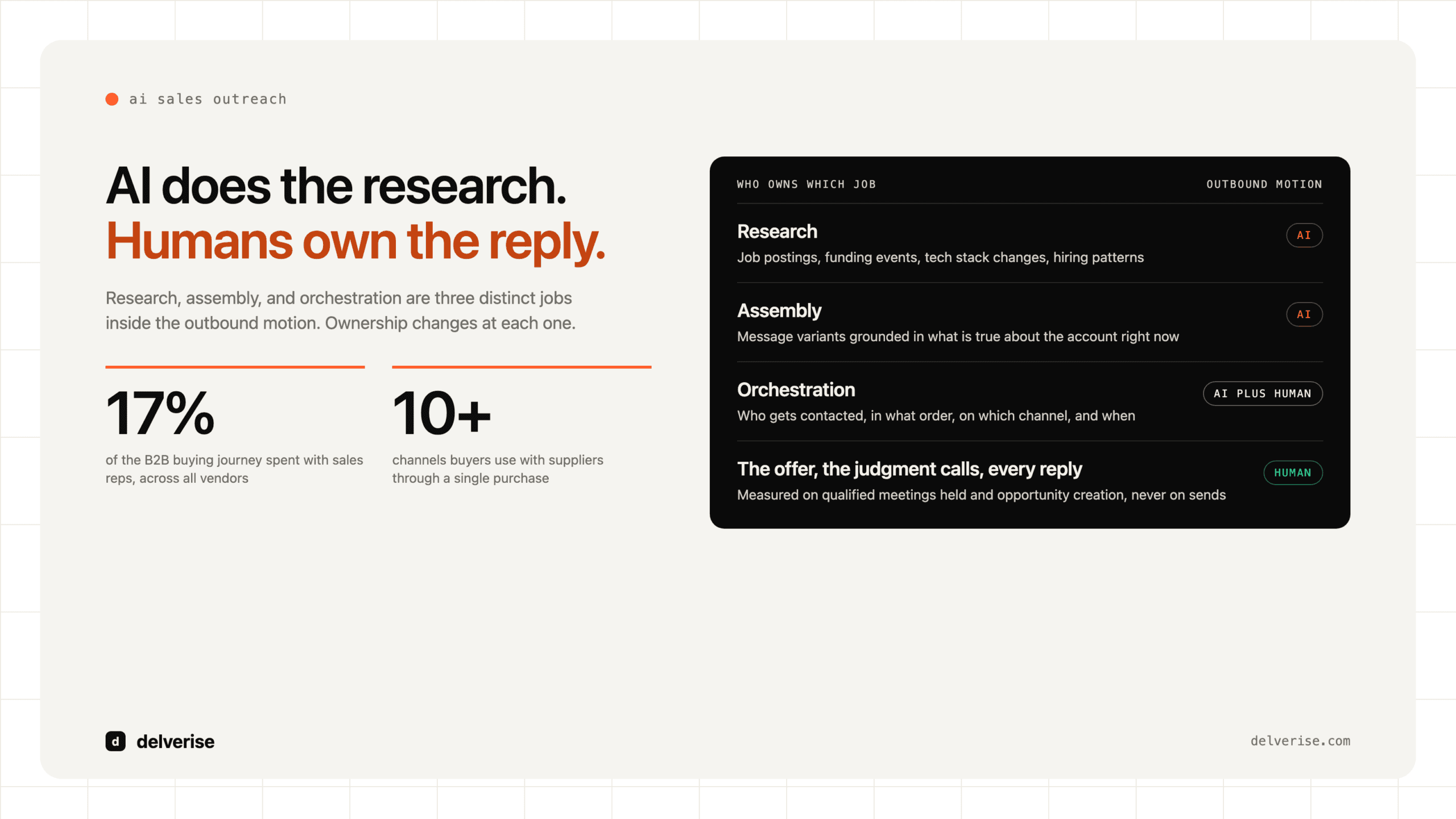
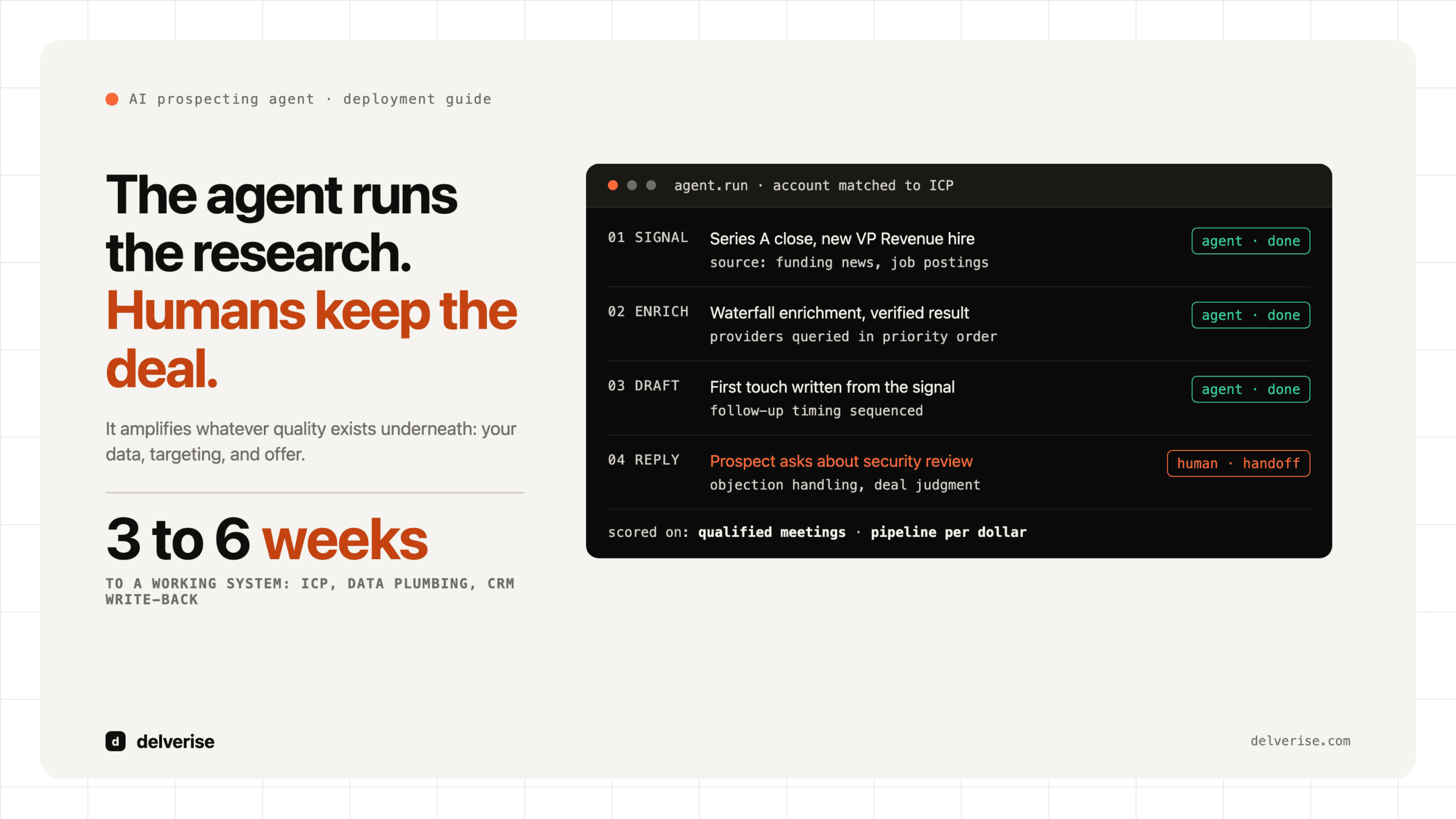
Automate list building, enrichment, verification, sequencing, deliverability monitoring, CRM sync, and reply classification. Keep the segment definition, the core message, the handling of any real reply, and the discovery call human. Our guide to outbound sales automation covers the dividing line in detail, and what one outbound SDR actually produces is useful before you decide to hire rather than build.
For most Seed to Series B teams, the sequence is: build the system, prove the conversion math for one segment, then add headcount against a channel that already works. Hiring a rep to fix a broken system usually produces an expensive version of the same result. A complete AI outbound system compounds because every campaign feeds the data layer that targets the next one.
Frequently Asked Questions
Is B2B cold email legal?
In the United States, CAN-SPAM permits unsolicited commercial email provided you use accurate headers and sender information, include a valid physical address, identify the message as a solicitation where required, and honor opt-outs within ten business days. The EU and UK apply GDPR, where business-to-business outreach generally relies on a legitimate interest basis with documented reasoning and an easy opt-out. Canada’s CASL and Germany’s rules are stricter and closer to consent-based. Check jurisdiction before you build the list, since the rules shape your targeting.
What reply rate counts as good?
For a tightly targeted B2B SaaS segment, 3% to 6% total reply rate is a healthy working range, with a quarter of those replies positive. Anything above 8% usually means a very narrow list with a strong trigger. Below 1.5%, the problem is almost always the list or deliverability rather than the copy.
How many domains and mailboxes do we need?
Divide your planned monthly send volume by 550, which is roughly what one warmed mailbox handles at 25 sends a day. Then group mailboxes two to four per domain. A program sending 6,000 emails a month needs about eleven mailboxes across three or four domains, plus warmup time before the first live send.
Should AI write the emails?
Use AI for research and variable generation, such as summarizing a prospect’s recent announcement or classifying which of three pain hypotheses fits an account. Have a human write the frame and the value claim. Fully generated emails converge on the same rhythm and vocabulary, which is exactly the pattern buyers now filter out.
How long until cold email produces pipeline?
Plan for 10 to 14 weeks. Three to four weeks of domain and mailbox warmup, four weeks to get statistically meaningful reply data across two or three segments, then a sales cycle on top. Programs judged at week four almost always get shut down right before the data becomes useful.
Read next