←Back to blog
Revenue Intelligence & Data ToolingGuideJuly 13, 20269 min read
AI in Marketing and Sales: What Actually Works in B2B SaaS
AI in marketing and sales works best as an infrastructure layer, applied to research, enrichment, scoring, personalization, and routing, rather than as a replacement for human judgment in the deal. Teams that see real revenue lift build clean data and clear ownership first, then apply models to specific decisions. Teams that buy tools before fixing data get faster noise.
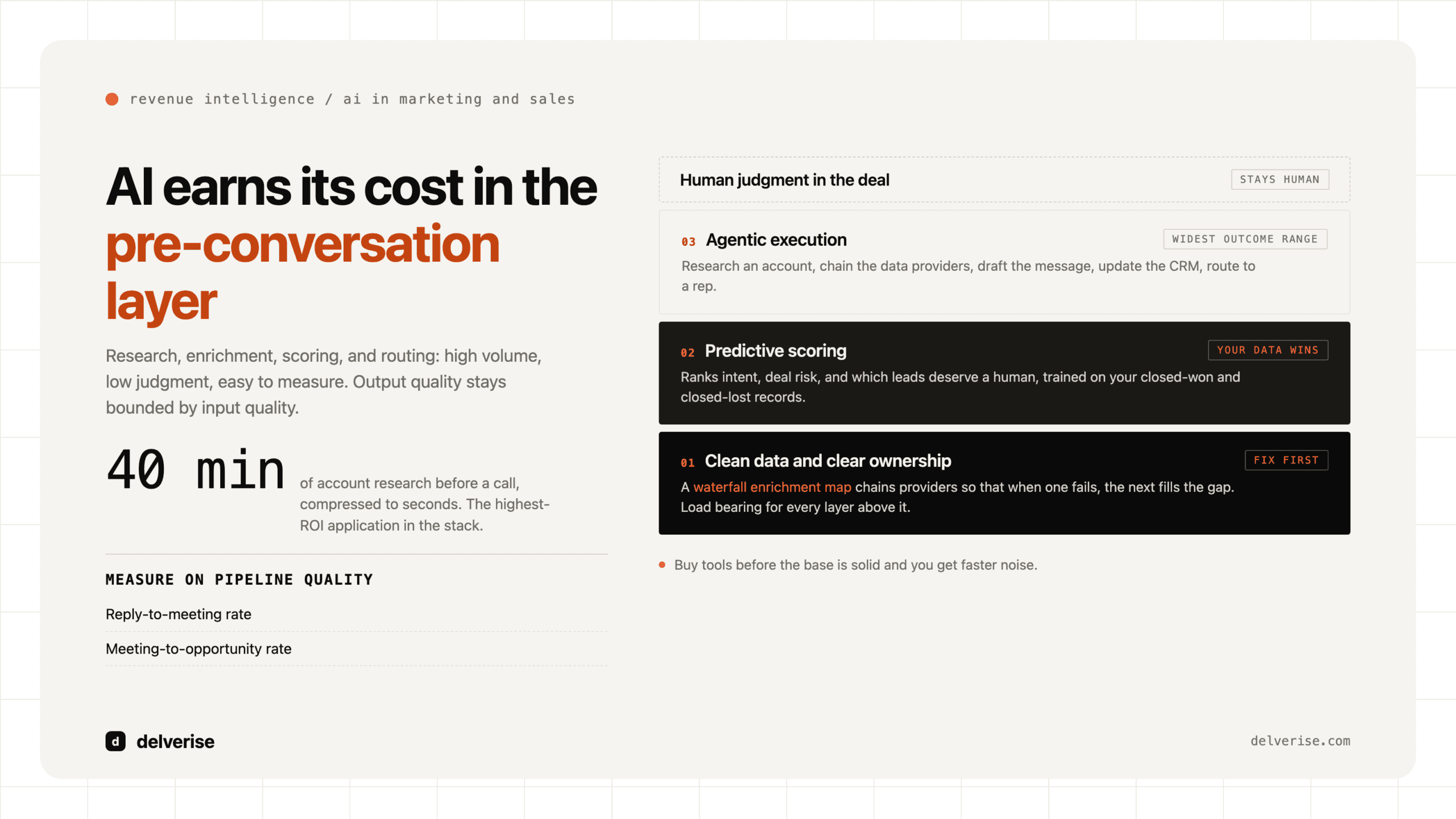
AI in marketing and sales works best as an infrastructure layer, applied to research, enrichment, scoring, personalization, and routing, rather than as a replacement for human judgment in the deal. Teams that see real revenue lift build clean data and clear ownership first, then apply models to specific decisions. Teams that buy tools before fixing data get faster noise.
Key takeaways
- AI produces the biggest gains in the pre-conversation layer: account research, enrichment, intent scoring, and prioritization. Those tasks are high-volume, low-judgment, and easy to measure.
- Output quality is bounded by input quality. A model reasoning over stale CRM records will generate confident, wrong recommendations at scale.
- The failure mode is rarely the model. It is missing ownership, no feedback loop, and no definition of what “good” looks like in your data.
- Measure AI on pipeline quality metrics (reply-to-meeting rate, meeting-to-opportunity rate, win rate by segment), not on activity volume.
- Start with one workflow, instrument it, and only expand once the loop closes. Broad rollouts across a messy stack reliably underperform.
What does “AI in marketing and sales” actually mean in 2026?
The term covers three distinct categories, and conflating them is the most common reason budgets get wasted.
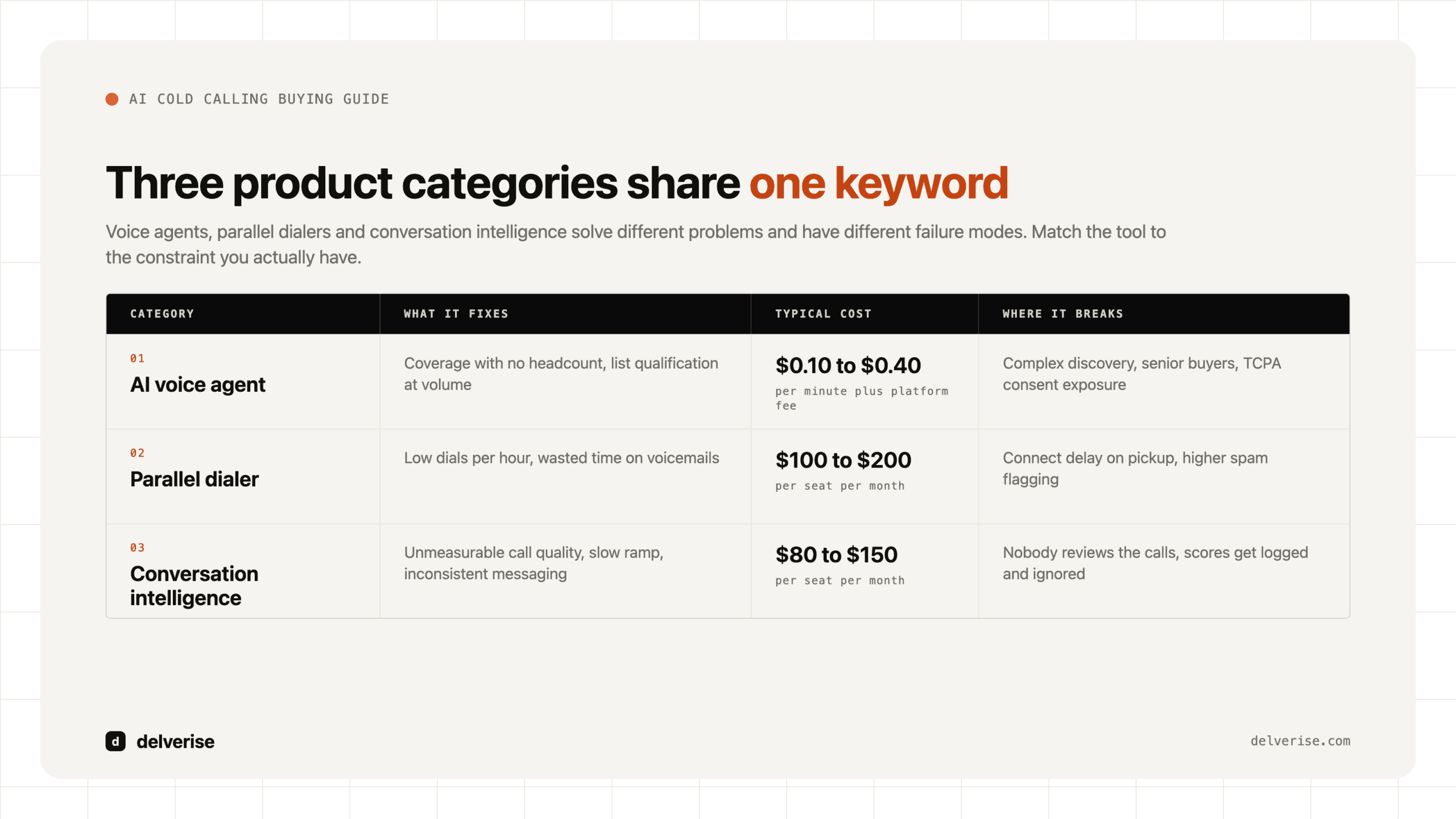
Generative AI produces content: emails, ad variants, call summaries, landing page copy, meeting notes. It is cheap, fast, and commoditized. Everyone has it. It creates no durable advantage on its own.
Predictive AI ranks and forecasts: which accounts are likely to buy, which deals are at risk, which leads deserve a human. This is where models trained on your closed-won and closed-lost data outperform generic tools.
Agentic AI executes multi-step workflows: research an account, find the right contact, chain data providers, draft a message, update the CRM, route to a rep. This is the category attracting the most spend and producing the widest range of outcomes, from genuinely useful to expensive theater.
Most vendors sell all three under one label. When you evaluate, ask which category the tool actually occupies, because the buying criteria and the failure modes are completely different.
Where does AI reliably move revenue?
Gartner’s research on B2B buying has consistently found that buyers spend only a small fraction of their purchase journey with any given supplier’s sales team, with most of the process happening in independent research and internal consensus-building. That reframes the problem. If reps get a narrow window of buyer attention, the highest-value use of AI is making that window count: knowing who to talk to, when, and with what context.
That points at four workflows where AI earns its cost:
1. Account research and enrichment. A rep spending 40 minutes researching an account before a call is a rep not selling. AI compresses that to seconds: funding events, hiring signals, tech stack changes, org structure, recent product launches. This is the single highest-ROI application because it is high-volume, verifiable, and directly saves seller hours.
2. Data quality and coverage. B2B contact data decays fast. People change jobs constantly. Chaining multiple data providers so that when one fails another fills the gap, a technique known as a waterfall enrichment map, materially raises match rates versus relying on a single source. AI handles the routing logic and validation. This is unglamorous work that quietly determines whether everything downstream functions.
3. Prioritization and scoring. Most B2B teams have more leads than capacity. A model trained on your own historical outcomes will rank them better than a rules-based system built from committee guesses. This is the core of lead scoring based on real buying intent, and it is where predictive AI has the clearest track record.
4. Personalization at the segment level. Not per-prospect creative writing, which usually produces uncanny, obviously-templated emails. Segment-level relevance: a message that reflects the account’s industry, stage, tech stack, and trigger event. That is a data problem AI solves well.
Where does AI break?
Honest tradeoffs matter more than vendor enthusiasm here.
| Use case | Reality | What to do instead |
|---|---|---|
| Fully autonomous outbound sequences | Volume goes up, reply quality goes down. Deliverability suffers when send volume outpaces domain reputation. | Use AI for research and drafting; keep human review on the send decision. See what AI BDRs actually automate. |
| AI-generated content at scale | Undifferentiated output that ranks poorly and converts worse. Search engines and buyers both discount it. | Use AI for outlines, research, and repurposing. Keep original thinking human. |
| Voice AI on cold calls | Works for qualification and routing. Struggles with objection handling and anything requiring discovery. | Deploy on inbound qualification and follow-up first. Voice AI has a narrow competence band. |
| Forecasting from CRM data | Garbage in, confident garbage out. Most CRMs have inconsistent stage definitions and stale close dates. | Fix CRM hygiene and stage exit criteria first. Then forecast. |
| Replacing SDR headcount entirely | Works for high-volume, low-ACV motions. Fails badly in complex, multi-threaded enterprise deals. | Match automation depth to deal complexity and ACV. |
The pattern across all five: AI is strong at retrieval, ranking, and synthesis. It is weak at judgment, relationship, and anything requiring accountability for a wrong answer.
What does a working AI revenue system actually look like?
Here is a concrete worked example of a system we would build for a Series A SaaS company selling to mid-market operations leaders, with two AEs and one SDR.
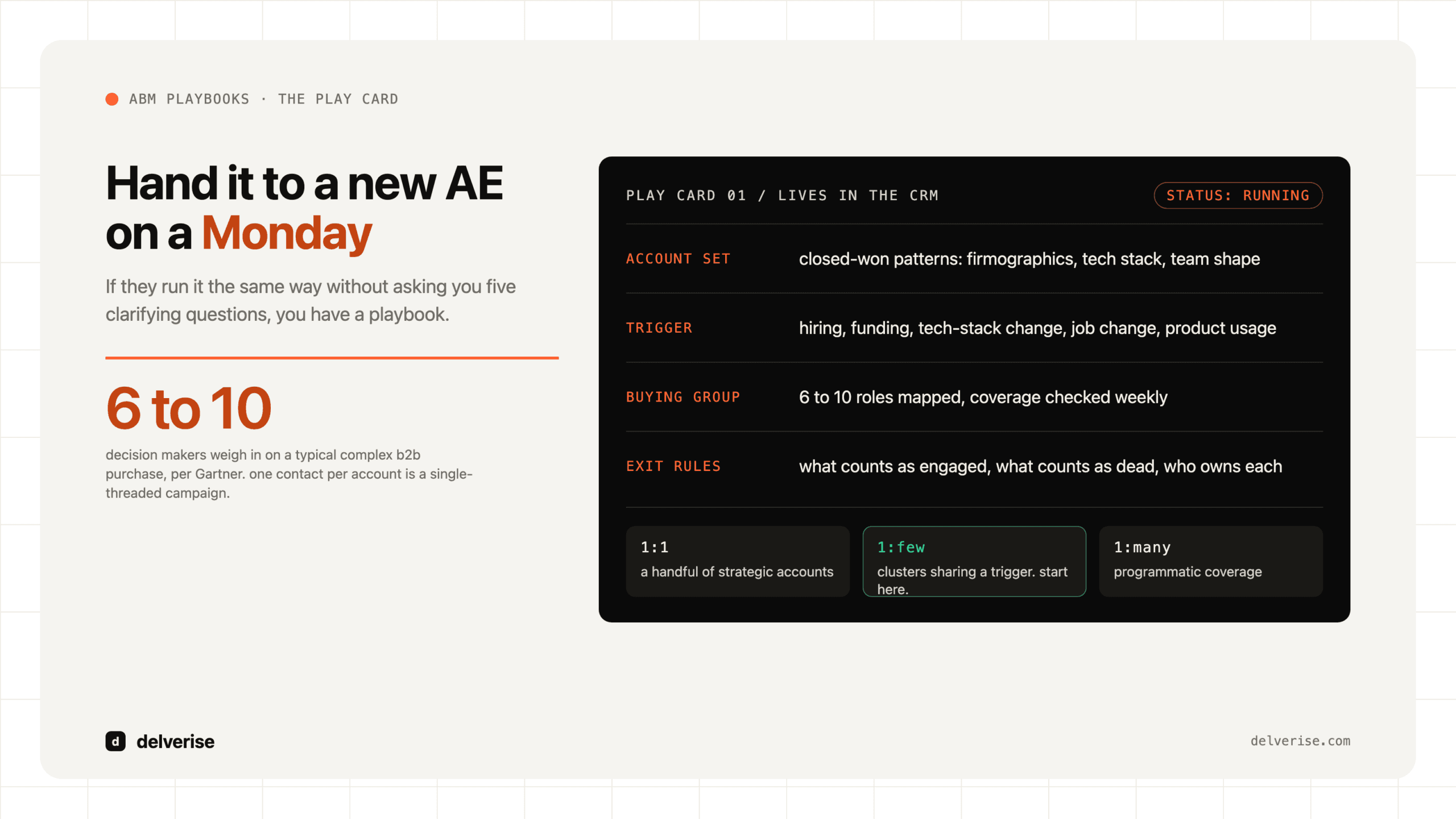
Layer 1: Signal capture. Track defined triggers: a target account posts a relevant job listing, adds a competing tool to their stack, announces funding, or has a champion change roles. These are pulled from job boards, tech-detection sources, funding databases, and job-change monitoring.
Layer 2: Enrichment and waterfall. Every triggered account runs through a provider chain. Provider A attempts the email; if it fails, Provider B tries; if that fails, Provider C. Results get verified before they touch the CRM. Match rates typically climb from the 50-60% range on a single provider into the 80s with a well-built chain.
Layer 3: Scoring. Each enriched account is scored against your closed-won profile. Firmographic fit, signal recency, and engagement history combine into a rank, not a binary yes/no.
Layer 4: Routing and drafting. High-score accounts route to the AE with a research brief attached. Mid-score accounts go to a nurture sequence. Low-score accounts stay in the database and get re-scored when a new signal fires.
Layer 5: Feedback. Outcomes flow back. Which signals actually produced meetings? Which produced closed revenue? The scoring model updates. Without this layer, you have automation, not intelligence.
Clay is the tool most teams reach for to orchestrate layers 1 through 4, because it handles provider waterfalls, AI research columns, and CRM writeback in one place. It is genuinely good at this, and it also has a real learning curve: it rewards teams who understand their data model and punishes teams who do not. If you want the system built and handed over rather than learned from scratch, that is what our Clay partner work covers. Alternatives exist, and for simpler motions a combination of your CRM’s native enrichment plus a single provider may be sufficient. Be honest about which situation you are in.
How should you measure whether AI is working?
Most AI dashboards report activity: emails sent, accounts researched, calls made. These numbers always go up, which makes them useless as evidence.
Track the metrics that reveal whether quality held while volume grew:
- Reply-to-meeting rate. If volume doubled and this halved, AI made you louder, not better.
- Meeting-to-opportunity rate. The clearest signal that targeting and qualification are sound.
- Data match rate and accuracy. Track bounce rate and CRM record completeness. This is the foundation everything else sits on.
- Cost per qualified opportunity. The number that actually matters to a CFO. Include tool spend, credits, and the human hours spent maintaining the system.
- Rep hours redeployed. If AI saved 8 hours a week per rep and those hours went into more calls with better accounts, that is real. If they evaporated, your automation is a cost center.
The full set of numbers worth watching lives in our B2B sales funnel metrics guide.
What should a revenue leader do first?
HBR’s writing on analytics adoption has repeatedly made the same point in different forms: organizations fail at data initiatives for organizational reasons, not technical ones. Ownership, definitions, and incentives break before the technology does. The same holds for AI in go-to-market.
A sequence that works:
- Audit CRM data quality before buying anything. What percentage of records have accurate titles, emails, and company data? If it is under 70%, fix that first.
- Define your closed-won profile from actual data, not from the ICP slide made two years ago.
- Pick one workflow. Account research is usually the safest starting point: high volume, measurable, low risk if wrong.
- Instrument it before you launch it. Decide what success looks like numerically, and where that number will be visible.
- Assign one owner. AI systems without a named owner degrade within a quarter.
- Run it for six weeks. Compare against your pre-AI baseline on quality metrics, not volume.
- Only then expand to a second workflow.
Teams that skip the audit step and buy the platform first are the ones writing off the contract at renewal. The stack decisions you make at Series A compound for years in both directions.
Build or buy?
The market has converged on a few honest realities. Point solutions are cheap and easy to start with, and they fragment your data across a dozen systems. Platforms are expensive and consolidate the data, and they lock you into one vendor’s roadmap. Custom builds give you control and require engineering capacity most Seed-to-Series-B teams do not have to spare.
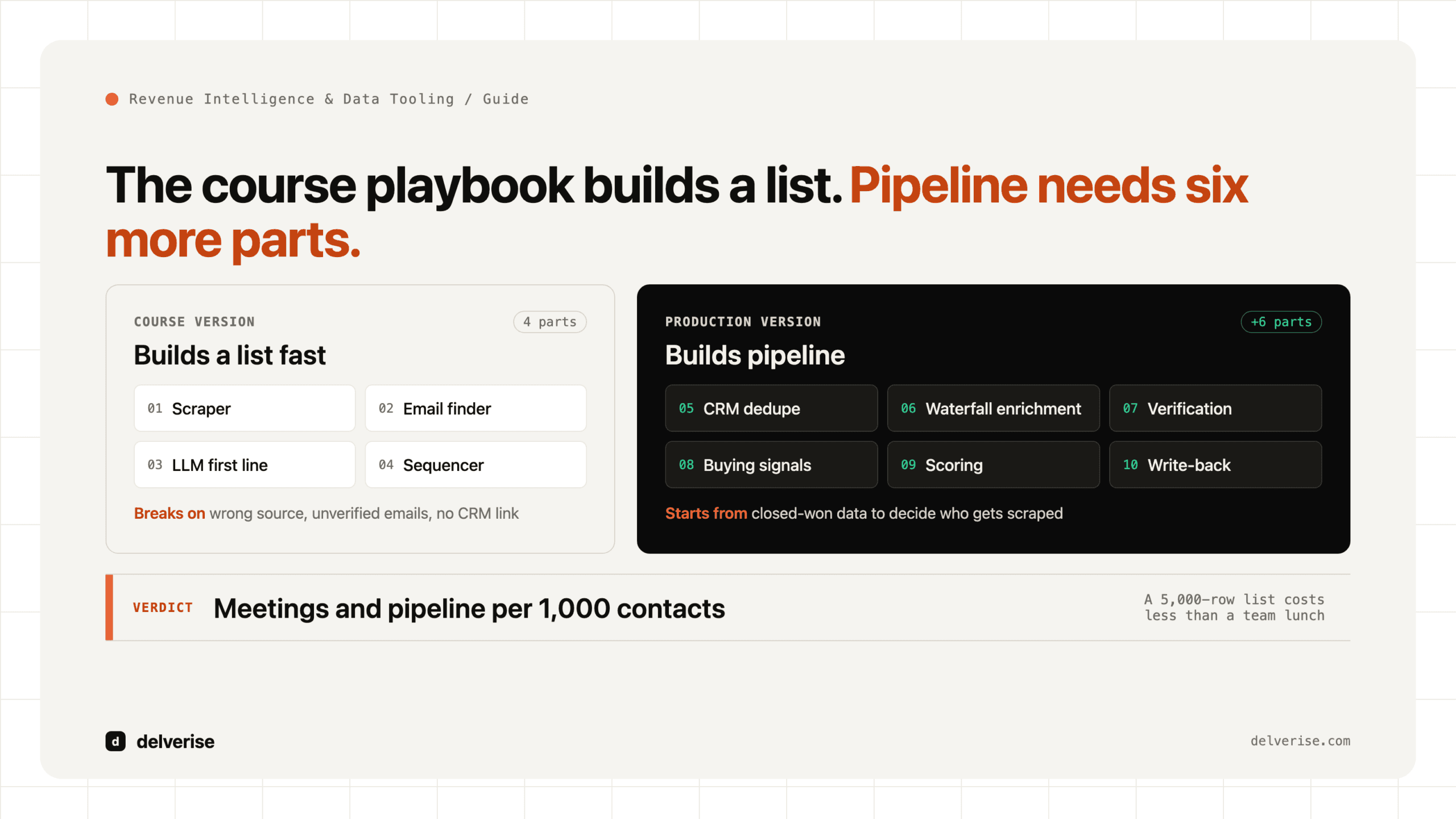
The practical answer for most companies at this stage: buy the components, engineer the connective tissue. Use best-in-class tools for enrichment, sequencing, and CRM. Build the orchestration, scoring logic, and feedback loops that connect them, because that connective tissue is where your competitive advantage actually lives and no vendor can sell it to you. That approach is the core of what GTM engineering means in practice, and it is the difference between owning a system and renting a collection of subscriptions.
Frequently Asked Questions
Will AI replace SDRs and BDRs?
In high-volume, low-ACV motions, AI is already absorbing a large share of the research and first-touch work. In complex enterprise sales with multiple stakeholders and long cycles, it is not close. The realistic outcome for most B2B SaaS teams is fewer SDRs doing higher-value work, with AI handling research, enrichment, and prioritization. Teams that cut headcount before the system is proven usually end up rehiring.
How much should we budget for AI in our GTM stack?
Tool spend is the smaller half of the cost. Budget for the tools, the enrichment credits (which scale with volume and surprise people), and the human time to build and maintain the workflows. A common mistake is buying a $30k platform and allocating zero hours to implementation, then concluding the platform failed. If you cannot fund the implementation, buy a simpler tool.
Does AI-generated outbound email still work?
AI-assisted email works. Fully AI-generated email at volume mostly does not, because deliverability is now the binding constraint. Inbox providers filter aggressively, and prospects recognize templated pseudo-personalization instantly. The durable use of AI in outbound is research quality and targeting precision, which lets you send fewer, better messages. Our guide to AI sales tools breaks down which categories hold up.
What data do we need before AI is useful?
At minimum: a CRM with consistent stage definitions, at least 12 months of closed-won and closed-lost outcomes, and reasonably complete firmographic data on your accounts. Predictive models need historical outcomes to learn from. If you have fewer than about 50 closed-won deals, start with rules-based scoring and generative assistance, and revisit predictive models once you have volume.
How long before we see results?
Research and enrichment workflows show measurable time savings in weeks. Scoring and prioritization take a full sales cycle plus a quarter before the data supports a verdict. Anything touching win rate takes two to three quarters to prove. Be skeptical of any vendor promising revenue lift inside 30 days, and be equally skeptical of an internal team asking for a year before showing any signal.
Read next