←Back to blog
Growth & Demand GenerationGuideOctober 5, 20268 min read
A Leads: What Counts as One and How to Route Them
A leads are the top tier in a lead grading system: accounts that match your best-fit customer profile and show genuine buying behavior at the same time. B and C leads satisfy one of those two conditions. D leads satisfy neither. The grade determines routing speed, owner, and motion, so grading accuracy directly sets pipeline quality.
A leads are the top tier in a lead grading system: accounts that match your best-fit customer profile and show genuine buying behavior at the same time. B and C leads satisfy one of those two conditions. D leads satisfy neither. The grade determines routing speed, owner, and motion, so grading accuracy directly sets pipeline quality.
Key takeaways
- Grading runs on two independent axes: fit (who the account is) and intent (what they just did). An A lead scores high on both.
- Most teams use the letters as vibes. Written thresholds, sourced from closed-won data, are what make the grade mean something.
- The payoff is allocation. A leads deserve minutes of response time and senior ownership. C leads deserve automated nurture and nothing more.
- Grading fails for two reasons: stale fit data in the CRM, and intent scores that reward volume of clicks instead of buying behavior.
- Grade decay matters as much as grade assignment. An A lead from six weeks ago is a C lead today.
What does “A leads” actually mean?
Lead grading assigns a letter to each inbound or sourced lead based on how closely it resembles the accounts you actually win. Forrester’s demand management work popularized the two-dimension version that most modern models still use: fit (firmographic and technographic match to your ideal customer profile) and interest or intent (observed behavior suggesting active evaluation). An A lead is high on both.
The distinction matters because the two axes fail in opposite directions. A VP of RevOps at a 400-person Series C company with your exact tech stack is high fit. If she downloaded one report in February and has not returned, intent is close to zero. Meanwhile, a solo founder who visited your pricing page four times this week has high intent and no budget. Treating those two as the same “warm lead” is how SDR capacity disappears.
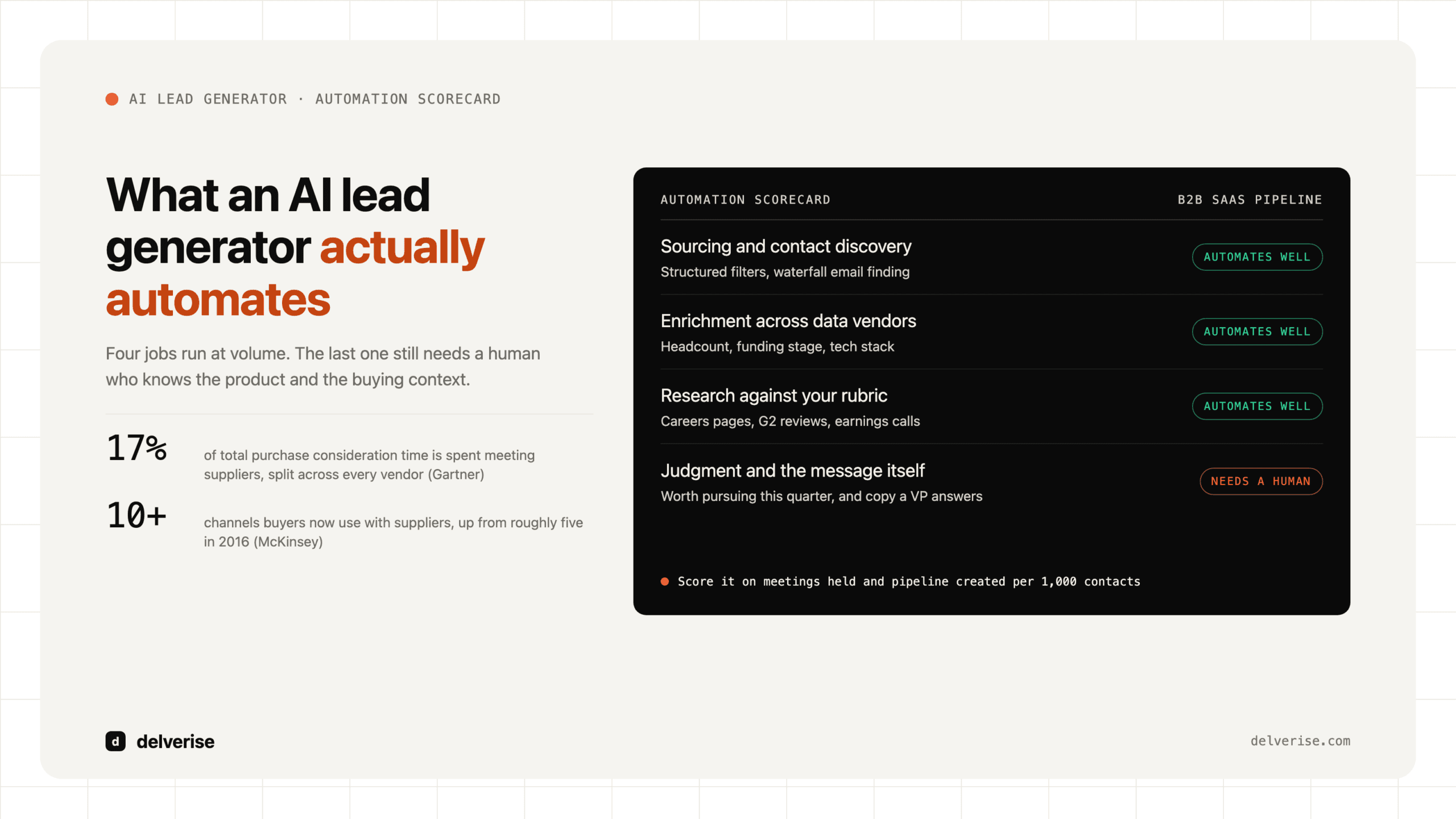
Gartner’s research on B2B buying is the reason grading pays off at all. Buyers spend only about 17% of their total purchase journey meeting with potential suppliers, and that time is split across every vendor on the list. You get a thin slice of attention, and you get it on the buyer’s schedule. Grading exists so that slice goes to the accounts where it converts. We covered the scoring mechanics in more depth in our guide to AI lead qualification.
What separates an A lead from a B lead?
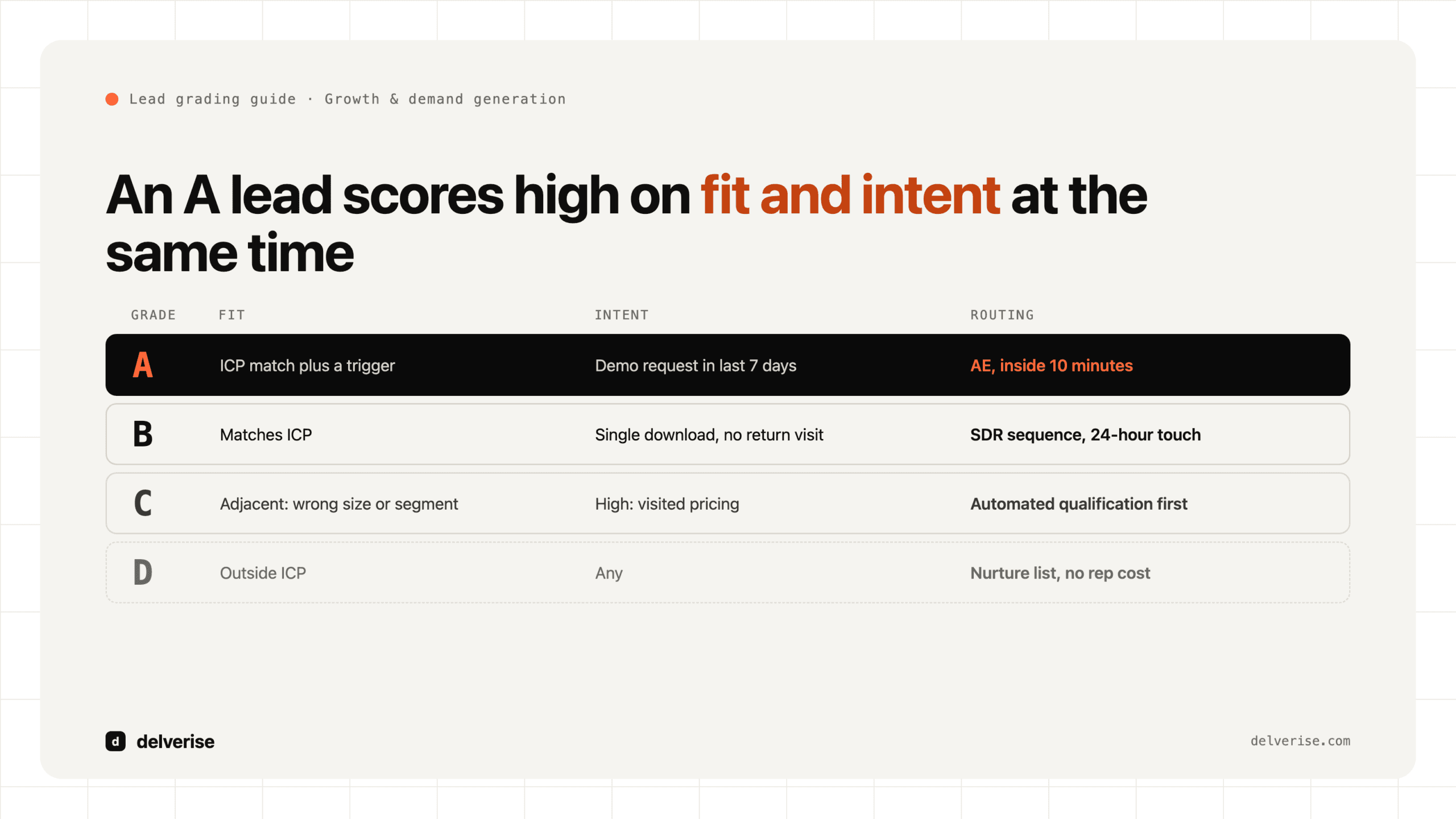
Thresholds, written down, with a routing consequence attached to each one. Here is the structure we build for Seed to Series B SaaS teams:

| Grade | Fit | Intent | Routing | Motion |
|---|---|---|---|---|
| A | Matches ICP on size, segment, and at least one trigger (funding, hiring, stack change) | High-value action in last 7 days: demo request, pricing page repeat visit, multi-stakeholder activity | AE or senior SDR, response inside 10 minutes during business hours | Human, personalized, multithreaded from the first touch |
| B | Matches ICP | Low or aging: single content download, webinar attendance, no return visit | SDR sequence with research step, 24-hour first touch | Semi-automated, human on reply |
| C | Adjacent: wrong size, wrong segment, or partial stack match | High: visited pricing, requested demo | Automated qualification step before any rep time | Self-serve path or form-based disqualification |
| D | Outside ICP | Any | Nurture list or suppression | Newsletter only, no rep cost |
Notice that C leads can be louder than B leads. They request demos, fill out forms, and reply fast. Pure behavioral scoring promotes them straight to the top of the queue, which is the single most common grading defect we see in audits.
How do you define the thresholds without guessing?
Work backward from revenue, not from opinions in a workshop. The fit model comes from your closed-won cohort, the intent model comes from your opportunity-created cohort, and both get re-fit quarterly.

- Pull every closed-won deal from the last 18 months, minimum 30 accounts, and record employee count, segment, buying-group title mix, and sales cycle length.
- Pull closed-lost and churned accounts separately. The attributes that appear in both won and churned cohorts are not fit signals, they are noise.
- Rank the three to five firmographic attributes with the widest gap between won and lost. Those become your fit gate.
- Score behaviors by their historical correlation with opportunity creation, then weight by recency. Pricing page visits in the same week beat a whitepaper download from last quarter.
- Write a decay rule: intent scores drop by a fixed percentage per week of inactivity, so grades fall on their own.
- Publish the thresholds in a document sales and marketing both sign off on, and attach the routing SLA to each grade.
Enrichment quality sets the ceiling on all of this. If employee count and tech stack fields are 40% empty, your fit gate silently downgrades good accounts into C. Fix the data layer before you tune weights, which is why CRM enrichment sits underneath every grading model we build. The broader dependency map is in our piece on the six foundation pieces under every revenue stack.
What does grading change operationally?
Response time becomes grade-dependent. The classic HBR study on online sales lead response, run across thousands of US firms, found that companies responding within an hour were roughly seven times more likely to have a meaningful qualifying conversation than those waiting even one hour longer. Average response times in that data were measured in days. Applying a ten-minute SLA to every lead is expensive. Applying it to the 5% graded A is affordable and produces most of the benefit.

Ownership also changes. A leads go to your strongest closer with a multithreaded plan, because McKinsey’s B2B buying research consistently shows buyers moving across self-serve, remote, and in-person channels within a single purchase, with most buying groups using all three. A high-fit account in active evaluation needs a human who can meet them in whichever channel they pick next.
What does this look like with real numbers?
Illustrative arithmetic, using the conversion spread we typically observe between graded tiers:
Say 900 leads arrive monthly. 6% grade A (54 leads), 20% grade B (180), and the remainder grade C or D. A leads convert to qualified opportunity at 45% and close at 22%, producing about 5.3 new customers. B leads convert at 18% and close at 10%, producing about 3.2 customers. At roughly 40 minutes of rep time per worked lead, the A tier consumes 36 rep hours and the B tier consumes 120.
Deals per 100 rep hours: roughly 14.7 for A, roughly 2.7 for B. Same team, same month, a 5x difference in return on the only resource that is genuinely fixed. That gap is the entire business case for grading, and it compounds when you redirect the saved hours into outbound funnel motion against lookalikes of your A tier.
Where do A lead programs break?
Four failure modes account for most of it. Grade inflation: reps lobby to promote their pet accounts until 30% of leads are A and the letter loses meaning. Stale fit data: the model runs on enrichment pulled at form-fill and never refreshed, so a company that tripled headcount still grades as a startup. Missing decay: yesterday’s A leads pile up in a queue nobody re-scores. And orphaned C leads: high-intent, low-fit accounts get dropped entirely when some of them are future-fit and belong in a specific nurture track with a re-grade trigger.
One more: grading a channel that does not produce volume yet. If inbound is 40 leads a month, you do not have a grading problem. You have a demand problem, and the fix starts with building the lead generation system first.
Should you build this in-house or bring in help?
Build it in-house when you already have a RevOps owner with CRM admin rights, clean enrichment coverage above 80%, and 18 months of closed-won history to fit the model against. The work is analysis plus configuration, and it takes a capable operator two to four weeks.
Bring in outside help when the grading model depends on systems that do not exist yet: enrichment waterfalls, routing logic, intent capture, reporting that ties grade to closed revenue. At that point grading is one component inside a larger revenue system, and sequencing the build correctly matters more than the scoring formula. That is the work delverise does, as GTM engineering: building the data, routing, and measurement layers so the grades mean something six months from now. delverise stays vendor-neutral on tooling, because the model works in HubSpot, Salesforce, or a Clay-driven stack, and the differentiator is the definition underneath.
Frequently Asked Questions
What percentage of leads should be A leads?
Between 3% and 10% of total inbound volume for most B2B SaaS teams. Above 15%, your thresholds are too loose and reps will stop trusting the grade. Below 2%, you are either under-enriching or your demand is coming from outside your ICP, which is a targeting question rather than a scoring one.
Is lead grading the same as lead scoring?
Scoring produces a number from behavior. Grading produces a letter from fit, and mature models combine both into a two-part label such as A1 or B3. Keeping the axes separate is what prevents a high-intent, poor-fit lead from outranking a perfect-fit account that is quietly evaluating you.
How often should we recalibrate the grading model?
Review conversion rates by grade monthly, and re-fit the underlying weights quarterly. If A leads and B leads start closing at similar rates, the model has drifted and the thresholds need new closed-won data behind them.
Can AI assign grades accurately?
Models are good at reading unstructured signals that rules miss: job posting language, website copy, intent from review sites. They are weak at inventing the definition of good fit, which still comes from your win data. Keep the fit gate deterministic and use AI to enrich the inputs and read the messy signals around it.
What should happen to C and D leads?
Automate them completely. C leads get a self-serve path plus a re-grade trigger that fires when a funding round, headcount jump, or stack change moves them into fit. D leads go to a low-cost newsletter or suppression. Neither should consume rep hours, and measuring how many C leads later convert to A tells you whether your fit gate is calibrated correctly.
Read next