←Back to blog
Revenue Intelligence & Data ToolingGuideSeptember 10, 20269 min read
Lead Nurturing Services: What They Actually Do and When to Buy Them
Lead nurturing services are engagements that build and run the systems moving interested-but-not-ready buyers toward a sales conversation: scoring, segmentation, triggered email and in-product sequences, routing rules, and the data layer underneath them. The good ones deliver working infrastructure your team owns. The weak ones deliver campaign volume.
Lead nurturing services are engagements that build and run the systems moving interested-but-not-ready buyers toward a sales conversation: scoring, segmentation, triggered email and in-product sequences, routing rules, and the data layer underneath them. The good ones deliver working infrastructure your team owns. The weak ones deliver campaign volume.
Key takeaways
- Most nurture underperformance is a data and routing problem, not a copywriting problem. Fix segmentation inputs before touching email templates.
- Ask any provider what they hand over at the end: a documented system in your stack, or a set of campaigns only they can operate.
- Scoring models built on demographic fit alone decay fast. Behavioral and account-level signals are what make a nurture track feel timely.
- Expect 90 days before nurture influence shows cleanly in pipeline reporting, and insist on attribution instrumentation from week one.
- Pricing that scales with email volume or hours rewards activity. Pricing tied to a working system and defined outcomes rewards results.
What do lead nurturing services actually include?
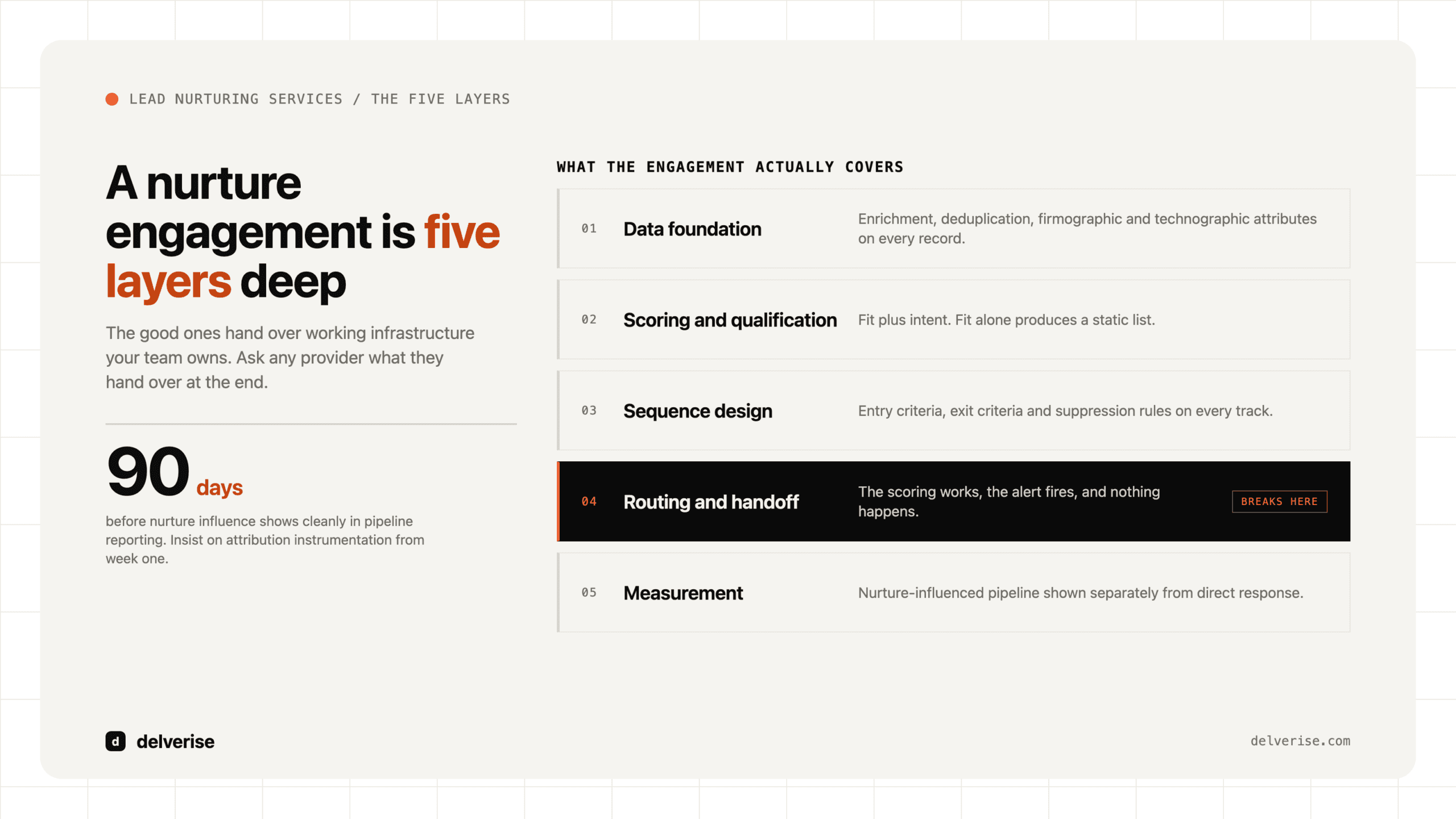
Lead nurturing, in the B2B SaaS sense, means the set of automated and semi-automated touches that keep a prospect engaged between first interest and sales readiness. A nurturing engagement typically covers five layers.

Data foundation. Enrichment, deduplication, and firmographic and technographic attributes on every record. Without this, segmentation collapses into “all leads from the demo form.” Most teams discover their nurture problem is really a CRM enrichment problem once someone audits the field completeness on their contact object.
Scoring and qualification. A model that combines fit (does this account look like a customer?) with intent (are they acting like a buyer?). Fit alone produces a static list. Intent alone produces noise from job seekers and competitors reading your pricing page.
Sequence design and content mapping. The actual tracks: onboarding nurture, closed-lost revival, product-qualified lead follow-up, event follow-up, dormant account reactivation. Each needs its own entry criteria, exit criteria, and suppression rules.
Routing and handoff. Rules that decide when a nurtured contact becomes a sales task, who owns it, and what context travels with them. This is where most implementations break: the scoring works, the alert fires, and nothing happens because ownership is ambiguous.
Measurement. Instrumentation that shows nurture-influenced pipeline separately from direct-response pipeline, so you can defend the spend in a board meeting.
Why do most nurture programs stall?
The pattern repeats across companies. A team buys a marketing automation platform, builds three drip campaigns, watches open rates for a quarter, and quietly stops looking. The campaigns keep sending. Nobody can say what they produced.

Three causes account for most of it.
The first is segmentation built on data nobody maintains. If your industry field is 40% blank and your employee-count field came from a 2023 list purchase, every downstream branch inherits that error. Gartner has published extensively on the cost of poor data quality to organizations, and in nurture specifically the failure is silent: your emails still send, they just land wrong.
The second is a mismatch between nurture cadence and actual buying cycles. Research from Gartner on B2B buying behavior found that buyers spend only a small share of their total purchase journey with any potential supplier’s sales reps, and most of the process happens independently across research, internal discussion, and validation. A nurture track that assumes a linear funnel misses buyers who go dark for eight weeks and return ready to talk.
The third is organizational. Marketing owns the sequences, sales owns the follow-up, and nobody owns the handoff logic in between. Companies that have built a clear GTM function with defined ownership across that boundary see far fewer leads die in the gap.
How do you tell a systems builder from a campaign sender?
The commercial market for lead nurturing services splits roughly into three models. Understanding which one you are buying prevents a lot of disappointment nine months in.

| Model | What you get | Good fit when | Risk |
|---|---|---|---|
| Managed campaign execution | Someone writes and sends your nurture emails on an ongoing retainer | You have clean data and a working automation stack, and just need throughput | Dependency: the campaigns live in their heads, not your documentation |
| Platform implementation | Configuration of a specific tool (HubSpot, Marketo, Customer.io) to a defined spec | You have already chosen a platform and know exactly what you want built | Tool-shaped thinking: the solution gets bent to fit what the platform does easily |
| System engineering | Data model, scoring logic, sequences, routing, and reporting built as connected infrastructure you own | Nurture is underperforming and you cannot tell which layer is broken | Higher upfront investment; requires internal stakeholder time |
The diagnostic question that separates them: ask a prospective provider what happens if you end the engagement in six months. A systems builder can describe the documented, transferable asset that remains. A campaign sender will describe the campaigns stopping.
This mirrors the decision every revenue leader eventually faces on the broader build-versus-buy question, which we work through in detail in our piece on go-to-market consultant versus building in-house.
What does a well-built nurture system look like in practice?
Here is a concrete example of the architecture we build for a Series A SaaS company with roughly 400 inbound signups a month, of which maybe 25 are genuinely qualified.
Layer 1, ingestion and enrichment. Every signup hits a table where it gets enriched with company size, funding stage, tech stack, and current headcount in relevant departments. Clay handles this well because it lets you waterfall across multiple data providers, so when one source misses the company domain another catches it. The honest tradeoff: Clay is a build environment, so it rewards teams willing to maintain logic and punishes teams that expect a set-and-forget tool. If nobody on your team will own it, a simpler single-vendor enrichment feed will serve you better. Teams that want the architecture built and handed over can start with our Clay implementation work.
Layer 2, scoring. Two scores, kept separate. A fit score computed from enrichment data, refreshed quarterly. A behavior score that decays over 30 days, weighted toward high-intent actions: pricing page visits, invite-a-teammate events, integration setup attempts. Separating them means you can see the difference between a great-fit account doing nothing and a poor-fit account doing everything.
Layer 3, tracks. Four sequences, not fourteen. High fit plus low behavior gets an education track focused on the problem, not the product. High behavior plus low fit gets a self-serve nurture with no sales involvement. High-high routes immediately to an account executive with a context summary. Low-low goes to a quarterly newsletter and nothing more.
Layer 4, routing. When the high-high threshold trips, a task is created in the CRM with an owner, an SLA, and the three enrichment fields the rep needs to open a relevant conversation. If the task is untouched in 48 hours, it escalates.
Layer 5, reporting. A weekly view showing how many contacts entered each track, how many crossed thresholds, how many became sales-accepted, and what closed. The reporting layer is what makes the whole system arguable in a QBR.
That architecture takes six to ten weeks to build properly. The temptation is to skip layers one and five, which is exactly why so many nurture programs cannot prove their worth. Choosing the software that sits underneath it is a separate decision we cover in our guide to selecting a lead nurturing tool.
How does nurture connect to outbound?
Treating nurture as a purely inbound motion wastes the data. The enrichment and scoring layer that powers nurture is the same layer that should be feeding your outbound targeting. An account that visited your pricing page twice and matches your ideal customer profile belongs in an outbound sequence, not just an email drip.
This is the practical case for building both on shared infrastructure. When your outbound funnel and your nurture tracks read from the same enriched account records and the same behavior signals, a rep working an account can see the full engagement history rather than a fragment. Teams running these as separate systems end up emailing the same person from two motions with contradictory messaging.
The same logic applies to AI-assisted workflows. Research and personalization automation are genuinely useful in nurture, and the honest constraints on where that helps are worth understanding before you buy: our analysis of AI in B2B sales covers what moves revenue and what does not.
What should you expect to pay, and what should you measure?
Pricing models in this market vary widely. Monthly retainers for managed campaign execution commonly run in the low thousands. Systems engagements that build the full stack are typically priced as a defined project with a fixed scope and outcome, then an optional lighter ongoing arrangement for iteration.
The pricing structure to be skeptical of is anything indexed to email volume or hours worked, because both reward activity that may produce nothing.
Metrics that actually indicate the system is working:
- Percentage of nurtured contacts that reach a sales conversation within 180 days
- Median time from first touch to sales-accepted status, tracked by segment
- Sales-accepted rate on nurture-sourced meetings compared to cold outbound meetings
- Closed-won revenue with nurture touchpoints in the path, reported separately from directly-sourced revenue
- Field completeness on the attributes your segmentation depends on, measured monthly
Open rate and click rate belong in campaign optimization, not in a board deck. They tell you whether a subject line worked. They tell you nothing about whether the system produces revenue.
When is nurture the wrong investment?
Honest answer: when you do not have enough top-of-funnel volume for segmentation to mean anything. If you get 30 inbound leads a month, a nurture system is over-engineering. Your constraint is demand generation, and the money is better spent on building the acquisition system first.
Nurture also underperforms when your sales cycle is genuinely short. If prospects sign up and buy within a week, the delay nurture is designed to bridge does not exist. Invest in activation and onboarding instead.
It becomes the right investment when you have volume, a sales cycle measured in months, multiple stakeholders per deal, and a visible gap between leads generated and leads worked. That gap is what nurture services exist to close.
Frequently Asked Questions
How long before lead nurturing services show measurable results?
Plan for 90 days before nurture influence appears cleanly in pipeline reporting, and two full sales cycles before you can judge revenue impact. Early signals, like track entry volume and threshold crossings, are visible within two to three weeks of launch. Insist the measurement layer is built at the start rather than retrofitted, because retroactive attribution on nurture is close to impossible.
Should we build lead nurturing in-house or hire a provider?
Build in-house if you have a RevOps person with capacity and existing familiarity with your automation stack. Bring in outside help when the problem spans data, scoring, routing, and reporting at once, since that combination usually exceeds what a single internal owner can design and ship alongside their existing responsibilities. A useful middle path is external design and build with internal ownership of ongoing operation.
Does lead nurturing still work given how much buying happens without vendors?
Yes, and arguably it matters more. Gartner’s research on B2B buying found that buyers do most of their evaluation independently of supplier sales reps. Nurture is one of the few ways to stay useful to a buyer during that independent period, provided the content genuinely helps them evaluate rather than just restating your product pitch.
What is the difference between lead nurturing and marketing automation?
Marketing automation is the software category: HubSpot, Marketo, Customer.io, and similar platforms. Lead nurturing is the strategy and system you build inside it. Buying the platform without designing the scoring model, segmentation, and routing logic is the most common and most expensive version of this mistake.
How many nurture tracks should we run?
Fewer than you think. Four to six well-instrumented tracks with clear entry and exit criteria consistently outperform twenty overlapping sequences. Every additional track multiplies suppression complexity and increases the chance a contact receives contradictory messaging from two motions at once. Add a track only when you can name the specific segment it serves and the specific action it drives.
Read next