←Back to blog
Growth & Demand GenerationGuideSeptember 20, 20268 min read
SalesIntel: What It Actually Does and Where It Fits in a Revenue System
SalesIntel is a B2B contact and company data platform built around human-verified emails and direct dial phone numbers, plus firmographics, technographics, and intent signals. US-focused teams use it to source and enrich accounts and contacts. Its main differentiator is human verification and research-on-demand for records its database lacks.
SalesIntel is a B2B contact and company data platform built around human-verified emails and direct dial phone numbers, plus firmographics, technographics, and intent signals. US-focused teams use it to source and enrich accounts and contacts. Its main differentiator is human verification and research-on-demand for records its database lacks.
Key takeaways
- SalesIntel competes on data accuracy and direct dial coverage rather than raw record volume. That tradeoff favors phone-heavy, US-centric motions.
- Human verification means a researcher confirmed the record, and SalesIntel publicly claims roughly 95% accuracy on verified contacts. Treat that as a vendor claim and validate it against your own ICP before signing.
- Research-on-demand, where their team sources contacts the database is missing, is the feature most buyers underuse and the one that most justifies the price.
- Non-US coverage is the clearest weakness. EMEA and APAC teams routinely find gaps that a Europe-first provider fills better.
- A data vendor fixes supply. Pipeline requires routing, sequencing, and CRM hygiene to work downstream, which is where most SalesIntel deployments quietly fail.
What problem does SalesIntel actually solve?
Every outbound motion runs on two inputs: a correct list of accounts, and correct ways to reach humans inside them. B2B contact data decays constantly because people change jobs, titles shift, and phone systems get replaced. A database that was accurate in January is meaningfully stale by July.

SalesIntel attacks that decay with human verification. Instead of relying only on crawling and pattern-based email guessing, researchers confirm records on a rolling cycle, and customers can flag a bad record and request a re-verification. For teams whose reps cold call, a wrong direct dial is more expensive than a missing one, because it burns the rep’s time and their confidence in the tool.
This matters more than it used to. Gartner’s B2B buying research found that buyers spend only about 17% of their total purchase journey meeting with potential suppliers, and that time is split across every vendor in consideration. When your window is that narrow, reaching the right person on the first attempt is the whole game.
How does human-verified data actually work?
Three terms worth defining before you evaluate anything in this category:

- Human-verified: a researcher confirmed the contact’s employment, title, and contact details, rather than an algorithm inferring them. Verified records carry a timestamp, so you can see how fresh a given contact is.
- Direct dial: a phone number that reaches the person, not a company switchboard. Mobile numbers and direct desk lines both count. Coverage here varies wildly by seniority and geography.
- Technographics and intent: what software an account runs, and which topics it is researching. Intent data in this category is usually licensed from a third-party co-op like Bombora, so it is the same signal your competitors can buy.
The practical implication: verification quality is the part you should test, and intent is the part you should discount, because it is rarely proprietary. Ask for a sample of 200 contacts inside your exact ICP, then verify the emails independently and have an SDR dial 50 numbers. That one test tells you more than any G2 grid, where SalesIntel consistently reviews well on accuracy and support while drawing more mixed feedback on international coverage and contract flexibility.
How does SalesIntel compare to ZoomInfo, Apollo, and Cognism?
These platforms are genuinely different products that happen to share a category label. Here is the honest split:
| Platform | Core strength | Geographic strength | Best fit | Main tradeoff |
|---|---|---|---|---|
| SalesIntel | Human-verified contacts, direct dials, research-on-demand | US, strong mid-market coverage | US phone-heavy outbound, ABM with tight account lists | Thinner outside North America; annual contracts |
| ZoomInfo | Breadth of records, account intelligence, large platform ecosystem | Broad, deepest in US | Enterprise teams wanting one system of record for GTM data | Highest cost; platform sprawl you may not use |
| Apollo | Volume plus built-in sequencing at low price | Broad, uneven accuracy by segment | Seed-stage teams testing motions on a small budget | Email accuracy varies; weaker direct dials |
| Cognism | Phone-verified mobiles, GDPR-conscious sourcing | EMEA, strong UK and DACH | European outbound, especially calling motions | Less depth in US mid-market |
| Clay | Orchestration across many data sources with waterfall enrichment | As broad as the providers you connect | Teams that want to combine providers and stop overpaying for one | Requires someone to build and maintain it |
The last row is the one most revenue leaders miss. A waterfall setup calls the cheapest source first and only pays a premium provider when earlier sources come back empty. That approach often cuts data spend substantially while improving coverage, because no single vendor wins every segment. If you are already evaluating account-intelligence platforms alongside data providers, the same logic applies to that decision, which we cover in our breakdown of 6Sense alternatives.
What does a SalesIntel deployment look like in practice?
Numbers make this concrete. Take a Series A SaaS company selling to mid-market operations leaders in the US, running two SDRs. The following figures are illustrative, using coverage and conversion rates in the range we typically see:

- Target list: 800 accounts matching a tight ICP, three personas per account, so 2,400 contacts wanted.
- Database returns usable contacts for roughly 70% of those slots: about 1,680 contacts.
- Direct dials exist for roughly 45% of those: about 750 dialable contacts.
- At a 7% connect rate across three dial attempts, that is roughly 52 live conversations per month of dialing capacity.
- At 25% conversation-to-meeting, that is 13 meetings per month from the phone channel alone, before email and LinkedIn contribute anything.
- The remaining 720 empty contact slots go to research-on-demand, which is where the contract earns its keep.
Two things fall out of that math. First, coverage percentage matters more than total database size, because you only care about your 800 accounts. Second, the gap between what the database has and what your list needs is the number to negotiate on. Ask the vendor to run your actual account list through their system during evaluation and report match rates by persona. Any provider confident in their data will do it.
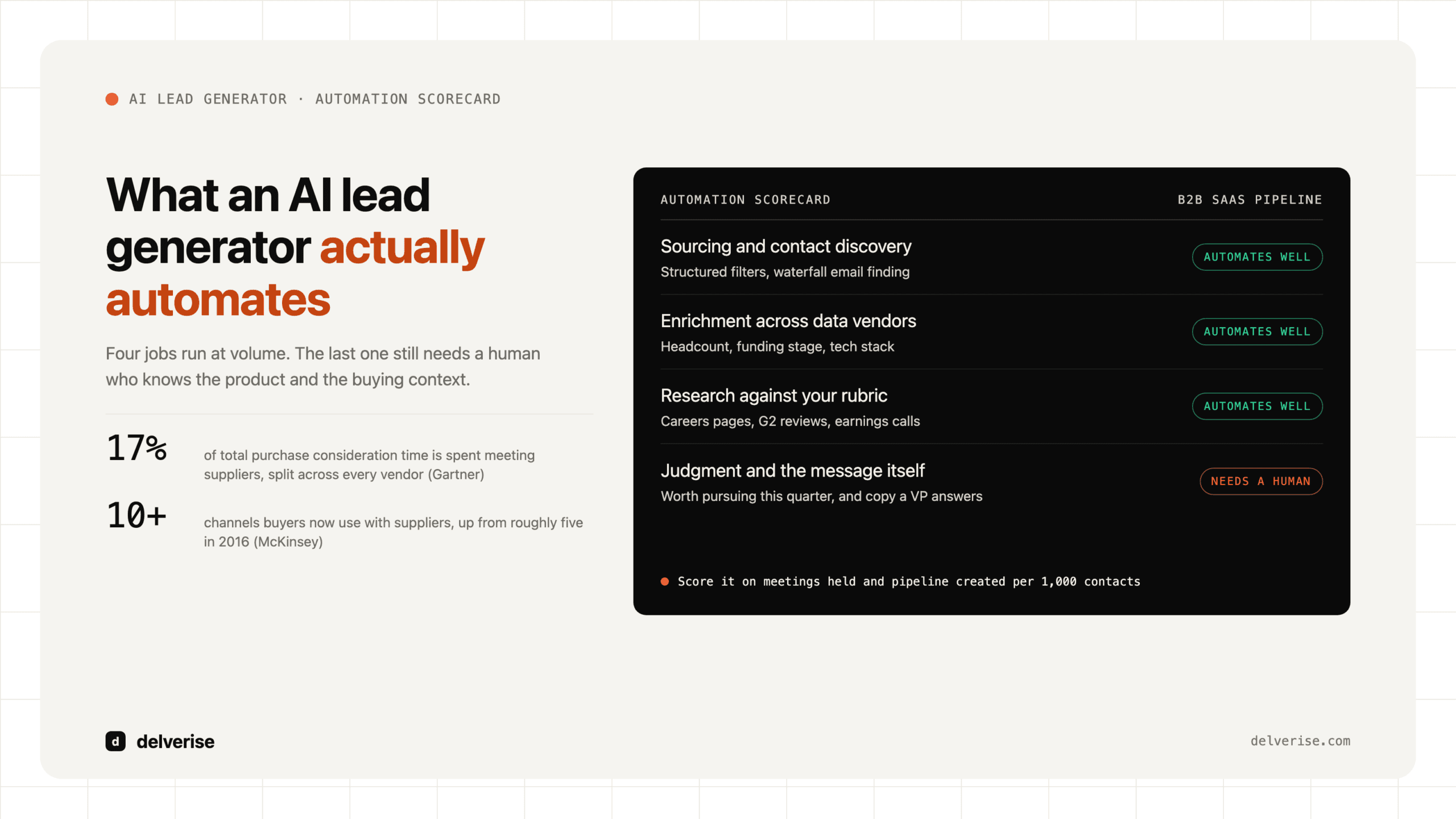
McKinsey’s B2B Pulse research has consistently found that buyers now move across a large number of channels during a single purchase, typically around ten, and that sellers winning share show up coherently across them. A contact record is the entry point for that, so the same verified data should feed your calling, email, LinkedIn, and paid audiences rather than living in one rep’s tab.
Where does SalesIntel break?
Four failure modes come up repeatedly.
Geography. If more than a third of your pipeline is outside North America, test coverage hard. Teams selling into Germany, the Nordics, or Southeast Asia often end up running a second provider anyway, which changes the cost comparison entirely.
Contract structure. Pricing in this category is annual, seat-based, and credit-gated, commonly landing in the low five figures per year for a small team. Teams get burned by buying unlimited-view tiers they never exhaust, or by capping credits so tightly that reps ration their own prospecting. Model your actual monthly pull before choosing a tier.
No routing layer. Good data landing in a CRM nobody trusts produces nothing. If your account ownership rules, dedupe logic, and enrichment triggers are undefined, better data makes the mess bigger rather than smaller. That foundation question is worth answering first, which is why we treat it as its own diagnostic in the six pieces under every revenue stack.
Expecting data to fix messaging. A verified mobile number for the right VP does nothing if the first fifteen seconds of the call are generic. Data determines who you reach. Relevance determines whether the conversation continues, and that is a function of your outbound funnel design and the research layer you attach to each account.
Should you buy SalesIntel?
Run this checklist before you take the demo:
- At least 60% of our target accounts are in North America
- Cold calling is, or will be, a real channel for us rather than an afterthought
- We have a defined ICP and an account list, not just a broad industry filter
- We can name who owns CRM data hygiene and enrichment rules today
- We tested match rates on our own account list, not the vendor’s sample
- We compared the annual cost against a waterfall of two cheaper sources
- We know our monthly credit consumption within about 25%
Five or more checked, and SalesIntel is a reasonable primary provider. Three or fewer, and the data vendor is the wrong purchase order to sign first. The higher-leverage move at that stage is building the system that consumes data, covered in our guide to building a B2B lead system, and then wiring providers into it through a CRM enrichment layer you control.
This is the work delverise does for Seed to Series B teams: pick the providers that fit the actual ICP, run them through a waterfall so you stop overpaying, and connect the output to sequencing and reporting that a revenue leader can hold a number against. The tool choice is about 10% of the outcome. If you are also evaluating how AI fits into this, our view on AI-assisted outbound and on picking a prospecting tool that builds pipeline covers where automation helps and where it quietly degrades quality.
Frequently Asked Questions
Is SalesIntel better than ZoomInfo?
For US mid-market teams that value contact accuracy and direct dials, SalesIntel usually wins on price-to-accuracy and on the research-on-demand option. ZoomInfo wins on breadth, account intelligence depth, and ecosystem integrations, which matters more to enterprise teams standardizing their whole GTM data stack on one vendor. Test both against your own account list.
Does SalesIntel work for non-US markets?
It has international records, but North America is where its coverage and verification are strongest. European teams, particularly those calling into the UK, DACH, or the Nordics, generally find better mobile coverage from a Europe-first provider. If your pipeline is split across regions, plan for two sources and budget accordingly.
What is research-on-demand and is it worth paying for?
You submit accounts or personas the database does not cover, and their research team sources and verifies those contacts, typically within a few business days. It is the feature that most differentiates the platform, and most customers underuse it. If you have a tight ABM list where coverage gaps block real revenue, it is usually the strongest reason to choose SalesIntel over a cheaper provider.
How much should we expect to pay?
Contracts are annual and priced by seats plus credit or view limits, and small teams commonly land in the low five figures per year. Pricing is negotiable, especially at renewal and especially if you can show measured match rates on your own list. Get the credit consumption model in writing before signing.
Do we still need separate enrichment tooling?
Usually yes. A single provider will not cover every segment, and orchestration platforms let you call multiple sources in sequence so you pay premium rates only when cheaper sources miss. That setup also gives you one place to normalize fields before anything reaches the CRM, which is what keeps reporting trustworthy as volume grows.
Read next