←Back to blog
Revenue Intelligence & Data ToolingGuideSeptember 3, 20269 min read
AI Lead Qualification: What It Actually Scores and How to Build It
AI lead qualification uses machine learning and language models to enrich, score, and route leads automatically, replacing static point-based rules. It reads firmographic data, product usage, and buying signals, then predicts which accounts deserve a human conversation and which belong in nurture. Done well, it compresses response time and puts your best reps in front of your best accounts.
AI lead qualification uses machine learning and language models to enrich, score, and route leads automatically, replacing static point-based rules. It reads firmographic data, product usage, and buying signals, then predicts which accounts deserve a human conversation and which belong in nurture. Done well, it compresses response time and puts your best reps in front of your best accounts.
Key takeaways
- Qualification quality is a data problem first. A model trained on incomplete CRM fields will confidently rank the wrong accounts.
- The biggest measurable gain is usually speed, not accuracy. Ranked routing within minutes beats a slightly better score delivered a day later.
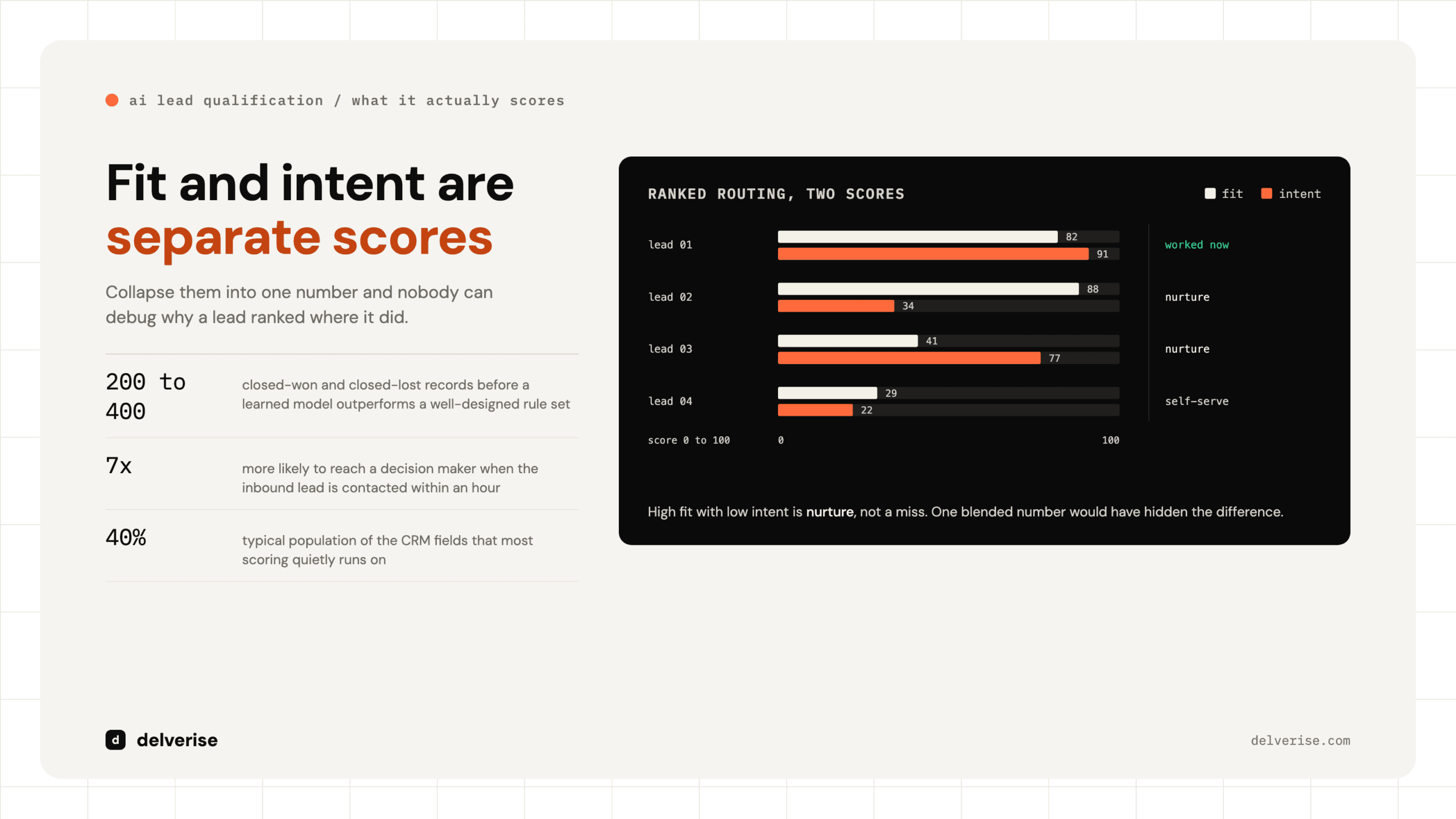
- Fit and intent are separate scores. Collapsing them into one number hides why a lead ranked where it did and makes the system impossible to debug.
- Language models are strong at reading unstructured context (job posts, website copy, form free-text) and weak at calibrated probability. Use each layer for what it does well.
- You need roughly 200 to 400 closed-won and closed-lost records before a learned model outperforms a well-designed rule set.
What is AI lead qualification?
Lead qualification is the process of deciding which leads get human attention and in what order. Traditionally this ran on point-based scoring: +10 for a demo request, +15 for a 200-employee company, minus 20 for a personal email domain, with a threshold at 100 points that somebody set in a meeting two years ago.
AI lead qualification replaces those hand-set weights with two layers. A predictive layer learns from your closed-won and closed-lost history which attributes actually correlate with revenue. A generative layer reads unstructured evidence a rules engine cannot parse: the prospect’s job postings, their pricing page, the free-text answer on your demo form, the tech listed on their careers site. Together they output a ranked list plus a written rationale a rep can read in ten seconds.
The output that matters to a revenue leader is a routing decision. Every lead lands in one of three lanes: worked by a human now, held in automated nurture until a trigger fires, or left to self-serve.
Why do traditional lead scoring models keep failing?
Three reasons show up in almost every audit we run.

The weights encode opinion, not evidence. Someone assigned +15 to “VP title” because it felt right. Nobody ever tested it against pipeline. When the ICP shifts, the weights stay frozen.
The inputs are half-empty. Scoring runs on CRM fields that are 40 percent populated. Employee count is blank on a third of records, industry is a free-text mess, and the model treats missing data as a negative signal. Fixing enrichment coverage typically moves qualification accuracy more than switching models does. That work sits upstream in CRM enrichment, and it is where most of the honest gains live.
Speed is ignored entirely. The scoring runs nightly. By the time a rep sees the lead, the buying window has moved. Harvard Business Review published a well-known study of lead response times finding that firms contacting an inbound lead within an hour were roughly seven times more likely to have a meaningful conversation with a decision maker than those waiting even two hours. Most scoring architectures are structurally incapable of hitting that window.
Context matters here too. Gartner’s research on B2B buying found that buyers spend only about 17 percent of their total purchase journey meeting with potential suppliers, split across every vendor in the deal. Your share of a buyer’s attention is small and it arrives on the buyer’s schedule. Qualification that runs on batch timing misses it.
What signals actually predict a qualified lead?
Group your inputs into three buckets and score them separately.

- Fit: employee count, revenue band, industry, geography, tech stack, funding stage. Stable, slow-moving, cheap to enrich. This answers “should we ever sell to them.”
- Intent: pricing page visits, second visit within seven days, competitor comparison searches, hiring for a role your product serves, a new leader in the buying function. Volatile and time-sensitive. This answers “why now.”
- Engagement: product usage depth, seats invited, email replies, meeting attendance. The strongest predictor once it exists, and completely absent on brand-new leads.
Keep them separate in your CRM as three fields. A 90-fit, 20-intent account belongs in a long-cycle nurture play. A 40-fit, 95-intent account is usually a bad ICP match having a moment, and burning an AE hour on it is how coverage models quietly degrade. Getting these inputs clean is the real work, and it depends heavily on the quality of your underlying lead gen data.
For the enrichment and research layer, Clay is the tool most teams reach for: it chains multiple data providers so a missing field falls through to a second and third source, then runs a language model over the result to answer subjective questions like “does this company sell to regulated healthcare buyers.” It is genuinely good at that. It is also credit-metered, so an unbounded enrichment run over 40,000 records gets expensive fast, and it works best when a person owns the table logic. If you want that built and maintained rather than staffed internally, that is what our Clay partner work covers.
How does AI qualification compare to rule-based scoring?
| Dimension | Rule-based scoring | AI lead qualification |
|---|---|---|
| Where weights come from | Team consensus, set once | Learned from closed-won and closed-lost history |
| Unstructured inputs | Ignored | Read and summarized by an LLM layer |
| Time to first value | Days | 4 to 8 weeks including data cleanup |
| Minimum data required | None | 200 to 400 labeled outcomes, decent field coverage |
| Explainability to a rep | High, the rule is visible | Medium, needs a generated rationale field |
| Ongoing maintenance | Quarterly manual re-tuning | Retraining plus drift monitoring |
| Typical failure mode | Stale weights, everyone hits threshold | Learns your historical bias and repeats it |
Under roughly 500 leads a month with a short history, a clean rule set plus fast routing will outperform a model. The learned approach earns its keep when volume exceeds rep capacity and ordering starts to matter.

What does the math look like in practice?
Here is an illustrative model for a Series A SaaS company, using round numbers rather than a specific customer.
The company gets 900 free-trial signups a month and has two AEs with realistic combined capacity of about 120 real conversations a month. The existing rule flags anything with 50-plus employees and a business email address, which surfaces roughly 310 leads. AEs cherry-pick from that list by company logo recognition. About 190 flagged leads are never contacted, and average first-touch time is 19 hours.
Rebuilt with AI qualification: all 900 signups are enriched within minutes, scored on fit and intent separately, and a language model reads the signup’s free-text “what are you trying to solve” answer. The top 130 route to AEs with a five-minute SLA and a three-line rationale. The next 300 enter a triggered nurture sequence that promotes them the moment a real intent signal fires. The remaining 470 stay self-serve.
Headcount does not change. What changes is that AE capacity is spent on a ranked list instead of a cherry-picked one, and first-touch drops from 19 hours to minutes for the leads most likely to convert. That combination, ranked coverage plus response speed, is where the return actually comes from. The scoring model contributes less than most vendors imply.
Where does AI lead qualification break?
Four failure modes are worth planning around.
It learns your historical bias. If your reps historically worked mid-market inbound and ignored enterprise, the model learns that enterprise leads do not convert, because nobody ever called them. Hold out a small random sample that gets worked regardless of score. That sample is what keeps the model honest.
Reps stop trusting the score. A number with no explanation gets ignored within a month. Every routed lead needs a written rationale and the two or three fields that drove it.
The definition of “qualified” drifts. Marketing optimizes for MQL volume, sales rejects them, and the label the model trains on becomes noise. Pick one label, usually “reached a first meeting that the AE accepted,” and hold it steady for at least two quarters.
Speed regressions go unnoticed. An enrichment provider rate-limits, the score takes 40 minutes instead of two, and nobody has an alert on it. Monitor time-to-route as a first-class metric alongside accuracy.
The same qualification logic should feed outbound, not just inbound. If your prospecting engine and your inbound scoring disagree about who the ICP is, one of them is wasting budget. The teams that get real compounding out of this treat qualification as one shared layer across the GTM tech stack, feeding both lead sourcing and routing from the same definition.
What should you build first?
- Define one qualification label and get sales and marketing to sign off on it in writing.
- Audit field coverage on your last 12 months of closed deals; anything under 80 percent populated gets fixed before modeling starts.
- Split fit and intent into two separate CRM fields with independent scores.
- Ship fast routing with your existing rules before you ship any model. Measure the lift from speed alone.
- Add an LLM rationale field so every routed lead arrives with a readable reason.
- Reserve 5 percent of leads as a randomly-worked control group to catch model bias.
- Set a monthly review of score-to-close correlation and a retraining trigger when it degrades.
The sequencing matters. Speed and data coverage deliver most of the value in the first month, and they are prerequisites for the model working at all. For the broader picture of where these systems pay off across the funnel, our guides on using AI in sales and AI powered lead generation cover the adjacent pieces.
One structural note. McKinsey’s B2B Pulse research has consistently found that buyers now move across roughly ten channels during a purchase and that a large majority are comfortable with remote and self-serve interactions for significant spend. Qualification systems built around a single form fill are modeling a buying process that no longer exists. Score the account, not the form submission.
Frequently Asked Questions
How much historical data do I need before AI lead qualification works?
Roughly 200 to 400 labeled outcomes covering both wins and losses, with reasonable field coverage on those records. Below that, a well-designed rule set with fast routing will perform better and cost far less to maintain. Volume of raw leads matters less than volume of labeled outcomes.
Will AI qualification replace SDRs?
It changes what they spend time on. The research, list-building, and first-pass filtering compress heavily. The parts that stay human are multi-threading into an account, handling an unexpected objection, and reading whether a champion actually has budget authority. Most teams we work with keep the same SDR headcount and redirect roughly half their hours from research to conversations.
Should qualification live in the CRM or in a separate tool?
Compute it outside the CRM, store it inside. Enrichment and scoring belong in a purpose-built layer where you can version the logic and re-run it. The resulting scores, rationale, and routing decision write back to Salesforce or HubSpot so reps see one system. Scoring logic built entirely in CRM workflow builders becomes unmaintainable past a few dozen rules.
How do I measure whether it is working?
Track four numbers: median time from lead creation to first human touch, percentage of leads scored above threshold that receive contact, conversion rate from routed lead to accepted first meeting, and the correlation between score decile and closed-won rate. The last one tells you whether the model has any predictive power at all.
What does this cost to run?
Data and enrichment are usually the dominant line item, scaling with lead volume rather than headcount. A mid-volume B2B SaaS motion typically spends more on enrichment credits and data providers than on the model inference itself. Budget for the data layer first and treat the scoring as the cheaper component. If you are weighing whether to build this internally or bring in outside help, our post on building in-house versus hiring out walks through the tradeoff.
Read next