←Back to blog
Growth & Demand GenerationGuideOctober 6, 20267 min read
What Is Lead411? What the Data Covers, What It Costs, and When It Fits
Lead411 is a B2B sales intelligence platform that sells verified email addresses, direct dial phone numbers, buyer intent data, and company growth triggers such as funding rounds and hiring surges. It fits Seed to Series B SaaS teams that want flat per-seat pricing and a clean data source, and it competes with ZoomInfo, Apollo, and Cognism on coverage and cost.
Lead411 is a B2B sales intelligence platform that sells verified email addresses, direct dial phone numbers, buyer intent data, and company growth triggers such as funding rounds and hiring surges. It fits Seed to Series B SaaS teams that want flat per-seat pricing and a clean data source, and it competes with ZoomInfo, Apollo, and Cognism on coverage and cost.
Key takeaways
- Lead411 sells contact data plus signals: verified emails, mobile numbers, Bombora-powered intent, and trigger events like funding and headcount growth.
- Pricing is per seat and annual, with unlimited views on the entry plan but a hard monthly export cap. The cap, not the view limit, is what actually constrains your team.
- North American coverage is its strength. EMEA and APAC coverage is thinner than Cognism’s, so validate by territory before signing.
- A data vendor improves input quality. It will not fix targeting, routing, sequencing, or attribution, which is where most pipeline actually leaks.
- Run a 30-day trial against a real segment and measure bounce rate, connect rate, and meetings per 100 contacts. Vendor-published accuracy claims are marketing, and your own test is evidence.
What does Lead411 actually do?
Lead411 has been in the B2B data business since 2001 and sells three things that matter to a revenue team.

First, contact records: work emails and direct dial numbers, including mobile numbers, filtered by title, function, seniority, geography, company size, and technology used. Second, company data: firmographics plus technographics, so you can build a list of every Series A SaaS company in North America running a specific billing platform. Third, signals. Lead411 layers Bombora intent data (aggregated content consumption showing which accounts are researching your category) onto its records, and publishes growth triggers such as funding announcements, executive hires, office expansions, and IPO filings.
Delivery is unremarkable in a good way: a web app for list building, a Chrome extension for pulling contacts off LinkedIn and company sites, CSV export, an API, and native syncs to Salesforce, HubSpot, Pipedrive, Zoho, Outreach, and Salesloft. If your stack is standard, the plumbing works on day one.
The signals are the part worth paying attention to. Gartner’s research on B2B buying found that buyers spend roughly 17% of their total purchase time meeting with potential suppliers, spread across every vendor in the deal. Intent and trigger data exist to help you spend your share of that window on accounts that are already in motion.
How does Lead411 pricing really work?
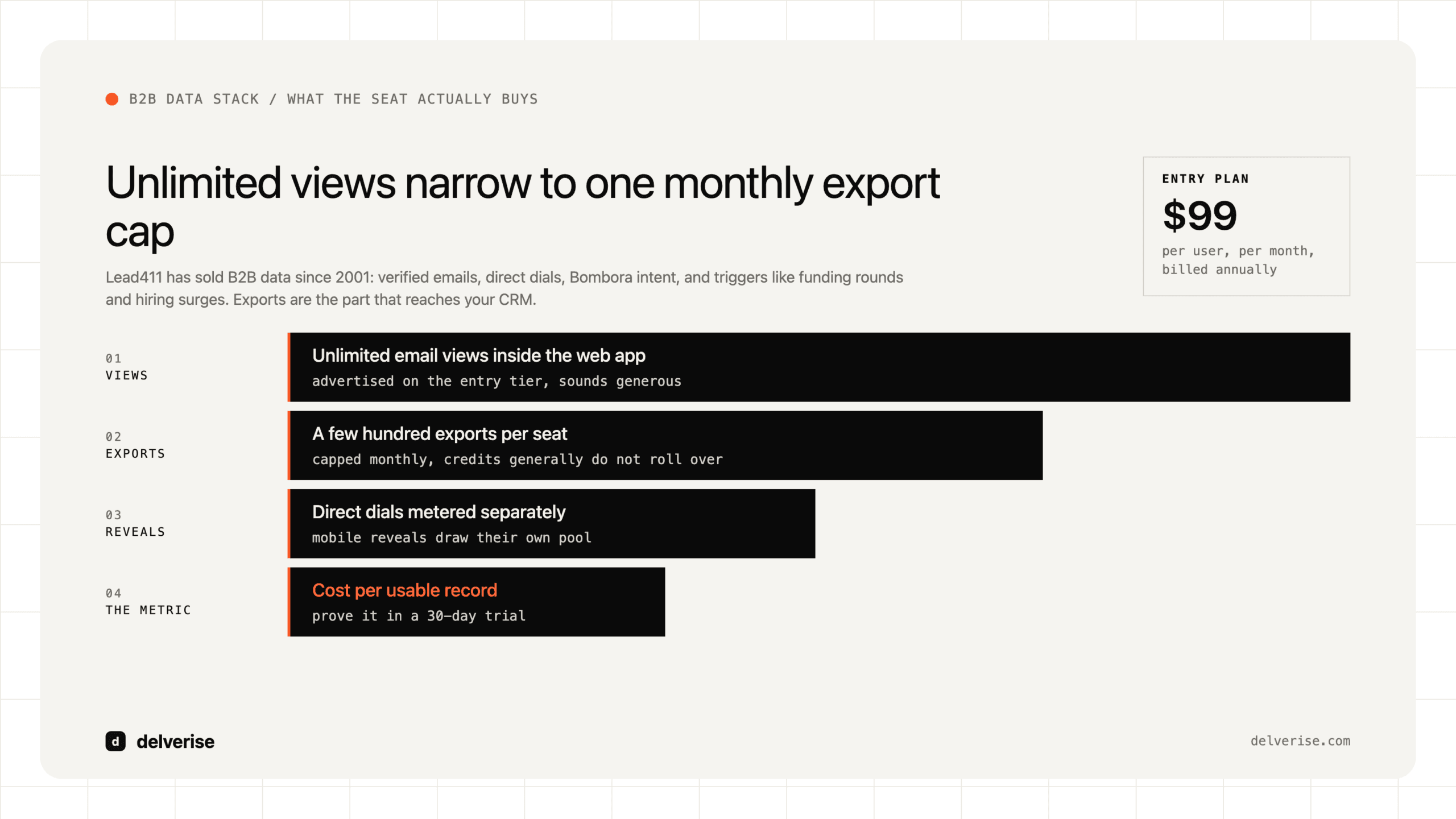
Lead411 publishes a self-serve entry tier at around $99 per user per month on annual billing, which is unusual in a category where most vendors hide behind a demo request. Higher tiers with Bombora intent and larger export allowances are quoted case by case. Confirm current numbers with the vendor before you budget, since data vendors reprice often.

The mechanic that matters is the export cap. The entry plan advertises unlimited email views, which sounds generous until you realize that viewing a record inside the app does nothing for your revenue team. Exporting it into your CRM or sequencer is what creates work, and exports are capped monthly (commonly a few hundred per seat) with credits that generally do not roll over. Direct dial and mobile reveals are often metered separately.
So the honest budgeting question is cost per usable exported record, not cost per seat. Take the annual license, divide by the total exports your plan permits in a year, and then discount that by the share of records your ICP filter will actually accept. That number is comparable across vendors. The sticker price is not.
How does Lead411 compare to ZoomInfo, Apollo, and Cognism?
| Platform | Pricing model | Strongest at | Weakest at |
|---|---|---|---|
| Lead411 | Per seat, annual, published entry tier, monthly export cap | North American contacts, growth triggers, predictable cost, fast setup | International coverage, deeper enterprise workflow features |
| ZoomInfo | Annual enterprise contract, credit-metered, custom quote | Breadth and depth of company data, org charts, enterprise integrations | Cost and contract rigidity at seed and Series A scale |
| Apollo | Self-serve tiers plus credits, free tier available | Bundling data with sequencing and dialing in one tool | Data accuracy varies by segment; bundled sequencer is thinner than a dedicated one |
| Cognism | Annual license, custom quote, phone-verified mobile tier | EMEA coverage and compliance posture, mobile number accuracy | Price and no self-serve entry point |
On G2, Lead411 consistently rates well on value and ease of setup compared with the enterprise incumbents, and reviewers are more mixed on coverage depth outside North America. That pattern matches what teams report in practice. Treat any vendor’s published accuracy percentage as a claim to test, since B2B databases decay continuously as people change jobs, and commonly cited estimates put annual decay somewhere between a quarter and a third of records.
Is Lead411 worth it? A worked example
Take a four-person outbound team at a Series A SaaS company selling a $20,000 ACV product. Four seats on the entry tier costs roughly $4,750 a year. At 200 exports per seat per month, that is 9,600 records annually.

Apply realistic filters. Suppose 60% of exported records survive your ICP and role checks, leaving about 5,760 contacts into sequences. At a 1.2% meeting rate on cold outbound (reasonable for a competent team with a clear offer), that is roughly 69 meetings a year. At a 20% close rate, 14 new customers, or about $280,000 in new ARR.
The arithmetic is illustrative, not a benchmark. What it shows is that the license cost is trivial relative to outcome, and every variable that actually decides the result sits outside the vendor: ICP definition, offer quality, sequence structure, and follow-up discipline. Buying better data raises the ceiling on a system that works. It does very little for a system that does not.
What does Lead411 leave unsolved?
Data is one input in a chain. If you buy a list and your targeting is loose, you have bought a faster way to email the wrong people. Most teams that plateau on outbound have a system problem rather than a data problem, and the specific failures are consistent: no enforced ICP, enrichment that runs once at import and never again, duplicate records across CRM and sequencer, no closed-loop reporting on which source produced which meeting.
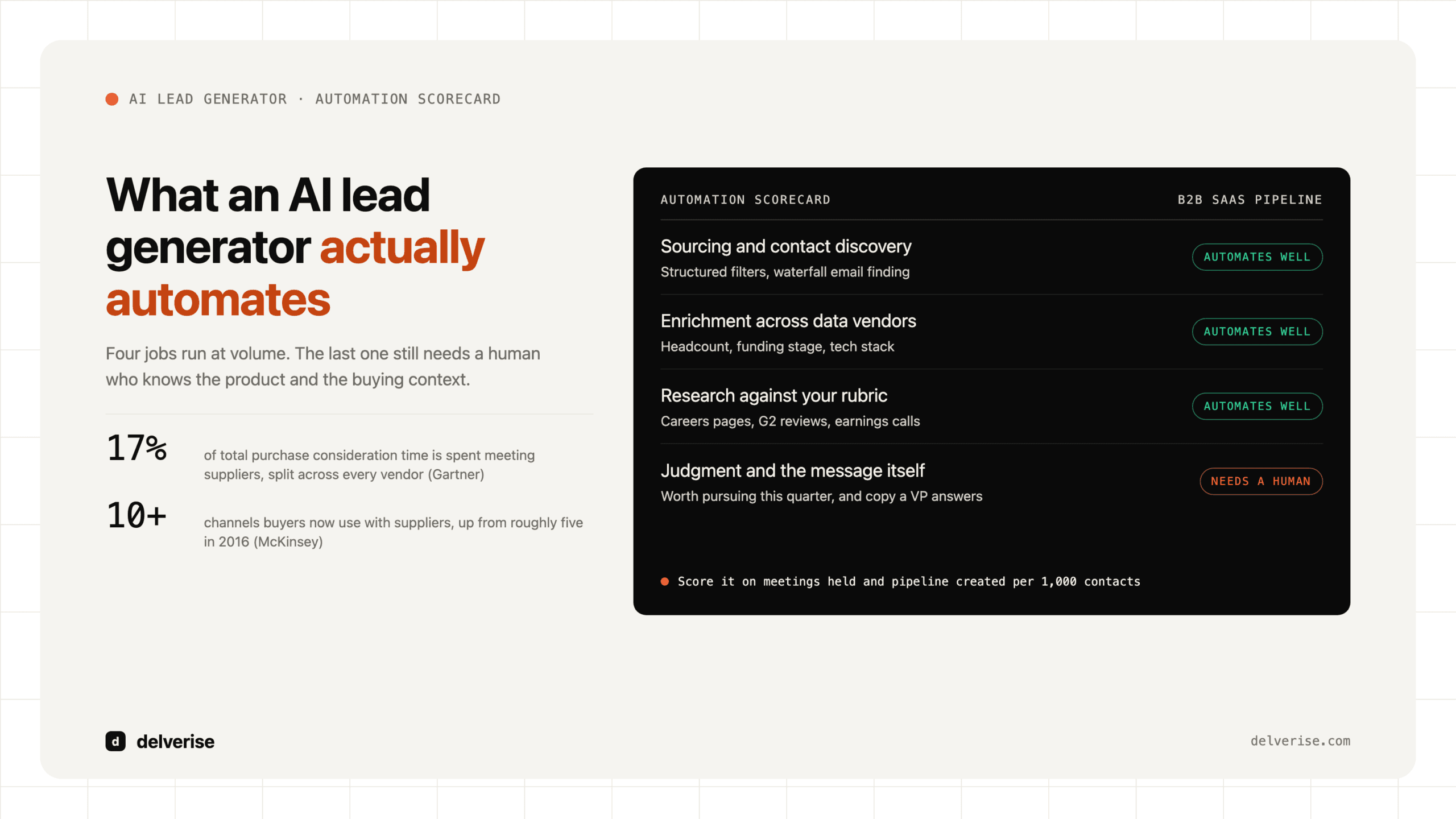
McKinsey’s B2B Pulse research found that buyers now routinely use ten or more channels when interacting with suppliers across a purchase. Single-channel email against a purchased list underperforms in that environment, which is why the sequencing and routing layer matters as much as the record itself. That is the territory covered in how to build a B2B lead generation system and in what to automate and what to keep human in outbound.
The durable version of this is an enrichment layer rather than a single vendor: a waterfall that hits your primary source first, falls back to secondary providers when a field is missing, verifies before send, and re-enriches on a schedule so job changes get caught. Tools like Clay make that orchestration straightforward, and Lead411 slots in as one source inside it. We cover the architecture in CRM enrichment, and the broader stack question in the six foundation pieces under every revenue stack.
How should you run a Lead411 trial?
Thirty days against one real segment will tell you more than any demo. Work the list:
- Define one narrow segment before you log in: industry, employee range, geography, and two target titles.
- Export 200 records in that segment and run every email through an independent verification tool before sending.
- Record the hard bounce rate. Above 3% on verified records is a coverage problem in your segment.
- Dial 50 mobile numbers and log connect rate and wrong-number rate separately.
- Compare the same 100 accounts against your incumbent source and count fields each one filled that the other missed.
- Test the CRM sync on a sandbox and check what it does with existing records: overwrite, append, or duplicate.
- Measure meetings booked per 100 contacts, which is the only number that survives the contract negotiation.
If the numbers hold, negotiate on export volume rather than seat price. Seats are cheap and exports are the constraint.
Frequently Asked Questions
Is Lead411 better than ZoomInfo?
For an early-stage SaaS team selling into North America, Lead411 usually delivers a better cost-to-value ratio, with published entry pricing and no enterprise contract minimum. ZoomInfo wins on data depth, org charts, and enterprise-grade workflow features. If your deal cycle depends on mapping large buying committees, the extra spend can be justified.
How accurate is Lead411 data?
Lead411 publishes high accuracy claims and runs verification on emails and phone numbers, as does every vendor in the category. Accuracy varies sharply by segment: North American mid-market tech tends to be strong, while small businesses, non-English-speaking markets, and non-technology verticals are weaker. Test your own segment and measure bounce rate directly.
Does Lead411 really offer unlimited data?
Unlimited applies to viewing records inside the platform. Exports, which are what your team actually uses, are capped per seat per month, and those credits typically expire monthly. Budget against the export cap.
Does Lead411 integrate with our CRM and sequencer?
Yes for the common stack: Salesforce, HubSpot, Pipedrive, Zoho, Outreach, and Salesloft, plus an API and CSV export for everything else. The integration existing and the integration behaving well under duplicate records are different questions, so test the sync in a sandbox before you turn your team loose on it.
Should we buy a data vendor or build an enrichment system?
Buy the vendor first, since you need records to test anything. Build the system once you know your cost per meeting and where records go stale. A single source becomes a bottleneck around the point where multiple teams depend on the same data, which is when a waterfall with verification and scheduled re-enrichment starts paying for itself. That build is the work delverise does under GTM engineering, and the buying logic for adjacent tooling is covered in how to pick an AI prospecting tool that actually builds pipeline.
Read next