←Back to blog
Revenue Intelligence & Data ToolingGuideSeptember 1, 20268 min read
Outbound Funnel: How B2B SaaS Teams Build One That Actually Converts
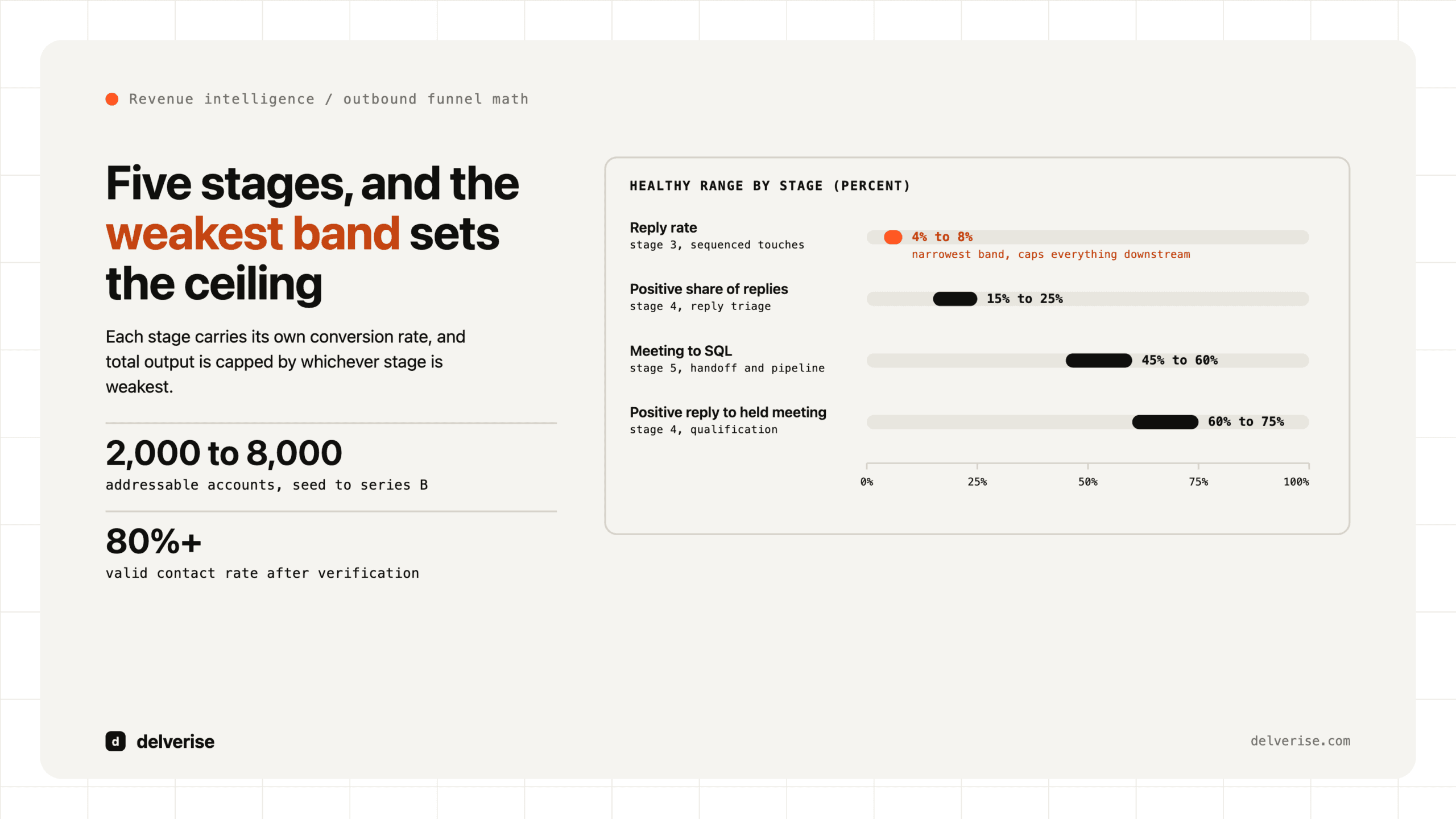
An outbound funnel is the sequenced system a B2B team uses to turn a defined target market into booked revenue: list building, enrichment, targeting, multichannel outreach, qualification, and handoff to sales. Each stage has its own conversion rate, and the funnel’s total output is capped by whichever stage is weakest.
An outbound funnel is the sequenced system a B2B team uses to turn a defined target market into booked revenue: list building, enrichment, targeting, multichannel outreach, qualification, and handoff to sales. Each stage has its own conversion rate, and the funnel’s total output is capped by whichever stage is weakest.
Key takeaways
- An outbound funnel is a measurable system with five stages, each with its own conversion rate and its own failure mode.
- Most teams diagnose outbound as a copy problem when the math points to data quality or targeting two stages upstream.
- Gartner’s research on B2B buying found that buyers spend roughly 17% of their purchase journey with all potential suppliers combined, so a single sequence rarely carries a deal.
- Realistic top-of-funnel benchmarks: 4% to 8% reply rates on well-targeted sequences, 15% to 25% of those replies positive, 60% to 75% of positive replies converting to a held meeting.
- The stack matters less than the instrumentation. If you cannot see stage-by-stage conversion, you cannot fix anything.
What is an outbound funnel, and how does it differ from an inbound funnel?
An inbound funnel captures demand that already exists: someone searches, lands on your site, and raises a hand. An outbound funnel manufactures the first contact. You choose the accounts, choose the people, and initiate the conversation before the buyer has signaled anything.

That difference changes the economics. Inbound conversion rates are higher because intent is already present. Outbound gives you control over which accounts enter the system at all, which is why it remains the primary pipeline engine for B2B SaaS companies selling into a defined market of a few thousand accounts. The tradeoff is that every stage of an outbound funnel is something you build and maintain rather than something you observe.
The practical implication for a revenue leader: outbound performance is a systems output. When it underperforms, the cause is usually structural, and structural causes are diagnosable. Our guide to B2B prospecting covers the account-selection layer that sits underneath all of this.
What are the stages of an outbound funnel?
Five stages, each with a metric you should be able to pull on demand.

| Stage | What happens | Primary metric | Healthy range | Most common failure |
|---|---|---|---|---|
| 1. Market definition | ICP criteria translated into a queryable account list | Total addressable accounts | 2,000 to 8,000 for a Seed to Series B motion | ICP defined in a slide, never in a query |
| 2. Data and enrichment | Contacts sourced, verified, enriched with buying signals | Valid, deliverable contact rate | 80%+ after verification | Stale data burning domain reputation |
| 3. Outreach | Sequenced touches across email, phone, LinkedIn | Reply rate | 4% to 8% | Volume raised before targeting is fixed |
| 4. Qualification | Replies triaged, meetings booked and held | Positive reply to held meeting | 60% to 75% | Slow response, no routing logic |
| 5. Handoff and pipeline | Meeting becomes a qualified opportunity in CRM | Meeting to SQL | 45% to 60% | No shared definition of qualified |
Define terms carefully here, because teams argue past each other otherwise. A positive reply is any response expressing interest or asking a question that moves the conversation forward. A held meeting is one that actually occurred, not one that was booked. An SQL is a meeting where the prospect has a problem you solve, a rough timeline, and access to budget. Write those three definitions down before you measure anything.
What does healthy outbound funnel math look like?
Here is a worked example for a Series A SaaS company with a $30,000 average contract value.

- 4,000 accounts match the ICP. Three relevant contacts per account gives 12,000 raw contacts.
- After verification and suppression, 82% are valid and deliverable: 9,840 sendable contacts.
- A four-touch sequence produces a 6% reply rate: 590 replies.
- 22% of those replies are positive: 130 conversations worth having.
- 65% convert to a held meeting: 84 meetings.
- 55% become qualified opportunities: 46 SQLs.
- At a 20% close rate, that is 9 deals, or roughly $276,000 in new ARR from one quarter of the list.
Now run the sensitivity. Lifting the reply rate from 6% to 7% adds about 1.5 deals. Lifting contact validity from 82% to 92% adds roughly the same. Improving positive-reply-to-meeting from 65% to 75% adds about 1.4 deals and costs nothing beyond faster response and better routing. The lesson repeats across companies: three modest improvements at different stages beat one heroic improvement at a single stage, and the cheapest wins usually sit in data quality and response speed rather than in copy.
Harvard Business Review’s coverage of the lead response research found that firms responding to a new lead within an hour were several times more likely to qualify it than firms that waited longer. That study looked at inbound web leads, and the mechanism carries directly to outbound replies: attention decays fast, and a reply sitting overnight is a meeting you paid for and did not collect.
Why do most outbound funnels stall?
Three structural causes, in the order we usually find them.
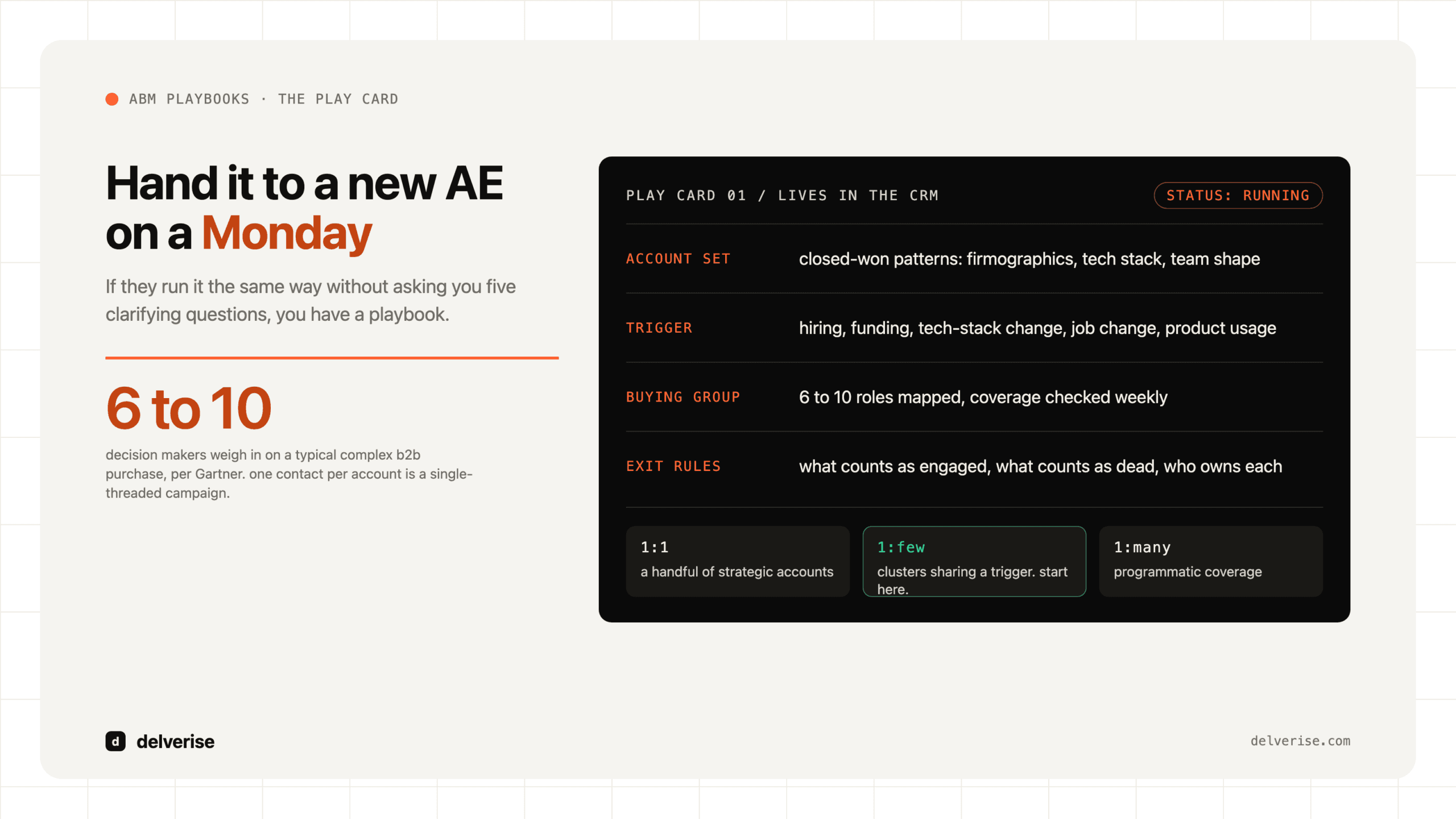
Targeting is too broad for the message. Gartner’s research on complex B2B purchases found that a typical buying group involves six to ten decision makers, each arriving with their own information. If your sequence speaks to a generic persona, it lands with none of them. Narrower segments with sharper messaging almost always outperform broad lists at the same send volume.
Data decays faster than the system refreshes it. Contact data degrades meaningfully every year through job changes alone. A list built once and reused for four quarters is a deliverability problem waiting to happen. Our breakdown of what lead gen data revenue teams actually need covers how to think about refresh cycles and provider coverage overlap.
Single-channel dependence. McKinsey’s work on B2B buying behavior found that buyers now use around ten channels across a decision journey, roughly double what they used a decade ago, and that they move fluidly between self-service, remote, and in-person interactions. An email-only funnel is competing for a shrinking slice of buyer attention. Adding phone and LinkedIn to the same sequence, orchestrated against the same account, typically raises effective reply rates without raising email volume at all.
What does the tooling stack look like at each stage?
Vendor choice is downstream of architecture. Decide what each layer must do, then pick tools.
Data and enrichment. Waterfall enrichment across several providers beats any single source, because coverage varies sharply by geography and company size. Clay is the common way teams orchestrate this: it chains providers, applies conditional logic, and writes clean records into CRM. It is genuinely good at this, and it is also easy to overspend on if you run enrichment without conditional gating. If you want that built and governed properly, delverise’s Clay implementation work is where teams usually start. Compare providers directly in our guide to B2B email list providers.
Sequencing and execution. Sales engagement platforms handle multichannel cadence, task management, and reply detection. The Outreach vs Salesloft comparison walks through which fits which team shape.
Orchestration and reporting. This is the layer most teams skip, and it is the one that determines whether you can diagnose anything. You need stage timestamps written back to CRM so conversion rates are queryable without a spreadsheet exercise. Our overview of the GTM tech stack covers how these layers fit together, and delverise’s AI outbound systems page covers what automation reasonably handles at each stage.
How do you know whether to build this in-house or bring in help?
Run this check before hiring another SDR or buying another tool:
- You can pull reply, positive reply, meeting held, and SQL rates for last quarter in under ten minutes
- Your ICP exists as a saved query with firmographic and technographic filters, not only as a description
- Contact records carry a verification date and a source, and anything older than 90 days is re-verified before send
- Inbound replies route to an owner within one business hour during working days
- Sales and marketing share one written definition of a qualified opportunity
- Domain health, bounce rate, and spam complaints are monitored weekly, not investigated after a drop
Fewer than four checked means your constraint is systems, and adding headcount will scale the existing conversion rates rather than improve them. delverise builds this layer for B2B SaaS teams from Seed through Series B: the data architecture, the enrichment logic, the routing, and the reporting that makes every stage visible. Compare that path against hiring in our post on go-to-market consultants versus building in-house.
Frequently Asked Questions
How long does it take a new outbound funnel to produce pipeline?
Plan on 60 to 90 days to first qualified opportunities and about two full sales cycles before the conversion rates are stable enough to forecast against. Domain warmup alone takes three to four weeks before meaningful volume is safe, and the first six weeks of reply data are too thin to draw conclusions from.
What reply rate should we expect from cold outbound?
4% to 8% on a well-targeted sequence into a defined ICP, with 15% to 25% of those replies positive. Anything above 10% usually means a very narrow segment or a strong trigger event. Below 2% points to a targeting or data problem rather than a copy problem, and rewriting emails will not move it.
How many contacts per account should we sequence?
Two to four, sequenced together rather than sequentially. Given that complex purchases involve six to ten stakeholders, multi-threading from the first touch raises the odds that one person forwards your message internally. Sending to a single contact and waiting is the most common structural cap on outbound funnel output.
Does AI meaningfully improve outbound funnel conversion?
It helps most in research and personalization at scale, where it can read a prospect’s site, funding news, or job postings and produce a specific opening line. It helps least at strategy, where segment choice and offer still require human judgment. Our review of AI powered lead generation covers what genuinely automates today.
Should we fix the outbound funnel or hire more SDRs first?
Fix the funnel. Adding reps multiplies your current conversion rates across more volume, including the bad ones. A team converting 4% of replies to meetings will still convert 4% with twice the headcount, at twice the cost. Instrument the stages, find the weakest one, fix it, then scale the motion that works.
Read next