←Back to blog
Revenue Intelligence & Data ToolingGuideAugust 23, 20268 min read
AI Cold Calling Agent: What It Actually Does and Where It Breaks
An AI cold calling agent is software that places outbound sales calls, speaks with a synthetic voice, handles objections in real time, and logs the outcome to your CRM. It works for high-volume qualification and list cleaning. It struggles with complex discovery, and US regulators treat AI voices as artificial under the TCPA.
An AI cold calling agent is software that places outbound sales calls, speaks with a synthetic voice, handles objections in real time, and logs the outcome to your CRM. It works for high-volume qualification and list cleaning. It struggles with complex discovery, and US regulators treat AI voices as artificial under the TCPA.
Key takeaways
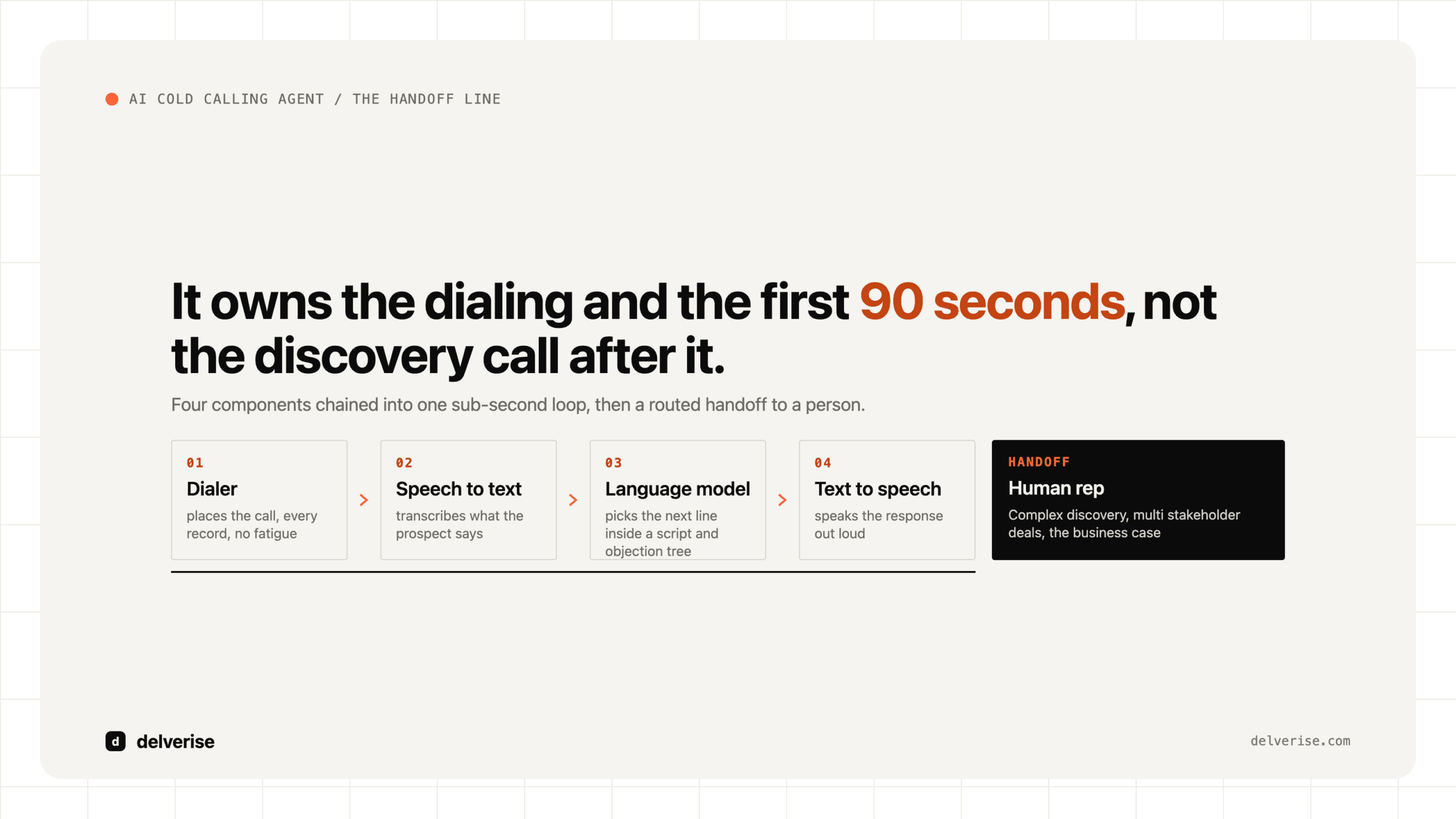
- An AI cold calling agent replaces the dialing and the first 90 seconds of a conversation, not the discovery call that follows it.
- The technology is mature enough to hold a natural conversation. The constraint is usually your list quality and your routing, not the voice model.
- The FCC ruled in February 2024 that AI-generated voices in robocalls count as artificial under the TCPA, which changes your consent and disclosure obligations.
- Best-fit use cases: reactivating dormant leads, speed-to-lead on inbound, qualifying event lists, and verifying data at scale.
- Worst-fit use cases: cold enterprise outbound, multi-stakeholder deals, and anything where the first call is the differentiator.
- Judge it on held meetings and pipeline created per dollar, not on dial volume or talk time.
What is an AI cold calling agent, exactly?
An AI cold calling agent (sometimes called a voice AI SDR or AI voice agent) chains four components: a dialer that places the call, a speech-to-text layer that transcribes what the prospect says, a language model that decides what to say next inside a defined script and objection tree, and a text-to-speech layer that speaks the response. Round-trip latency of under a second is what makes it feel like a conversation instead of an IVR menu.
The category overlaps heavily with AI BDR software, and many vendors sell both under one subscription. The practical difference is channel: email agents get asynchronous forgiveness, voice agents get five seconds before someone hangs up.
What it does well is narrow and real. It dials every record on a list without fatigue, it never skips the follow-up cadence, it transcribes and structures every call, and it works at 6 a.m. or 8 p.m. in whatever time zone the record sits in. What it does not do is build a relationship or improvise a business case on the fly.
Where does an AI cold calling agent actually work?
The strongest results show up where the call is short, the qualifying question is binary, and the volume is too high for a human team to cover economically.

- Speed-to-lead on inbound. The classic HBR study on online sales leads found that firms contacting a lead within an hour were roughly seven times more likely to have a meaningful conversation with a decision maker than those that waited even two hours. A voice agent can call in under 60 seconds, every time. This is the single highest-ROI deployment we see, and it pairs directly with the process work in lead follow up.
- Dormant lead reactivation. Six thousand closed-lost and no-decision records that no human will ever call again. An agent works the list, finds the 2 percent whose situation changed, and routes them to a rep.
- List verification and enrichment. Confirming a title, a tech stack, or whether someone still works there. Cheap, unglamorous, and it makes every downstream channel better.
- Event and webinar follow-up. High intent, short shelf life, predictable script.
Notice what these share: the prospect has already signaled something. The agent is confirming and routing, which is a job with a clear right answer.
Where does it break?
Three failure modes account for most disappointing pilots.

The list is the problem. A voice agent applied to a bad list produces bad calls faster. If your connect rate is 3 percent because the mobile numbers are stale and the ICP filter is loose, automating the dialing multiplies the waste. Fixing the input layer comes first, which is why we treat prospecting list construction as the prerequisite rather than the afterthought.
Complex sales resist scripting. Gartner’s research on B2B buying found that buyers spend only about 17 percent of the total purchase journey meeting with potential suppliers, and that time gets split across every vendor in consideration. When a rep’s share of attention is that thin, the first live conversation carries enormous weight. Handing it to a synthetic voice on a six-figure enterprise deal trades a scarce asset for a cost saving.
Compliance is not a footnote. In February 2024 the FCC issued a declaratory ruling confirming that AI-generated voices in robocalls are artificial under the Telephone Consumer Protection Act. That brings consent requirements, DNC obligations, and state-level rules into scope. Several states also require all-party consent for call recording. Get your counsel involved before the pilot, not after the first complaint. Nothing here is legal advice.
There is also a quieter issue: timing. Batch calling has the same blind spot as batch emailing, which is that it fires on your calendar instead of the buyer’s. We wrote about that specific failure in why cold email cannot see buying timing, and voice inherits it wholesale unless you trigger calls off signals.
How does it compare to a human SDR or an AI-assisted dialer?
| Dimension | AI cold calling agent | Human SDR | AI-assisted human dialing |
|---|---|---|---|
| Cost per conversation | Lowest | Highest | Middle |
| Daily dial capacity | Effectively unlimited | 60 to 120 | 200 to 400 |
| Handles unscripted objections | Weak | Strong | Strong |
| Consistency of message | Perfect | Variable | Good |
| Compliance exposure | High, requires disclosure | Standard | Standard |
| Best fit | Speed-to-lead, reactivation, verification | Enterprise, multi-threaded deals | Mid-market volume outbound |
| Time to first value | 2 to 4 weeks | 8 to 12 weeks | 2 to 3 weeks |
Most teams under Series B get more from the third column than the first. A parallel dialer plus AI-generated call prep and automatic logging raises a human rep’s effective capacity three or four times without touching the conversation itself. Compare that against the broader category map in our AI sales tools buyer’s guide before you commit budget.

What does the math look like on a real list?
Illustrative planning numbers for a 3,000-record reactivation campaign, using conservative mid-market assumptions:
- 3,000 records, dialed twice each: 6,000 attempts
- Connect rate of 5 percent: 300 live conversations
- Of those, 55 percent are the right person and stay on past the disclosure: 165 qualified conversations
- Meeting acceptance of 7 percent: 12 booked
- Show rate of 65 percent: 8 held meetings
- At typical per-minute voice agent pricing plus platform fees, the run costs roughly $1,500 to $2,500 all in
Eight held meetings from a dead list for around $250 each is a good outcome. That same spend buys you about two weeks of a junior SDR’s fully loaded cost. The comparison only holds if the meetings convert at a similar rate, so track opportunity creation from AI-sourced meetings separately from human-sourced ones for at least a quarter. If they convert at half the rate, your real cost per opportunity doubles and the case may collapse.
What has to be true before you turn one on?
The voice agent is the last thing you build. Everything upstream determines whether it produces pipeline or noise.
- A defined ICP with a written disqualification rule, so the agent knows what to reject
- Verified mobile and direct-dial coverage above 60 percent on the target list
- A signal or trigger that justifies the call today rather than any other day
- CRM fields that can receive a call outcome, a transcript link, and a disposition code
- Instant routing to a human calendar the moment the agent gets a yes
- Written disclosure language and a consent posture reviewed by counsel
- A human review loop on the first 200 transcripts before you scale volume
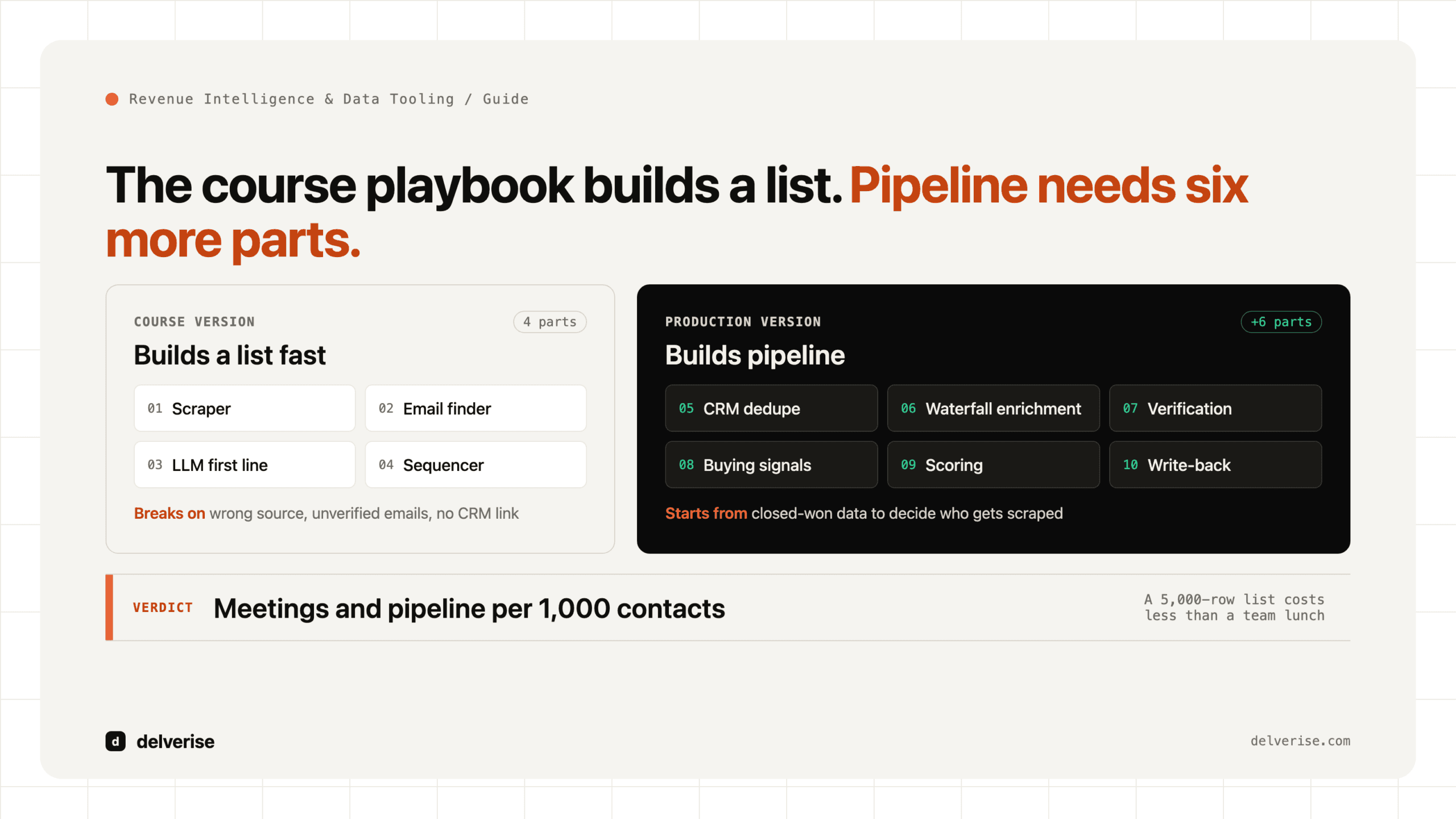
The data layer is where most of this work lives. Building the trigger logic, the enrichment waterfall, and the routing rules is exactly the kind of job Clay handles well, since it lets you assemble list construction, waterfall enrichment, and signal detection in one place and push clean records to the calling layer. delverise is a Clay First 100 Solutions Partner and builds these pipelines for revenue teams; if you want the implementation done rather than described, start at our Clay partner page or our AI outbound overview.
One honest tradeoff: Clay is a build-it tool, and it rewards teams willing to own the logic. If nobody on your side wants to maintain a table, a simpler point solution will serve you better.
What should you measure in the first 60 days?
Dial volume and talk minutes are vanity. Four numbers decide whether the program survives.
- Qualified conversation rate: live connects where the right person engaged past the opener, divided by connects. Below 40 percent means the script or the list is wrong.
- Held meeting rate: meetings that actually happened, divided by booked. AI-booked meetings historically no-show more than human-booked ones, so watch this closely.
- Opportunity conversion, segmented by source: the only number that proves the meetings are real.
- Complaint and opt-out rate: a leading indicator of brand damage and regulatory risk.
McKinsey’s B2B Pulse research has consistently found that buyers now move across roughly ten interaction channels during a purchase decision, and that they punish inconsistency across them. A voice agent that contradicts your website or your email sequence costs more than it earns. Treat it as one instrument in the system rather than a standalone growth lever.
Frequently Asked Questions
Do prospects know they are talking to an AI?
They usually figure it out within 20 to 30 seconds, and increasingly they ask directly. The honest and safer approach is to disclose up front. Under the FCC’s 2024 ruling, AI-generated voices in robocalls fall under TCPA restrictions, and several states have added their own disclosure requirements. Vendors that market undetectable voices are selling you risk.
Will an AI cold calling agent replace my SDR team?
For teams selling five-figure deals into complex accounts, no. It replaces the dialing, the voicemail drops, and the first qualifying question, which frees SDRs to spend their time on live conversations and multi-threading. Teams that cut headcount first and deploy the agent second usually end up rebuilding the team within two quarters.
How much does one cost?
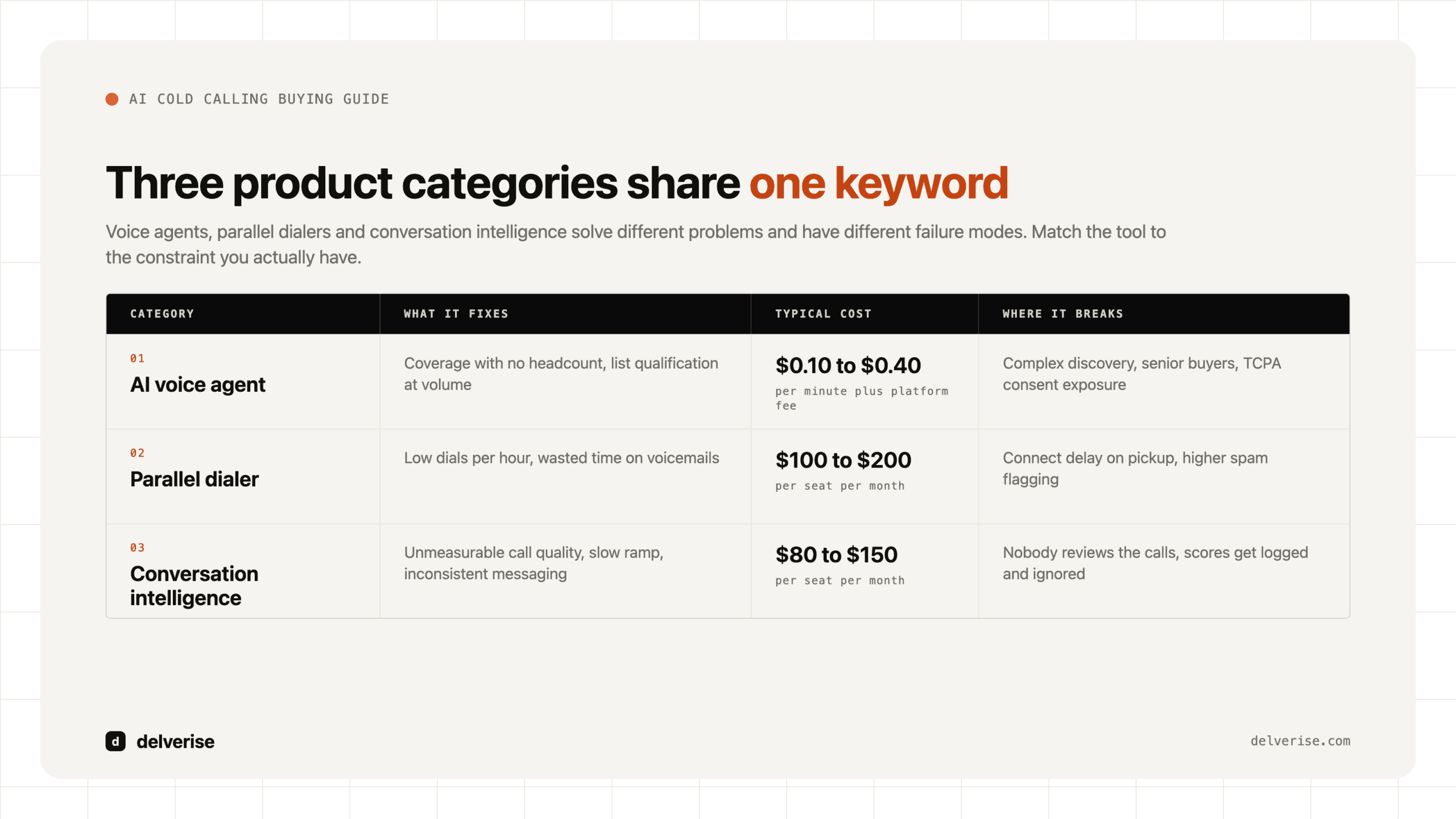
Most vendors price per minute of connected conversation, commonly in the $0.10 to $0.25 range, plus a platform fee between $500 and $3,000 per month depending on concurrency and integrations. Budget separately for phone numbers, data enrichment, and the engineering time to connect it to your CRM, which is often the larger line item.
What is the difference between an AI cold calling agent and a power dialer?
A power dialer places calls and connects a human when someone answers. An AI cold calling agent places the call and conducts the conversation itself. Power dialers raise a rep’s throughput; voice agents remove the rep from the first conversation entirely. Many mid-market teams get better economics from the dialer.
What is the fastest way to test one without wasting a quarter?
Pick your dormant lead list, cap it at 500 records, write one script with three objection branches, and review every transcript from the first week yourself. You will know inside ten business days whether the conversations are real. Run it against a matched human-called control group so you can attribute the difference honestly.
Read next