←Back to blog
Revenue Intelligence & Data ToolingGuideJuly 28, 20268 min read
Lead Follow Up: How B2B SaaS Teams Turn Speed and Context Into Pipeline
Lead follow up is the system that decides who contacts a new lead, how quickly, with what context, and how many times before the record is closed out. In B2B SaaS, three variables drive the result: response time, routing accuracy, and message relevance. Most revenue lost at this stage is operational, and it is measurable.
Lead follow up is the system that decides who contacts a new lead, how quickly, with what context, and how many times before the record is closed out. In B2B SaaS, three variables drive the result: response time, routing accuracy, and message relevance. Most revenue lost at this stage is operational, and it is measurable.
Key takeaways
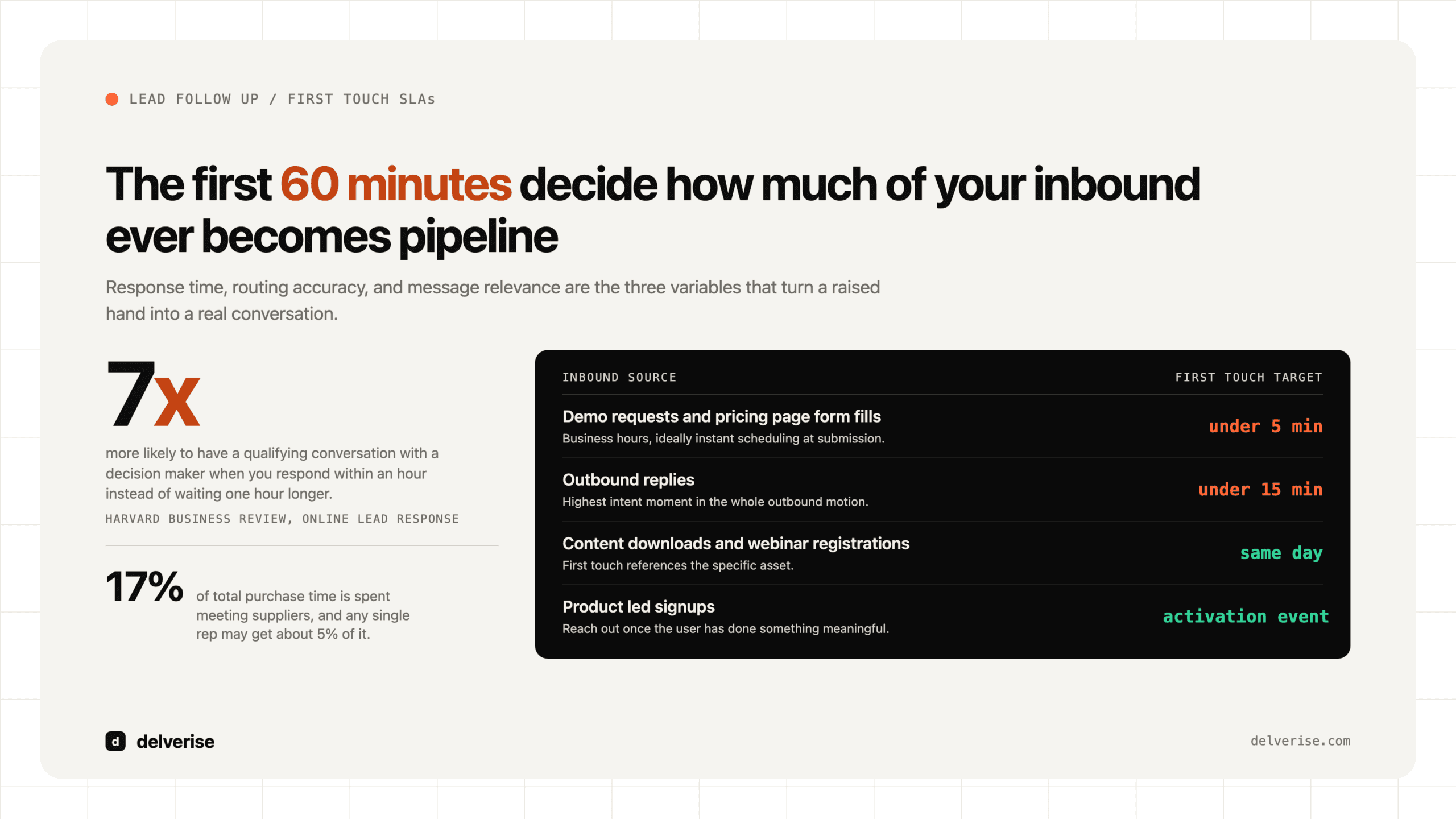
- Speed compounds. Harvard Business Review’s study of online lead response found companies that responded within an hour were about seven times more likely to have a qualifying conversation with a decision maker than those that waited even one hour longer.
- Routing errors cost more than slow reps. A lead sitting in the wrong queue, or assigned to a territory owner who is on PTO, never gets a fair first touch.
- Context beats cadence length. Two well-researched touches out-convert eight generic ones on high-intent inbound.
- Follow up is a data problem before it is a sales problem. Enrichment, scoring, and routing logic determine what the rep sees when the alert fires.
- Measure per-source response time and touch completion rate, not just aggregate reply rate.
What is lead follow up, and why does it decide more revenue than lead volume?
Lead follow up covers everything that happens between a person raising their hand and a real conversation starting: capture, enrichment, scoring, routing, first touch, and the sequence of attempts that follows. Every one of those steps is a place where a qualified buyer quietly disappears.

The economics are unforgiving at Seed to Series B. If you generate 400 inbound leads a month and 25% of the genuinely qualified ones never receive a second attempt, you are funding demand generation to produce records nobody works. Adding more top-of-funnel spend on top of that gap multiplies the waste. Fixing follow-up mechanics is usually the cheapest pipeline available, because the demand is already paid for.
Buyer behavior makes this sharper. Gartner’s research on the B2B buying journey found buyers spend roughly 17% of their total purchase time meeting with potential suppliers, and when they are comparing several vendors, any single rep may get about 5% of that time. The window you get is small, so the first interaction has to land while intent is still hot. That is also why lead scoring matters here: it determines which leads earn a human first touch versus an automated one.
How fast does lead follow up actually need to be?
Fast enough that the buyer is still on your site or still thinking about you. The HBR research on online sales leads remains the most cited benchmark: response inside 60 minutes changed qualification odds by roughly 7x versus responding an hour later, and by a much larger multiple versus waiting a full day. Despite that being public since 2011, median response times across B2B SaaS are still measured in hours or days.

Practical targets that hold up in the field:
- Demo requests and pricing page form fills: under 5 minutes during business hours, ideally instant scheduling at the point of submission.
- Content downloads and webinar registrations: same day, with the first touch referencing the specific asset.
- Product-led signups: triggered on an activation event rather than on signup itself, so the rep reaches out when the user has done something meaningful.
- Outbound replies: under 15 minutes. A reply to a cold email is the highest-intent moment in the entire outbound motion, and it is routinely the slowest-served.
Speed without context creates a different failure. A five-minute call that opens with “I saw you downloaded our whitepaper” wastes the moment. The goal is a fast first touch that already knows the account size, the tech stack, the likely use case, and whether anyone else at that company has engaged in the last 90 days.
What breaks lead follow up in most B2B SaaS teams?

The failure modes repeat across companies at this stage:
- Silent routing failures. Territory rules that never got updated after the last headcount change, round robin that keeps assigning to a rep who left, form fills landing in a CRM queue nobody owns.
- Enrichment gaps at the moment of truth. A form captures an email and nothing else, so the rep spends ten minutes researching before touching a lead that needed a response in five.
- Sequence abandonment. Most teams complete two or three attempts against a documented cadence of eight. Nobody notices because the CRM records the sequence as “in progress” forever.
- No definition of a closed loop. Leads sit in “working” status indefinitely, which makes conversion math meaningless and hides the size of the problem.
- Channel monoculture. McKinsey’s B2B Pulse research found buyers now use around ten channels across a decision journey. Email-only follow up matches how the seller is organized rather than how the buyer behaves.
Almost none of these are motivation problems. They are systems problems, which means they respond to instrumentation. If you are unsure who should own the fix internally, our breakdown of what each go-to-market role actually owns is a useful reference point.
What should follow up look like by lead type?
| Lead type | Target first response | First touch owner | Cadence shape | Primary risk |
|---|---|---|---|---|
| Demo request | Under 5 minutes | AE or senior SDR | 3 channels, 5 touches, 8 days | Slow routing kills a ready buyer |
| Pricing page visit (identified) | Same day | SDR | 4 touches, 10 days, account-level | Reaching the researcher, not the buyer |
| Content download | 24 hours | Automated, human on score threshold | Nurture plus 2 human touches | Over-investing rep time in low intent |
| PLG signup | On activation event | Automated, then AE | Usage-triggered, 3 touches | Contacting before value is felt |
| Outbound reply | Under 15 minutes | Sequence owner | Conversational, no cadence | Reply handled like a new cold lead |
| Event or webinar | 48 hours | SDR | 5 touches, 14 days | Generic “great to meet you” messaging |
The pattern to notice: response targets should track intent, and rep time should be rationed by score. Treating every lead identically is how teams end up slow on the leads that mattered.
What does a working lead follow up system look like end to end?
Here is a concrete build for a Series A company handling roughly 400 inbound leads and 150 outbound replies per month.
1. Capture and normalize. Every form, chat, calendar booking, and signup writes to one object model in the CRM with a consistent source field. Without this, per-source response time is uncomputable.
2. Enrich on arrival. Within seconds of capture, append firmographics, headcount, funding stage, tech stack, and any known account history. Teams building this layer often start in Clay, which chains multiple data providers so match rates hold up on smaller or non-US accounts. The honest tradeoff: credit costs climb quickly if you enrich indiscriminately, so gate enrichment behind a minimum fit check. If you want the pattern implemented against your CRM, that is what our Clay partner work covers.
3. Score and route in the same step. Fit plus intent produces a tier. Tier determines the queue, the SLA, and whether a human touches it at all. Route on the enriched record, never on the raw form.
4. Alert with context, not just notification. The Slack alert should carry the account summary, the page path, prior touches, and a suggested opener. A rep who has to open three tabs before calling will not hit a five-minute SLA.
5. Enforce the cadence in the system. Overdue tasks escalate to a manager view after 24 hours. Leads auto-close to a nurture status after the cadence completes, which keeps the funnel math honest.
6. Report weekly on SLA compliance by source and by rep. This is the control loop. Everything above degrades without it.
A build like this typically takes a few weeks of focused engineering across the CRM, enrichment layer, and alerting. It is the same class of work described in our GTM engineering practice, and it usually pays back faster than any new demand channel.
Which metrics prove lead follow up is working?
- Median and 90th percentile first response time, split by source
- Percentage of leads receiving the full documented cadence
- Lead-to-meeting-held conversion rate by tier
- Percentage of leads with complete enrichment at time of first touch
- Routing error rate: leads reassigned or untouched after 24 hours
- Reactivation rate from the nurture pool back into active pipeline
Track the 90th percentile, not just the median. Medians hide the tail where your largest deals often sit. For the broader measurement frame, our guide to B2B funnel conversion benchmarks puts these numbers in context.
Should you automate lead follow up with AI?
Partially, and with clear boundaries. AI handles the mechanical layer well: drafting a first-touch email from enriched context, summarizing account history, transcribing and logging calls, flagging stalled sequences. Those are safe, high-return applications.
Where it degrades is autonomous multi-touch conversation with high-value accounts. Buyers recognize generated follow up quickly, and a mistimed automated nudge on a six-figure opportunity costs more than the labor it saved. A reasonable default: automate research, drafting, and enforcement; keep human judgment on which accounts get pursued and how hard. Our assessment of AI sales assistants goes deeper on where the line sits, and the lead intelligence platform guide covers the data layer these tools depend on.
Frequently Asked Questions
How many follow-up attempts should a B2B SaaS team make?
For qualified inbound, five to eight touches across email, phone, and LinkedIn over 8 to 14 days is a reasonable range. The number matters less than completion: most teams document eight and complete three. Fix completion rate before extending the cadence.
What is a realistic speed-to-lead target for a Series A team?
Under five minutes for demo and pricing requests during business hours, same day for lower-intent inbound. Hitting five minutes reliably requires automated routing and context-rich alerts, since manual triage alone cannot sustain it.
Should marketing or sales own lead follow up?
Ownership should sit with whoever owns the handoff SLA, usually RevOps or a marketing operations lead, with sales accountable for touch execution. The common failure is treating the handoff as a boundary rather than a monitored process with a named owner on both sides.
How do we handle leads that go cold without losing them?
Close them to a defined nurture status with a re-entry trigger tied to a real signal: a new pricing page visit, a funding round, a relevant job posting, or a champion changing companies. Reactivated leads often convert better than net-new because the account already knows you.
Does better enrichment actually improve follow-up conversion?
Yes, when it changes what the rep says. Enrichment that only fills CRM fields adds cost with no lift. Enrichment that surfaces a specific, verifiable reason to reach out now improves reply rates measurably, which is why the data layer and the messaging layer should be designed together.
Read next