←Back to blog
Revenue Intelligence & Data ToolingGuideNovember 14, 20268 min read
AI Lead Follow Up: What to Automate and What Still Needs a Human
AI lead follow up is the use of automation and language models to respond to inbound and outbound leads within minutes, enrich and qualify them against real firmographic and behavioral data, and sustain a relevant conversation until a human should take the call. It produces pipeline when routing, data, and handoff rules are built first, and it produces noise when they are not.
AI lead follow up is the use of automation and language models to respond to inbound and outbound leads within minutes, enrich and qualify them against real firmographic and behavioral data, and sustain a relevant conversation until a human should take the call. It produces pipeline when routing, data, and handoff rules are built first, and it produces noise when they are not.
Key takeaways
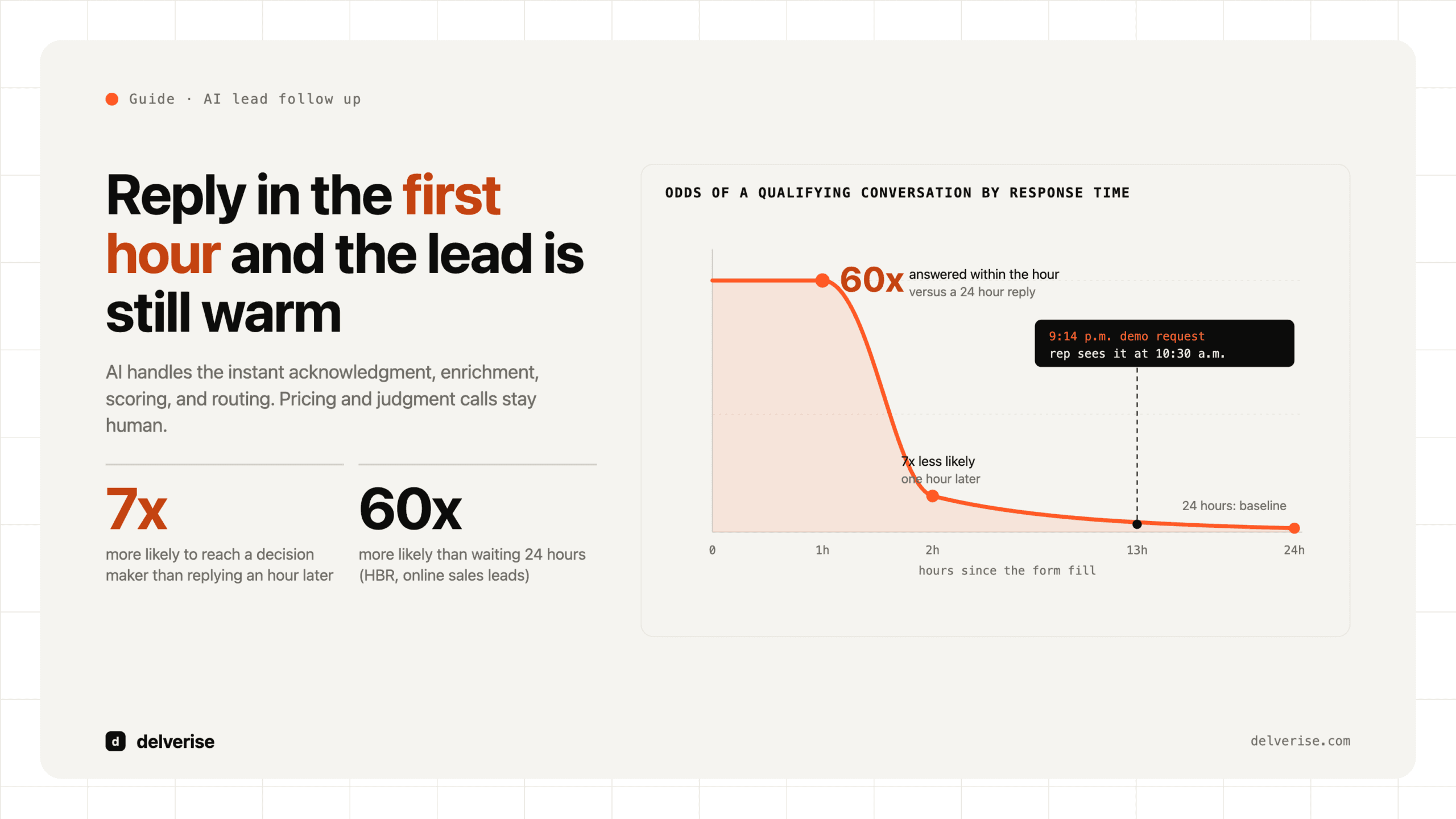
- Speed is the highest-leverage variable. Harvard Business Review’s research on online sales leads found that companies responding within an hour were roughly seven times more likely to have a qualifying conversation with a decision maker than those responding an hour later, and about sixty times more likely than those waiting 24 hours.
- AI is best at the mechanical layer: instant acknowledgment, enrichment, scoring, routing, drafting, and logging. Judgment calls, pricing conversations, and multi-threading stay human.
- Most follow-up failures trace back to data and ownership rules, so fixing copy alone rarely moves the number.
- Gartner’s research on B2B buying puts the share of the journey spent with all potential suppliers combined at around 17 percent, which means your follow-up window is narrow and your context needs to be right the first time.
- Measure follow up with median and 90th-percentile speed to first touch, coverage rate, and meeting rate by source, then trace those into win rate.
What does AI lead follow up actually mean?
Follow up covers every touch after a lead raises a hand or replies: the acknowledgment, the qualification, the scheduling attempt, and the sequence of reminders when someone goes quiet. AI enters that flow in four places.

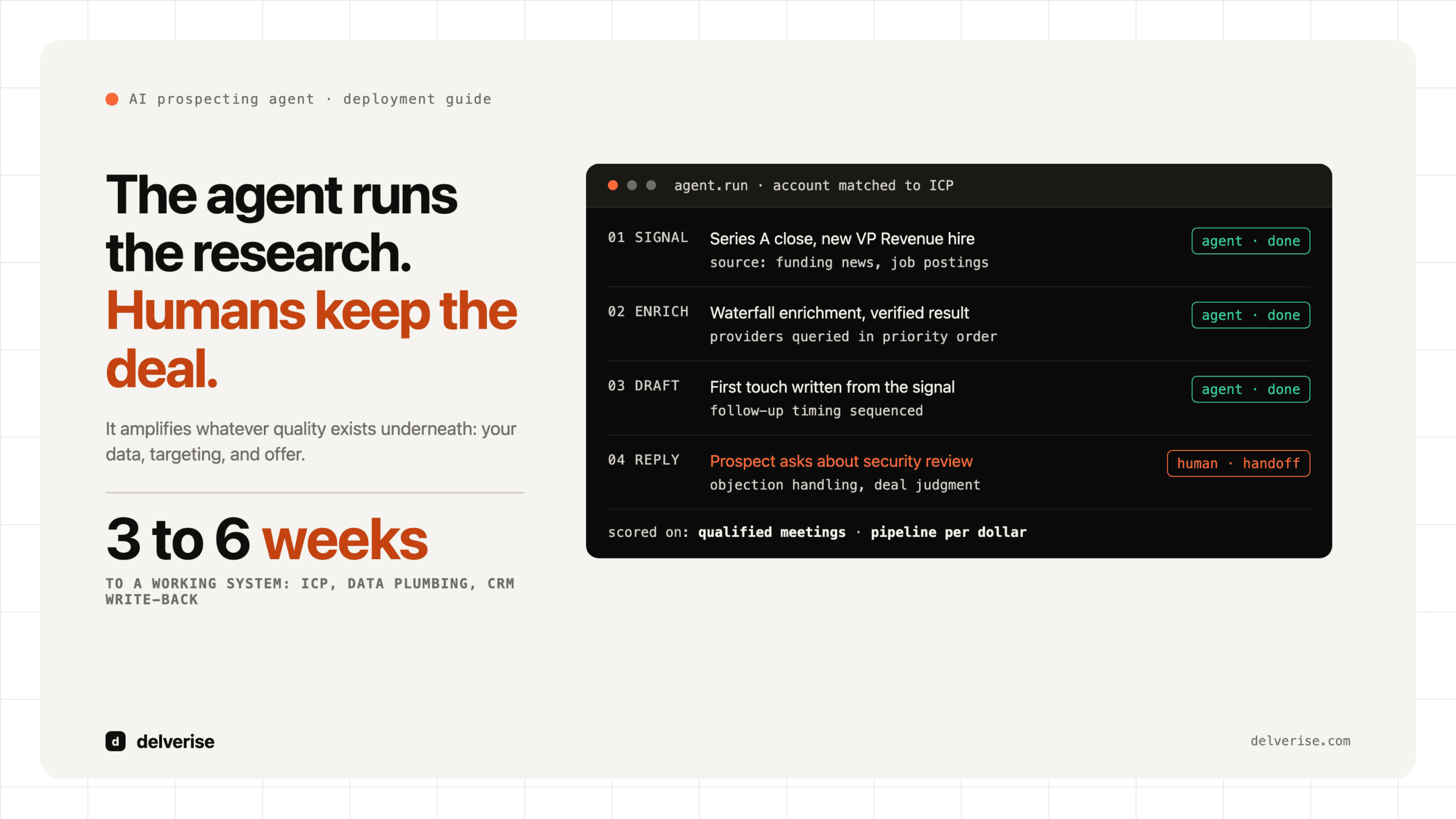
First, triage: the system reads the form fill, the signup, or the reply, enriches the record with company size, funding stage, tech stack, and hiring signals, then decides whether this is a buyer, a student, or a competitor. Second, scoring: a model ranks the lead against patterns from your closed-won history rather than an arbitrary points table. Third, drafting: a language model writes the first reply using the actual context of the lead’s behavior, which a rep edits or approves. Fourth, orchestration: the system routes, books, reminds, and logs without anyone touching a CRM field.
The scoring layer is where most of the value sits, and it deserves its own design work. We covered how to build it in AI lead qualification, including what signals actually predict a closed deal versus what merely correlates with form-fill enthusiasm.
Why does follow up break in most B2B SaaS teams?
Four failure modes show up repeatedly, and only one of them is about writing.

Response lag. A demo request arrives at 9:14 p.m. on a Tuesday. A rep sees it at 10:30 a.m. Wednesday. By then the buyer has three competitor calls booked. The HBR finding above is more than a decade old and still describes the single biggest gap between teams that convert inbound and teams that complain about lead quality.
Ownership ambiguity. Round-robin assigns the lead to a rep on vacation. The record sits assigned and untouched, which looks fine on a dashboard and is invisible until a quarterly pipeline review.
Context loss. The rep opens the record and sees a name, an email, and “Requested demo.” The buyer read three pricing pages, attended a webinar, and works at a company that just closed a Series B. None of that reached the rep, so the first email is generic and the reply rate reflects it.
Nurture that is really a drip. A five-email sequence fires on a fixed schedule regardless of what the lead does. Gartner’s work on buying groups, which typically run six to ten stakeholders in a complex purchase, explains why a single-threaded drip underperforms: you are emailing one person about a decision several people own.
McKinsey’s research on B2B buying behavior points the same direction, showing buyers moving fluidly across many channels and expecting continuity between them. A follow-up system that only knows about email is working with a fraction of the signal.
What should AI handle, and what should stay human?
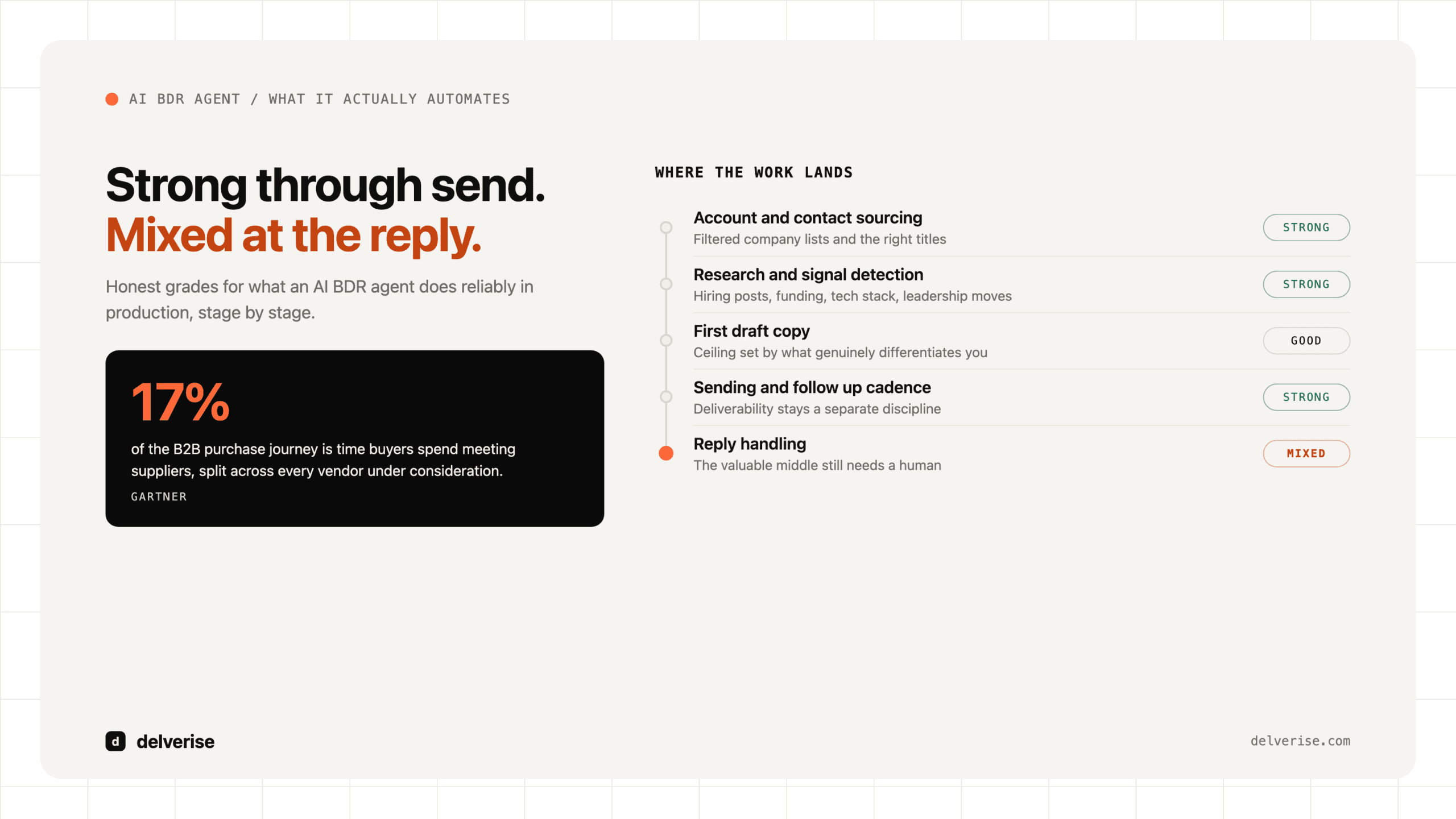
Vendor-neutral answer: automate anything deterministic or high-volume, and keep anything that requires reading a room.

| Task | Owner | Why |
|---|---|---|
| Instant acknowledgment and calendar link | AI | Pure latency problem. No judgment required, and every minute of delay costs conversion. |
| Enrichment and ICP fit check | AI | Data lookup and pattern matching at a volume humans cannot sustain accurately. |
| Routing and SLA escalation | AI | Rules plus monitoring. A system notices an untouched lead at hour four; a manager notices it at week two. |
| First-reply drafting | AI drafts, human approves | Models write a competent, context-aware draft. A rep catches the tone error that would cost the deal. |
| Discovery and objection handling | Human | Requires reading hesitation, reframing a problem, and committing to something on the company’s behalf. |
| Multi-threading into a buying group | Human, AI-assisted | AI surfaces the other stakeholders. A person earns their attention. |
| Pricing, security review, procurement | Human | Commercial and legal exposure. Automate the reminders, never the commitments. |
The same split applies further up the funnel. We laid out the boundary in more detail in outbound sales automation, and the underlying principle holds here: automate the connective tissue, keep the conversation.
What does a working system look like end to end?
Here is the architecture we build, described in the order data moves.
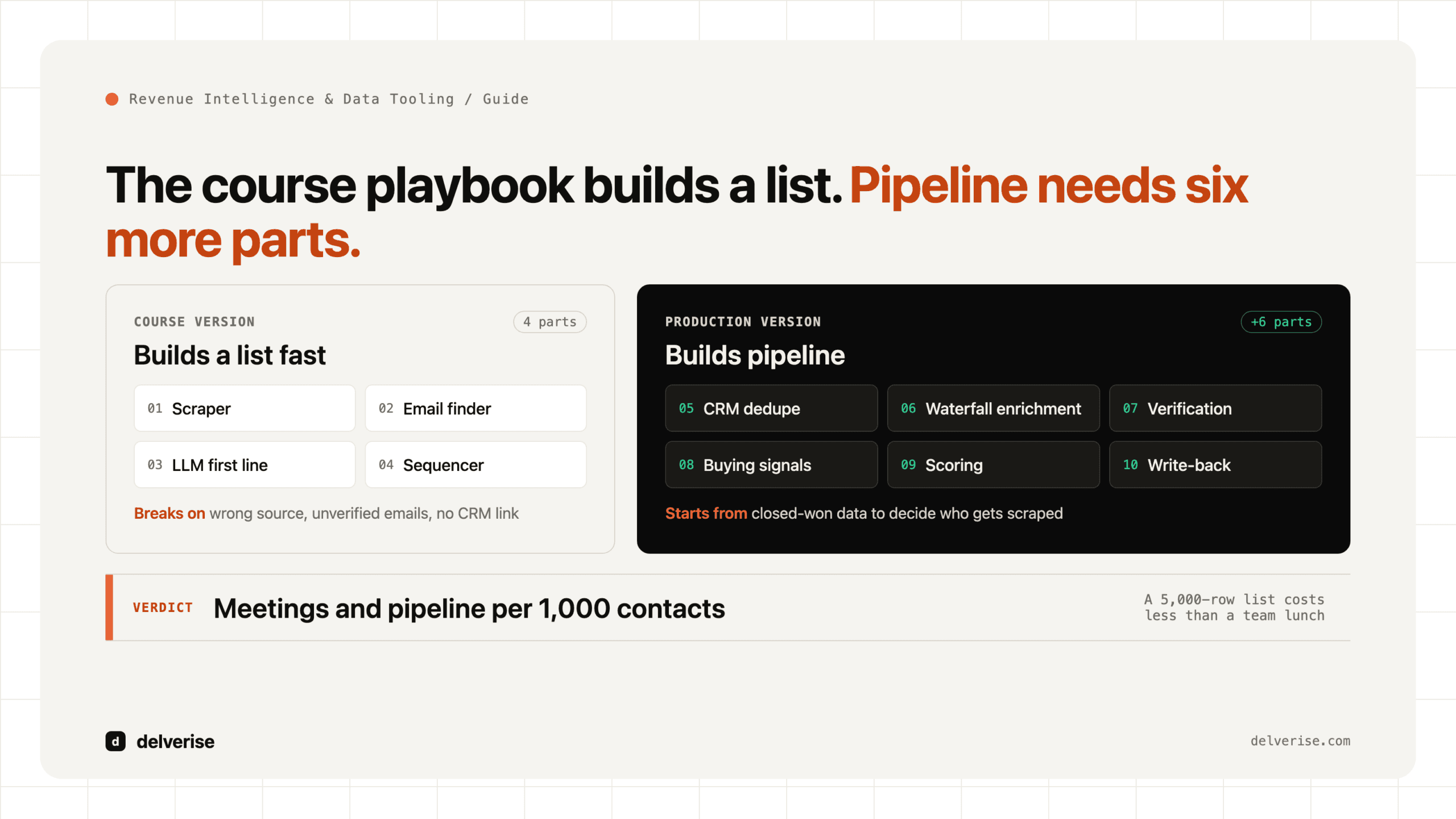
- Capture. Form, signup, chat, or reply lands in one place with source and behavior attached. Form logic itself is worth tightening first, as covered in lead forms AI.
- Enrich. Company data, headcount, funding, tech stack, and intent signals attach within seconds. Clay is the tool most teams reach for here, since it chains multiple data providers with waterfall logic so you pay for the second source only when the first one misses. The honest tradeoff: Clay rewards teams willing to maintain it, and it becomes shelf-ware when nobody owns the tables.
- Score and route. Fit plus intent produces a tier. Tier one goes to a rep with a five-minute SLA. Tier two gets an AI-assisted nurture track. Tier three gets self-serve content and a quarterly re-check.
- Respond. Acknowledgment goes out immediately with real context in it. The rep’s first human touch follows inside the SLA window.
- Sustain. Behavior-triggered follow up replaces the fixed drip. Pricing page visit triggers one path, webinar attendance another.
- Write back. Every touch, score, and outcome lands in the CRM so the next quarter’s model has training data and the forecast has inputs.
A modeled example makes the economics concrete. Assume 300 inbound leads a month, 40 percent matching ICP, so 120 real opportunities. At a median six-hour first response and an 18 percent meeting rate, that is roughly 22 meetings. Move median response under five minutes with proper context and routing, and 26 percent is a realistic target, or about 31 meetings. Those ten extra meetings at a 22 percent close rate and an $18,000 ACV are roughly $40,000 in new ARR per month. Your inputs will differ, and the point of the model is that you can run it with your own numbers before you buy anything.
That arithmetic also belongs in your planning, since follow-up conversion is one of the few assumptions a board will actually interrogate. See revenue forecasting for B2B SaaS for how those rates roll up.
How do you know whether it is working?
Track six numbers monthly:
- Median and 90th-percentile time to first touch, split by source. The p90 exposes the leads falling through gaps.
- Coverage rate: percentage of ICP-fit leads that received a human touch inside SLA.
- Meaningful reply rate, counting only replies from a person in the buying group.
- Meeting-held rate by source and tier.
- Win rate of AI-touched versus human-only cohorts, so you can prove or disprove the investment.
- Data completeness on routed records, because scoring degrades silently when enrichment coverage drops.
If win rate diverges badly between the AI-touched and human-only cohorts, the usual culprit is scoring drift rather than the automation itself. AI in B2B sales goes deeper on which parts of the cycle hold up under automation and which quietly degrade.
When should you build this versus buy a tool?
Under roughly 100 inbound leads a month, a clean CRM, a routing rule, and a disciplined SLA will outperform any AI layer. Between 100 and 500, enrichment and scoring start paying for themselves. Above that, orchestration becomes the constraint and a real system is warranted.
Tool choice matters less than the data model underneath it, which is why the same platform produces excellent results at one company and nothing at another. If you want the enrichment and orchestration layer built and owned properly, that is what our Clay implementation work and broader GTM engineering practice exist to do.
Frequently Asked Questions
Is AI lead follow up the same as marketing automation?
No. Marketing automation fires sequences on rules you write in advance. AI lead follow up adds enrichment, model-based scoring, and generated responses that adapt to what a specific lead did. Most teams run both, with the AI layer handling triage and the automation platform handling delivery.
Will AI-written follow up emails hurt our brand?
They can, when they ship unreviewed at volume. The pattern that holds up is AI drafting with human approval on tier-one leads and fully automated sends limited to acknowledgments and logistics, where tone risk is low. Keep a sample review each week so quality drift gets caught early.
How fast does the first response really need to be?
Under five minutes for high-fit inbound. The HBR research showing sharply higher qualification odds inside the first hour sets the outer bound, and competitive inbound markets have compressed it further since. For outbound replies, same business day is usually sufficient.
What breaks first when we scale this?
Data quality. Enrichment coverage slips, a provider changes its schema, and scores go stale while dashboards still look green. Build a weekly data completeness check before you build anything clever on top of the scores.
Do we need a full-time person to run it?
Not full-time at Seed or Series A, though it needs a named owner with a few hours a week. Systems without an owner decay within a quarter, regardless of how well they were built.
Read next