←Back to blog
Revenue Intelligence & Data ToolingGuideAugust 31, 20269 min read
AI in B2B Sales: Where It Actually Moves Revenue (and Where It Doesn’t)
AI in B2B sales means using machine learning and large language models to research accounts, prioritize pipeline, personalize outreach, and capture what happens in the CRM. It works best on data-heavy, repetitive work where a human reviews the output. It works poorly on judgment, negotiation, and multi-threaded relationships.
AI in B2B sales means using machine learning and large language models to research accounts, prioritize pipeline, personalize outreach, and capture what happens in the CRM. It works best on data-heavy, repetitive work where a human reviews the output. It works poorly on judgment, negotiation, and multi-threaded relationships.
Key takeaways
- AI compresses research and data work first. Prospecting research, enrichment, list building, and CRM hygiene are where returns show up in weeks, not quarters.
- Personalization at scale is real but conditional. It only works when the underlying data is accurate and the trigger is genuinely relevant.
- Your CRM data quality sets the ceiling. Bad data plus AI equals faster bad decisions.
- Forecasting and deal scoring need volume. Below roughly 200 closed-won deals of history, most predictive models are guessing with confidence.
- Sequence matters. Fix data, then automate research, then automate outreach, then add scoring. Teams that reverse this order buy tools that quietly fail.
What does AI actually do in a B2B sales process?
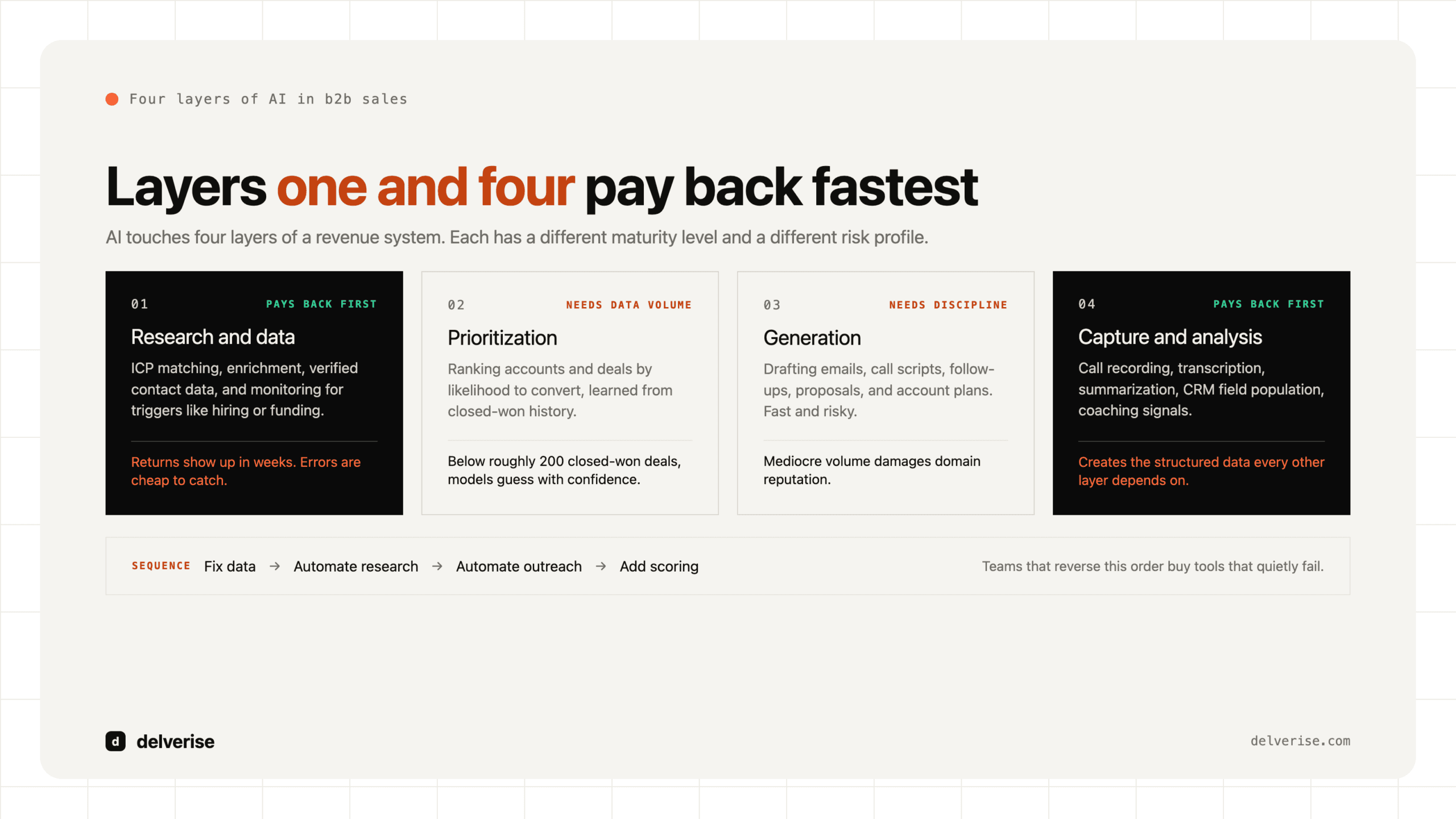
Strip away the demos and AI touches four distinct layers of a revenue system. Each has a different maturity level and a different risk profile.

Research and data. Finding accounts that match your ICP (ideal customer profile: the account attributes that correlate with your best customers), enriching them with firmographic and technographic signals, verifying contact data, and monitoring for buying triggers like hiring, funding, or tooling changes. This is the most reliable application by a wide margin, because the task is well defined and errors are cheap to catch.
Prioritization. Ranking accounts and deals by likelihood to convert. Useful when you have enough closed-won and closed-lost history for a model to learn from. Below that threshold, scoring is mostly restating rules you already wrote by hand.
Generation. Drafting emails, call scripts, follow-ups, proposals, and account plans. Genuinely fast, genuinely risky. The failure mode is volume of mediocre output that damages domain reputation and brand.
Capture and analysis. Call recording, transcription, summarization, CRM field population, and coaching signals. The most reliably valuable, least discussed layer. It removes admin work reps hate and creates the structured data every other layer depends on.
The practical read: layers one and four pay back fastest. Layer two needs data volume. Layer three needs discipline.
Where does AI in B2B sales create measurable returns?
The clearest wins are time reclamation and coverage expansion.
Research time is the obvious one. A rep building a genuinely researched account list manually spends real hours per account on company research, contact identification, and trigger checking. Systems built on platforms like Clay, which orchestrates enrichment across dozens of data providers with waterfall logic, compress that into minutes. The rep still reviews and edits. The mechanical work disappears. If you want the full picture of how this pipeline gets assembled, we broke it down in AI powered lead generation.
Coverage expansion is the second. Most B2B teams cover a fraction of their addressable market because human research capacity caps how many accounts can be worked properly. AI-assisted research raises that ceiling without proportional headcount. That is the real economic argument, and it is a headcount efficiency argument rather than a magic-pipeline argument.
CRM hygiene is the third and most undervalued. McKinsey’s research on B2B sales has consistently found that reps spend a large share of their week on non-selling activity, with administrative work and data entry among the biggest drains. AI note-taking and CRM field population claw back a meaningful portion of that. It also improves forecast accuracy as a side effect, because the data underneath the forecast finally gets entered.
Where does AI break in B2B sales?
Four failure modes show up repeatedly.

Bad data in, confident nonsense out. AI does not fix a broken data foundation. If your CRM has duplicate accounts, stale contacts, and inconsistent stage definitions, an AI layer on top produces polished output built on wrong inputs. Data cleanup is unglamorous and it is the prerequisite. We covered what good inputs look like in lead gen data.
Personalization that reads as automation. “I saw you recently joined Acme” is not personalization when it arrives from 400 senders in the same week. Buyers pattern-match fast. Generated first lines that reference a LinkedIn headline or a funding round have largely burned out as differentiators. What still works is relevance to a problem the buyer actually has, which requires a real hypothesis, not a text generator. Our breakdown of what actually works in cold email goes deeper on the distinction.
Deployment without a review layer. Fully autonomous outbound is where most teams get burned. Deliverability damage, brand damage, and factual errors sent to named executives are hard to reverse. Human review at the send gate costs a little throughput and saves a lot of cleanup. The same caution applies to voice: we walk through the realistic limits in AI cold calling agent.
Tool sprawl without system design. Buying six point solutions produces six data silos and no compounding advantage. The value comes from how the pieces connect, which is a systems problem before it is a purchasing problem. That is the argument in what a GTM tech stack actually is.
Which AI sales use cases are ready now versus still early?
| Use case | Maturity | What it needs to work | Realistic expectation |
|---|---|---|---|
| Account research and enrichment | Production ready | Clear ICP definition, quality data sources | Large reduction in research hours per account |
| Contact data waterfalls | Production ready | Multiple providers, verification step | Higher match rates, lower bounce rates than single-vendor |
| Call capture and CRM population | Production ready | Consistent stage and field definitions | Hours back per rep per week, better forecast inputs |
| Assisted email drafting | Ready with review | Human edit before send, strong offer | Faster drafting, not better response rates on its own |
| Intent and trigger detection | Mixed | Signal validation against closed-won history | Useful for prioritization, weak as a standalone buying signal |
| Predictive deal scoring | Needs volume | Roughly 200+ closed deals, clean stage data | Directional guidance for managers, not a forecast replacement |
| Autonomous AI SDR agents | Early | Tight guardrails, narrow segment, monitoring | Works in constrained pilots, fails when scaled unsupervised |
How should a revenue leader sequence AI adoption?
Order of operations determines whether this works. A sequence that holds up across most Seed to Series B teams:

1. Fix the data layer. Deduplicate accounts, standardize stage definitions, define required fields, pick your enrichment sources. Two to four weeks of unglamorous work. Everything downstream depends on it.
2. Automate research, not outreach. Build the account research and enrichment pipeline first. Reps get better lists, response rates improve, and nothing gets sent that shouldn’t. Low risk, fast payback.
3. Add capture. Call recording, transcription, and automated CRM updates. This buys back rep time immediately and generates the structured history that later scoring models require.
4. Then assist outreach. Generated drafts with human review. Measure reply rate and meeting rate against your pre-AI baseline. If those numbers don’t move, the problem is your offer or targeting, and no model fixes either. Email prospecting as a system covers the mechanics.
5. Add scoring last. Once you have twelve to eighteen months of clean deal history, predictive prioritization has something real to learn from.
Most teams that report disappointing AI results ran this sequence backwards: they bought a generation tool first, pointed it at dirty data, and scaled sends before validating a single message.
A worked example: what “AI-assisted” actually looks like
Take a Series A company selling infrastructure monitoring software, 4 AEs, 2 SDRs, targeting engineering leaders at 200 to 2,000 employee technology companies.
Before. SDRs pull a list from a contact database, filter by title and headcount, and send a three-touch sequence. Roughly 1,200 contacts per month, 1.5 percent reply rate, mostly negative. Research per account is near zero because there is no time for it.
After. The team defines a trigger set validated against closed-won history: companies that recently posted for site reliability roles, run a competing monitoring tool, and had a public incident in the last 90 days. An enrichment pipeline monitors those signals continuously and surfaces roughly 150 qualifying accounts per month. AI drafts a first email referencing the specific trigger. The SDR reviews and edits every send.
The tradeoff. Volume drops by roughly 85 percent. Reply quality rises sharply because every message has a genuine reason to exist. Total meetings booked typically holds flat or improves, and meeting-to-opportunity conversion improves more, because the accounts were qualified before contact rather than after.
That tradeoff is the actual decision in front of most revenue leaders. AI lets you go narrower with more precision or wider with more noise. Narrower usually wins in B2B, where buying committees are large and reputations travel.
How do you measure whether AI is working?
Vanity metrics will tell you it’s working when it isn’t. Track these instead:
- Research hours per qualified account, measured before and after
- Reply rate and positive reply rate, separated (total replies hide rising opt-outs)
- Meeting-to-opportunity conversion, which reveals targeting quality
- Contact data match rate and bounce rate by provider
- Percentage of CRM required fields populated at each stage
- Domain health: spam complaint rate and deliverability by sending domain
- Cost per qualified opportunity, all-in including tooling spend
Establish the baseline before you deploy anything. Teams that skip this step can never prove the return and end up defending tooling spend with anecdotes.
Should you build this in-house or bring in outside help?
Honest answer: it depends on whether you have someone who owns systems full time.
Build in-house when you have a RevOps or GTM engineering hire with capacity, when your motion is stable enough that the system won’t need rebuilding in six months, and when you can tolerate a longer ramp. The knowledge stays internal, which matters over time.
Bring in outside help when you need the system working this quarter, when nobody internally has built enrichment waterfalls or CRM architecture before, or when your team is capable but fully consumed by hitting the current number. The failure mode to avoid is a half-built system that nobody owns. We laid out the full decision framework in go-to-market consultant vs building in-house.
Either way, the deliverable should be a working system with documentation your team can operate, not a dependency. If you’re evaluating Clay specifically as the orchestration layer, our Clay implementation page covers how those builds are scoped. For the broader architecture, GTM engineering covers how the layers fit together.
Frequently Asked Questions
Will AI replace B2B sales reps?
Not in complex B2B sales. AI is replacing tasks rather than roles: research, data entry, first-draft writing, and note-taking. What it does not replace is multi-threading a buying committee, handling a procurement objection, or reading a room. Gartner has projected significant growth in AI-augmented selling, and the consistent pattern in that research is augmentation of reps rather than elimination. The roles most exposed are ones defined purely by volume activity.
How much does an AI sales stack actually cost?
For a Seed to Series B team, budget roughly $1,500 to $6,000 per month in tooling: enrichment and orchestration, contact data credits, a sequencing platform, and call capture. Implementation is separate and usually the larger cost, whether internal time or outside help. The number that matters is cost per qualified opportunity, not total tool spend.
What’s the difference between an AI SDR and AI-assisted prospecting?
An AI SDR agent researches, writes, and sends autonomously with minimal human input. AI-assisted prospecting keeps a human at the review and send gate. The second approach is where most teams find durable results today, because a rep catches the factually wrong or tonally off message before it reaches a VP. Autonomous agents work in narrow, well-monitored segments and degrade quickly when scaled without supervision.
Do we need clean CRM data before starting?
Yes, and this is the most commonly skipped step. AI amplifies whatever is in your system. Duplicate accounts produce duplicate outreach, stale contacts produce bounces that hurt domain reputation, and inconsistent stage definitions make every downstream model unreliable. Two to four weeks of data cleanup before deployment pays for itself repeatedly.
How long until we see results?
Research and enrichment automation shows measurable time savings within two to four weeks. Outreach quality improvements typically show in reply data after four to eight weeks, assuming you have a baseline to compare against. Pipeline and revenue impact takes a full sales cycle plus a quarter, so for most B2B SaaS teams that means three to six months before the revenue effect is clearly attributable.
Read next