←Back to blog
Revenue Intelligence & Data ToolingGuideNovember 14, 20267 min read
AI BDR Agent: What It Actually Automates and When It Works
An AI BDR agent is software that runs the top-of-funnel sales development job end to end: sourcing accounts, researching them, writing outbound messages, sending them, and handling replies until a meeting is booked. It automates execution well. It still depends entirely on the data, offer, and routing logic you give it.
An AI BDR agent is software that runs the top-of-funnel sales development job end to end: sourcing accounts, researching them, writing outbound messages, sending them, and handling replies until a meeting is booked. It automates execution well. It still depends entirely on the data, offer, and routing logic you give it.
Key takeaways
- An AI BDR agent compresses the mechanical parts of sales development: list building, research, first-draft copy, sending, follow-up, and basic reply triage.
- Output quality tracks input quality. Weak ICP definition and stale contact data produce more bad email faster.
- Packaged agents are fastest to start. Assembled stacks give you control over data and logic, which matters once you are running more than one motion.
- Reply handling and meeting routing are where most deployments quietly lose pipeline.
- Judge a pilot on qualified meetings and downstream opportunity rate, never on send volume or open rate.
What is an AI BDR agent, exactly?
A BDR (business development representative) is the rep who works cold accounts to create first meetings for account executives. An AI BDR agent is software that performs that same sequence of tasks with an LLM doing the reasoning: interpreting an ICP, picking accounts, reading firmographic and behavioral signals, drafting personalized messages, scheduling touches, and parsing responses.
The distinction worth holding onto is between a sequencer and an agent. A sequencer executes steps you define in advance. Tools like Salesloft and Outreach sit here, and if you want the full picture of what that category costs and covers, we broke it down in our Salesloft review. An agent decides the steps: which accounts to work, what to say, when to follow up, and whether a reply deserves a human. That decision authority is the whole value and the whole risk.
What can an AI BDR agent actually do today?
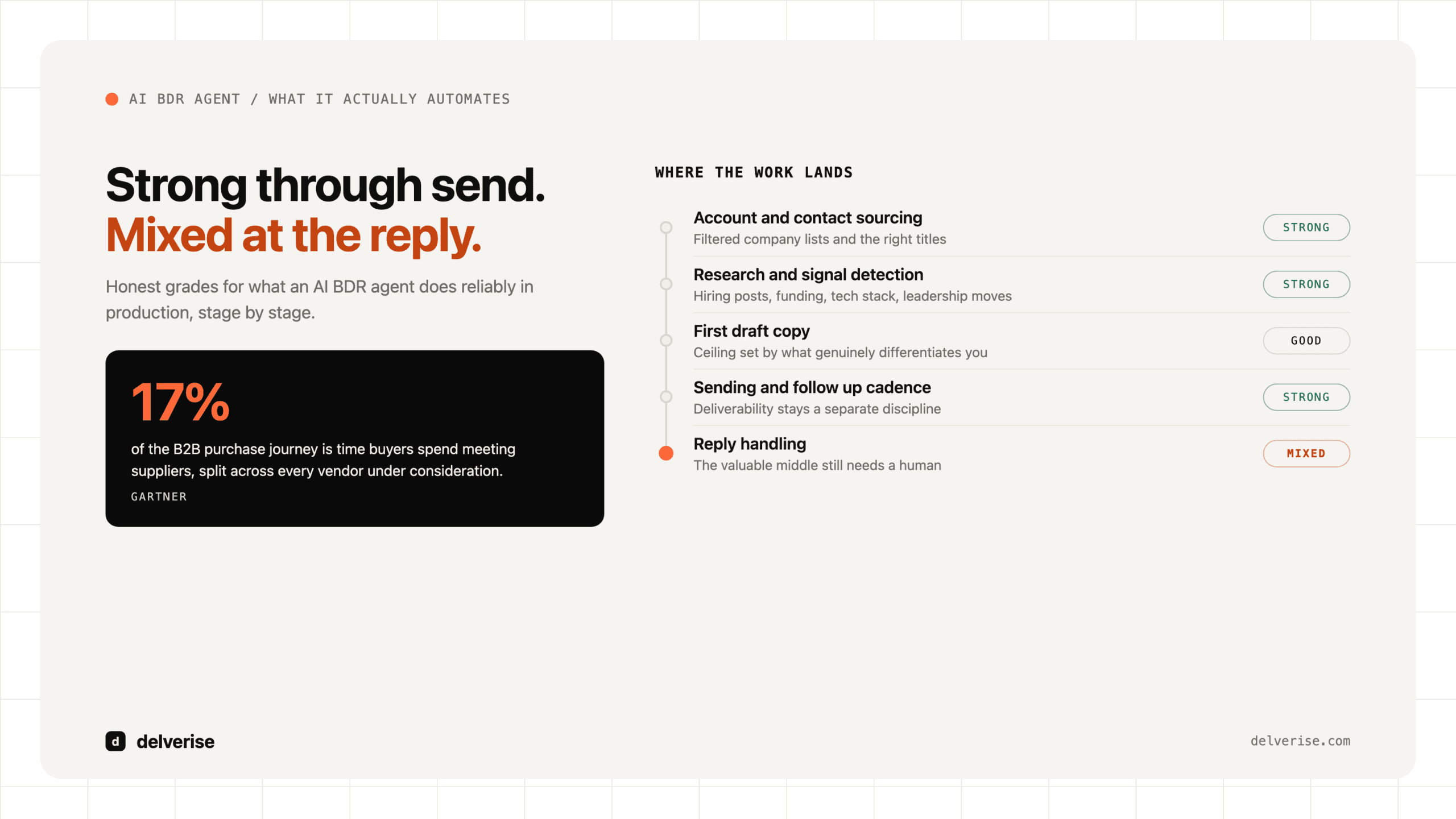
Honest grades, based on what these systems do reliably in production rather than in demos:

- Account and contact sourcing. Strong. Pulling a filtered list of companies matching firmographic criteria and finding the right titles is largely solved.
- Research and signal detection. Strong for public signals: hiring posts, funding events, tech stack changes, leadership moves, product launches. Weak for anything requiring judgment about whether the signal implies budget.
- First-draft copy. Good and improving. The ceiling is set by how much genuinely differentiating information the agent has about your product. Our breakdown of what actually books meetings in cold email applies to agent-written copy the same way it applies to human-written copy.
- Sending and follow-up cadence. Strong, with a caveat: deliverability infrastructure is a separate discipline that most packaged agents handle only partially.
- Reply handling. Mixed. Agents classify obvious categories accurately: out of office, unsubscribe, hard no. They routinely mishandle the valuable middle, the “interesting, send me more” and “we just bought something similar” replies where the right next move depends on context the agent does not have.
Gartner’s research on B2B buying found that buyers spend only about 17 percent of their purchase journey meeting with potential suppliers, and that sliver gets divided across every vendor under consideration. The scarce resource is buyer attention, so the useful question about any agent is whether it earns more of that attention per contact, not whether it sends more.
Where do AI BDR agents break?
Data. Every agent inherits the quality of the records underneath it. If your enrichment is thin, the personalization layer produces confident, specific, wrong statements about a prospect’s company. This is the most common failure and the most damaging, because it burns domains and accounts simultaneously.

Offer. An agent cannot fix a message the market does not want. Teams that see flat results from an agent usually had flat results from human outbound and expected automation to change the arithmetic.
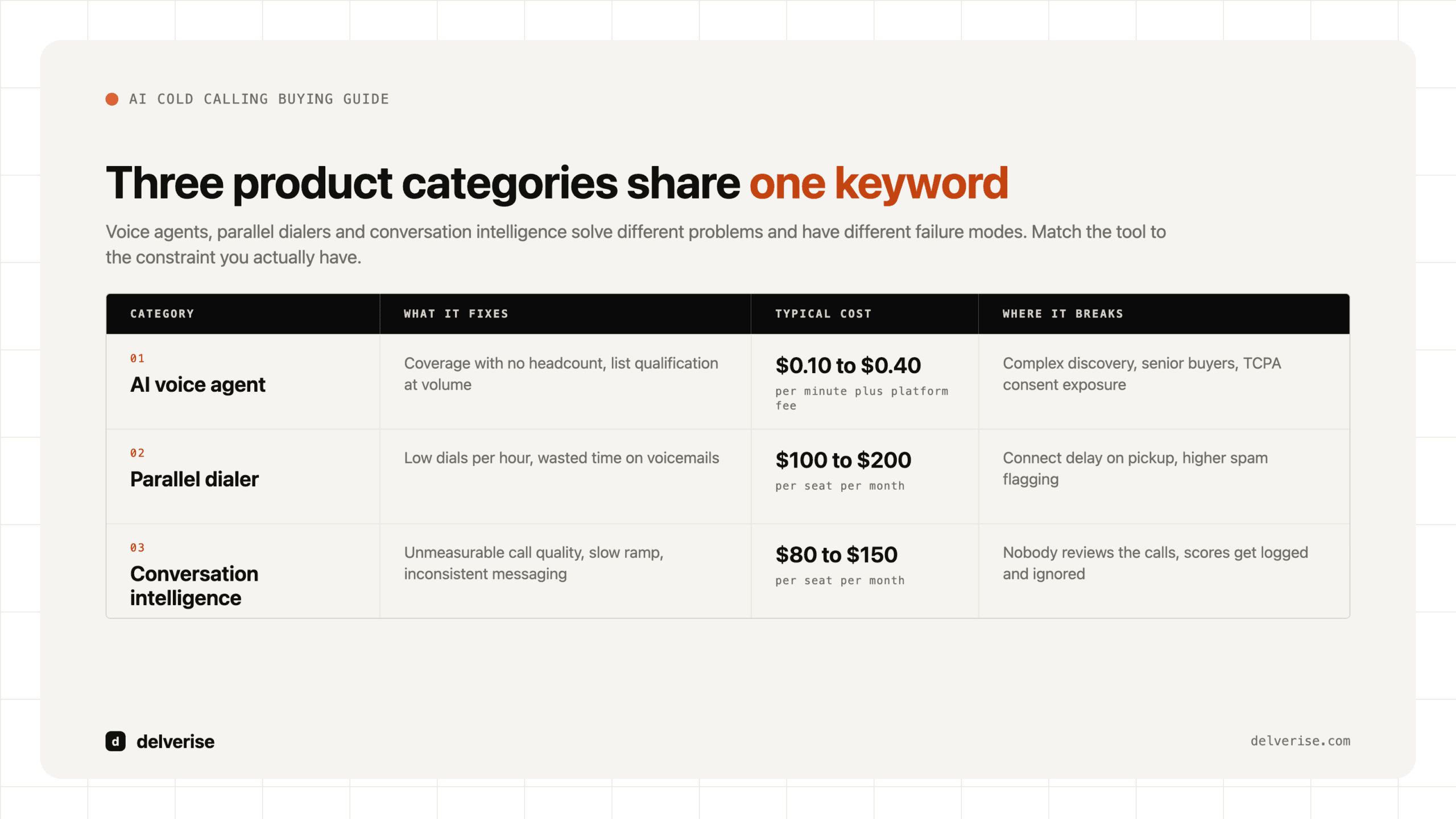
Channel concentration. Most packaged agents are email-first. McKinsey’s B2B Pulse research found buyers now move across roughly ten channels during a purchase decision. An email-only agent covers one of them, which is why the stronger deployments pair it with calling and LinkedIn touches. We compare the calling side in our guide to AI cold calling software.
Speed of handoff. A classic HBR study of lead response times found that firms contacting a prospect within an hour were close to seven times more likely to have a substantive conversation with a decision maker than firms that waited longer. Agents create replies at all hours. If those replies sit in a shared inbox until someone checks it at 9am, you have automated the top of the funnel and left the bottleneck exactly where it was.
AI BDR agent vs. human SDR vs. assembled stack: which fits?
| Approach | Best when | Time to first meetings | Realistic monthly cost | Main failure mode |
|---|---|---|---|---|
| Packaged AI BDR agent | One clear ICP, one motion, you need volume tested fast | 2 to 4 weeks | $1,500 to $5,000 including data credits | Generic personalization; vendor owns your logic |
| Human SDR team | High ACV, complex qualification, multithreaded accounts | 3 to 5 months including ramp | $8,000 to $12,000 fully loaded per rep | Slow to scale; quality varies by hire |
| Assembled agent stack | Multiple segments or motions, data is a real asset | 4 to 8 weeks to build | $2,000 to $6,000 in tooling plus build effort | Needs an owner; decays without maintenance |
The assembled route is where most Series A and B teams end up. A waterfall enrichment and research layer in Clay feeds scored, researched accounts into a sequencer, with routing rules in the CRM deciding what reaches a human. That structure keeps the data and the qualification logic inside your system rather than inside a vendor’s. delverise builds these as production systems, and the Clay implementation page covers how that work is scoped.

What does the math look like on a real pipeline target?
Say you need 20 qualified meetings a month at a $35,000 ACV. Working backward with defensible cold outbound rates:
- Positive reply to meeting held: roughly 50 percent. So you need about 40 positive replies.
- Positive reply rate on a well-targeted list: 1.5 percent. So you need about 2,700 contacted prospects.
- At three touches per prospect, that is roughly 8,000 sends a month across warmed domains.
One SDR sends 600 to 900 genuinely researched emails a month alongside calls, which puts this target at three to four reps. An agent covers the send volume comfortably. The constraint moves upstream: sourcing 2,700 contacts a month who actually match your ICP without recycling the same accounts. That is a data problem, and it is the reason qualification scoring matters more than send capacity once an agent is running. Our breakdown of what one SDR actually produces has the full benchmark set.
How should you evaluate an AI BDR agent?
Run a 60-day pilot against a control. Before you sign anything, confirm:
- You can export every contact, message, and reply, in full, at any time
- The agent writes to your CRM with clean attribution on source and campaign
- You control the sending domains and can see deliverability metrics directly
- A human approval step exists for the first two weeks of any new segment
- Replies route to a person in under 15 minutes during business hours
- Success is measured in qualified meetings and opportunity conversion, not sends
- You can run a holdout list to prove incrementality against your current motion
What has to be true before any of this works?
An agent amplifies whatever system it plugs into. That means a documented ICP with real disqualifiers, enrichment that covers at least 80 percent of your target accounts, working CRM routing, and a booking path that does not break when someone says yes at 11pm. Teams missing two or more of those get faster failure rather than faster pipeline. Our post on the six foundation pieces under every revenue stack is the honest checklist, and the AI outbound page covers how the pieces fit together.
Frequently Asked Questions
Can an AI BDR agent replace my SDR team?
It can replace the mechanical portion of the role: list building, research, drafting, sending, and follow-up. It does not replace the judgment work of multithreading an account, handling an objection live, or deciding a prospect is worth a fourth attempt. Most teams that deploy well keep reps and give each one a much larger account surface.
How much does an AI BDR agent cost?
Packaged agents typically run $1,500 to $5,000 a month once data credits and sending infrastructure are included. Vendors quoting well below that usually exclude enrichment, which is the line item that scales with volume. Compare on cost per qualified meeting after 60 days rather than on subscription price.
Will emails written by an AI agent hurt deliverability?
The copy is rarely the problem. Volume per domain, list quality, and bounce rates are. An agent that sends 8,000 emails a month needs a properly warmed pool of sending domains and aggressive verification on every address. Skipping that will damage your primary domain regardless of how good the writing is.
What is the difference between an AI BDR agent and a lead generation tool?
A lead generation tool hands you contacts. An agent works them through to a booked meeting and manages the follow-up in between. The categories overlap heavily in vendor marketing, so ask specifically whether the tool handles reply classification and scheduling. We cover the sourcing side in our guide to AI sales lead generation.
How long before an AI BDR agent produces pipeline?
First meetings usually appear in weeks three to five, assuming domains are already warmed. Meaningful read on opportunity quality takes a full sales cycle, so plan a 90-day evaluation window and resist judging the deployment on week-four reply rates alone.
Read next