←Back to blog
Revenue Intelligence & Data ToolingGuideNovember 15, 20268 min read
AI Prospecting Agent: What It Actually Does and How to Deploy One
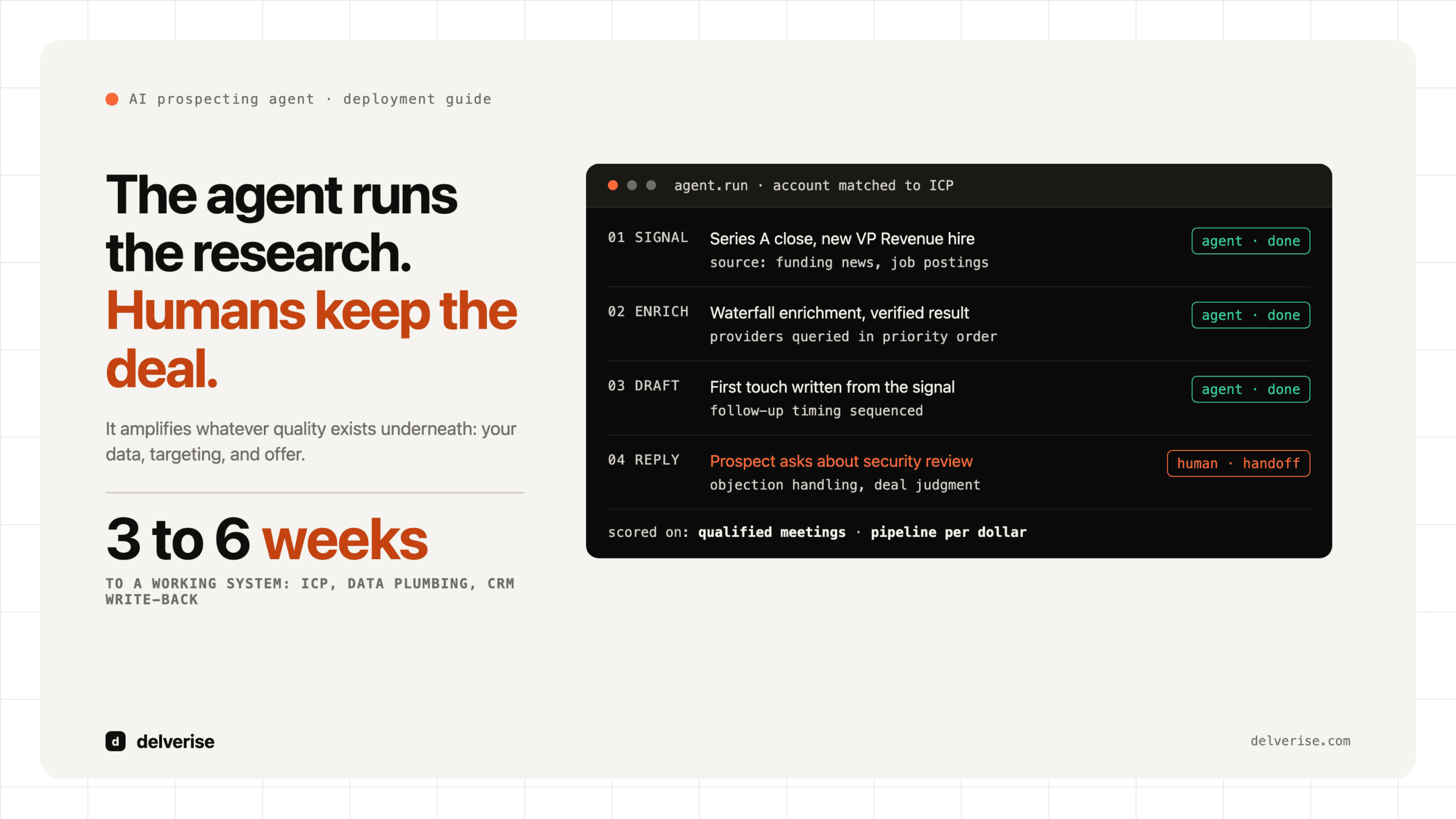
An AI prospecting agent is software that runs the research-and-outreach steps an SDR does manually: finding accounts that match your ICP, enriching them with live signals, writing a relevant first touch, and sequencing follow-up. It works when your data, targeting, and offer are already sound, and it amplifies whatever quality exists underneath.
An AI prospecting agent is software that runs the research-and-outreach steps an SDR does manually: finding accounts that match your ICP, enriching them with live signals, writing a relevant first touch, and sequencing follow-up. It works when your data, targeting, and offer are already sound, and it amplifies whatever quality exists underneath.
Key takeaways
- An AI prospecting agent handles research, list building, enrichment, message drafting, and follow-up timing. Deal judgment and objection handling stay with humans.
- The quality ceiling is set by your data layer. An agent running on stale firmographics produces fluent, well-formatted noise at volume.
- Most teams get more value from agents on the research side (signal detection, account scoring, personalization inputs) than on the send side.
- Expect 3 to 6 weeks to a working system, not a same-day switch-on. The build cost is in ICP definition, data plumbing, and CRM write-back.
- Measure agents on qualified meetings and pipeline per dollar, never on emails sent or “hours saved.”
What is an AI prospecting agent, exactly?
Three different products get sold under this label, and the differences matter when you are writing the check.

The first is a research agent: it reads job postings, funding announcements, product changelogs, review sites, and LinkedIn activity, then returns structured fields you can score and route. The second is an outreach agent: it takes an enriched record and drafts plus sends sequenced email or LinkedIn touches, adapting on reply. The third is a full-loop agent, which claims to source, qualify, write, send, handle replies, and book meetings with no human in the path.
The first two are mature enough to buy today. The third is still uneven, and the gap usually shows up at the reply stage, where a prospect asks something specific about pricing, security review, or a competitor, and the agent answers plausibly but wrongly.
Two terms worth defining while we are here. Signal means an observable event that changes buying probability: a new VP Revenue hire, a Series A close, a job posting for the exact role your product replaces. Waterfall enrichment means querying multiple data providers in priority order until one returns a verified result, instead of relying on a single vendor’s coverage.
Why are buyers pushing toward agents now?
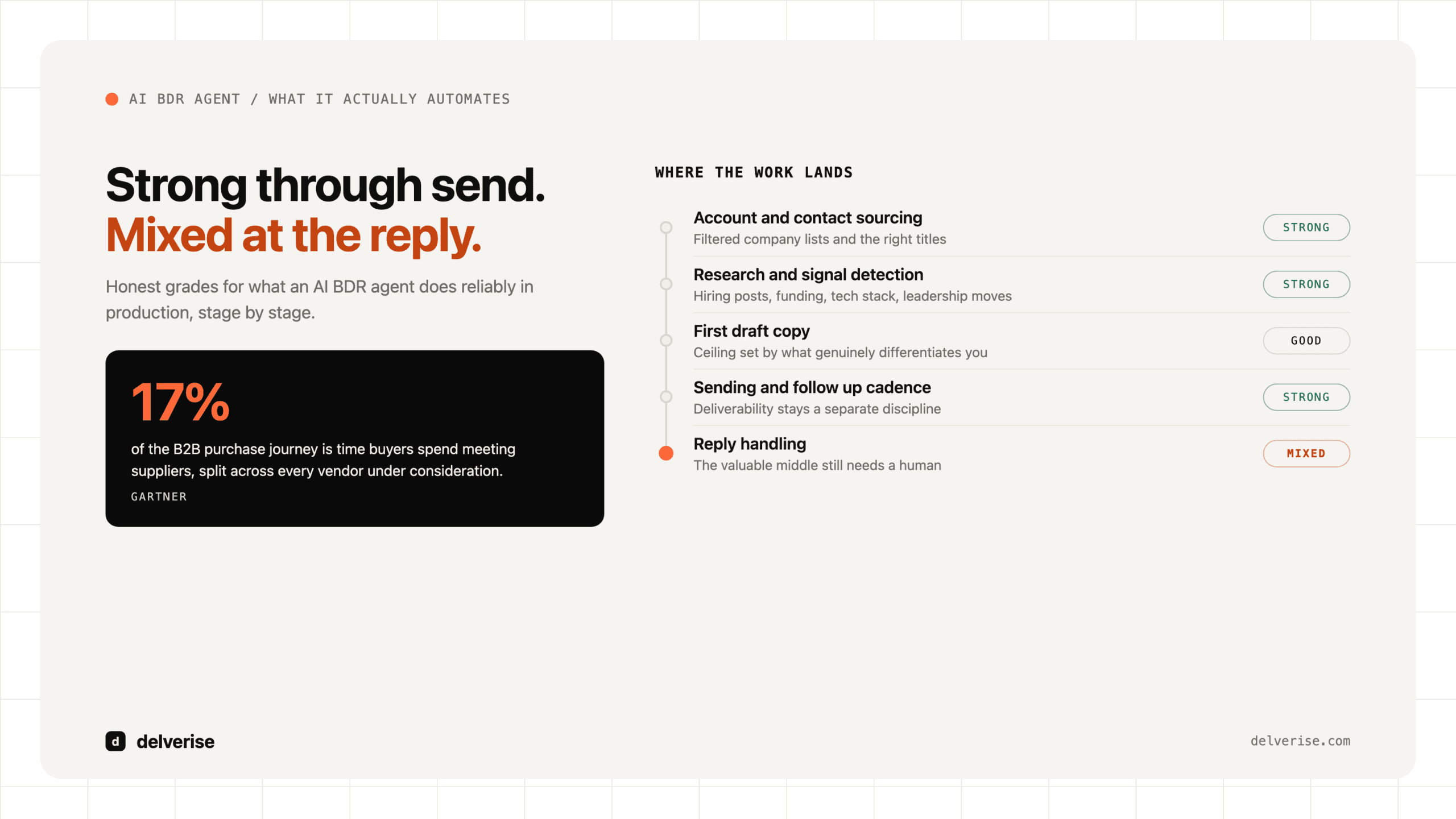
The economics of manual prospecting got worse, and buyer behavior is the reason. Gartner’s research on B2B buying found that customers spend only about 17% of the total purchase journey meeting with potential suppliers, and that time is split across every vendor in consideration. McKinsey’s work on B2B buying behavior found that buyers now use roughly ten channels across a decision journey, up from about five a decade earlier. Gartner also puts the typical buying group for a complex B2B solution at six to ten decision makers.

Read those three findings together and the implication is clear: you need to reach more people, across more surfaces, with more specificity, for a shrinking slice of attention. That arithmetic does not resolve by hiring more reps. It resolves by making each touch better-informed, which is exactly the work agents are good at.
Where do AI prospecting agents break?
Four failure modes account for most disappointed buyers.

Bad inputs. An agent pointed at a list bought two quarters ago will confidently personalize around a contact who changed jobs in March. Contact data decays fast in B2B SaaS, and agents have no instinct for staleness. They only know what the record says.
Fake personalization. “I saw your recent post about scaling” is a tell, and buyers have learned to spot it. Personalization earns a reply when it references something that costs effort to know and connects to a problem you solve. Generic observation at scale reads as automation and gets filtered accordingly.
Deliverability collapse. Agents make it trivially easy to increase send volume, which is precisely how domains get burned. Volume without infrastructure discipline (separate sending domains, warmed inboxes, tight bounce thresholds, real list hygiene) converts a working channel into a dead one in about six weeks.
No CRM write-back. If the agent’s research lives in its own interface and never lands in Salesforce or HubSpot as structured fields, you have built a second source of truth. Your forecast and your attribution both degrade. This is the quiet one, and it is the most expensive to unwind later. If that sounds familiar, it usually traces back to missing foundation pieces in the revenue stack rather than to the agent itself.
AI prospecting agent vs. sales engagement platform vs. human SDR
These three get compared as substitutes. In a working system they stack.
| Dimension | AI prospecting agent | Sales engagement platform | Human SDR |
|---|---|---|---|
| Core job | Research, enrich, score, draft | Sequence, deliver, track, report | Judgment, conversation, objection handling |
| Scales with | Credits and compute | Seats | Headcount and ramp time |
| Marginal cost per account | Cents | Near zero once seated | High |
| Handles a surprising reply | Poorly | Not its job | Well |
| Time to productive | 3 to 6 weeks of build | Days | 60 to 90 days of ramp |
| Fails when | Data is stale or ICP is fuzzy | Content is weak | Targeting is wrong |
A useful way to hold it: the agent decides who and why, the engagement platform decides when and where, and the human decides what happens after someone answers. Teams that try to collapse all three into one vendor usually end up with a weak version of each. For a deeper comparison of the delivery layer, see our breakdown of what Salesloft actually does and where it fits, and our look at what one outbound SDR realistically produces.
What does a working agent setup look like in practice?
Here is the shape of a build for a Series A SaaS selling a compliance product to fintech operations leaders. The numbers below are illustrative arithmetic, not a client result.
Step 1, define the trigger. The team decides the buying signal is a fintech company posting for a compliance or risk operations role. That is a specific, observable event tied to the pain the product solves.
Step 2, build the account layer. A table pulls fintech companies between 50 and 500 employees, then runs a daily job against job boards to flag matching postings. About 40 accounts trip the trigger each week.
Step 3, enrich and score. Waterfall enrichment resolves the Head of Compliance and the VP Operations at each flagged account, verifies email, and pulls their current tech stack. Accounts with a verified contact plus two or more supporting signals score as tier one. Roughly 22 of the 40 clear the bar.
Step 4, generate the research summary. The agent writes three sentences per account: what the posting says, what it implies about their current process, and the most likely objection. This lands in the CRM as a field the AE can read in ten seconds.
Step 5, draft and route. The agent drafts the first touch against that summary. A human approves in batch, which takes about 20 minutes a week, and the sequence runs through the engagement platform. Replies route to a human immediately.
At 22 accounts a week with two contacts each, that is roughly 44 well-researched touches weekly, something an SDR could plausibly do manually but not while also handling calls, replies, and meeting prep. The agent’s contribution is depth of research at a volume a person cannot sustain. Clay is the most common place teams build this account and enrichment layer, because it holds the waterfall logic, the scoring, and the AI research columns in one table. It carries real tradeoffs: credit costs climb quickly with sloppy table design, and it expects someone who enjoys thinking in systems. If you want that layer built and maintained rather than learned, that is what our Clay implementation work covers.
How should you evaluate an AI prospecting agent?
Run any vendor through this before you sign.
- Ask what happens when the underlying data is wrong, and get a specific answer about verification and fallbacks
- Require a live test on 50 of your real accounts before purchase, scored by your AEs for relevance
- Confirm bidirectional CRM sync with named, structured fields rather than notes or activity logs
- Check whether sending happens on your domains and infrastructure or theirs
- Get the full cost at your actual volume, including enrichment credits and overage, not the list price
- Ask how a prospect reply gets to a human, and how fast
- Verify you can export your data and logic if you leave
The test that separates useful agents from expensive ones is simple: have three AEs read 20 agent-generated research summaries and mark which ones they would actually use in a call. Anything below 60% means the targeting or the data layer needs work before the agent gets more budget. Our guide to picking an AI prospecting tool goes further on vendor selection, and AI lead qualification covers the scoring side.
What should you keep human?
Keep discovery, pricing conversations, multi-threading into a buying group, competitive displacement, and anything involving a champion who has internal politics to manage. Those interactions carry information that never made it into a CRM field, and that is exactly the information an agent cannot access. The practical line we use when scoping an AI outbound system: automate the work that produces a decision input, keep the work that produces a commitment. Our post on what to automate and what to keep human works through the harder edge cases.
Frequently Asked Questions
Can an AI prospecting agent replace my SDR team?
For research, list building, and first-touch drafting, an agent covers most of the work. For reply handling, discovery calls, and anything requiring judgment about a specific buyer’s situation, it does not. Most teams we see land on a smaller SDR team doing higher-value work, with agents carrying the research volume underneath them.
How much does an AI prospecting agent cost?
Tooling for a small team typically runs a few hundred to a couple thousand dollars a month once you add enrichment credits, verification, and sending infrastructure. The larger cost is the build: defining ICP, wiring data sources, and setting up CRM write-back. Budget 3 to 6 weeks of focused work, whether internal or bought, and treat any quote that skips this step as incomplete.
Will AI-generated outreach hurt my deliverability?
The generation does not, the volume does. Deliverability breaks when send volume rises faster than domain reputation and list quality. Use separate sending domains, warm them properly, keep bounce rates under 2%, and cap daily sends per inbox. Agents make it easy to violate all four at once.
What metrics should I hold an AI prospecting agent to?
Qualified meetings booked, pipeline created per dollar spent, and reply-to-meeting conversion rate. Ignore emails sent, accounts researched, and estimated hours saved. If the agent doubles activity while meetings stay flat, you have a targeting problem the agent is now amplifying.
Do I need clean CRM data before deploying one?
You need a clear ICP definition and a CRM that can accept structured fields. Perfect data is not a prerequisite, since good enrichment repairs a lot of it. Ambiguous targeting is a real blocker, because the agent will apply your fuzzy criteria consistently and at scale, which produces a large volume of confidently wrong accounts.
Read next