←Back to blog
Revenue Intelligence & Data ToolingGuideAugust 18, 20268 min read
What Is GTM Tech? The Stack Layers That Actually Move Pipeline
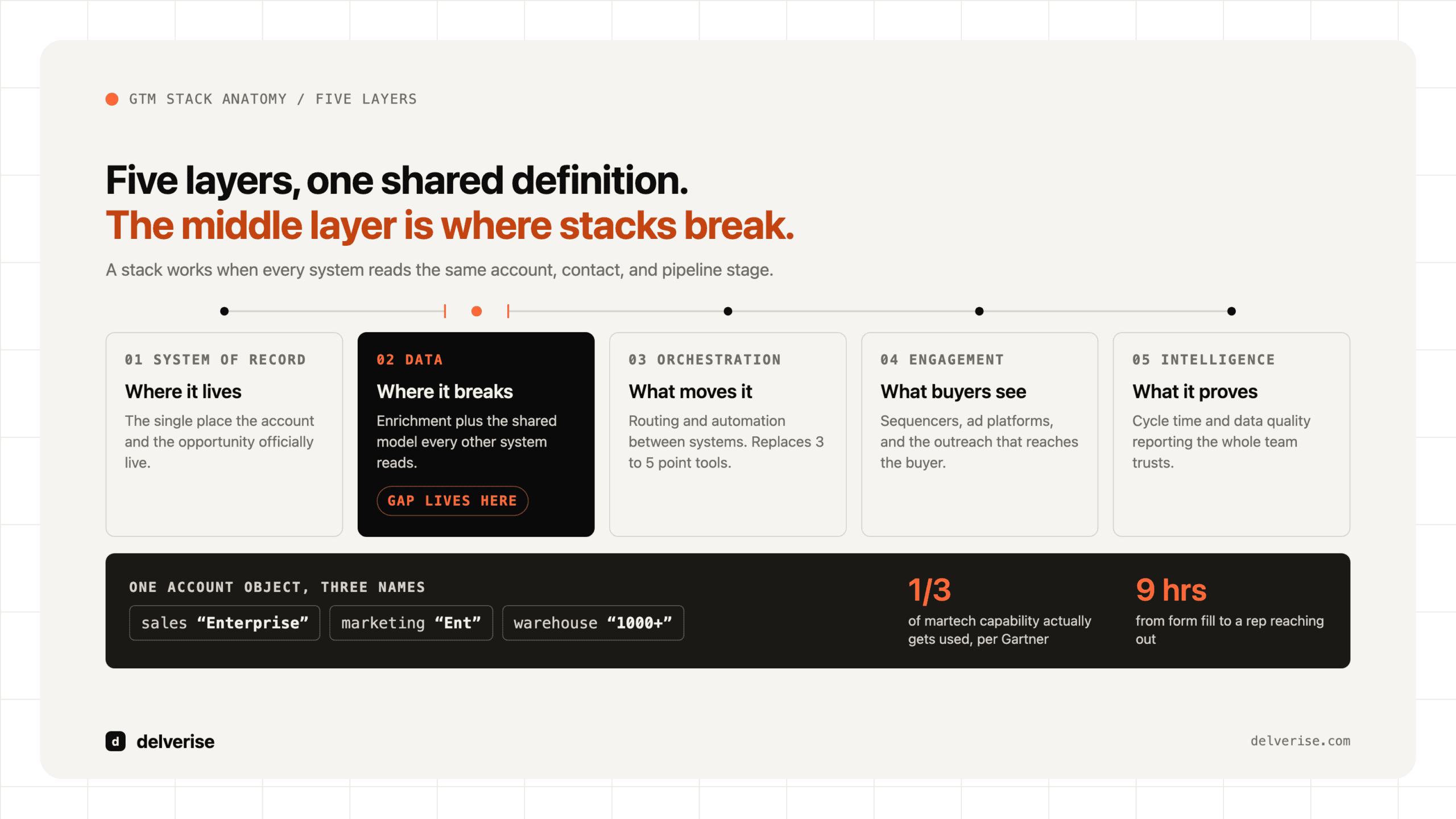
GTM tech is the connected set of software a revenue team uses to find, engage, convert, and retain customers: CRM, data and enrichment, engagement, orchestration, and analytics. A stack works when every system shares one definition of an account, a contact, and a pipeline stage. Most stacks break at that shared-definition layer, and buying another tool rarely fixes it.
GTM tech is the connected set of software a revenue team uses to find, engage, convert, and retain customers: CRM, data and enrichment, engagement, orchestration, and analytics. A stack works when every system shares one definition of an account, a contact, and a pipeline stage. Most stacks break at that shared-definition layer, and buying another tool rarely fixes it.
Key takeaways
- GTM tech spans five layers: system of record, data, orchestration, engagement, and intelligence. Gaps in the middle layer cause most of the pain.
- Gartner’s CMO Spend and Strategy Survey has found marketers use only about a third of their martech stack’s capabilities, so the constraint is usually activation, not access.
- Tool sprawl is a symptom of unclear ownership. Every tool needs a named owner and a workflow it serves.
- Orchestration platforms and workflow automation can replace three to five point tools, and they create real maintenance debt if nobody owns them.
- Measure the stack on cycle-time and data-quality metrics, not seat counts or logo count.
What is GTM tech, exactly?
Go-to-market technology is every system involved in generating and closing revenue: the CRM your reps live in, the data providers that tell you who to call, the sequencers and ad platforms that reach buyers, the automation that moves records between systems, and the reporting that tells you whether any of it worked.

Two terms worth defining now. A system of record is the single place a data object officially lives (Salesforce or HubSpot for accounts and opportunities, your billing system for revenue). A system of action is anything that reads from the record and does something: sends an email, routes a lead, updates a score, alerts an AE in Slack. Confusion between the two is where stacks quietly rot, because when three systems each think they own the account object, none of them do.
GTM tech is broader than martech. Martech usually means demand generation and lifecycle marketing tooling. GTM tech covers that plus sales engagement, data infrastructure, CS tooling, and the automation layer that ties them together. If your GTM team structure spans marketing, sales, and CS, your tech has to span the same territory.
Why do most GTM tech stacks underperform?
Because they were bought one department at a time. Marketing bought a scoring tool, sales bought a sequencer, a founder bought a data provider during a trial, and nobody rebuilt the connections between them. Gartner’s research on martech has repeatedly shown that marketers activate only around a third of what they already own, which means the average team is paying full price for partial capability.
Three specific failure patterns show up over and over in Seed to Series B companies:
- No shared data model. Sales calls it “Enterprise,” marketing calls it “Ent,” the data warehouse calls it “1000+.” Every report needs manual reconciliation, so nobody trusts the dashboard.
- Manual handoffs disguised as process. A form fill lands, someone checks a shared inbox, someone else enriches the record by hand, and a rep reaches out the next afternoon. Each step is defensible. The sum is a nine-hour response time.
- Unowned tooling. The person who set up the sequencer left. The integration still runs. Nobody knows what it writes to.
These are operations problems that money alone will not solve. The fix lives in GTM operations: clear ownership, a documented data model, and automation that survives a headcount change.
What actually belongs in a GTM tech stack?
| Layer | What it does | What breaks without it | Common tools |
|---|---|---|---|
| System of record | Holds accounts, contacts, opportunities, and stage definitions | No shared truth; forecasting becomes guesswork | HubSpot, Salesforce |
| Data and enrichment | Fills in firmographics, contacts, technographics, and intent | Reps spend selling hours researching | Apollo, Clearbit, ZoomInfo, SignalHire |
| Orchestration | Moves and transforms data between systems on triggers | Humans become the integration layer | Clay, n8n, Zapier, Workato |
| Engagement | Delivers the message across email, phone, ads, and LinkedIn | Activity happens, attribution does not | Outreach, Salesloft, Instantly, Customer.io |
| Intelligence | Reporting, attribution, forecasting, conversation data | You optimize on anecdotes | Gong, Looker, Hex, native CRM reporting |
The data layer deserves specific attention because single-vendor coverage is always incomplete. Chaining providers so that a second source fills gaps the first one missed is the standard approach, and we walk through the mechanics in our guide to the data enrichment waterfall. If you are evaluating what a consolidated data layer should even include, the lead intelligence platform breakdown covers the category honestly.

Orchestration is where most Seed to Series B teams get the biggest return per dollar. Platforms like Clay sit between the data layer and the engagement layer: they pull from many providers, apply logic, run AI research on each row, and push clean records into the CRM and sequencer. The honest tradeoff is that credit-based pricing scales with volume and can surprise you, and a poorly documented orchestration setup becomes shadow infrastructure that only one person understands. Both risks are manageable with a named owner and a written spec.
Should you buy another tool or connect the ones you have?
Start with the workflow, then ask which of three options serves it. Buy when the capability is commoditized and the vendor’s roadmap outpaces yours: email deliverability, call recording, ad platforms. Orchestrate when the capability is a sequence of steps across systems you already own, which covers most enrichment, routing, scoring, and alerting work. Build only when the logic is genuinely proprietary to how you sell, and even then keep it in a maintainable automation platform rather than bespoke code.

A practical filter before any purchase: name the workflow it serves, the person who owns it, the metric that should move, and the tool it replaces. If a purchase does not replace anything, treat that as a signal worth interrogating.
What does a working stack look like in practice?
Consider a Series A B2B SaaS company with four AEs, two SDRs, and one marketer. It gets 350 self-serve signups and identifies 1,200 outbound-fit contacts a month. Say 20% of signups match the ICP, which is 70 real opportunities to work.
In the manual version, an ops-minded marketer enriches signups in batches twice a week and routes them in a spreadsheet. Median time from signup to first touch is around nine hours, and the batch cadence means Thursday signups sometimes wait until Monday. Roughly two hours per rep per day goes to research and CRM hygiene, which across six reps is 12 selling hours a day spent on data entry.
In the orchestrated version, signup fires a webhook, enrichment runs against a waterfall of providers, an ICP score is written to the record, non-fit signups route to a nurture track, and fit accounts post to a Slack channel with the account brief attached. First touch drops under five minutes for fit leads. The research hours largely disappear. Those numbers are illustrative, and the arithmetic is the point: at 70 fit opportunities a month, moving contact rates even modestly changes the pipeline math more than any single sequence rewrite would. Speed compounds, which is why lead follow-up mechanics deserve engineering attention rather than a reminder in a team meeting.
How do you know your GTM tech is actually working?
Track five things quarterly:
- Data coverage. Percentage of records with a complete, verified set of the fields your routing and scoring depend on.
- Speed to first touch. Median minutes from qualifying signal to human or automated outreach.
- Selling time. Hours per rep per week spent in the CRM on administrative work rather than conversations.
- Forecast variance. How far off your 30-day forecast lands. Persistent variance usually points to stage definitions, not rep optimism.
- Cost per stage. Tooling cost divided by opportunities created and closed, so you can see whether new spend actually improved unit economics.
Gartner’s often-cited finding that B2B buyers spend only about 17% of their purchase journey meeting with potential suppliers explains why these metrics matter. Your systems have to work in the 83% where nobody from your team is in the room. McKinsey’s B2B Pulse research has found buyers now move across ten or more channels in a single journey, which means fragmented tooling produces a fragmented buyer experience whether you intend it or not.
Where should you start in the next 90 days?
- Inventory every GTM tool with cost, contract end date, and named owner
- Document the data model: what an account is, what a qualified lead is, what each pipeline stage requires
- Map the three highest-volume workflows end to end and mark every manual handoff
- Cancel or consolidate any tool with no owner and no workflow
- Automate the single highest-volume handoff first and measure the before/after
- Set a quarterly review so the stack does not silently re-sprawl
Teams that want this designed and built rather than assembled over eighteen months of trial and error can look at how delverise approaches GTM engineering, or at Clay implementation specifically if orchestration is the bottleneck you have already identified.
Frequently Asked Questions
What is the difference between GTM tech and martech?
Martech covers demand generation and lifecycle marketing tools. GTM tech includes those plus sales engagement, data and enrichment infrastructure, customer success tooling, and the orchestration layer connecting all of it. If a system touches how revenue is created or retained, it belongs in the GTM stack.
How much should a Series A company spend on GTM tech?
Public benchmarks put per-rep tooling costs anywhere from the low hundreds to a few thousand dollars per month, with enormous variance by motion. A more useful discipline than a percentage target is per-workflow budgeting: price each tool against the specific workflow it serves and the manual hours it removes. Tools that cannot be tied to a workflow are the first candidates for cancellation.
Do we need an orchestration tool if we already have HubSpot and Apollo?
Not always. If your routing, scoring, and enrichment logic fits inside native CRM workflows and your data needs are met by one provider, stay there. Orchestration earns its place when you need multi-provider data waterfalls, conditional research per record, or logic that spans systems the CRM cannot reach.
Who should own the GTM tech stack?
One person or function with authority across marketing and sales, typically RevOps or a GTM engineering owner reporting to the CRO. Split ownership produces the exact fragmentation the stack is supposed to solve. At sub-30-headcount companies this is often a fractional or embedded role rather than a full-time hire.
How long does it take to fix a messy stack?
Audit and data model work takes two to four weeks. Consolidating tools and rebuilding the top two or three workflows typically runs six to twelve weeks depending on CRM complexity and how much historical data needs cleaning. Sequencing matters: fix the data model before automating on top of it, or you will scale the mess.
Read next