←Back to blog
Revenue Intelligence & Data ToolingGuideJuly 28, 20267 min read
AI Prospecting Tools: A B2B Revenue Leader’s Buying Guide
AI prospecting tools use machine learning to find, enrich, and prioritize potential buyers, then draft outreach at scale. For B2B SaaS teams, the strongest ones combine broad data coverage, buying-intent signals, and workflow automation. They speed research and list-building, but they raise pipeline quality only when they run on clean data and a sharply defined target market.
AI prospecting tools use machine learning to find, enrich, and prioritize potential buyers, then draft outreach at scale. For B2B SaaS teams, the strongest ones combine broad data coverage, buying-intent signals, and workflow automation. They speed research and list-building, but they raise pipeline quality only when they run on clean data and a sharply defined target market.
Key takeaways
- AI prospecting tools automate the mechanical parts of finding and researching accounts: sourcing contacts, enriching records, scoring fit, and drafting first-touch messages.
- They amplify whatever targeting and data quality you already have. Point them at a vague ICP and they produce more noise faster.
- The market splits into four categories: data platforms, intent providers, sequencers, and orchestration layers. Most teams need two or three, not one.
- Buy for match rate, signal quality, and integration with your CRM, not for the length of the feature list.
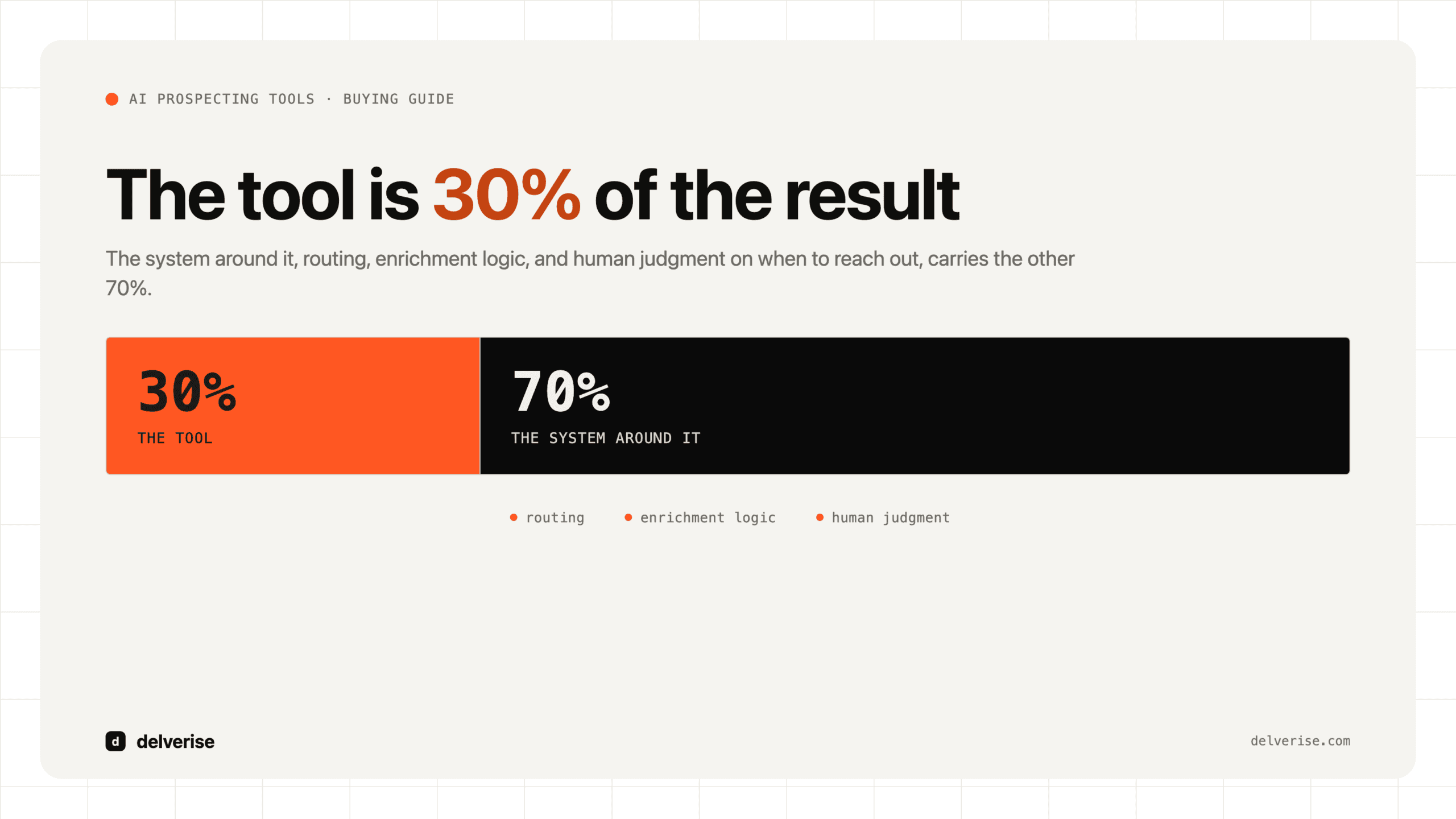
- The tool is roughly 30% of the result. The system around it, routing, enrichment logic, and human judgment on when to reach out, carries the rest.
What are AI prospecting tools?
AI prospecting tools are software that helps sales and marketing teams identify and qualify potential customers using automation and machine learning. In practice they cover four jobs: sourcing (who exists that fits your market), enrichment (adding accurate emails, phone numbers, firmographics, and technographics), prioritization (scoring which accounts to work first), and outreach drafting (writing personalized first messages).

A few terms worth defining up front. Enrichment means filling a thin record (a name and a company) with the data you need to act. Intent data is behavioral signal that suggests an account is actively researching a problem you solve, for example spikes in relevant content consumption or hiring for a related role. Waterfall enrichment is the practice of querying multiple data providers in sequence so that when the first misses, the next fills the gap. We break that mechanic down in our waterfall map guide.
What do these tools actually do well, and where do they break?
They are genuinely strong at volume research. A task that took a rep 15 minutes per account, checking headcount, funding, tech stack, and recent news, now runs in seconds across thousands of records. They are also good at deduplication, normalizing job titles, and generating a competent first-draft email that a human can sharpen.

They break in three predictable places. First, data decay: contact data goes stale fast, and B2B records degrade meaningfully every year as people change jobs. A tool that looks accurate in a demo can return 40% bad emails on a cold list six months later. Second, personalization at scale often reads as personalization at scale, and buyers notice. Third, the tools cannot fix a weak ICP. If you do not know precisely who buys and why, faster prospecting just accelerates you toward the wrong accounts.
This matters because the buyer has changed. Gartner’s research on B2B buying found that customers spend only about 17% of the purchase journey meeting with potential suppliers, and split across several vendors that is a sliver of attention per rep. McKinsey’s work on B2B sales found buyers now move fluidly across roughly ten channels before they commit. Volume alone does not win that buyer. Relevance and timing do. For a wider view of what AI is actually moving in go-to-market, see our take on AI in marketing and sales.
How do the main categories compare?
Most founders treat this as a single purchase. It is really a stack. Here is how the four categories differ in what they are best at and what they cost you if you rely on them alone.

| Category | Example tools | Best at | Weakness if used alone |
|---|---|---|---|
| Data and enrichment platforms | Apollo, ZoomInfo, Clearbit | Broad contact coverage, firmographics, one-stop sourcing | Single-source match rates cap out; data ages |
| Intent and signal providers | Bombora, 6sense, G2 Buyer Intent | Spotting accounts actively in-market | Signal without good targeting creates false urgency |
| Sequencers and outreach engines | Outreach, Salesloft, Apollo sequences | Executing and tracking multi-step cadences | Automates sending, not deciding who deserves a touch |
| Orchestration and agentic layers | Clay, custom workflows | Chaining data sources, custom scoring, AI research per account | Requires build effort and clear logic to pay off |
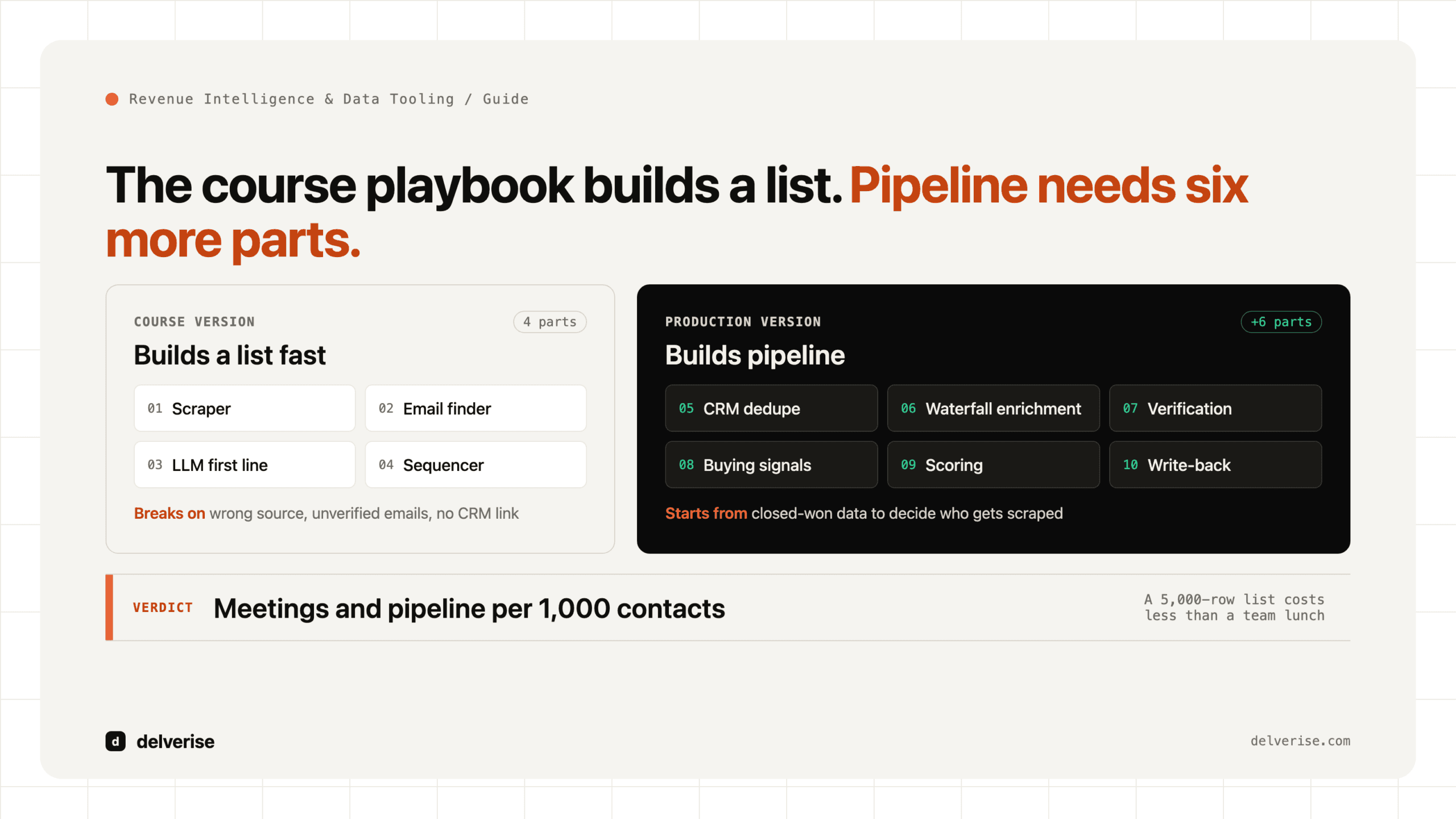
The all-in-one platforms are the common starting point because they are cheap to try. Apollo is a reasonable first buy for a Seed-stage team, and we cover its tradeoffs in our Apollo.io guide. The trap is assuming one vendor’s database is enough. Single-provider match rates on niche or international markets often disappoint, which is exactly why waterfall enrichment exists. If you want the deeper framing on evaluating data vendors, our lead intelligence platform buying guide walks through it.
Where does Clay fit, and do you need it?
Clay sits in the orchestration category. Instead of being a single database, it lets you query many data providers in one table, run waterfall enrichment automatically, and trigger AI to research each account or draft copy against custom prompts. For a team with a specific, non-obvious ICP, this is where AI prospecting gets genuinely differentiated, because you encode your own targeting logic rather than borrowing a vendor’s generic filters.
Clay is not the right first tool for everyone. If your motion is simple and your ICP is broad, a data platform plus a sequencer will do. Clay earns its place when your qualification is nuanced, when you need to combine several signals, or when off-the-shelf lists keep missing your best accounts. It rewards teams that can define the logic and build the workflow. That build step is real, which is why we help teams stand it up on our Clay implementation page. If you are weighing whether to run an AI-assisted development function at all, our piece on the AI BDR covers what it automates and where it still needs a human.
How should a revenue leader evaluate these tools? A worked example
Say you run revenue at a Series A SaaS company selling compliance software to mid-market fintechs. You are choosing between buying one all-in-one platform at $15,000 a year and building a two-layer stack.
Run the math on quality, not seats. Assume your team can work 1,000 outbound accounts a quarter. With a single database returning a 55% valid-email rate and no intent layer, you get 550 reachable contacts, few of them in-market. Add waterfall enrichment and match rates commonly climb into the 80s, so now you have roughly 800 reachable contacts. Layer intent data on top and you can rank those 800 so your reps work the 150 accounts showing active research first. Same effort, materially different pipeline.
The decision is not which logo to buy. It is which combination lifts reachable, relevant, in-market contacts per rep hour. When you evaluate, insist on a live test against your own list, not the vendor’s demo data, and measure valid contact rate, duplicate rate, and how many surfaced accounts actually match your ICP. Our overview of AI sales tools that move revenue lays out the metrics to hold vendors to.
What does it cost to run this well?
Budget in three buckets: data (per-credit or per-record enrichment), platform licenses (per seat), and orchestration or build time. A common Seed-to-Series-B setup lands somewhere between $1,500 and $6,000 a month across tools, with the bigger variable being the human system around them. G2 reviews are a useful sanity check on real-world support and data quality before you commit, since vendor demos rarely show the decay problem.
The honest tradeoff: cheaper tools push more work onto your team, and richer orchestration pushes more work onto setup. Neither removes the need for someone to own targeting, routing, and the judgment call on timing. That ownership question, which role holds which part of the number, is worth settling early, and our GTM role guide maps it out.
Frequently Asked Questions
Do AI prospecting tools replace SDRs or BDRs?
No. They remove the manual research and list-building that consumed most of an SDR’s day, which lets a smaller team cover more accounts. The human still owns targeting decisions, message judgment, and the timing of when an account is genuinely worth a call. Teams that fire their reps and expect the tool to sell tend to see reply rates fall.
How accurate is the data these tools return?
It varies widely by market and provider, and it decays over time as people change jobs. Any single database will miss contacts, especially outside North America or in niche verticals. Waterfall enrichment across multiple providers is the standard fix, and you should always test match rates against your own target list before signing.
What is the difference between AI prospecting tools and intent data?
Prospecting tools find and enrich the accounts and people you could contact. Intent data tells you which of those accounts are actively researching a problem right now. They work best together: intent tells you when, and prospecting tells you who and how to reach them.
Can a Seed-stage team justify a tool like Clay?
Sometimes. If your ICP is broad and your motion is simple, a data platform plus a sequencer is enough and cheaper to run. Clay and similar orchestration layers pay off when your qualification is nuanced, you combine several signals, or standard lists keep missing your best-fit accounts.
What should I measure to know if a tool is working?
Track valid contact rate, duplicate rate, percentage of surfaced accounts that match your ICP, and reply-to-meeting conversion, then tie those back to pipeline created per rep hour. If a tool raises volume but those quality metrics fall, it is costing you more than it returns.
Read next