←Back to blog
Revenue Intelligence & Data ToolingGuideAugust 23, 20268 min read
Free AI Tools for Lead Generation: What Actually Works in B2B SaaS
Free AI tools for lead generation cover four jobs: market research, contact data, message drafting, and workflow automation. Free tiers from general LLMs, prospecting databases, CRMs, and open-source automation platforms can produce real pipeline at zero software cost. The constraint is volume and data coverage, so free tools fit teams validating a motion before funding it.
Free AI tools for lead generation cover four jobs: market research, contact data, message drafting, and workflow automation. Free tiers from general LLMs, prospecting databases, CRMs, and open-source automation platforms can produce real pipeline at zero software cost. The constraint is volume and data coverage, so free tools fit teams validating a motion before funding it.
Key takeaways
- Free AI tools work best as a validation layer: prove a segment converts before you commit to annual contracts.
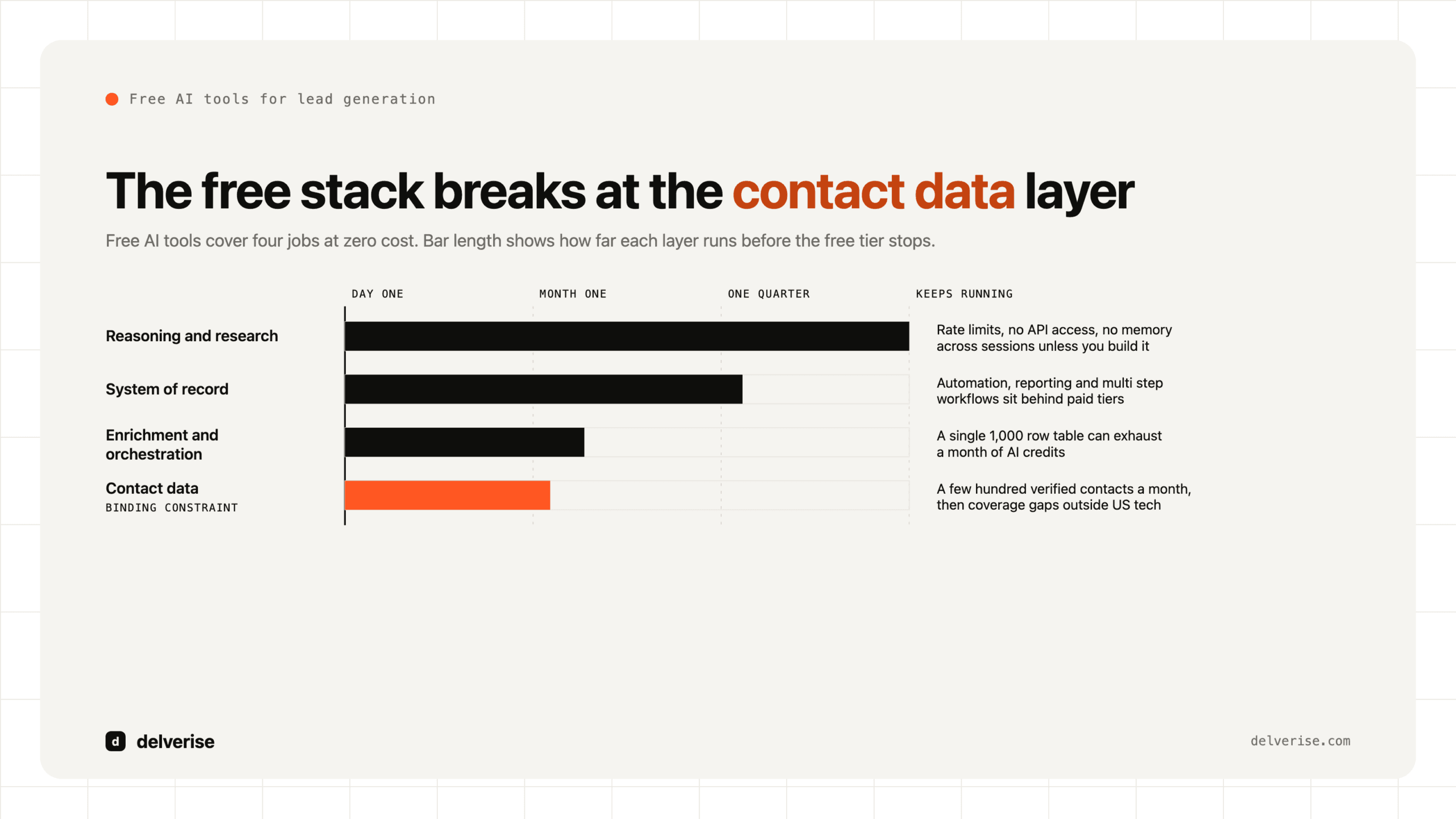
- The binding constraint on a free stack is contact data coverage, not AI quality. Free databases thin out fast outside US tech.
- An LLM plus a free CRM plus one automation tool covers most of what a two-person GTM team needs in month one.
- Free tiers cost you time instead of money. Price that time honestly before calling the stack free.
- The moment to pay is when a segment shows repeatable conversion and manual work becomes the ceiling.
What counts as a free AI tool for lead generation?
Lead generation here means identifying accounts that fit your ICP (ideal customer profile: the account traits that predict a closed deal), finding the right people inside them, and starting a relevant conversation. AI enters at three points: research and summarization, data enrichment and inference, and message generation.
 free trials mar” class=”wp-image-3083″/>
Free tools split into three honest categories. Permanently free products, usually open source or ad-supported, like n8n’s community edition or Google Search Console. Free tiers of commercial products, which give you limited credits and expect you to outgrow them. And free trials, which are paid tools with a 14-day delay. Only the first two belong in a stack you plan to run for a quarter.
Which free AI tools earn a place in a B2B pipeline stack?
| Layer | Free options | What it does at zero cost | Where the free tier stops |
|---|---|---|---|
| Reasoning and research | ChatGPT, Claude, Gemini free tiers | ICP definition, account research summaries, message variants, list cleanup logic | Rate limits, no API access, no memory across sessions unless you build it |
| Contact data | Apollo free plan, Hunter free tier, LinkedIn free search | A few hundred verified contacts a month, enough for one segment test | Coverage gaps outside US tech, weak mobile numbers, export caps |
| Enrichment and orchestration | Clay free plan | Waterfall enrichment across providers, AI research columns, list building in a spreadsheet interface | Credits burn fast on AI columns, so a single 1,000-row table can exhaust a month |
| System of record | HubSpot free CRM | Contacts, deals, email tracking, basic sequences for a small team | Automation, reporting, and multi-step workflows sit behind paid tiers |
| First-party intent | Google Search Console, GA4 | Which companies and queries already find you, which pages convert | No person-level identification, sampling on high-traffic properties |
| Automation glue | n8n community edition, Google Apps Script | Self-hosted workflows connecting data, LLM calls, and CRM writes | You own hosting, error handling, and maintenance |
Notice what this table implies. The AI layer is close to free and close to commoditized. The scarce resource is accurate contact data, which stays expensive because someone has to collect and verify it. Any evaluation of AI prospecting tools that skips data quality is measuring the wrong variable.

What does a free AI lead generation stack look like end to end?
Here is a concrete worked example for a Seed-stage B2B SaaS company with a founder selling and one AE, targeting mid-market operations leaders in North America.

Week one, define and size the market. Use an LLM to convert your last 20 closed-won and closed-lost deals into an ICP scorecard: employee band, tech signals, org structure, trigger events. Ask it to produce a set of firmographic filters you can apply in a free prospecting database. This exercise takes about three hours and typically kills a third of the segments the team assumed were good. A structured prospecting list built this way outperforms a large unfiltered one at every stage.
Week two, build 300 accounts and 600 contacts. Free tiers realistically deliver a few hundred verified email addresses per month per seat. That is enough for one segment test. Pull the accounts, enrich the contacts, and accept a 15 to 25 percent gap where free data has no record. Log the gap. It is your first real signal about whether a paid provider is required for this market.
Week three, research and write. Run an AI research pass over each account: recent hiring, product launches, funding, public job posts mentioning the problem you solve. Generate a first-line variant per account, then edit every one by hand. Model-written outreach that ships unedited reads like model-written outreach, and buyers have calibrated to it. Our guide to ChatGPT for sales covers where the drafting boundary sits.
Week four, send, track, and count. Route replies into the free CRM, tag them by segment, and measure positive reply rate per 100 contacts by segment rather than in aggregate. Aggregate numbers hide the one segment that is actually working.
Total software cost: zero. Total time cost: roughly 60 to 80 hours of a senior person’s month. That is the trade, and it is a reasonable one when you are still learning which segment converts.
Where do free tiers break?
Four failure points show up predictably.
Data coverage. Free plans give you the easy records. Mobile numbers, non-US contacts, and mid-market companies without strong web presence are where coverage collapses. If your ICP sits outside US tech, expect match rates well below what the marketing pages suggest.
Credit math on AI enrichment. An AI research column that runs against 1,000 rows consumes credits at a different order of magnitude than a simple email lookup. Teams routinely exhaust a month of free credits in one afternoon of table building, then conclude the tool does not work.
No routing or timing logic. Free stacks send batches. They cannot see when an account enters a buying window, which is the structural weakness we describe in why cold email has a blind spot. Gartner’s research on B2B buying found that buyers spend only about 17 percent of their total purchase journey meeting with potential suppliers, split across every vendor they consider. Batch sending into that narrow window is mostly waste.
Response latency. HBR’s study on the short life of online sales leads found that companies contacting a lead within an hour were roughly seven times more likely to have a meaningful qualifying conversation than those waiting even one hour longer, and dramatically more likely than those waiting a day. Free stacks without automated routing almost always miss that window, and no amount of AI copy quality compensates.
When should you start paying, and for what?
Pay when one of three things becomes true. Data coverage blocks you, meaning your match rate on target accounts is below roughly 60 percent and you cannot reach the buyers you need. Volume blocks you, meaning manual steps cap you well below the contact volume your pipeline math requires. Or timing blocks you, meaning you can identify buying signals but have no way to act on them within hours.
The buying order that tends to hold: contact data first, because everything downstream depends on it. Then orchestration, so enrichment and routing run without a person in the loop. Then sequencing and CRM tiers. AI models are usually the last thing worth paying for, since the free tiers are already strong enough for research and drafting.
McKinsey’s B2B Pulse research found that buyers now use around ten channels to interact with suppliers across a purchase, up sharply from a decade ago. That fragmentation is why a single-channel free stack plateaus. Covering more channels requires either more headcount or more system, and system is the cheaper answer past a certain point. That architecture question is what GTM engineering exists to answer.
How do you evaluate a free tool before you build on it?
- Run a 200-account match-rate test against your real ICP before trusting any published coverage claim
- Check export limits and data ownership terms, since some free tiers restrict what leaves the platform
- Confirm there is an API or webhook path on a paid tier, so today’s manual step can be automated later
- Price the human hours the free tier consumes each month and compare against the paid tier cost
- Test one AI-enriched column on 50 rows and check accuracy manually before running 5,000
- Verify the tool writes cleanly into your CRM, because data that lives in a silo stops compounding
That last point matters more than most teams expect. Every tool you add without a write path back to the system of record creates a reconciliation problem later. Keeping the CRM as the source of truth from day one is what makes B2B prospecting compound instead of restart each quarter.
Frequently Asked Questions
Can free AI tools actually generate qualified B2B pipeline?
Yes, at limited volume. A free stack can realistically support a few hundred targeted contacts per month, which is enough to test whether a segment converts and to book early meetings. It will not sustain a quota-carrying team of five. Treat it as a validation instrument for a single motion.
Which free AI tool should a Seed-stage team start with?
Start with a general LLM for ICP definition and research, plus a free CRM to hold the data. Those two cost nothing and shape every later decision. Add a contact data free tier once you know exactly which titles at which companies you are targeting, so you do not burn credits on a list you will discard.
Is Clay’s free plan enough to run outbound?
It is enough to learn the tool and build a small, well-enriched list. It is not enough to run continuous outbound, because AI research columns consume credits quickly and waterfall enrichment multiplies that. Most teams use the free plan to prove the workflow, then size a paid plan against actual credit consumption. If you want the workflow architected once and handed over running, our Clay implementation work covers that.
What is the real cost of a free lead generation stack?
Senior time. A free stack typically consumes 15 to 20 hours a week of manual list building, enrichment cleanup, and copy editing. At founder or VP loaded cost, that exceeds most paid tool budgets within the first month. The free stack is still correct early, when you are buying information about your market rather than throughput.
How do free AI tools fit into a larger GTM system later?
They usually become the research and drafting layer inside a paid data and orchestration pipeline. The LLM work you do defining ICP and message structure carries forward. The manual list building does not. Our guide on how to use AI for sales prospecting covers what changes structurally once routing and enrichment run automatically.
Read next