←Back to blog
Revenue Intelligence & Data ToolingGuideAugust 23, 20269 min read
How To Use AI In Sales: A Revenue Leader’s Practical Guide
To use AI in sales, apply it to the work that is high-volume and low-judgment: research, data enrichment, list building, call summarization, CRM hygiene, and first-draft messaging. Keep human ownership of qualification, discovery, and negotiation. AI multiplies whatever system it runs on, so fix your data and process first.
To use AI in sales, apply it to the work that is high-volume and low-judgment: research, data enrichment, list building, call summarization, CRM hygiene, and first-draft messaging. Keep human ownership of qualification, discovery, and negotiation. AI multiplies whatever system it runs on, so fix your data and process first.
Key takeaways
- AI returns compound value in research, enrichment, and admin work. It returns thin value when pointed at persuasion or judgment.
- Bad CRM data plus AI equals faster bad outreach. Data quality is the gating constraint, not model quality.
- The highest-ROI first project for most teams is signal-to-action routing, not autonomous sequence writing.
- Measure AI by pipeline quality metrics (reply-to-meeting rate, meeting-to-opportunity rate), not activity volume.
- Buy AI features inside systems you already run. Build custom workflows only where your motion is genuinely differentiated.
What does “using AI in sales” actually mean in 2026?
The phrase covers four distinct categories that get collapsed into one, which is why buying decisions go sideways.

Generative AI produces text, summaries, and drafts: call recaps, email variants, account one-pagers. Predictive AI scores and ranks: which accounts look like your closed-won set, which deals are slipping. Agentic AI chains multiple steps with tool access: research an account, check three data sources, write a record, trigger a task. Embedded AI is the feature layer your existing vendors ship inside Salesforce, HubSpot, Outreach, and Gong.
Most teams need embedded and generative AI working well before agentic anything is worth the operational overhead. Gartner’s research on GenAI in sales has consistently pointed to the same pattern: value concentrates in seller productivity and content generation, while fully autonomous selling remains far from proven. That ordering matters for sequencing your roadmap.
Where does AI actually create measurable lift in a sales motion?
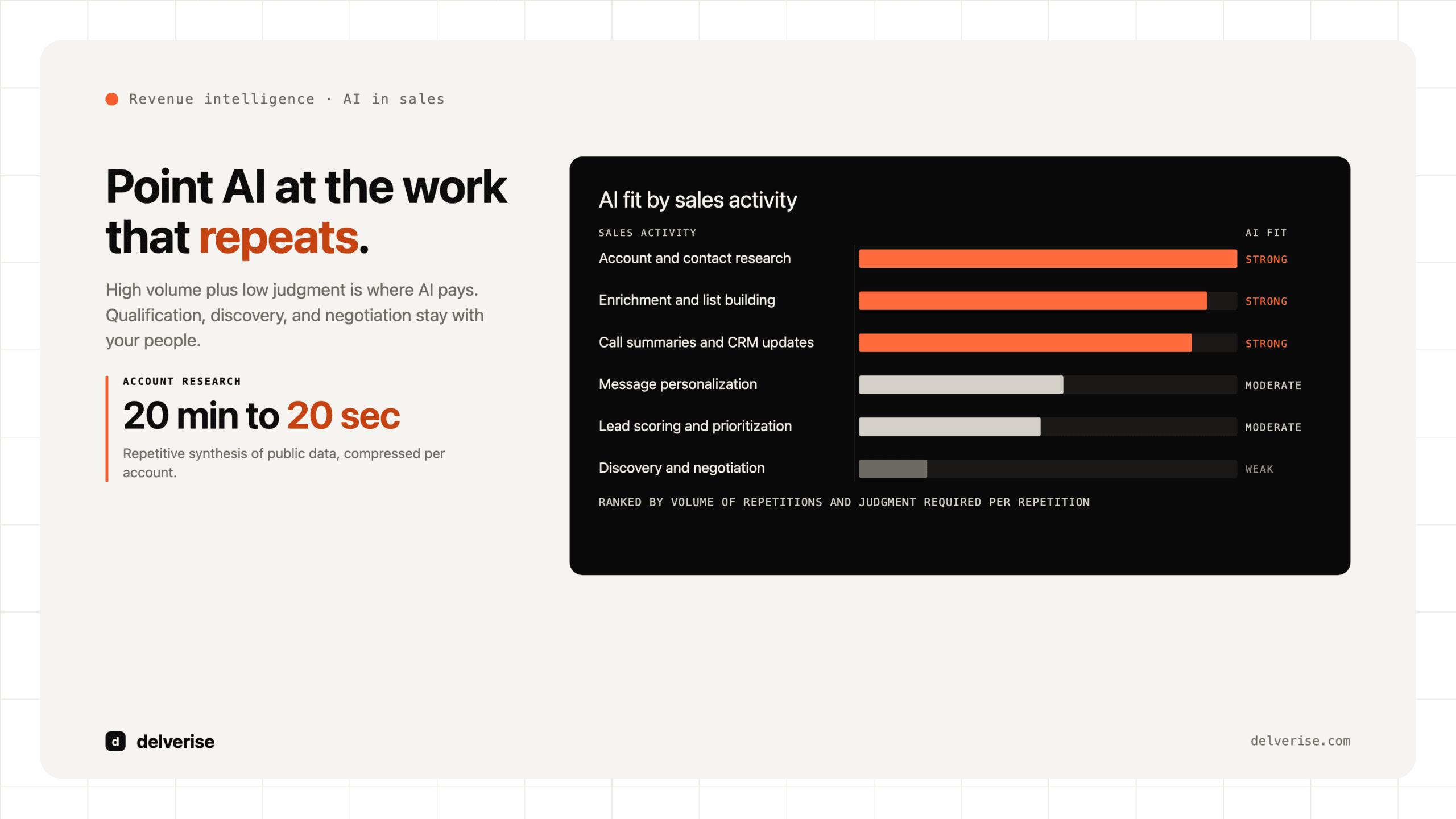
Work through your funnel and mark each step by two variables: volume of repetitions and the judgment required per repetition. High volume plus low judgment is where AI pays. Here is how the common steps sort out.

| Sales activity | AI fit | Why |
|---|---|---|
| Account and contact research | Strong | Repetitive synthesis of public data. AI compresses 20 minutes to 20 seconds per account. |
| Data enrichment and list building | Strong | Deterministic-ish tasks with checkable outputs. Errors surface fast. |
| Call summaries and CRM updates | Strong | Recovers rep hours and improves forecast data quality at the same time. |
| Message personalization | Moderate | Works when grounded in real signals. Produces obvious slop when grounded in nothing. |
| Lead scoring and prioritization | Moderate | Only as good as your closed-won history. Thin data means thin models. |
| Discovery and qualification calls | Weak | Requires reading intent, context, and politics in real time. |
| Negotiation and commercial terms | Weak | Relationship, risk, and trust. Delegating this is a cost, not a saving. |
McKinsey’s work on B2B sales and generative AI has found that the strongest gains show up in prospecting and lead-qualification support plus sales-process automation, rather than in replacing seller conversations. That is consistent with what actually happens inside revenue teams: reps get their week back, and the number they hit still depends on how well they run a call.
What has to be true before AI works in your sales process?
AI does not fix a broken revenue system. It runs faster on top of it. Three things gate everything else.
Your data has to be trustworthy. If contact records are 40% stale, an AI agent will confidently write personalized emails to people who left two years ago. Enrichment coverage, email deliverability, and account hierarchy accuracy are prerequisites. Most teams solve this with a data enrichment waterfall that chains multiple providers, so coverage comes from whichever source actually has the record rather than from a single vendor’s blind spots.
Your process has to be written down. AI encodes whatever definitions you give it. If “qualified” means something different to each rep, no model will produce a consistent scoring output. Define stages, exit criteria, and ICP boundaries in plain language first.
Someone has to own the system. AI workflows drift: prompts age, data sources change schemas, models get deprecated. Without a clear owner in GTM operations, you end up with six half-working automations nobody trusts. This is a staffing question as much as a tooling one, and it usually maps to a specific GTM role rather than being spread across the team.
What is the highest-ROI first AI project for a B2B SaaS team?
Signal-to-action routing. Pick one buying signal you already have access to, and build the full path from signal to a rep doing something specific about it.

Here is a concrete worked example a 12-person revenue team can ship in about two weeks.
The signal: a target-account company posts a job listing for a role that implies they now own the problem you solve (say, their first Head of RevOps).
The chain:
- A scheduled job pulls new job postings across your ICP account list.
- An AI classification step reads each posting and answers one question: does this role imply ownership of our problem? Yes, no, or unclear. Unclear goes to a human queue.
- For yes results, enrichment finds the hiring manager and two adjacent stakeholders, then verifies emails.
- An AI research step writes a four-line brief: what the posting implies, what the company recently shipped, which of your customers look similar, and the single most relevant proof point.
- The brief and contacts land in the CRM as a task assigned to the account owner, with a suggested first-touch draft the rep edits before sending.
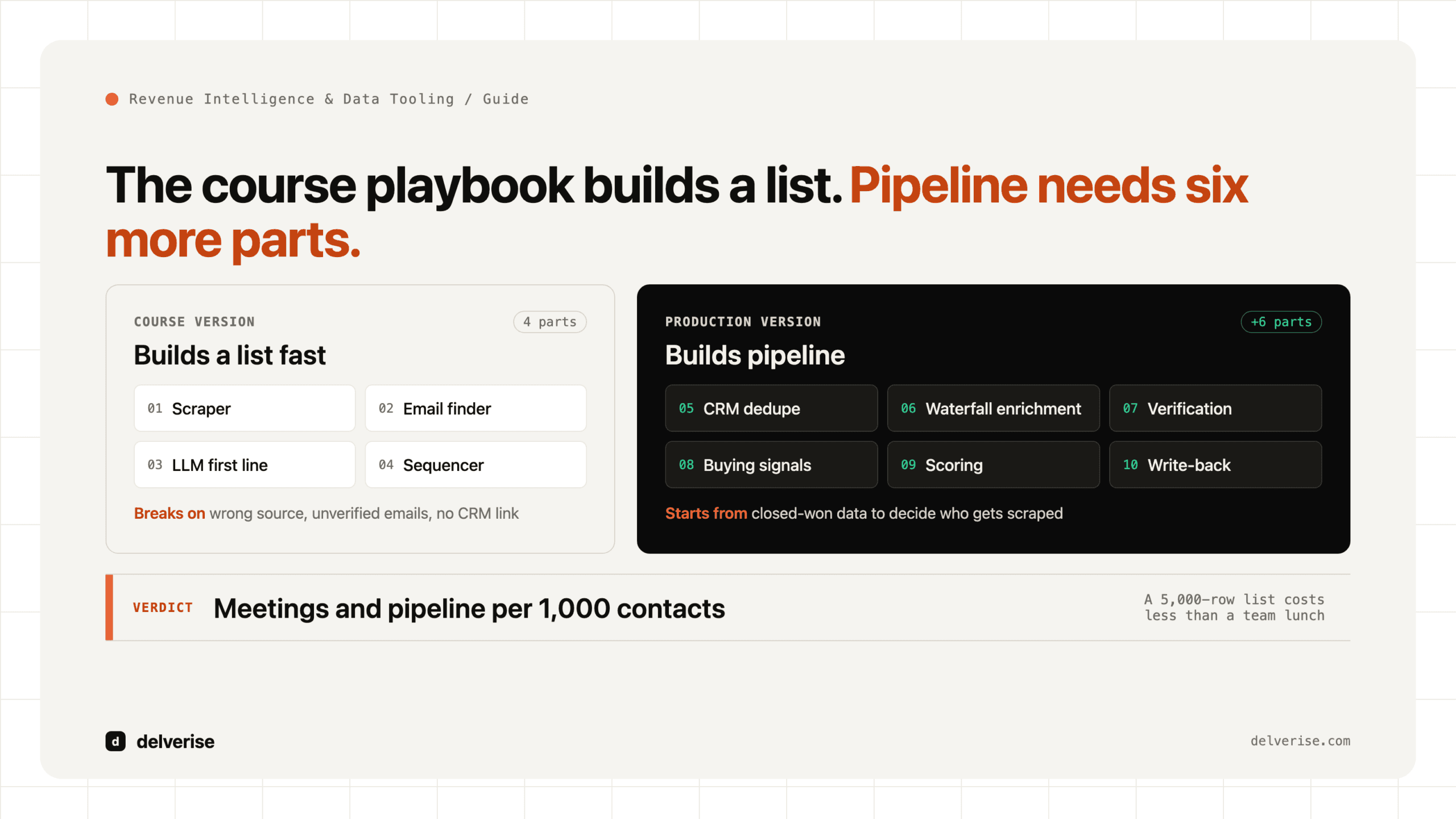
Notice what stays human: the rep decides whether to reach out and what to say. AI removed the research tax, not the judgment. Teams commonly build this pattern in Clay because the enrichment, waterfall logic, and AI columns live in one table, though the same chain runs in n8n plus a data provider stack if you prefer more control. If you want the version that already runs inside your CRM and sequencer, our Clay implementation work covers that build.
The related patterns are worth understanding before you commit: AI prospecting tools handle the discovery half, and intent data platforms supply a different signal class if job postings do not fit your motion.
How do you evaluate AI sales tools without getting sold?
Vendor demos run on clean data and cherry-picked accounts. Your evaluation should not. Run every tool against the same 50 real accounts from your actual pipeline, and score the output blind.
Ask these questions in every evaluation:
- What is the accuracy rate on our accounts, measured by us, not by the vendor’s benchmark?
- Does it write back to our CRM, and can we control which fields it touches?
- What happens when the model is uncertain? Does it flag, guess, or fail silently?
- Can we export our data and prompts if we leave?
- Who on our team owns this after the trial ends?
- Is the pricing per seat, per credit, or per action, and what does that cost at 3x our current volume?
The last one catches people. Credit-based AI pricing looks cheap in a pilot and expensive at scale, and per-action pricing punishes exactly the workflows you want to expand. Model the cost at your 12-month volume before signing.
G2 review data across sales-AI categories shows a consistent gap between satisfaction with individual features and satisfaction with implementation and support. That gap is your risk. A capable tool with no owner and no integration path produces nothing. For deeper category-by-category comparison, our AI sales tools buyer’s guide breaks down what each layer actually does.
How should you measure whether AI is working?
Activity metrics will always improve when you add AI. More emails, more accounts touched, more calls logged. That tells you nothing about revenue.
Track these instead:
- Reply-to-meeting rate. If AI personalization works, replies convert to meetings at a higher rate. If volume went up and this rate went down, you automated noise.
- Meeting-to-opportunity rate. Catches bad targeting. AI that books meetings with the wrong people shows up here.
- Rep hours reclaimed, then reallocated. Saving four hours a week means nothing unless those hours go into calls. Measure both halves.
- CRM field completeness on closed deals. A proxy for whether AI-assisted data capture is actually improving your forecast inputs.
- Cost per qualified opportunity. The number that consolidates everything. If AI spend rises and this falls, the system works.
Set a baseline for at least one full sales cycle before you turn anything on. Teams that skip this can never prove the lift, and the AI budget becomes the first thing cut when the board asks hard questions.
Where does AI in sales break?
Four failure modes account for most of what goes wrong.
Volume without targeting. AI makes it trivial to 10x outbound volume. If your ICP definition is loose, you have now 10x’d your domain reputation damage and your unsubscribe rate. Deliverability infrastructure has a hard ceiling that AI cannot raise.
Personalization that is technically personal and practically hollow. “I saw your company raised a Series B” is not insight. Buyers pattern-match AI-generated openers within a sentence now, and the credibility cost is real.
Autonomous agents without checkpoints. Fully automated AI BDR systems fail predictably at the handoff, where a warm reply needs a human who knows the product. Build the human checkpoint at the reply, not at the send.
Tool sprawl. Six AI point solutions with overlapping functions and no shared data layer costs more than one integrated system and produces less. Consolidation is usually the higher-return move once you are past the experiment phase.
Harvard Business Review has published repeatedly on the disconnect between AI investment and realized business value, with the pattern pointing at workflow redesign rather than model capability as the binding constraint. That matches what happens in revenue teams: the tool works, the process around it was never rebuilt.
Frequently Asked Questions
Will AI replace SDRs in B2B SaaS?
Not in the current generation of tooling. AI reliably replaces the research, list-building, and data-entry portion of the SDR role, which is a meaningful share of the hours. What it does not replace is handling a live objection, reading whether a reply is genuine interest or a polite brush-off, and knowing when to escalate to an AE. The realistic outcome is fewer SDRs doing higher-value work, supported by a much larger automated research layer.
What is the minimum data quality needed before AI is worth trying?
A practical floor: 80%+ email deliverability on your enriched contacts, an ICP definition specific enough that two people on your team would classify the same account identically, and at least 50 closed-won deals with clean stage history if you want predictive scoring. Below that, start with generative use cases like call summaries and research briefs, which do not depend on your historical data being clean.
Should we build custom AI workflows or buy tools with AI built in?
Buy for anything standard: call recording and summarization, CRM data capture, email assistance. Build where your motion is genuinely different from your competitors’, which is usually signal detection and routing specific to your market. The build-versus-buy line moves as vendors ship features, so revisit it every two quarters rather than treating it as a one-time architecture decision.
How long before AI in sales shows measurable ROI?
Efficiency gains like reclaimed rep hours appear within 30 to 60 days and are easy to measure. Pipeline and revenue effects take one full sales cycle plus a quarter, because you need enough deals through the new process to separate signal from noise. Budget for two quarters before you judge the outcome, and instrument the baseline on day one.
What is the first thing to fix if our AI outbound is not working?
Targeting, before messaging. Most teams reach for better prompts when reply rates are low, but the more common cause is that the list is wrong. Pull the last 100 people you contacted and ask whether each one plausibly owns the problem you solve and has a reason to act this quarter. If more than a third fail that test, the problem is your list, and improving your follow-up process or your copy will not fix it.
Read next