←Back to blog
Revenue Intelligence & Data ToolingGuideAugust 23, 20268 min read
AI Powered Lead Generation: What It Actually Automates in B2B SaaS
AI powered lead generation uses machine learning and large language models to find, research, score, enrich, and contact potential buyers with far less manual work. In B2B SaaS it performs best on research and routing, where it compresses hours of account digging into seconds. It performs worst when teams point it at bad data or vague targeting.
AI powered lead generation uses machine learning and large language models to find, research, score, enrich, and contact potential buyers with far less manual work. In B2B SaaS it performs best on research and routing, where it compresses hours of account digging into seconds. It performs worst when teams point it at bad data or vague targeting.
Key takeaways
- AI is strongest at the middle of the funnel-building process: research, enrichment, classification, and message personalization at volume.
- It is weakest at deciding who to sell to. Segment definition and offer clarity stay human decisions.
- Data quality sets your ceiling. A model reasoning over stale firmographics produces confident nonsense faster than a person could.
- Measure AI lead generation on qualified pipeline per rep hour and reply-to-meeting rate, not on volume of contacts created.
- Buy tools for the layers where vendors have real moats (contact data, intent, deliverability). Build the connective logic yourself.
What is AI powered lead generation?
AI powered lead generation is the use of predictive models and language models inside the sequence of steps that turns an unknown market into named, qualified, contacted buyers. Those steps have not changed in twenty years: define the segment, find the accounts, find the people, verify contactability, judge fit and timing, then reach out with something relevant.

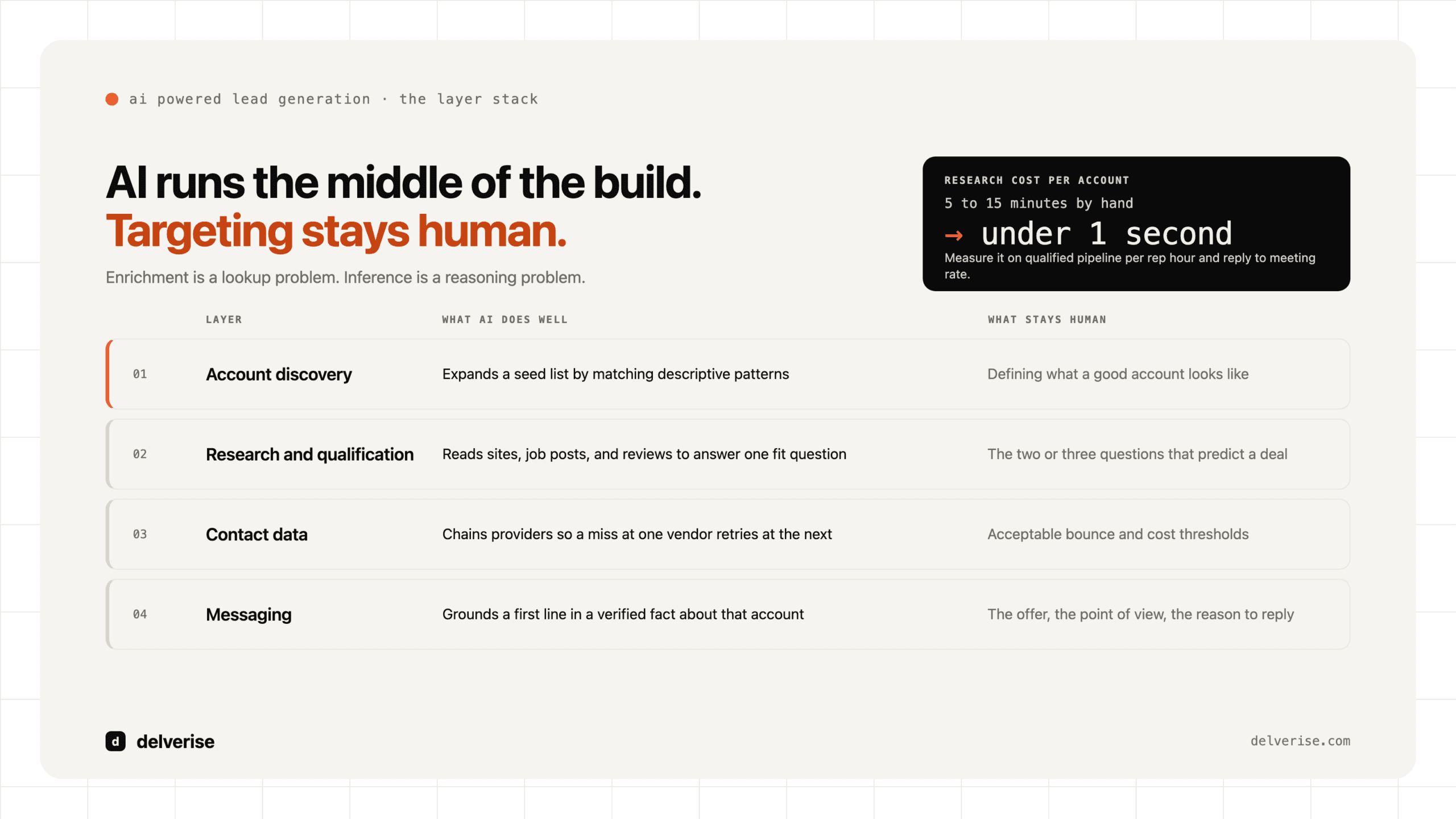
What changed is cost per step. Reading a company’s careers page, pricing page, and last three product announcements to decide whether they are a fit used to take a researcher five to fifteen minutes per account. A language model does a version of that in under a second for a fraction of a cent. When a step gets 100x cheaper, you do not just save money on it. You start doing it at a scale that was previously impossible, which is where the actual advantage lives.
Two terms worth defining because vendors blur them. Enrichment means appending known attributes to a record: headcount, tech stack, funding, direct dial. Inference means having a model form a judgment that no database stores, like “this company is building an in-house billing system based on three job postings.” Enrichment is a lookup problem. Inference is a reasoning problem. Most of the recent gain in lead generation comes from the second one.
Where does AI actually improve lead generation?
Five layers, ranked by how reliably AI improves them today.

| Layer | What AI does well | What stays human | Common failure mode |
|---|---|---|---|
| Account discovery | Expanding a seed list by matching descriptive patterns instead of rigid SIC codes | Defining what a good account looks like in the first place | Lookalike drift: the list grows and gets worse |
| Research and qualification | Reading websites, job posts, filings, and reviews to answer a specific fit question per account | Choosing the two or three questions that actually predict a deal | Vague prompts producing vague scores nobody trusts |
| Contact data | Chaining providers so a miss at one vendor gets retried at the next | Deciding acceptable bounce and cost thresholds | Paying three times for the same record |
| Messaging | Grounding a first line in a verified fact about that account | The offer, the point of view, the reason to reply | Personalized noise: accurate detail, no relevance |
| Routing and follow-up | Classifying replies, prioritizing queues, prepping call context | The conversation itself | Silent automation errors that nobody notices for weeks |
The layer with the highest ratio of gain to risk is research and qualification. Gartner’s buyer research is instructive here: B2B buyers spend only about 17% of their total purchase journey meeting with potential suppliers, and across several competing vendors that can mean 5% or 6% of a buyer’s time with any single rep. You do not win that sliver with volume. You win it by showing up already informed, which is exactly what cheap inference at scale buys you. If you are evaluating specific products for this layer, our breakdown of AI prospecting tools covers where each category earns its price.
What can AI lead generation not fix?
Three things, and every stalled program we see is stuck on at least one of them.
Unclear targeting. If your team cannot state in one sentence which companies should buy and what triggers the need, AI will faithfully scale that ambiguity. Models optimize inside a definition. They do not supply one.
Bad underlying data. Enrichment coverage varies wildly by geography, company size, and seniority. A US mid-market VP is well covered. A German mid-market operations manager often is not. Waterfalling providers is the practical fix, and we walk through the economics in the data enrichment waterfall. Buying one more AI layer on top of thin data changes nothing.
Weak offer and weak follow-through. Gartner has also documented how difficult buyers find these purchases: a large majority describe recent B2B buying as complex or difficult, with buying groups of roughly six to ten people each carrying their own independently gathered information. That is a consensus problem inside the account. Faster outbound does not resolve it. Sequenced, useful follow-up does, which is why lead follow up discipline usually beats another prospecting tool.
What does a working system look like end to end?
Here is a concrete worked example. Assume you sell a $30,000 ACV compliance product to Series A through C SaaS companies, and your best-fit signal is a company hiring its first dedicated security or compliance role.

Step one, signal capture. A scheduled job scrapes job boards for postings matching “security engineer,” “compliance manager,” and “GRC” at companies in your headcount and funding band. Say that returns 180 companies a month.
Step two, inference filter. For each company, a model reads the posting plus the careers page and answers two narrow questions: is this the company’s first such hire, and does the posting mention SOC 2 or ISO 27001? Narrow questions produce auditable answers. Broad ones produce scores you cannot debug. Assume 60 companies pass.
Step three, people and contact data. Identify the hiring manager and the likely economic buyer, then run a provider waterfall for verified email and mobile. At realistic coverage you get contactable records for roughly 45 accounts, two people each.
Step four, grounded outreach. Each first message references the specific role being hired and the specific framework named in the posting. The offer stays constant. Only the evidence changes. This is the difference between personalization and trivia, and it is the central argument in AI email lead generation.
Step five, routing. Replies get classified, positive ones route to a rep with a one-paragraph brief already attached, and everything writes back to the CRM as a structured record rather than a note.
Ninety contacts a month from that pipeline, sent well, is a real quarter of pipeline for a Seed to Series B team. The point is not the volume. It is that every account in the list has a documented reason to be there.
Most teams assemble this in a workflow platform rather than a monolithic tool. Clay has become the common choice because it holds the enrichment waterfall, the model calls, and the conditional logic in one place, so the qualification rules stay inspectable instead of buried across four vendors. It is not the only path: n8n plus direct provider APIs is cheaper at high volume and harder to maintain, and Apollo or a similar all-in-one is simpler if your targeting is genuinely straightforward. The tradeoff is real, and delverise is candid about it before anyone signs a contract. If you want the system built and handed over rather than assembled internally, that is what our Clay implementation work and broader AI outbound practice cover.
How do you measure whether it is working?
Replace volume metrics with efficiency and quality metrics. Four worth instrumenting from day one:
- Qualified pipeline per rep hour. The only number that proves automation created capacity rather than activity.
- Reply-to-meeting rate. Rising volume with a falling ratio means your targeting loosened. Catch it in week two, not quarter three.
- Cost per contactable, verified record. Tracks whether your waterfall is efficient or just expensive.
- Signal-to-close correlation. Which entry signals actually produced closed revenue two quarters later. This is the feedback loop that makes the whole system compound.
Attribution gets harder as you add channels, and it will get harder. McKinsey’s B2B Pulse research has tracked buyers moving across ten or so channels during a purchase decision, up sharply from a handful a decade ago. Single-touch attribution stops being meaningful in that environment. Track first qualifying signal and last meaningful touch, and accept the fuzziness in between. Getting this measurement layer right is ordinary GTM operations work, and skipping it is why plenty of AI programs cannot prove their own value.
How should you sequence the build?
In this order. Each step is worthless without the one before it.
- Write your ICP as testable rules, not adjectives. Two or three questions a model can answer with evidence.
- Audit current data quality: bounce rate, enrichment coverage by segment, CRM duplicate rate.
- Pick one signal and one segment. Build the full loop end to end for that single path.
- Instrument the four metrics above before you scale volume.
- Fix deliverability and follow-up before adding a second signal.
- Only then add signals, segments, and channels, one at a time.
Teams that skip straight to step six get a large volume of low-quality activity and conclude AI does not work for their market. The sequencing is where the outcome is decided.
Frequently Asked Questions
Is AI powered lead generation different from marketing automation?
Yes. Marketing automation executes predefined rules: if a form is submitted, send this email. AI adds judgment steps, where a model reads unstructured information and forms a conclusion no rule could encode. Most working systems combine both, with AI handling research and classification while deterministic automation handles delivery and record-keeping.
Will AI replace our SDR team?
It replaces specific SDR tasks, mainly list building, account research, and first-draft messaging. It does not replace discovery calls, objection handling, or multithreading a buying group. The realistic outcome for most Seed to Series B teams is a smaller prospecting team supported by a much better system. We break down exactly where the boundary sits in AI BDR: what it actually automates and where it breaks.
How much should we expect to spend?
Budget in three buckets: data providers, workflow tooling, and model usage. For a team running a few thousand contacts a month, data is usually the largest line, workflow tooling is a fixed platform cost, and model usage is often surprisingly small, frequently under a few hundred dollars monthly. The bigger cost is implementation time, which is why the buy-versus-build decision matters more than the tool prices.
Does intent data make this work better?
Sometimes. Third-party intent data adds timing signal, which is genuinely valuable when your product solves a problem buyers actively search for. It adds noise when your category is one buyers do not know to look for. Test it against your own first-party signals before committing to an annual contract, and see our analysis of what buying intent data actually changes.
What is the single most common mistake?
Scaling before validating. A system that produces 50 excellent, well-researched conversations a month is worth more than one producing 5,000 generic touches, and it is also the only version you can debug. Get the loop right on one segment, prove the ratio holds, then increase volume.
Read next