←Back to blog
Revenue Intelligence & Data ToolingGuideAugust 31, 20268 min read
Outbound SDR: What the Role Actually Does and What One Rep Produces
An outbound SDR (sales development representative) is a specialist who researches, contacts, and qualifies buyers who have not raised their hand, then hands qualified meetings to account executives. In B2B SaaS, the role produces predictable pipeline only when it sits on top of a working targeting, data, and sequencing system underneath it.
An outbound SDR (sales development representative) is a specialist who researches, contacts, and qualifies buyers who have not raised their hand, then hands qualified meetings to account executives. In B2B SaaS, the role produces predictable pipeline only when it sits on top of a working targeting, data, and sequencing system underneath it.
Key takeaways
- An outbound SDR converts cold accounts into qualified meetings. The rep is the last mile of a pipeline system, and the system decides most of the output.
- One fully ramped SDR in mid-market SaaS realistically books 8 to 15 held meetings per month. Below that, the constraint is usually list quality or deliverability rather than effort.
- Contact data accuracy has a compounding effect: a 25-point drop in usable contacts cuts closed-won output by roughly the same proportion, at identical headcount cost.
- Hiring an SDR before ICP, data, sending infrastructure, and CRM routing exist tends to burn cash and torch a domain reputation.
- AI moves research, list building, and personalization inputs. It has not moved the parts of the job that require judgment on a live call.
- Measure SDRs on held meetings and downstream opportunity quality, since activity counts are trivially gamed.
What does an outbound SDR actually do?
The job has four parts. First, account and contact selection: deciding which companies fit the ideal customer profile (ICP) and which people inside them sit in the buying group. Second, research: finding a reason this account should care right now. Third, multi-channel outreach across email, phone, and LinkedIn. Fourth, qualification and handoff, which means running a discovery conversation and passing a real opportunity to an AE.

Only two of those four require a human. Selection and research can be systematized almost entirely. That distinction matters when you size the team, because most SDR org charts are staffed as if all four parts scale linearly with headcount. They do not. Where the SDR role fits inside the broader GTM function determines whether you are buying capacity or buying a workaround for a missing system.
Gartner’s research on B2B buying is the useful frame here: buyers spend roughly 17% of the total purchase journey meeting with potential suppliers, and when they are comparing several vendors, any single sales rep may get about 5% or 6% of that time. The typical enterprise buying group runs six to ten decision makers. An SDR is competing for a narrow slice of attention across a committee, which is why targeting precision beats volume.
What does one outbound SDR realistically produce?
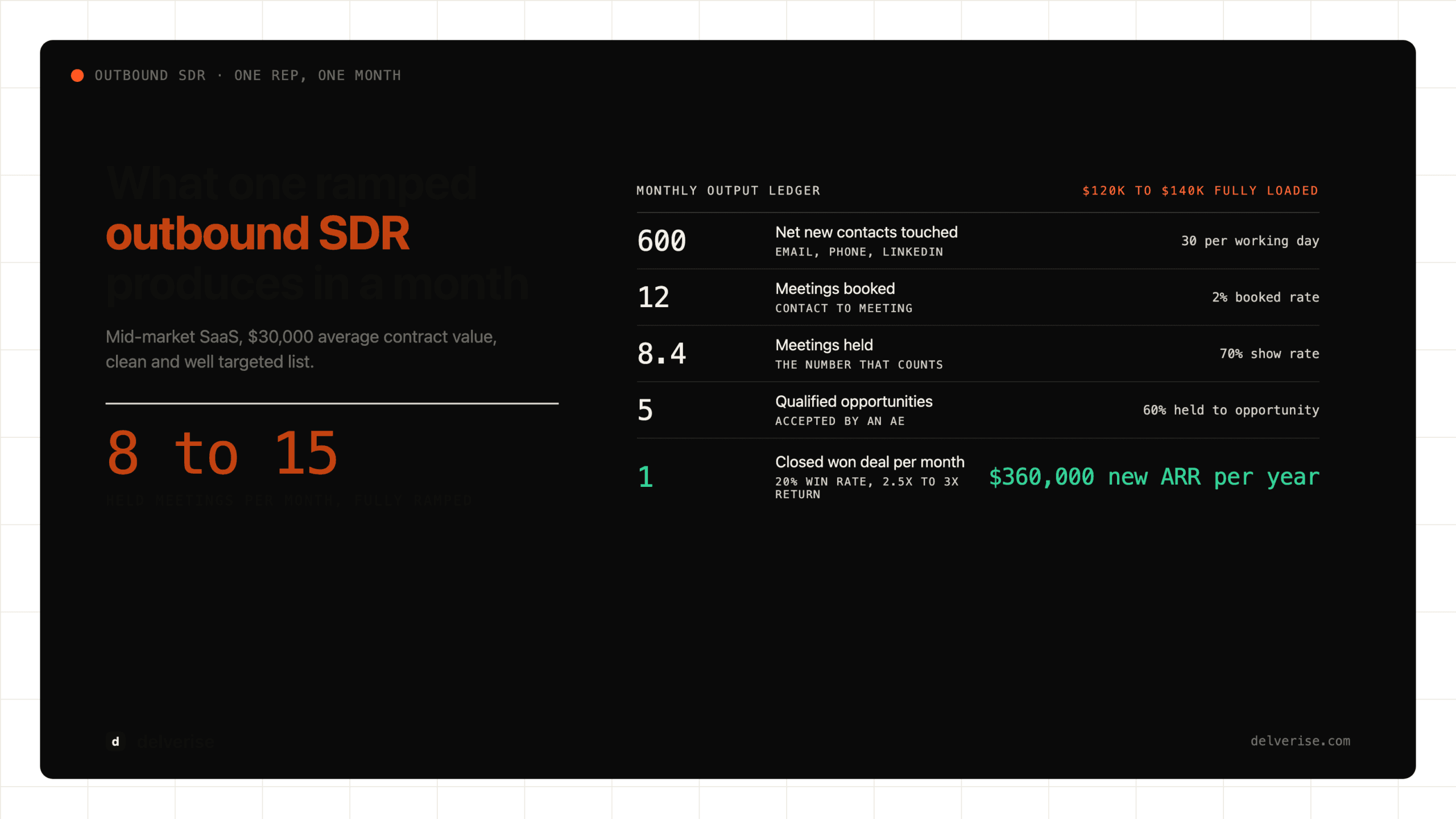
Work the math forward instead of trusting a benchmark. Assume a fully ramped rep in mid-market SaaS with a $30,000 average contract value.

- 600 net-new contacts touched per month across email, phone, and LinkedIn (about 30 per working day)
- 2% contact-to-meeting-booked rate on a clean, well-targeted list, so 12 meetings booked
- 70% show rate, so 8.4 held meetings
- 60% held-to-opportunity conversion, so about 5 qualified opportunities (an SQL, or sales-qualified lead, that an AE accepts)
- 20% win rate, so 1 closed-won deal per month at $30,000, or roughly $360,000 in new ARR per year
Fully loaded cost for that rep, including base, variable comp, tooling seats, and a slice of management time, lands near $120,000 to $140,000. So the model returns about 2.5x to 3x. That is a viable business case, and it is also fragile.
Now change one input. Suppose your contact data is 65% accurate instead of 90%, which is common when a list is bought once and never re-verified. Usable contacts fall from 600 to about 430. Everything downstream compresses proportionally: 8.6 meetings booked, 6 held, 3.6 opportunities, 0.72 wins per month, roughly $260,000 in new ARR. Same salary, same effort, 28% less revenue. Adding a second SDR to close that gap costs another $130,000 to recover output you already paid for. Fixing the data layer costs a fraction of that, which is the argument for treating contact data sourcing as an engineering decision instead of a procurement one.
Which outbound operating model fits your stage?
There are three defensible ways to run outbound. The wrong one for your stage is where most wasted spend lives.
 systematized outbound with a small SDR pod, each wi” class=”wp-image-3239″/>
| Model | Best fit | What it costs | Where it breaks |
|---|---|---|---|
| Founder-led outbound | Pre-seed to early seed, ICP still moving | Founder time, plus $500 to $2,000/mo in tooling | Stops the moment the founder gets pulled into product or fundraising. No institutional memory. |
| SDR-led, manual | Teams with a proven ICP and a repeatable pitch | $120k to $140k fully loaded per rep, per year | Output scales only with headcount. Research time crowds out selling time. Ramp is 3 to 4 months per hire. |
| Systematized outbound with a small SDR pod | Seed to Series B, expanding into new segments | One-time build plus tooling, then 1 to 3 reps | Requires real ownership of data, routing, and deliverability. Fails when nobody maintains the system after launch. |
The third model is where most Series A companies should end up. Signal detection, account scoring, contact enrichment, and first-draft personalization run as automated steps. The SDR spends their day on calls and live conversations, which is the part machines still handle badly. In practice this pushes usable contacts per rep well past 600 without degrading list quality.
What has to exist before you hire an outbound SDR?
Hiring into a missing system is the single most expensive mistake in early-stage outbound. Before a req goes out, confirm each of these:
- A written ICP with firmographic and technographic filters that produce a countable list, not a vibe
- At least 5 to 10 closed-won deals from the same segment, so the pitch has evidence behind it
- Dedicated sending domains with SPF, DKIM, and DMARC configured and warmed, kept separate from your corporate domain
- A contact data source with verified emails and a re-verification cadence, since B2B data decays roughly 2% to 3% per month
- CRM objects and routing rules that record meeting booked, meeting held, and opportunity created as distinct events
- An AE with capacity to take the meetings, confirmed by their current pipeline coverage
- A sequencing platform and a defined multi-channel cadence, covered in more depth in our breakdown of email prospecting as a system
- A named owner for deliverability monitoring, with weekly reporting on bounce and spam-complaint rates
Miss the domain and data items and you will spend the first quarter debugging silence. Harvard Business Review’s well-known audit of lead response behavior found that firms contacting a lead within an hour were about seven times more likely to have a meaningful qualifying conversation than those waiting even an hour longer. That speed is a routing property of your system, and no individual rep can compensate for it.
Where does AI actually help an outbound SDR?
AI reliably compresses the research half of the role. Account scoring, trigger detection, and drafting a first-pass personalization line from public sources are now routine. Tools like Clay chain enrichment providers together, run waterfall lookups so you only pay for the second vendor when the first returns nothing, and push a scored, enriched account into your sequencing platform without a human in the loop. Teams that build this layer well spend less per usable contact and give reps more selling hours. If you want that built and maintained instead of assembled ad hoc, that is the work described on our Clay implementation page.
The honest tradeoff: AI-generated personalization degrades fast when it is applied at volume without a quality gate. Buyers recognize the pattern, reply rates fall, and the domain damage lasts longer than the campaign. Keep a human review step on the first 100 messages of any new sequence. We covered the broader boundary of what works in AI in B2B sales.
McKinsey’s B2B Pulse research found buyers now move across ten or more channels during a purchase, with a strong preference for remote and self-serve interaction. That argues for outbound that shows up consistently in several places rather than an email-only cadence with a phone call bolted on.
How should you measure an outbound SDR?
Activity metrics get gamed within two weeks of becoming a target. Emails sent, dials placed, and connects logged tell you about effort, and effort is the input you already pay for.
Measure three things instead. Held meetings, because a booked meeting nobody attends is a rounding error. Opportunity acceptance rate by the AE, which catches reps who book anyone with a pulse. And pipeline-to-close by source cohort, tracked at 90 and 180 days, which is the only number that tells you whether outbound-sourced revenue converts as well as inbound. Your sequencing platform should feed those events into the CRM cleanly, which is one of the practical differences between vendors covered in Outreach vs Salesloft.
One caution on comp design: paying purely on meetings booked reliably produces low-quality meetings. Pay on held meetings with a kicker on accepted opportunities, and the behavior corrects itself in a quarter.
Frequently Asked Questions
How long does an outbound SDR take to ramp?
Plan on three to four months to full productivity in mid-market SaaS, longer for technical or regulated categories. Budget the first month as near-zero output. If your ICP, messaging, and data are already built, ramp compresses meaningfully because the rep learns the conversation instead of inventing the process.
Should we hire SDRs or build automated outbound first?
Build the system first, then hire into it. A single rep working a clean, enriched, well-routed list outperforms three reps sharing a bad one, at a third of the cost. Once the system produces meetings at a stable rate, headcount becomes a straightforward capacity decision. delverise typically builds the data and routing layer before any hiring plan is finalized, and you can see that scope on our GTM engineering page.
What is a healthy reply rate for outbound SDR email?
On a tightly targeted list with verified contacts and a relevant trigger, 4% to 8% total reply rate and 1% to 3% positive reply rate is a realistic band in B2B SaaS. Below 2% total reply, the problem is almost always targeting or deliverability. Check bounce rate and inbox placement before rewriting copy.
Do outbound SDRs still work when buyers prefer self-service?
Yes, with a narrower job. Buyer preference for digital research means the SDR’s value shifts toward timing and relevance: reaching the right account when a real trigger fires, then getting out of the way. Generic volume outreach performs worse every year. Signal-driven outreach continues to book meetings.
How many accounts should one SDR own?
For mid-market, 150 to 250 named accounts per rep per quarter is workable, with roughly four to six contacts per account. Enterprise pods run 40 to 80 accounts with deeper multithreading. If a rep owns more than 300 accounts, they are running volume plays and the targeting work has effectively been abandoned.
Read next