←Back to blog
Growth & Demand GenerationGuideSeptember 12, 20268 min read
What Is Salesloft? What It Does, Who It Fits, and What It Really Costs
Salesloft is a sales engagement platform: software that runs and measures the multi-step outreach sequences your reps execute across email, phone, and LinkedIn. It sits between your CRM and your sellers, automating task queues, logging every touch, recording calls, and reporting on what actually converts. Founded in 2011, it now positions itself as a revenue orchestration platform.
Salesloft is a sales engagement platform: software that runs and measures the multi-step outreach sequences your reps execute across email, phone, and LinkedIn. It sits between your CRM and your sellers, automating task queues, logging every touch, recording calls, and reporting on what actually converts. Founded in 2011, it now positions itself as a revenue orchestration platform.
Key takeaways
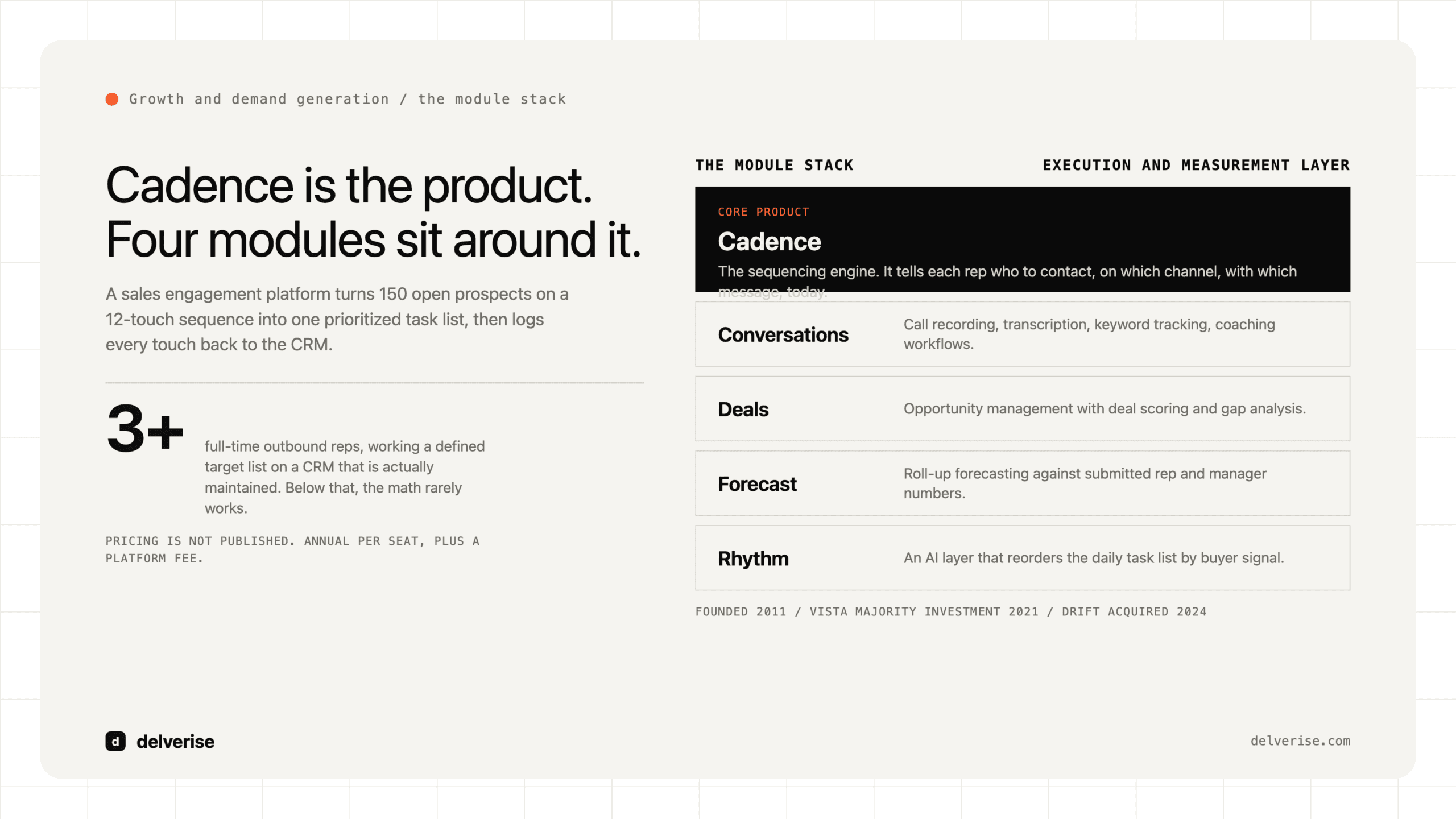
- Salesloft’s core product is Cadence, a sequencing engine that tells each rep exactly who to contact, on which channel, with which message, today.
- Around Cadence sit four other modules: Conversations (call recording and coaching), Deals (opportunity management), Forecast, and Rhythm (an AI-prioritized action list driven by buyer signals).
- It is an execution and measurement layer. Your target list, your data quality, and your messaging determine whether it produces pipeline.
- Pricing is not published. Expect annual per-seat contracts plus a platform fee, with real total cost of ownership landing well above the license line once admin time and CRM integration work are counted.
- It fits teams with three or more full-time outbound reps and a functioning CRM. Below that, CRM-native sequencing or a lighter prospecting tool usually wins.
- Buying it before you have a defined ICP, clean contact data, and a message that gets replies just makes bad outreach faster and better documented.
What does Salesloft actually do?
A sales engagement platform solves a specific operational problem: a rep working 150 open prospects across a 12-touch sequence cannot reliably remember who needs a call on Tuesday and who needs a third email on Thursday. Salesloft turns that into a single prioritized task list.

The modules break down like this:
- Cadence. The sequencing engine. You define a series of steps (email, call, LinkedIn touch, manual research task) with timing between them, enroll prospects, and reps work the resulting queue. Templates, snippets, and A/B testing sit here.
- Conversations. Call and meeting recording with transcription, keyword tracking, and coaching workflows. Managers can review call segments instead of shadowing live.
- Deals. Opportunity management with deal scoring and gap analysis, sitting alongside your CRM’s opportunity records.
- Forecast. Roll-up forecasting against submitted rep and manager numbers.
- Rhythm. An AI layer that ingests buyer signals (email opens, website visits, intent) and reorders each rep’s daily task list by likelihood of engagement.
Salesloft took majority investment from Vista Equity Partners in 2021 and acquired Drift in 2024, adding website chat and conversational capture to the stack. The direction of travel is clear: the company is expanding from “sequencing tool” toward “system of action for the whole revenue team.” Forrester’s Wave evaluating revenue orchestration platforms for B2B has placed Salesloft among the leaders in the category, and it holds a consistent leader position in G2’s sales engagement grids based on user reviews.
Who is Salesloft actually for?
The honest answer is teams with enough outbound volume that coordination becomes the bottleneck. Our rough threshold: three or more full-time reps whose primary job is generating conversations, working from a defined target account list, on a CRM that is actually maintained.

Below that, the math rarely works. One founder-seller or a single SDR can run sequences out of HubSpot or Salesforce native tooling, or out of a lighter prospecting tool, and spend the difference on data and list quality. If you are still working out what one rep should produce, start with the unit economics of the role before you buy the platform that scales it. We covered that in detail in our breakdown of what an outbound SDR actually produces.
Above that threshold, the case gets strong quickly. Gartner’s research on the future of sales projected that the large majority of B2B buyer and seller interactions would happen through digital channels, and McKinsey’s B2B buying research has consistently found that buyers now move across roughly ten channels during a purchase decision. Coordinating that many touches across that many channels by memory and spreadsheet stops working at scale.
What does it cost, and what is the real total cost of ownership?
Salesloft does not publish list pricing. Contracts are annual, priced per seat, tiered by module access, and negotiated. Public reporting and buyer reviews put per-seat costs in the low-to-mid hundreds of dollars per user per month depending on tier, with implementation and platform fees on top. Treat any number you see online as a starting point for negotiation, not a quote.

Here is the worked example we run with clients evaluating the buy. Take a team of four SDRs and six AEs, all needing seats. At roughly $125 per user per month on an annual deal, that is $15,000 per year in license. Add implementation, CRM field mapping, template and cadence build, and the ongoing admin time of whoever owns the instance. Call it $25,000 in fully loaded first-year cost.
Now the break-even. If your average contract value is $30,000 and roughly a quarter of qualified opportunities close, a single extra closed deal per year covers the entire investment. That is a low bar for a ten-seat team, which is why the platform decision is usually straightforward once you have the volume. The decision that matters more is whether your sequences deserve to be run at higher throughput in the first place.
How does Salesloft compare to the alternatives?
Four realistic options, with honest tradeoffs:
| Option | Best fit | Strength | Tradeoff |
|---|---|---|---|
| Salesloft | 10+ seats, Salesforce or HubSpot in place, dedicated outbound motion | Deep cadence analytics, strong coaching layer, mature CRM sync | Annual commitment, needs an owner, overkill under 3 reps |
| Outreach | Similar profile, often larger enterprise teams | Comparable depth, strong workflow customization | Similar cost profile and admin burden |
| CRM-native sequences (HubSpot, Salesforce) | 1 to 5 reps, low outbound volume | No extra vendor, no sync issues, included in existing spend | Weaker dialer, thinner cadence reporting, limited coaching |
| Prospecting-first tools (Apollo and similar) | Early-stage teams needing data plus sequencing together | Contact data and outreach bundled, lower entry price | Data quality varies, deliverability controls and reporting are shallower |
The Salesloft versus Outreach question is the one most teams actually agonize over, and the answer usually comes down to CRM architecture and coaching culture rather than feature checklists. We broke that decision down properly in Outreach vs Salesloft.
Where does Salesloft break?
Three failure modes show up repeatedly.
Bad inputs, faster. The platform executes whatever list you enroll. Feed it a scraped list with 30% bounce rates and you will burn sending domains at speed while producing beautiful dashboards of the damage. Data quality and enrichment sit upstream of any engagement platform, which is why we treat CRM enrichment as a prerequisite rather than an add-on.
Volume mistaken for strategy. Sequencing makes it trivial to send 400 emails a day. It does nothing to make those emails worth reading. Reply rates are a function of relevance and offer, and a cadence tool amplifies whatever quality level your messaging already has.
No owner. Cadences drift, templates multiply, and reporting turns to noise within two quarters unless one person owns the instance. Budget for that role explicitly, whether it is a RevOps hire or a fractional resource.
What has to be true before you buy it?
Run this before you sign anything:
- A written ICP with firmographic and technographic filters you can actually query
- A contact data source with verified emails and a bounce rate under 3%
- CRM hygiene good enough that account and contact records sync without manual cleanup
- At least one message and offer combination that has produced replies manually
- A named owner for the instance with time allocated to it
- Agreement across sales and marketing on what qualifies as a meeting
- Sending infrastructure configured: SPF, DKIM, DMARC, and warmed domains
Miss more than two of these and the platform will expose the gap rather than close it. Most teams that plateau after buying a sales engagement tool are missing something structural underneath it, which we mapped out in the six pieces under every revenue stack.
How does it fit into a wider revenue system?
Salesloft is the execution layer of an outbound motion. Around it sit data sourcing and enrichment, routing and qualification logic, CRM as the system of record, and attribution that tells you which segments and messages deserve more budget. Get those right and the engagement platform compounds. Get them wrong and it becomes an expensive activity tracker.
The sequencing decision is one node in a larger design question about how conversations become pipeline. If you are building that end to end, start with the structure of your outbound funnel, then choose the tooling that fits it. delverise builds these systems as integrated infrastructure, which is what our GTM engineering work is oriented around.
Frequently Asked Questions
Is Salesloft a CRM?
No. Salesloft is an engagement and execution layer that sits on top of a CRM such as Salesforce, HubSpot, or Microsoft Dynamics. Your CRM remains the system of record for accounts, contacts, and opportunities. Salesloft syncs activity back into it. Running Salesloft without a CRM underneath creates a second, incomplete source of truth.
How much does Salesloft cost per user?
Pricing is quote-based and not published. Contracts are typically annual and priced per seat with tiered module access, and buyer reports put per-user costs in the low-to-mid hundreds of dollars per month depending on tier and volume. Ask for the platform fee, implementation cost, and dialer minutes separately when you evaluate quotes.
What is the difference between Salesloft and Outreach?
Both are mature sales engagement platforms with sequencing, call recording, and forecasting. The practical differences show up in CRM sync architecture, coaching workflow design, admin complexity, and how each prices its AI features. Most teams should evaluate both against their actual CRM setup and pipeline reporting requirements rather than feature lists.
Do we need Salesloft if we already use HubSpot?
Under about five reps, usually no. HubSpot’s native sequences cover the basics, and the money is better spent on data and messaging. Above that, the gaps in dialer quality, cadence-level analytics, and call coaching start to cost real productivity, and a dedicated engagement platform earns its seat cost.
Can AI replace a sales engagement platform?
AI changes what happens inside the platform more than whether you need one. Research, personalization, and prioritization are increasingly automated, while the underlying need for orchestrated multi-touch execution and clean activity data remains. The practical view on where automation adds revenue is covered in our piece on AI in B2B sales.
Read next