←Back to blog
Revenue Intelligence & Data ToolingGuideSeptember 2, 20268 min read
AI Tool for Sales Prospecting: How to Pick One That Actually Builds Pipeline
An AI tool for sales prospecting uses machine learning and large language models to find accounts, enrich contact data, score buying signals, and draft outreach a rep would otherwise write by hand. The good ones compress research time from hours to seconds. None of them replace a sharp ICP, clean data, or a defined offer.
An AI tool for sales prospecting uses machine learning and large language models to find accounts, enrich contact data, score buying signals, and draft outreach a rep would otherwise write by hand. The good ones compress research time from hours to seconds. None of them replace a sharp ICP, clean data, or a defined offer.
Key takeaways
- “AI prospecting tool” covers five different jobs: account discovery, contact discovery, enrichment, prioritization, and message generation. Most vendors claim all five and are genuinely strong at one or two.
- Data quality sets your ceiling. A model reasoning over stale contact records produces confident, well-written emails to people who left two years ago.
- The buying decision that matters is category, not brand. Pick the layer you are missing before you compare logos inside it.
- Personalization at volume only works when the signal is real. Generic “I saw you’re hiring” openers now read as automation to the people you most want to reach.
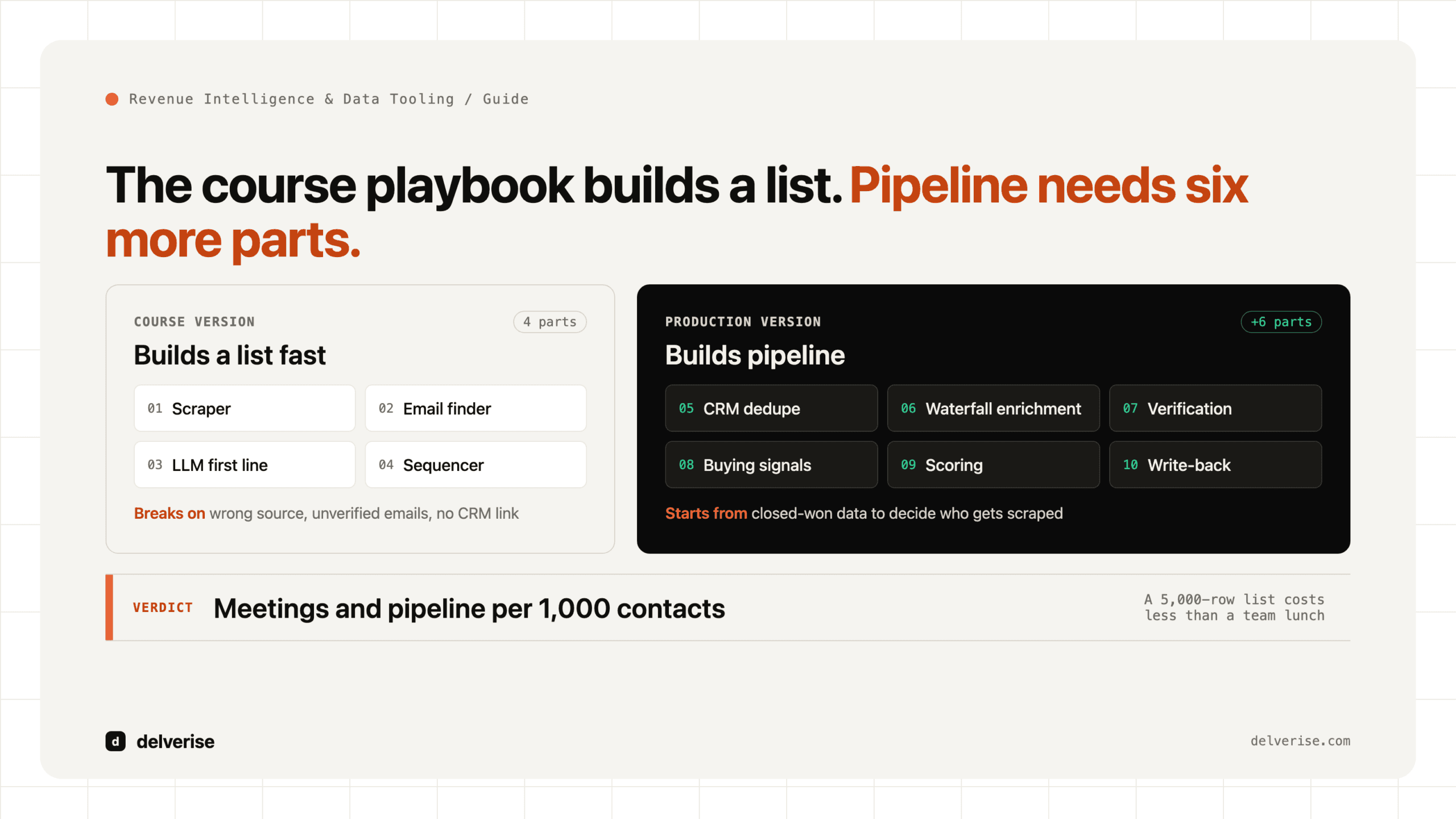
- Tools produce output. Systems produce pipeline. The gap between them is routing, enrichment logic, deliverability, and CRM hygiene.
What is an AI tool for sales prospecting?
Prospecting is the work that happens before a sales conversation exists: deciding who to contact, finding a way to reach them, and giving them a reason to reply. An AI tool for sales prospecting automates part of that sequence using models rather than manual research.
The category is broad because the underlying work is broad. Some tools apply AI to search, scanning job boards, filings, and websites to surface accounts matching a pattern. Some apply it to enrichment, filling in emails, phone numbers, and technographics (the software a company runs). Some apply it to scoring, ranking accounts by fit and intent. Some apply it purely to copy, generating first-touch emails from a LinkedIn profile.
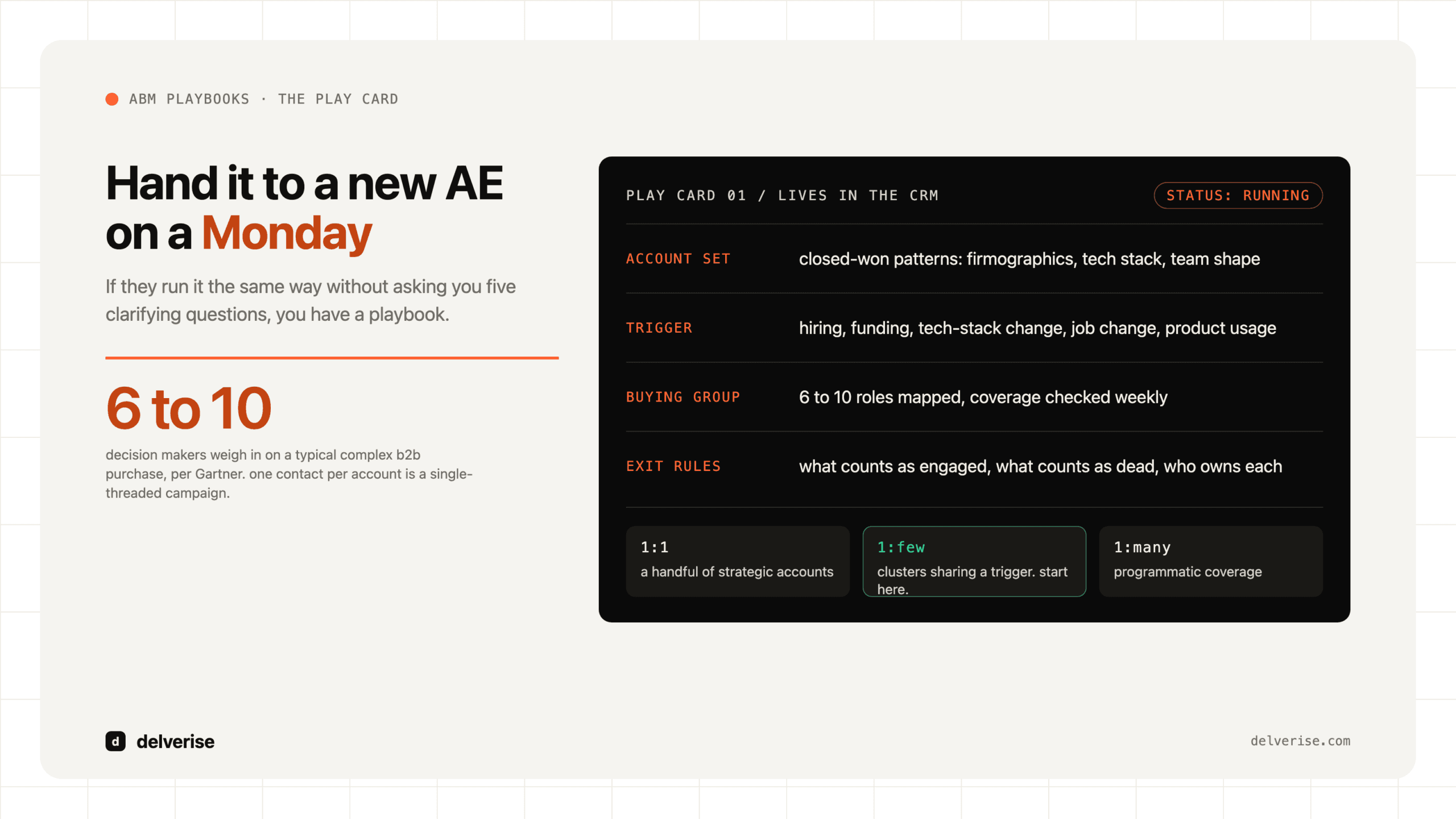
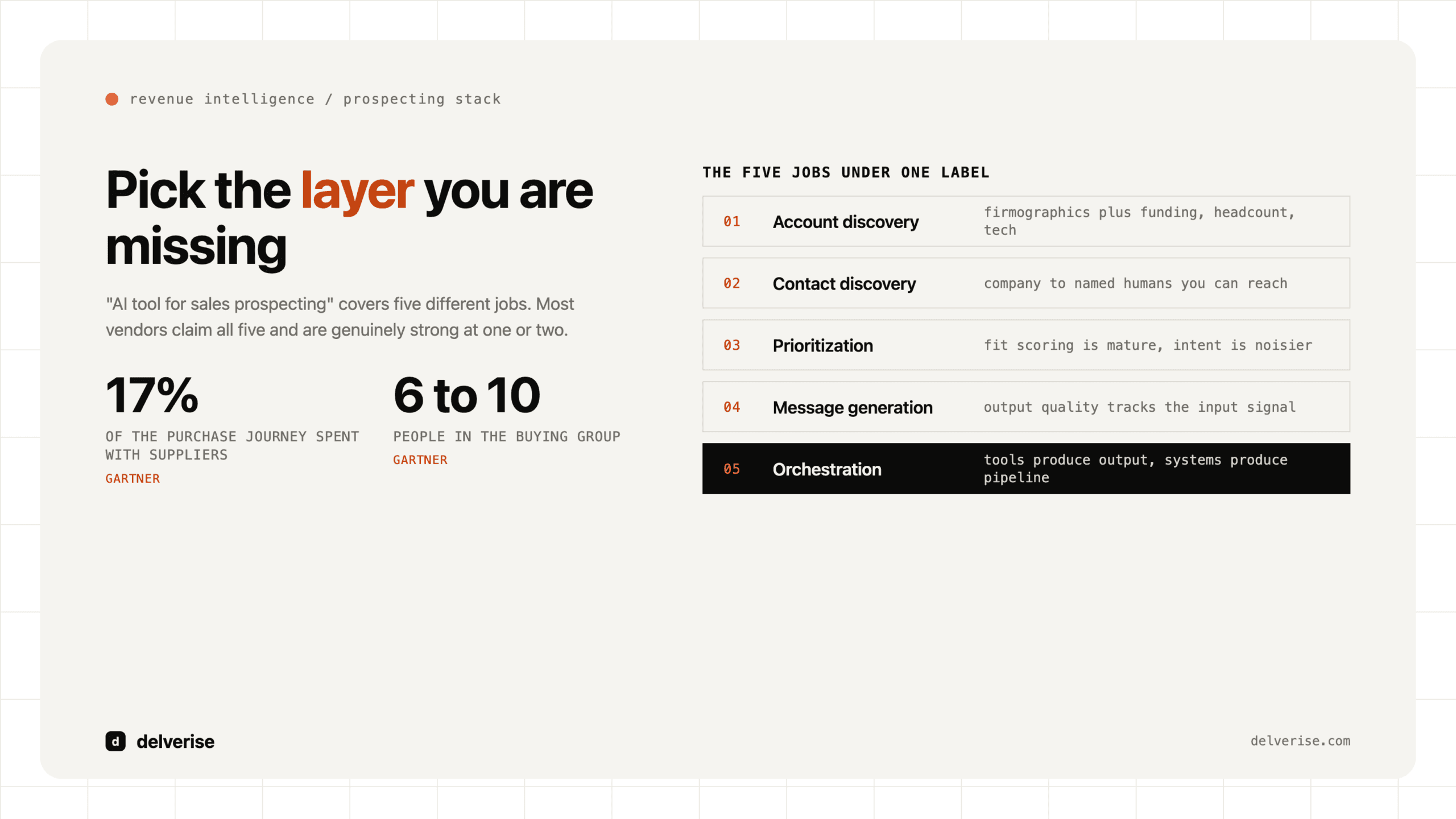
Understanding which job you are buying matters more than any feature comparison. Gartner’s research on B2B buying found that buyers spend only about 17% of their total purchase journey meeting with potential suppliers, and Gartner also puts the typical buying group for a complex solution at six to ten people. Your prospecting motion has a narrow window and multiple humans to reach inside every account. Speed on the wrong list burns that window faster.
What do these tools actually automate?
Five distinct jobs sit under the label. Sorting them makes the buying decision tractable.

Account discovery. Building the target list from firmographic filters plus signals: recent funding, headcount changes, tech installs, hiring patterns, leadership moves. This is where an AI lead finder earns its keep, and where a lot of tools quietly return the same stale database everyone else queries.
Contact discovery and enrichment. Getting from a company to named humans with reachable work emails and mobile numbers. Coverage varies wildly by geography and company size. Anyone selling into European mid-market learns this quickly. Our breakdown of how to buy contact data covers the waterfall approach that fixes most coverage gaps.
Prioritization. Ranking who to work first. Fit scoring is mature. Intent scoring is noisier than vendors admit, since most third-party intent is IP-resolved and probabilistic.
Message generation. Drafting the first touch from research the model gathered. Quality here tracks the quality of the input signal almost perfectly.
Orchestration. Deciding what happens when a signal fires: which sequence, which owner, which CRM field updates. This is the least glamorous layer and the one that separates a demo from a working pipeline.
Which category of AI prospecting tool fits which job?
| Category | Representative tools | What it genuinely solves | Where it breaks |
|---|---|---|---|
| Contact databases | Apollo, ZoomInfo, Cognism | Fast access to a broad contact universe with basic filters and sequencing built in | Coverage decay, everyone prospects the same records, weak on non-obvious signals |
| Enrichment and orchestration layers | Clay, Common Room | Waterfall enrichment across many providers, custom AI research per row, signal-triggered workflows | Needs an owner who can build; credit spend climbs fast; becomes shelfware without one |
| Sales engagement platforms | Outreach, Salesloft, Lemlist | Sequencing, deliverability controls, rep workflow, activity capture into CRM | Weak as a data source; AI features are usually copy assistance layered on top |
| AI SDR agents | 11x, Artisan, AiSDR | End-to-end autonomous sending for high-volume, low-ACV motions | Thin personalization at enterprise ACVs, brand risk, hard to debug when reply rates fall |
| General LLMs in the workflow | ChatGPT, Claude | Research summarization, message iteration, account briefs, list QA | No native data access, no deterministic execution, quality depends on the operator |
Most teams need two layers, rarely five. A useful sequencing rule: fix data before you buy generation. For a fuller map of how these pieces fit together, see our guide to the GTM tech stack.

How should a revenue leader evaluate one?
Run every vendor through the same gate. Use your own accounts, never their sample data.

- Upload 200 accounts from your actual ICP and measure real coverage, not their published match rate
- Check email verification: bounce-tested at send time, or verified once at some point in the past
- Confirm the signals are first-party observable (job posts, tech installs, filings) rather than modeled probability
- Read ten AI-generated messages cold and ask whether you would reply to any of them
- Map the CRM write path: which object, which field, what happens on conflict
- Model total cost at your real volume including credits, seats, and overage
- Identify the internal owner by name before signing, since unowned tooling reliably goes unused
- Ask what happens to your data and enriched records if you churn
What does the math look like in practice?
Consider a Series A B2B SaaS company with four AEs, a $28,000 average contract value, and a 12,000-company addressable market. The team has been running broad sequences into a purchased list at a 1.1% reply rate.
Rebuilt as a signal-driven motion: firmographic filters plus three signals (hiring a RevOps role, running a competitive platform, funded in the last nine months) reduce 12,000 companies to roughly 1,600 accounts with an actual reason to buy this quarter. Three contacts per account gives 4,800 targets. Waterfall enrichment across three providers returns verified work emails for about 70%, so 3,360 people are reachable.
At a 4% reply rate, which is realistic when the trigger is genuine and the copy references it specifically, that is roughly 134 replies. At 22% positive, about 30 meetings. Against the old approach, the list is 72% smaller and the meeting count is higher, because relevance carries the reply rate.
The lesson generalizes. Volume amplifies whatever your targeting already is. McKinsey’s B2B Pulse research has consistently found buyers now move across roughly ten channels during a purchase, which means your email is one of many touches and has to earn its place. Our post on building prospecting that compounds goes deeper on the signal side, and what actually works in cold email covers the copy half.
Where do AI prospecting tools break?
Data decay outruns your refresh cycle. B2B contact records go stale continuously as people change roles. A tool that enriched a record eight months ago is guessing. Verify at send time.
Personalization becomes pattern-matched noise. When every vendor generates an opener from the same LinkedIn headline, buyers learn the pattern within weeks. Forrester’s work on B2B buyer behavior keeps pointing the same direction: buyers self-educate heavily and get sharper at filtering vendor outreach every year. Depth of signal is the only durable edge.
Deliverability collapses quietly. Volume without domain infrastructure, warmup, and bounce discipline sends you to spam, and the dashboard still shows sends. Track reply rate against delivered, not sent.
Nobody owns the system. The most common failure has no technical cause. A tool gets bought, configured for a pilot, and then the person who understood it moves to another priority.
Should you buy a tool or build the system around it?
Buy the tool. Then decide honestly who builds the system it sits inside, because that is where the compounding happens. Enrichment logic, signal definitions, routing rules, CRM field governance, and deliverability infrastructure are the assets. Tools are replaceable components inside them.
Teams with a technical RevOps or GTM engineer already on staff should build in-house, since the feedback loop between the person running campaigns and the person building workflows is worth a lot. Teams without that person face a real choice: hire for it, which takes a quarter or more, or bring in outside build capacity to stand up the system and hand it over. Our post on building in-house versus bringing in outside help works through the tradeoff with actual numbers.
delverise builds these systems as GTM engineering engagements, and since Clay sits at the center of most modern prospecting architectures, we work with it directly through our Clay partner practice. The honest position on Clay: it is the strongest orchestration layer available right now, and it demands an owner who can think in tables and waterfalls. Without one, it costs money and produces nothing.
Frequently Asked Questions
What is the best AI tool for sales prospecting?
There is no single answer, because the tools solve different jobs. If your problem is contact coverage, a database like Apollo or Cognism fits. If it is signal-driven targeting and custom enrichment, Clay is the strongest option. If it is rep workflow and deliverability, Outreach or Salesloft. Diagnose the bottleneck first.
Can AI fully replace SDRs?
For high-volume, low-ACV, transactional motions, autonomous agents handle a meaningful share of the work today. For deals above roughly $25,000 in ACV with multi-person buying committees, AI handles research, list building, and drafting, while humans handle judgment, objection navigation, and multithreading. The realistic outcome is a smaller team covering more accounts.
How much should we budget for AI prospecting tooling?
A functional stack for a team of four to six reps typically lands between $1,500 and $5,000 per month across data, enrichment credits, and sequencing. Credit-based tools are the variable line, and spend scales with how aggressively you enrich. Model your real volume before signing an annual contract.
How do we measure whether an AI prospecting tool is working?
Track four numbers: verified contact coverage against your ICP, reply rate against delivered volume, positive reply rate, and meetings per 1,000 contacts touched. Vanity metrics like emails sent or records enriched tell you nothing about pipeline. Set a baseline before rollout so the comparison is honest.
Will AI-generated outreach hurt our brand with senior buyers?
It can, when the personalization is shallow and the signal is generic. Executives receive high volumes of automated outreach and recognize templates quickly. Use AI for research depth and speed, keep a human review step for anything going to VP level and above, and hold the bar at whether you would reply yourself.
Read next