←Back to blog
Revenue Intelligence & Data ToolingGuideNovember 15, 20268 min read
AI Sales Outreach: What It Actually Automates and What Still Needs a Human
AI sales outreach uses machine learning to research accounts, assemble buying signals, draft personalized messages, and sequence follow-up across email, LinkedIn, and phone. It works when the underlying data and targeting are sound. Teams that see durable results treat AI as a research and assembly layer, with humans owning the offer, the judgment calls, and every reply.
AI sales outreach uses machine learning to research accounts, assemble buying signals, draft personalized messages, and sequence follow-up across email, LinkedIn, and phone. It works when the underlying data and targeting are sound. Teams that see durable results treat AI as a research and assembly layer, with humans owning the offer, the judgment calls, and every reply.
Key takeaways
- AI compresses the research and drafting steps of outreach. It does not fix a weak offer or a badly defined ICP.
- The highest-return use of AI in outreach is signal collection and account prioritization, which happens before a single message gets written.
- Volume is the wrong lever. Deliverability, domain reputation, and reply quality all degrade faster than pipeline grows.
- Measure AI outreach on qualified meetings held and opportunity creation, never on sends, opens, or messages generated.
- Most stalled programs fail at the data layer: stale contacts, missing firmographics, no signal feed. Fix that before buying another tool.
What is AI sales outreach, exactly?
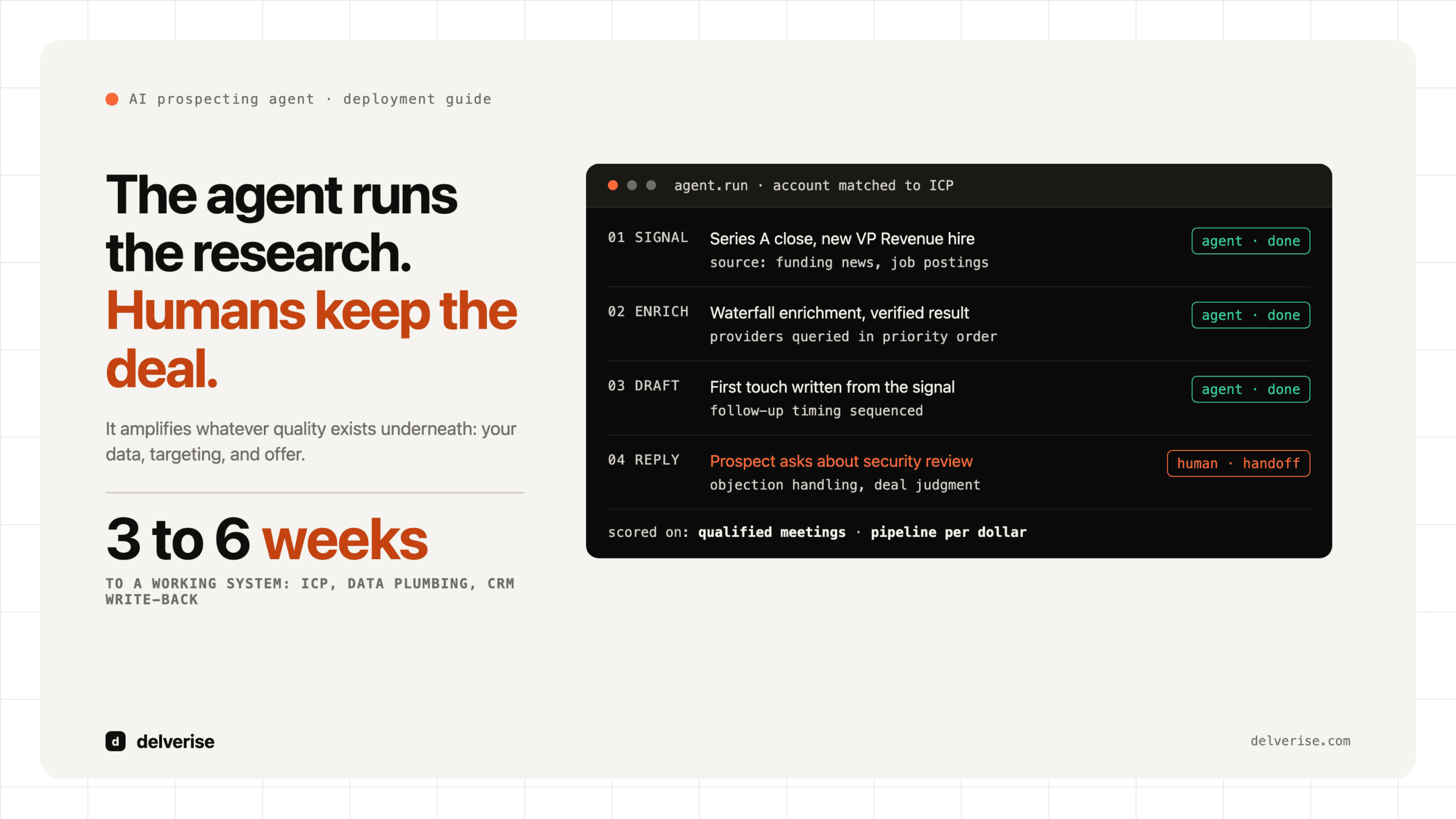
AI sales outreach is the use of large language models and machine learning inside the outbound motion: enriching and scoring accounts, monitoring for buying signals, generating message variants grounded in real research, choosing send timing, and routing replies. The category spans three distinct jobs that often get collapsed into one.

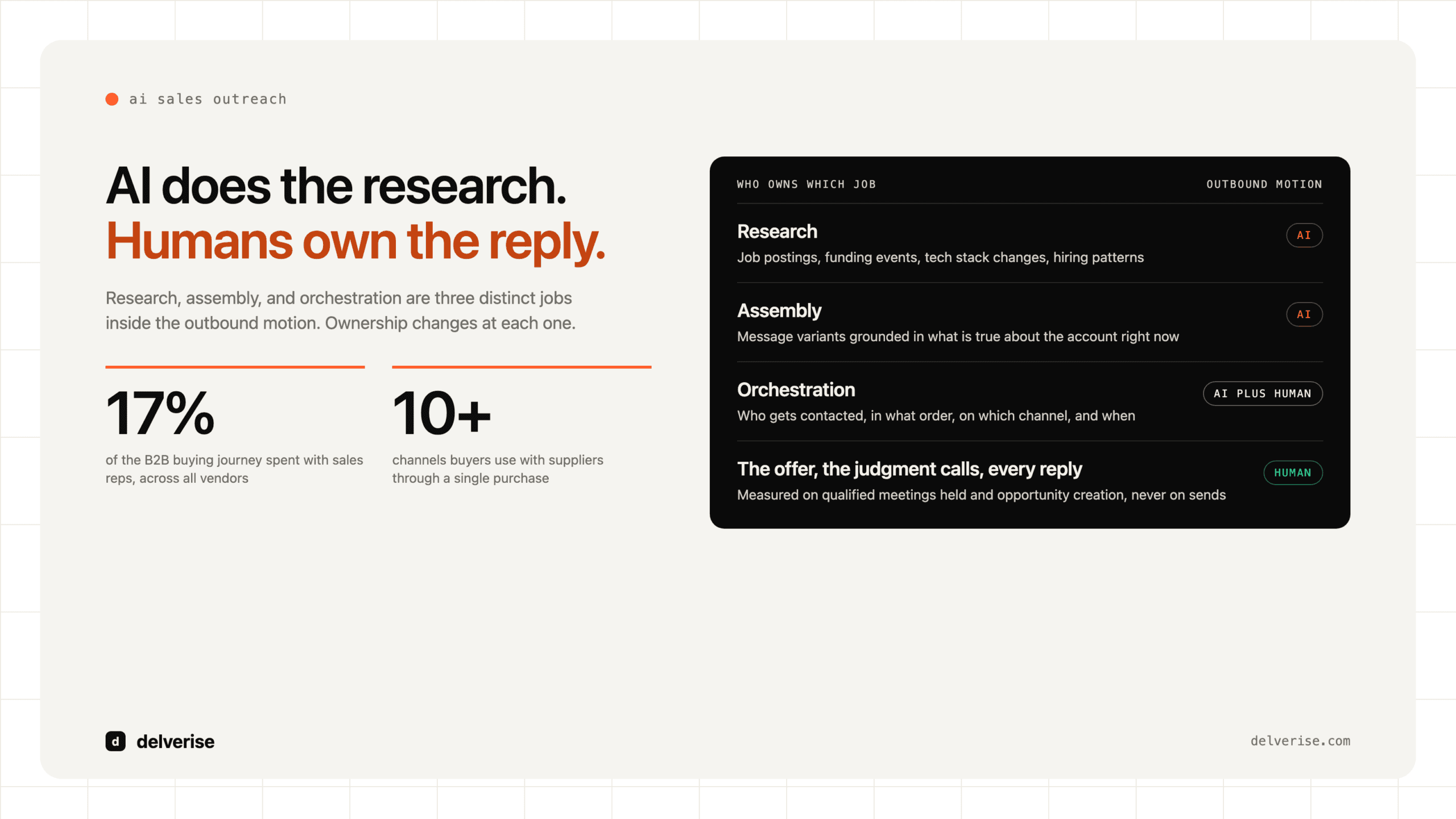
The first job is research: pulling together what is true about an account right now, from job postings, funding events, tech stack changes, product launches, and hiring patterns. The second is assembly: turning that research into a message that a specific person would plausibly care about. The third is orchestration: deciding who gets contacted, in what order, on which channel, and what happens when they respond.
Buying an “AI SDR” usually means buying all three bundled into one opinionated workflow. Building the system yourself means you can put AI where it earns its keep and keep humans where judgment matters. The tradeoff is real: bundled tools ship in a week and plateau in a quarter, while assembled systems take four to six weeks and keep compounding. Our breakdown of what to automate and what to keep human covers that split in detail.
Why does AI outreach work at all right now?
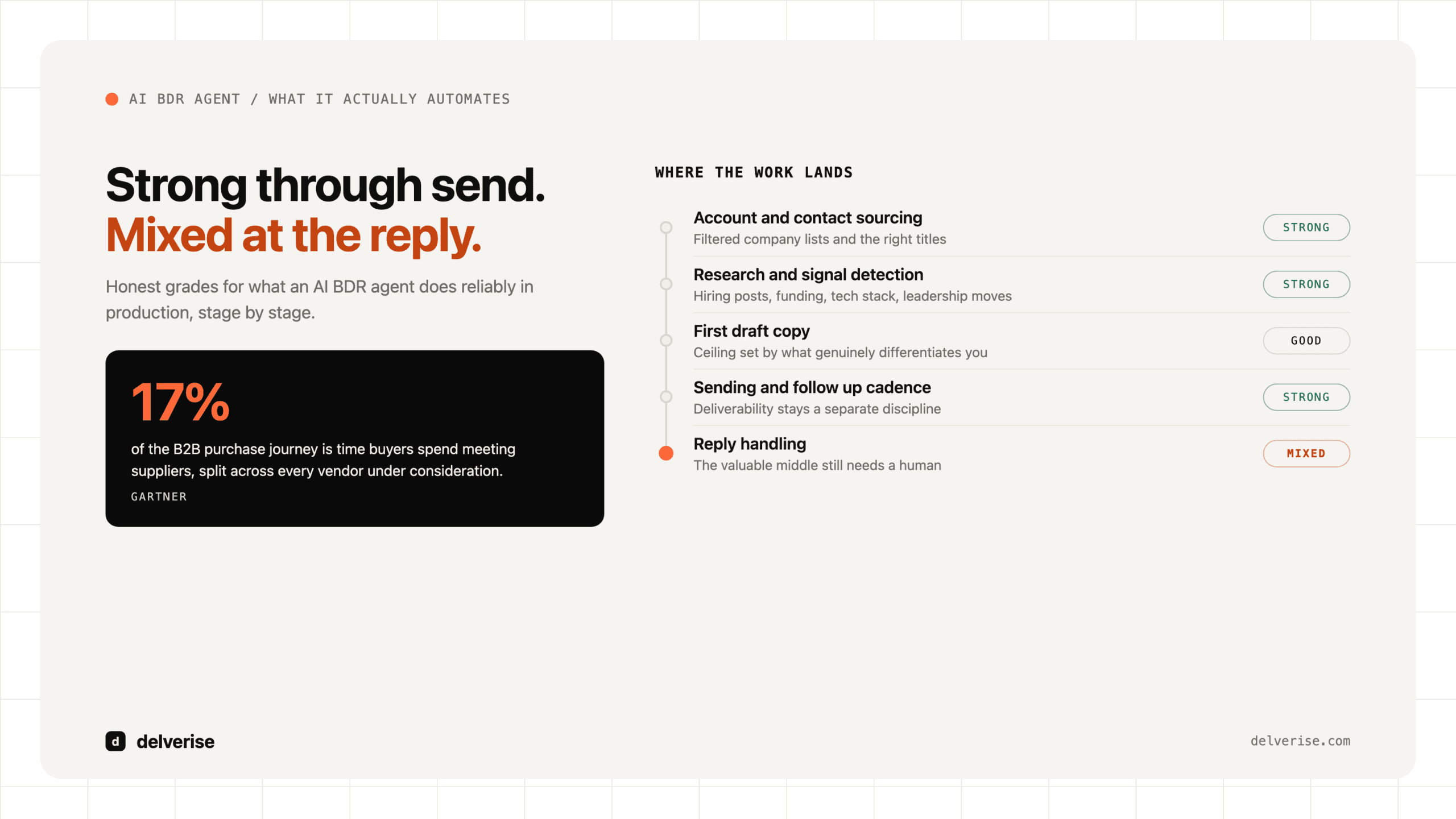
Because buyers stopped talking to sellers early. Gartner’s research on B2B buying has consistently found that buyers spend a small minority of their total purchase journey with sales reps, roughly 17% across all vendors under consideration, which leaves single-digit percentages of attention for any one supplier. McKinsey’s B2B Pulse research found that buyers now routinely use ten or more channels to interact with suppliers through a purchase, and that they expect the same quality of information in every one.
Those two findings together explain the shift. If you get a few percent of a buyer’s attention, the content of each touch carries enormous weight, and generic outreach burns the window. AI makes it economically possible to do real research on every account instead of the top fifty, which is the only honest reason to use it.
The counterweight: every competitor has the same capability. Harvard Business Review’s long-running work on the Challenger sales model argued that buyers reward sellers who teach them something about their own business. That bar goes up, not down, when message generation becomes cheap.
Which parts of outreach should AI own?
Here is the split we use when designing these systems. The right-hand column is where programs quietly break.

| Layer | What AI handles well | What still needs a human |
|---|---|---|
| ICP definition | Clustering closed-won accounts to surface shared attributes | Deciding which segment you actually want to win this year |
| Account research | Reading job posts, filings, docs, and changelogs at scale; extracting structured facts | Judging which facts imply budget and urgency |
| List building and enrichment | Waterfall enrichment, deduplication, title normalization, email verification | Setting exclusion rules: current customers, active deals, bad-fit segments |
| Message drafting | Producing grounded first lines and variants from verified research | Writing the offer and the point of view. This is the whole game. |
| Sequencing | Channel timing, throttling, suppression, A/B allocation | Approving cadence aggression against brand tolerance |
| Reply handling | Classifying intent, routing, drafting suggested responses | Every actual reply to a real buyer |
The pattern across that table: AI is strong at gathering and structuring, weaker at deciding. A system that respects the boundary tends to hold up. One that hands decisions to the model produces polished messages aimed at the wrong people.
What does a working system look like in practice?
Run the arithmetic for a representative Series A team, two AEs and one SDR, selling a $40k ACV product.

The addressable list is 3,200 accounts matching a tight ICP, three buying-committee contacts each, so 9,600 contacts total. Blasting all of them in a quarter destroys the domains and teaches the market to ignore you. Instead, a signal layer scores accounts weekly against triggers that correlate with closed-won deals: a relevant role opening, a funding event, a competitor tool appearing in the stack. In a typical quarter, roughly 20% of the list shows a live signal, so about 640 accounts and 1,900 contacts become active.
Spread across thirteen weeks, that is around 145 new contacts entering sequence per week. At four touches over three weeks, peak send volume lands near 600 emails weekly, comfortably inside eight warmed mailboxes running 20 sends a day. Deliverability holds.
At a 6% reply rate, which tight targeting plus grounded research can support, that is about 115 replies a quarter. If 30% are positive, you book roughly 35 meetings, hold around 26 after no-shows, and convert perhaps 8 to real opportunities. Against a $40k ACV and a 25% close rate, that is $80k in new ARR from one quarter of outbound, with a pipeline tail behind it.
Those numbers are modest on purpose. The point of the exercise is that the constraint is never message generation capacity. It is signal quality, mailbox capacity, and the number of human conversations your team can actually hold. AI moves the first constraint and leaves the other two exactly where they were.
What breaks most often?
Four failure modes account for most of the stalled programs we see.
- Data decay. B2B contact data goes stale at roughly 2-3% per month through job changes alone. Without a re-verification loop, a list built in January is meaningfully wrong by June.
- Signal theater. Tracking triggers that feel meaningful but have no correlation with closed-won deals. Validate signals against your own history before building sequences on them.
- Personalization that reads as surveillance. Referencing a prospect’s recent LinkedIn comment produces more unsubscribes than replies. Relevance to their business beats proof that you researched them.
- No qualification gate. Replies arrive, nobody scores them, AEs spend calendar time on tire-kickers. A defined qualification layer protects the most expensive resource you have.
Underneath all four sits the same root cause: outreach was treated as a campaign rather than as a system with owners, refresh cycles, and instrumentation. The foundation pieces have to exist before AI has anything useful to act on.
Which tools actually matter?
Three categories, and you need something in each.
Data and orchestration. Clay is the most flexible option here, combining waterfall enrichment across dozens of providers with AI research agents that can read a website or a job post and return structured answers. Its honest tradeoffs: credit costs scale with your creativity, and it rewards someone who knows what they are building. delverise is a Clay First 100 Solutions Partner, and our Clay implementation work exists precisely because the tool’s ceiling is high and its learning curve is real. Apollo and similar all-in-one platforms are cheaper and simpler, with less control over data quality.
Sending infrastructure. Dedicated cold-email platforms handle inbox rotation and warmup. Full sales engagement platforms like Outreach or Salesloft make more sense once you have reps working multichannel cadences against existing pipeline.
The CRM. Everything above writes into it. If your CRM data model cannot represent accounts, buying committees, and opportunity stages cleanly, no amount of AI upstream will produce a forecast you trust. That connection runs straight into how a forecast actually holds together.
For message construction itself, the constraint is your offer and point of view. Cold email structures that book meetings are worth studying before you ask a model to generate anything.
How do you know it is working?
Track four numbers weekly, in this order of importance: qualified meetings held, opportunities created, reply-to-positive-reply ratio, and deliverability health (bounce rate under 2%, spam complaints under 0.1%). Sends, opens, and generated messages are diagnostics, useful when something breaks and misleading as goals.
Give the system a full sales cycle before judging it. Outbound programs typically need six to eight weeks to produce a readable signal and a full cycle length to prove economics. Our AI outbound systems work is built around that timeline rather than a two-week pilot.
Frequently Asked Questions
Is AI sales outreach going to replace SDRs?
It changes what the role does. The research, list building, and drafting work that consumed most of an SDR’s day compresses dramatically. What remains is conversation quality, objection handling, and judgment about which accounts deserve real effort. Teams that redeploy SDRs toward those activities get more from a smaller team. Teams that remove the humans entirely see reply rates decay within two quarters.
How much should we budget for an AI outreach system?
Tooling for a Series A team typically runs $1,500 to $4,000 per month across data, enrichment credits, sending infrastructure, and CRM seats. Build cost depends on whether you have someone internally who can own the data model, sequencing logic, and reporting. The cost that gets underestimated is maintenance: signals drift, data decays, and someone has to own the weekly refresh.
Will AI-written emails hurt our deliverability?
The writing itself is neutral. What damages deliverability is volume without warmup, poor list hygiene, high bounce rates, and spam complaints from badly targeted sends. AI makes it easy to generate more volume, which is exactly why throttling and verification have to be built into the system before it scales.
Should we buy an AI SDR product or build the system?
Buy if you need something running this month, your ICP is simple, and you can accept the plateau that comes with someone else’s workflow. Build if your ICP requires nuanced qualification, your data lives across multiple systems, or outbound is a primary channel rather than an experiment. Many teams start with a bundled product and assemble their own layer once they understand where the bundle constrains them.
How long until we see pipeline from AI outreach?
First meetings usually appear within three to four weeks of launch. Readable conversion data takes six to eight weeks. Whether the economics work takes one full sales cycle, so a 90-day cycle means a six-month evaluation window. Judging the program before then produces decisions based on noise.
Read next