←Back to blog
Revenue Intelligence & Data ToolingGuideJuly 3, 20266 min read
Apollo.io Explained: What B2B Revenue Leaders Need to Know
Apollo.io is a sales intelligence and engagement platform that pairs a large B2B contact database with prospecting, email sequencing, dialing, and CRM enrichment in one subscription. For Seed to Series B teams, it works as an affordable all-in-one starting point that covers list building and outbound execution before you invest in specialized tooling for each function.
Apollo.io is a sales intelligence and engagement platform that pairs a large B2B contact database with prospecting, email sequencing, dialing, and CRM enrichment in one subscription. For Seed to Series B teams, it works as an affordable all-in-one starting point that covers list building and outbound execution before you invest in specialized tooling for each function.
Key takeaways
- Apollo.io combines a contact database (roughly 275M+ contacts by its own reporting), sequencing, and enrichment, so early teams get prospecting and outreach in one place.
- Data accuracy is strong for direct dials and firmographics in North America, and weaker for niche verticals, smaller companies, and non-US regions.
- The value is highest when your motion is simple and your team is small; complexity is where the single-vendor model starts to strain.
- Buyers should judge Apollo against a composable stack (a dedicated database, an enrichment layer, and a sending platform) on data coverage, deliverability control, and workflow flexibility.
- Most companies outgrow Apollo’s built-in sequencer before they outgrow its data, so plan the migration path early.
What is Apollo.io and what does it actually do?
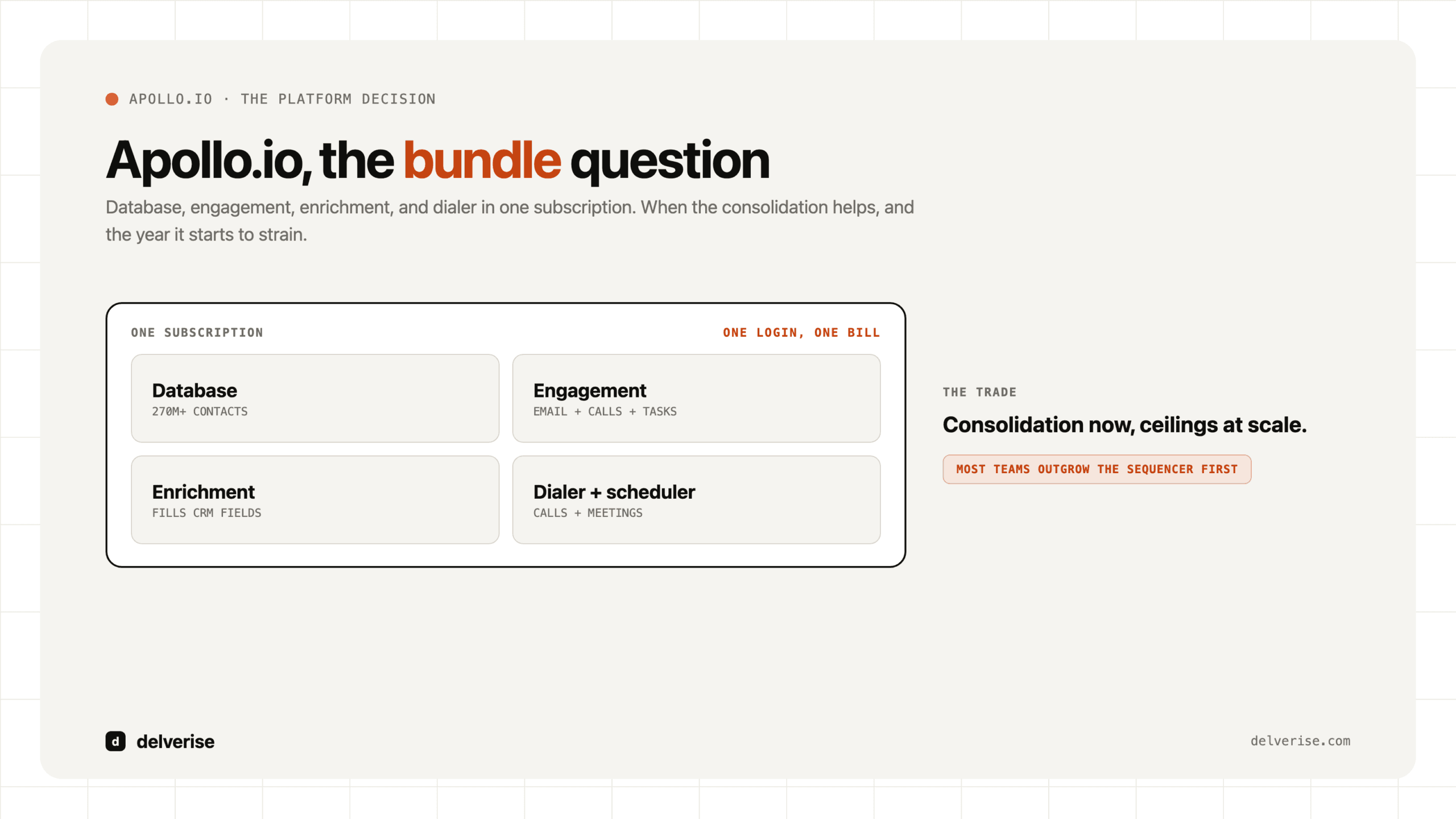
Apollo.io bundles four jobs that used to require four separate vendors. First, a B2B database: company and contact records with emails, phone numbers, titles, and firmographic filters (industry, headcount, revenue, technographics). Second, a sales engagement layer, meaning multi-step sequences across email, calls, and LinkedIn tasks. Third, enrichment, which fills missing fields on records already sitting in your CRM. Fourth, a set of workflow features like a dialer, meeting scheduler, and basic deal tracking.

For a founder or revenue leader, the appeal is consolidation. One login, one bill, and a rep can go from “build a list of VP Marketing contacts at Series A fintech companies” to “send a five-touch sequence” without exporting a CSV. That end-to-end coverage is why Apollo sits near the top of G2’s sales intelligence category by review volume and satisfaction, and why it spreads fast inside teams through self-serve adoption.
How good is Apollo’s B2B data quality?
Data quality is the question that decides whether Apollo earns its place. The honest answer depends on who you sell to. For mid-market and enterprise accounts in North America, Apollo’s firmographics and direct-dial coverage hold up well against pricier databases. For small businesses, emerging verticals, and buyers outside the US and Western Europe, accuracy drops and bounce rates climb.
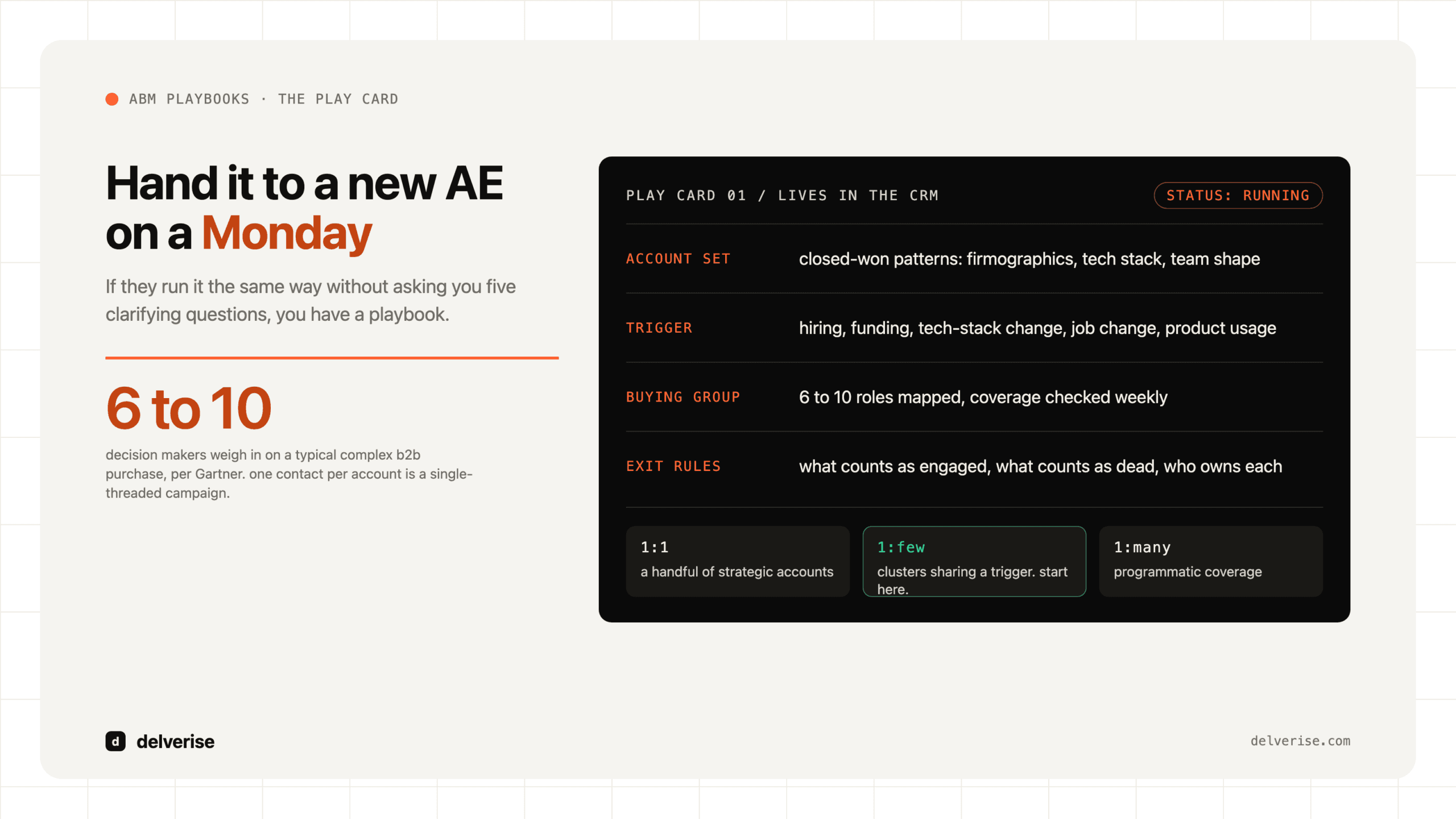
Apollo builds much of its email data from a community-contribution model, where usage helps refine and verify records over time. That approach produces broad coverage at a low price, and it also means verification lags reality when people change jobs. Gartner’s research on B2B buying groups found that a typical purchase now involves six to ten decision-makers, so a list that is 85% accurate at the contact level can still leave real gaps across a full buying committee. Treat any single-source database as a starting point, then verify against a second source before high-stakes campaigns.
This is where an enrichment discipline matters more than the vendor logo. A waterfall enrichment approach that checks Apollo first, then falls back to other providers for missing or stale fields, consistently beats relying on one database. We cover the mechanics of that on our CRM enrichment hub.
Where does Apollo fit in a modern GTM stack?
Apollo is a strong fit when three things are true: your ICP is broadly represented in mainstream B2B data, your outbound motion is still relatively simple, and your team is small enough that one shared tool reduces friction. In that setup, Apollo covers the whole path from targeting to first reply, and the low per-seat cost frees budget for other priorities.
The picture changes as motions get more sophisticated. Once you run account-based plays, layer in intent signals, or want tight control over sending infrastructure and deliverability, the all-in-one design starts to constrain you. McKinsey’s work on B2B buying shows customers now move fluidly across in-person, remote, and self-serve channels, which pushes revenue teams toward orchestration that a single sequencer rarely handles cleanly. At that stage, many teams keep Apollo for data and move execution to a dedicated platform. Our guide to the best sales engagement platforms walks through those options.
Apollo.io vs a composable stack: what is the tradeoff?
The core decision for most revenue leaders is Apollo’s bundled model versus a composable stack of specialized tools. Here is a direct comparison on the dimensions that affect pipeline.

Neither column is the right answer for everyone. A five-person team running a single outbound motion gets more value from Apollo’s simplicity. A Series B team with three segments and an ABM program usually gets more pipeline from a composable stack, even accounting for the extra cost and engineering. For a wider view of the category, our lead generation platforms comparison maps the alternatives.
What does Apollo.io cost, and is it worth it?
Apollo runs a freemium model with paid tiers that scale by credits, seats, and feature access. A free plan covers light prospecting; paid plans move into the range of tens of dollars per user per month, with higher tiers unlocking more credits, advanced filters, and deeper integrations. Compared with legacy sales databases that cost several times more, the price is the reason Apollo became a default first purchase for early-stage teams.
Worth is a function of usage, not sticker price. The cost that hurts is the hidden one: reps burning sender reputation with Apollo’s built-in sending, or a stale list quietly dragging reply rates down. SaaStr’s benchmark commentary on outbound has long pointed to reply and meeting rates, not raw volume, as the metrics that separate teams that hit plan from teams that stall. Tie your Apollo spend to those downstream numbers, and the ROI question answers itself.
When should a team outgrow Apollo.io?
A concrete example makes the trigger points clear. Picture a Series A SaaS company selling into RevOps leaders at mid-market software firms. In year one, two reps use Apollo end to end: build lists, enrich, and send. It works, and pipeline grows.
By year two, three things break. Deliverability suffers because all outbound runs through one sending setup with little domain control. Data gaps appear because their ICP includes newer companies Apollo indexes thinly. And the sequencer cannot express the branching logic their multi-segment plays now need. The fix is to split the stack: keep Apollo for its database and enrichment, move sending to a dedicated platform with domain-level control, and add a second data source for coverage. Pipeline efficiency recovers because each layer does one job well.

The general rule: teams outgrow Apollo’s sequencer before its data. Watch reply-rate decline, rising bounce rates, and reps asking for workflow logic the tool cannot support. Those are your signals. Pairing outbound with a disciplined lead scoring model and a documented AI outbound system keeps the whole engine measurable as you add tools.
Frequently Asked Questions
Is Apollo.io accurate enough for enterprise outbound?
For North American mid-market and enterprise firmographics and direct dials, Apollo is competitive with pricier databases. Accuracy drops for small businesses, niche verticals, and non-US regions. Verify high-value contacts against a second source before enterprise campaigns, because a full buying committee often spans records a single database indexes unevenly.
Can Apollo.io replace my CRM?
No. Apollo includes light deal tracking, and most teams still run a dedicated CRM like HubSpot or Salesforce as the system of record. Apollo feeds and enriches that CRM rather than replacing it. If you are choosing a CRM, our HubSpot vs Salesforce comparison covers the decision.
Should I use Apollo’s built-in email sending?
It works for early, low-volume outreach. As volume grows, the limited deliverability control becomes a liability, since sender reputation and inbox placement need domain-level management that a bundled sequencer rarely offers. Many teams move sending to a dedicated engagement platform while keeping Apollo for data.
How does Apollo.io compare to Clay?
They solve different problems. Apollo is a database plus outreach tool with its own contact data. Clay is an orchestration and enrichment layer that pulls from many sources, including Apollo, and builds custom workflows on top. Growing teams often run both: Apollo as one data source inside Clay-driven enrichment workflows.
Is the free version of Apollo.io useful?
Yes, for validating the tool and light prospecting. The free tier gives enough credits to test data quality against your ICP and try basic sequences. Run a real list through it before committing budget, so you judge coverage on your actual market rather than on category averages.
Read next