←Back to blog
Revenue Intelligence & Data ToolingGuideNovember 25, 20268 min read
B2B Sales Intelligence Tools: How Revenue Leaders Should Choose and Stack Them
B2B sales intelligence tools are software platforms that tell your revenue team who to sell to, how to reach them, and when they are likely to buy. They combine contact and firmographic data, buying signals, and enrichment. The best choice depends on your ICP, your data gaps, and how well the tool feeds your CRM and outbound motion. Most teams buy one of these tools, load a few thousand contacts, and then wonder why pipeline barely moves.
B2B sales intelligence tools are software platforms that tell your revenue team who to sell to, how to reach them, and when they are likely to buy. They combine contact and firmographic data, buying signals, and enrichment. The best choice depends on your ICP, your data gaps, and how well the tool feeds your CRM and outbound motion.
Most teams buy one of these tools, load a few thousand contacts, and then wonder why pipeline barely moves. Usually nobody decided which question the tool should answer, or how its output would reach a rep at the right moment. This guide covers the categories, the tradeoffs, and how to evaluate the purchase.
Key takeaways
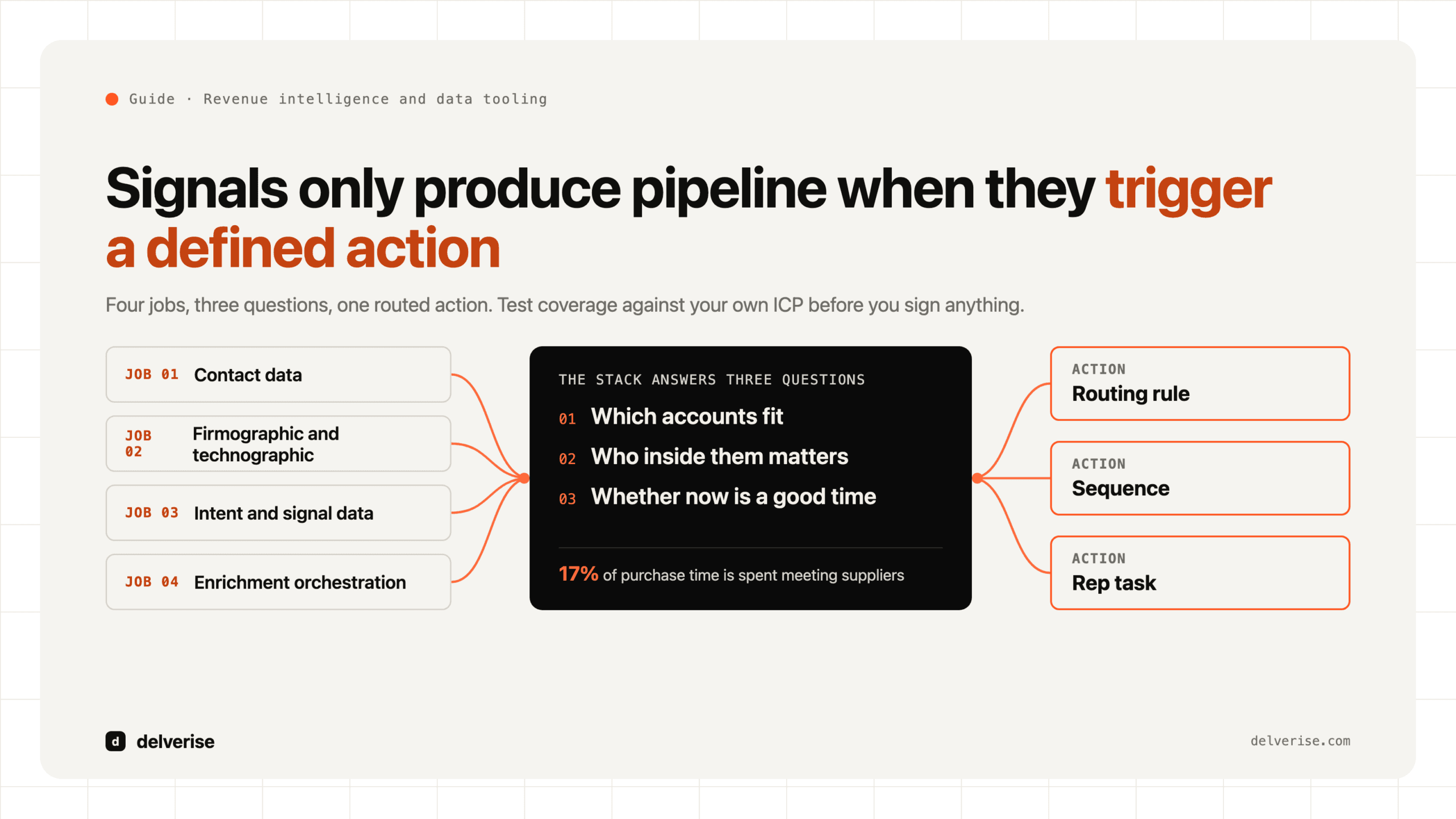
- Sales intelligence splits into four jobs: contact data, firmographic and technographic data, intent and signal data, and enrichment orchestration. Few vendors do all four well.
- Coverage varies sharply by region, seniority, and industry. Test against your own ICP before you sign anything.
- Signals only produce pipeline when they trigger a defined action: a routing rule, a sequence, or a rep task.
- Data decays constantly. Budget for ongoing refresh and hygiene, and treat the initial load as the easy part.
- Seed and Series A teams usually need one strong contact source plus an enrichment layer. Intent platforms pay off later, once you have volume to act on.
What are B2B sales intelligence tools, exactly?
The category is broad, so it helps to define the parts. Contact data means verified emails, direct dials, and job titles for the people on your target accounts. Firmographic data describes the company itself: headcount, revenue band, industry, location, funding. Technographic data tells you what software a company runs, which matters a lot if your product integrates with or replaces something specific.

Intent data is evidence that an account is researching a topic related to what you sell, usually gathered from content consumption across a network of publisher sites. Signal data is a wider term covering observable trigger events: a new VP of Sales, a funding round, a hiring spike, a champion changing jobs, a visit to your pricing page. Enrichment is the process of filling in missing fields on records you already have, often by querying several providers in sequence.
Put together, these tools answer three questions for a revenue team: which accounts fit, who inside them matters, and whether now is a good time to reach out.
Why do revenue leaders invest in sales intelligence now?
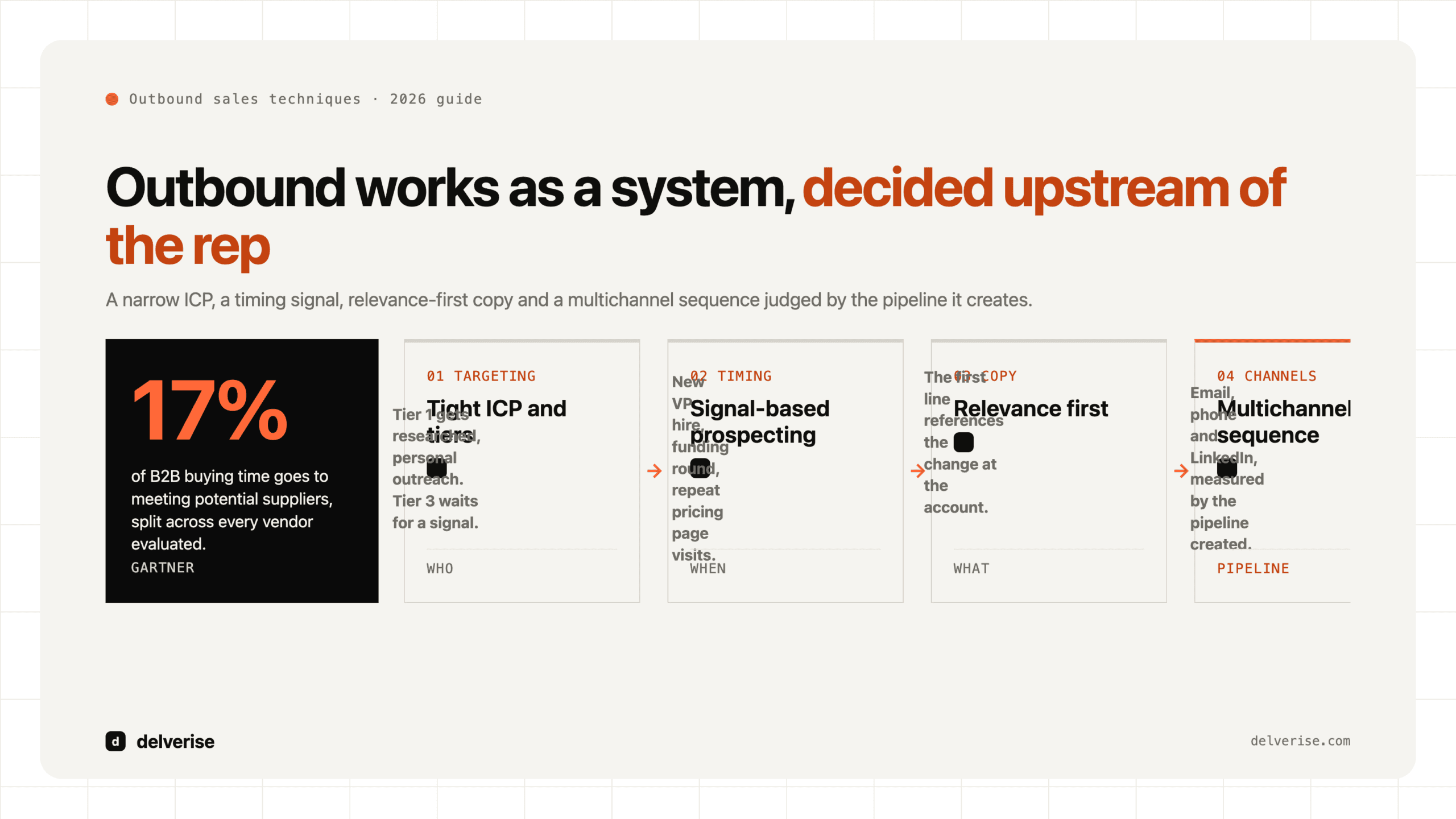
Buyers do most of their work without you. Gartner’s research on the B2B buying journey found that buyers spend only about 17% of their total purchase time meeting with potential suppliers, and that time gets split across every vendor they are considering. McKinsey’s B2B Pulse research found that buyers now routinely use ten or more channels during a purchase. Your reps get a narrow window, and they need to show up already knowing who the buying group is and what triggered the evaluation.
The second reason is efficiency. SDR hours spent researching the wrong account are wasted capacity. Good intelligence moves research effort from the rep to the system, which is the whole point of outbound sales automation done well.
Which types of sales intelligence tools exist, and how do they compare?
Vendors blur these lines, so sort them by the job they do best. G2 maintains separate categories for sales intelligence and buyer intent data, which is a useful hint that these are different purchases.

| Category | Primary job | Example tools | Best fit | Main tradeoff |
|---|---|---|---|---|
| Contact and company databases | Find people and verified contact details at target accounts | ZoomInfo, Apollo, Cognism, Lusha, SalesIntel | Any team running outbound | Coverage and accuracy vary by region and seniority |
| Account intent platforms | Show which accounts are researching your category | 6sense, Bombora, Demandbase | Series B teams with enough TAM and pipeline volume to act on account-level surges | Topic-level intent is directional and needs interpretation |
| Signal and trigger tools | Surface specific events like job changes, hiring, funding | UserGems, Common Room, LinkedIn Sales Navigator alerts | Teams with a strong customer base or product-led motion | Signals are only useful if a play is attached to each one |
| Enrichment and orchestration | Query multiple providers, clean and score records, push to CRM | Clay, plus native enrichment inside HubSpot and Salesforce | Teams with specific ICP criteria that no single database covers | Requires someone who can design and maintain workflows |
The table also exposes the most common mistake: buying an intent platform before the basics work. If your contact data bounces and your CRM has duplicates everywhere, a surge alert just creates a faster path to a bad record.
How should you evaluate a sales intelligence tool before you buy?
Vendor demos use accounts the vendor covers well. Run your own test instead.
Test coverage against your real ICP
Pull 200 to 300 accounts that match your ideal customer profile, including some closed-won customers and some open opportunities. Ask each vendor on your shortlist to return contacts for the specific personas you sell to. Measure match rate, email deliverability after verification, and direct dial connect rate.

Check freshness and refresh mechanics
People change jobs constantly, and a database is always somewhat stale. Ask how often records are reverified, whether you are charged again for refreshed data, and whether the tool can update records already in your CRM automatically.
Look at integration depth
CSV exports create manual work and drift. Look for native, bidirectional sync with your CRM, field-level mapping control, and rules that prevent the tool from overwriting data your team has already corrected. If you are unsure whether your CRM can support it, start with the foundation pieces under every revenue stack.
Understand the pricing model
Pricing usually combines seats, credits, and export limits. Credit-based models look cheap until enrichment runs across your whole database. Model your expected monthly volume before comparing quotes, and ask what happens when you hit the ceiling mid-quarter.
What does a working sales intelligence stack look like?
Here is a concrete example for a Series A company selling a finance automation product to mid-market companies, with three SDRs and two AEs.
- Account list: firmographic filters (200 to 2,000 employees, North America, specific industries) plus a technographic filter for the ERP systems the product integrates with.
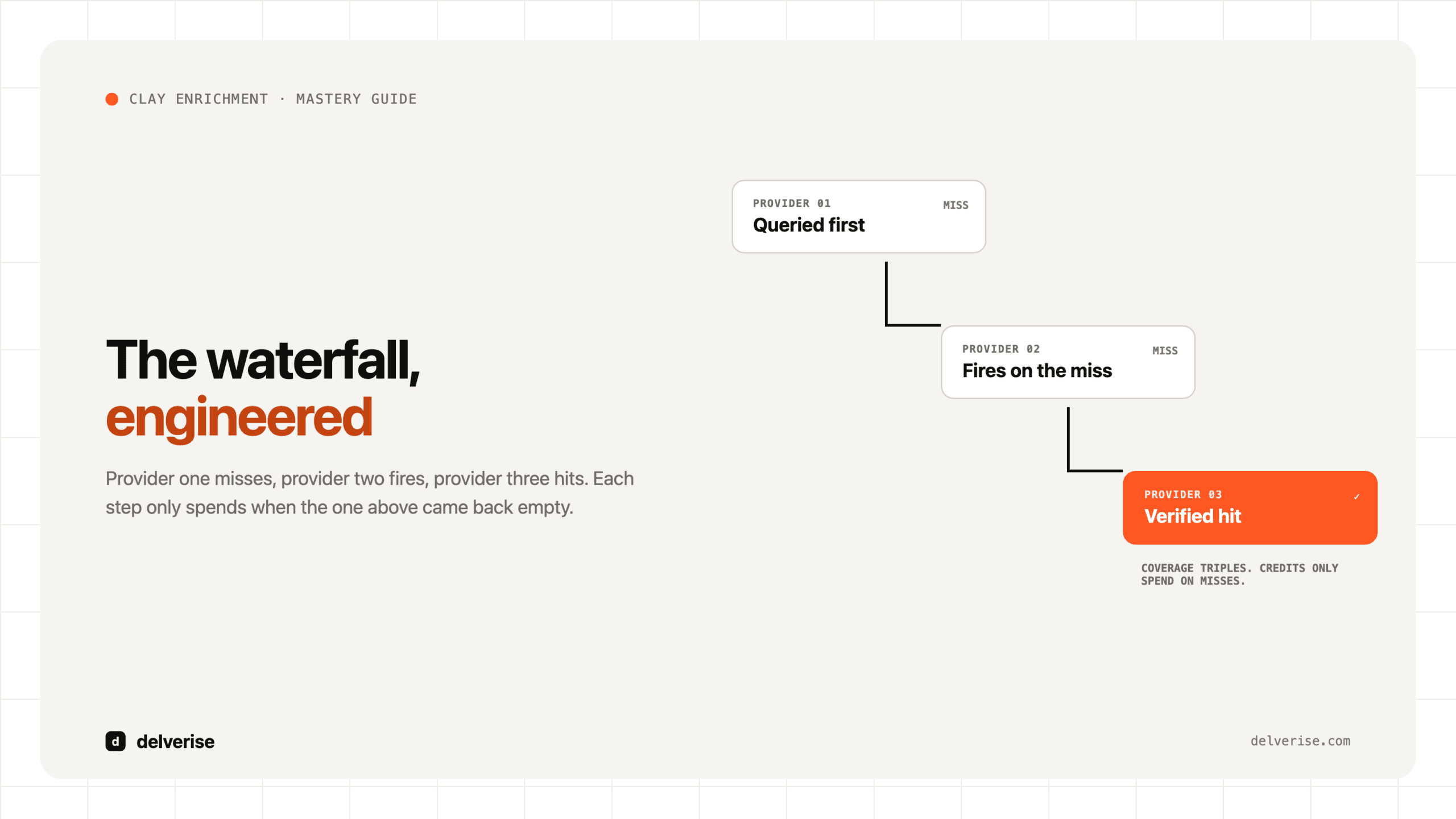
- Contact layer: one primary database for the CFO, VP Finance, and Controller personas, with a second provider queried only when the first returns no verified email.
- Enrichment and scoring: an orchestration layer such as Clay runs the waterfall, adds a fit score, and writes clean records to the CRM with an owner assigned.
- Signals: three triggers get defined plays. A new finance leader hire starts a sequence within a week. A former customer champion joining a target account routes directly to the AE. A pricing page visit from a known account creates a same-day task.
- Feedback: meetings and opportunities are tagged with their source signal, so the team can see which triggers produce pipeline after one quarter and cut the rest.
Notice what is missing: an enterprise intent platform. At this stage, three well-run signals beat thirty ignored ones. The intent platform becomes worth evaluating once the team has more accounts showing activity than reps can reasonably cover.
Where do sales intelligence tools break?
The failure points are predictable and mostly operational:
- No owner for the data. Enrichment runs once, then nobody maintains field mappings, dedupe rules, or refresh schedules. The CRM degrades within a few quarters.
- Signals without plays. Reps get a dashboard of intent scores with no guidance on what to do next. Adoption fades within weeks.
- Tool overlap. Teams end up paying for two or three databases with heavily overlapping coverage, each loaded by a different person, each writing to different fields.
- Treating intelligence as qualification. A strong fit score says an account is worth pursuing. It says nothing about whether a specific lead is ready to talk. Keep those separate, as covered in our guide to AI lead qualification.
Each of these problems comes down to architecture decisions. That is why CRM enrichment works best as a designed system with clear rules for source priority, overwrite logic, and refresh.
How do you measure ROI on sales intelligence?
Track a short list of metrics before and after rollout. Start with operational health: verified email rate, bounce rate, and the share of target accounts with at least two mapped contacts in the buying group. Then measure outcomes: meetings booked per SDR, the percentage of pipeline sourced from signal-triggered plays, and time from account assignment to first touch.
The most revealing number is usually pipeline per signal type. It shows which data actually drives revenue and gives you a clean basis for renewal negotiations. If you are also comparing prospecting tools with built-in AI research, our breakdown of AI tools for sales prospecting covers how to test those against the same criteria.
Pre-purchase checklist
- Written ICP with firmographic, technographic, and persona criteria
- Coverage test on 200 or more of your own target accounts
- Deliverability and connect rates measured on real test sends
- CRM field mapping and overwrite rules documented
- A defined play attached to every signal you plan to buy
- A named owner for data hygiene and refresh
- Monthly credit volume modeled against the pricing tiers
Frequently Asked Questions
What is the difference between sales intelligence and intent data?
Sales intelligence is the broader category covering contact, firmographic, technographic, and signal data. Intent data is one subset that estimates which accounts are actively researching topics related to your product. Most teams need reliable contact and company data before intent data becomes useful.
Do early-stage B2B SaaS companies need a sales intelligence tool?
Yes, once founders or early reps are doing outbound. A seed or Series A team usually gets the most value from one solid contact database plus an enrichment layer. Enterprise intent platforms tend to pay off later, when account volume exceeds what reps can research manually.
How accurate is data from sales intelligence tools?
Accuracy varies heavily by region, industry, and seniority, and no provider is complete. Test each vendor against your own target accounts and measure verified email and connect rates directly.
Should we use one data provider or several?
Many teams use a primary provider and a waterfall that queries secondary sources only when the first comes back empty. This raises coverage without paying twice for the same records, but it needs an orchestration layer and clear rules about which source wins when data conflicts.
How long does it take to see results from a sales intelligence rollout?
Operational improvements like lower bounce rates show up within weeks. Pipeline impact usually takes at least one full sales cycle to measure, since you need signal-triggered plays to run long enough to produce meetings and opportunities you can attribute.