←Back to blog
Revenue Intelligence & Data ToolingGuideNovember 22, 20268 min read
Outbound Sales Techniques: What Actually Works for B2B SaaS in 2026
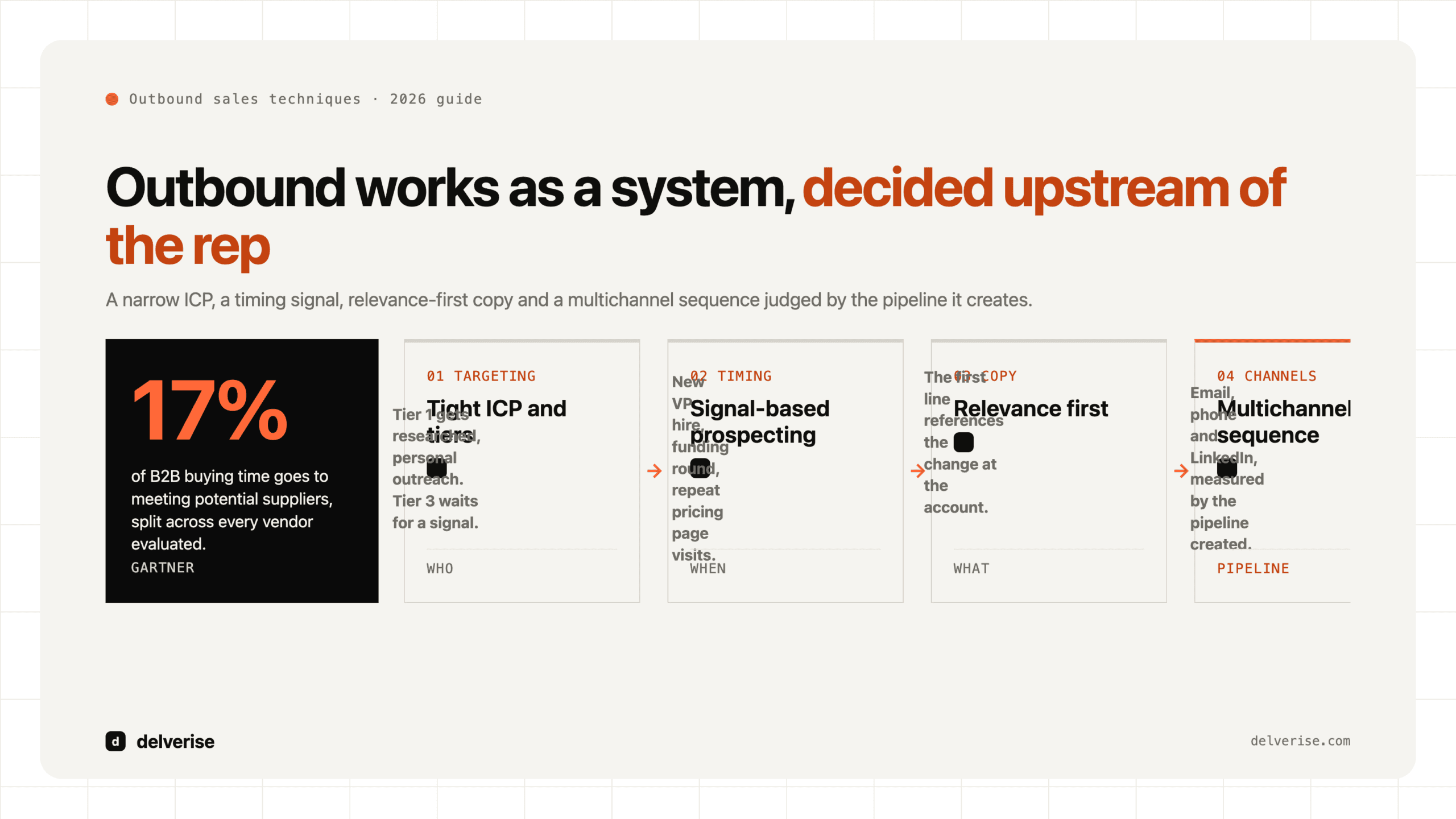
Outbound sales techniques are the methods a B2B team uses to start conversations with buyers who have not raised their hand yet. The techniques that work in 2026 share one pattern: a narrow ideal customer profile, a timing signal that justifies the outreach, copy built on relevance, and a multichannel sequence judged by the pipeline it creates.
Outbound sales techniques are the methods a B2B team uses to start conversations with buyers who have not raised their hand yet. The techniques that work in 2026 share one pattern: a narrow ideal customer profile, a timing signal that justifies the outreach, copy built on relevance, and a multichannel sequence judged by the pipeline it creates.
Key takeaways
- Targeting and timing decide most outbound results. Copy matters, but it cannot rescue a bad list.
- Signal-based outbound, meaning outreach triggered by a real change at the account, consistently beats static list blasting on reply quality.
- Deliverability is now a hard constraint. Mailbox providers enforce spam complaint thresholds, so volume-first tactics carry real risk to your domain.
- Multichannel sequences (email, phone, LinkedIn) outperform single-channel ones because buyers spread their research across many channels.
- The winning teams treat outbound as a system with data, routing, and measurement, then let reps spend their time on conversations.
Why do most outbound programs stall after the first quarter?
Most outbound programs start with a tool purchase and a list export. The first few weeks look fine because the easiest accounts reply. Then reply rates slide, domains start landing in spam, and reps quietly go back to working inbound leads.
The root cause is usually upstream of the rep. Gartner’s research on B2B buying found that buyers spend only a small share of their total buying time, roughly 17%, meeting with potential suppliers, and that share is split across every vendor they evaluate. When your window is that small, a generic message sent at the wrong moment gets ignored. The fix sits in how accounts are chosen and when they are contacted.
If you want a full picture of the stages involved, our breakdown of the outbound funnel maps each conversion point from list to closed deal.
Which outbound sales techniques actually produce pipeline?
Here are the techniques that hold up under scrutiny for Seed to Series B SaaS teams, in the order we would build them.
1. Tight ICP and account tiering
An ideal customer profile (ICP) describes the companies most likely to buy, succeed, and renew. A useful ICP goes beyond “SaaS, 50 to 500 employees.” It names the tech stack, team structure, and business event that make your product urgent. Tier accounts into three groups: Tier 1 gets researched, personal outreach; Tier 2 gets segment-level personalization; Tier 3 goes into lighter automated plays or waits for a signal.

2. Signal-based prospecting
A buying signal is an observable change that raises the odds an account needs you now. Common examples include a new VP hire in the function you sell to, a funding round, job postings that mention a problem you solve, a competitor tool appearing in their stack, or repeat visits to your pricing page. Signal-based outbound means the sequence starts because something changed, and the first line of the message references that change.
This is where data tooling earns its keep. Platforms like Clay let you pull from dozens of data providers, run waterfall enrichment (checking provider after provider until one returns a verified contact), and trigger outreach off signals in a single table. Apollo and ZoomInfo cover similar ground with their own databases. The tradeoff: Clay is more flexible but takes real build time, while all-in-one databases are faster to start and harder to customize.
3. Relevance-first messaging
Personalization that mentions a prospect’s alma mater or a recent post reads as a trick now. Relevance works better: a short message that connects the signal to a specific problem and a specific outcome. Three to five sentences, one clear ask, no attachments on the first touch. Our guide to cold email templates for B2B SaaS covers structures that consistently book meetings.
4. Multichannel sequencing
A sequence is a timed series of touches across channels. McKinsey’s B2B Pulse research has repeatedly found that buyers use ten or more channels during a purchase, so a single-channel sequence misses most of the places your buyer actually pays attention. A solid default for Tier 1 accounts is eight to twelve touches over three to four weeks, mixing email, a LinkedIn connection and message, and two or three phone attempts timed near email opens or replies.

5. Cold calling, used selectively
Phone still works for senior buyers who ignore email, especially in verticals where the phone is part of daily operations. It works best when the rep already knows why they are calling, which again comes back to signals. Dialer and AI calling tools can raise connect rates, and our guide to AI cold calling software covers where they help and where they sound robotic.
6. Deliverability as infrastructure
Since Google and Yahoo introduced their bulk sender requirements in 2024, senders need SPF, DKIM, and DMARC authentication, an easy unsubscribe path, and a spam complaint rate held below 0.3%. For outbound, that means secondary sending domains, warmed inboxes, verified emails, and sensible daily volume per inbox. Skip this, and every other technique on this list suffers.

How do these techniques compare?
| Technique | What it requires | Best fit | Where it breaks |
|---|---|---|---|
| Account tiering | Clean CRM data, agreed ICP | Any team with a defined market | When sales and marketing disagree on the ICP |
| Signal-based prospecting | Enrichment, signal sources, routing logic | Mid-market and enterprise motions | Signals that are too common to mean anything |
| Relevance-first email | Research inputs per segment | Most B2B SaaS motions | Generic AI copy with no real insight behind it |
| Multichannel sequences | Sequencer, LinkedIn access, dialer | Tier 1 and Tier 2 accounts | Poor handoffs between channels and reps |
| Cold calling | Direct dials, trained reps | Senior or phone-heavy buyers | Low connect rates and bad phone data |
| High-volume blasting | Large lists, many inboxes | Very broad, low-ACV markets | Spam complaints and domain reputation damage |
What does a signal-based play look like with real numbers?
Here is an illustrative example built on planning assumptions. Treat the math as a template and plug in your own figures.
Say your total addressable market is 2,000 accounts. Instead of emailing all of them, you track three signals: a new sales leader hire, a Series A or B round, and job posts for SDRs. In a given month, 250 accounts show at least one signal. You target two to three buying committee contacts at each, giving roughly 600 contacts. After verification, about 510 have deliverable emails.
If a well-targeted sequence produces a positive reply rate around 3% on that list, you get about 15 interested conversations and perhaps 10 booked meetings. A generic blast to 5,000 contacts at a 0.5% positive reply rate might produce 25 conversations, but it burns five times the data spend, pushes your complaint rate toward the danger zone, and leaves reps sorting through low-intent replies. The signal-based version also builds a repeatable engine: next month, a new set of accounts trips a signal and the play runs again.
This is the part most teams underestimate. The technique is simple to describe. Building the data flows, enrichment logic, and routing so it runs every week without a RevOps person babysitting it is the hard part. If you are building on Clay, our Clay implementation team handles that layer.
What should you automate, and what should stay human?
Automate the research inputs, list building, enrichment, signal detection, verification, and sequence enrollment. Keep humans on Tier 1 messaging, live calls, reply handling, and discovery. Generative AI is useful for first drafts and summarizing account research, but unreviewed AI copy at scale tends to sound identical to everyone else’s. Our piece on outbound sales automation goes deeper on where that line sits.
Qualification also belongs in the system. Scoring accounts and replies against your ICP before a rep touches them keeps expensive human time on real opportunities. See our guide to AI lead qualification for how that scoring is built.
How should a revenue leader measure outbound?
Activity metrics like emails sent and dials made are easy to count and poor at predicting revenue. Track these instead:
- Positive reply rate by segment and by signal type
- Meetings actually held per 100 contacts enrolled
- Meeting to qualified opportunity conversion
- Pipeline created per rep and per sending domain
- Spam complaint rate and bounce rate per inbox
- Win rate and sales cycle length on outbound-sourced deals versus inbound
Review these monthly by signal. Signals that produce meetings but not opportunities should be cut, however good the reply rate looks.
Where does delverise fit?
delverise builds the revenue systems behind outbound for B2B SaaS teams from Seed to Series B: the data layer, signal detection, enrichment, sequencing, CRM routing, and the reporting that ties it to pipeline. If your reps are spending more time building lists than talking to buyers, explore our AI outbound systems work.
Frequently Asked Questions
What is the most effective outbound sales technique right now?
Signal-based prospecting paired with relevance-first messaging is the most dependable approach for B2B SaaS. Reaching the right account at a moment of real change does more for reply quality than any copywriting trick or volume increase.
How many touches should an outbound sequence include?
For high-value accounts, eight to twelve touches across email, LinkedIn, and phone over three to four weeks is a sensible starting point. Lower-tier accounts can run shorter, email-led sequences. Test and adjust by segment.
Is cold email still worth it with stricter spam rules?
Yes, if the infrastructure is right. Authenticated secondary domains, warmed inboxes, verified lists, and moderate volume per inbox keep complaint rates low. Teams that ignore those basics are the ones seeing email stop working.
Should a Seed-stage company hire SDRs or build automated outbound first?
Build the targeting and data foundation first, often with the founder running early outreach. Once you know which signals and messages convert, an SDR has a proven play to execute. Our overview of the outbound SDR role covers what one rep realistically produces.
Which tools do you need for modern outbound?
At minimum: a CRM such as HubSpot or Salesforce, a data and enrichment layer such as Clay or Apollo, a sequencer such as Outreach or Salesloft, email verification, and a dialer if phone is part of the motion. The integration between them matters more than any single tool.