←Back to blog
Revenue Intelligence & Data ToolingGuideAugust 20, 20269 min read
AI Cold Calling Bot: What It Actually Does and When It Works
An AI cold calling bot is software that places outbound phone calls, speaks with a synthetic voice, understands replies in real time, and takes an action such as booking a meeting or routing to a rep. In B2B SaaS it performs best on high-volume, low-complexity motions: qualification, list validation, speed-to-lead, and reactivation. Complex discovery still belongs to humans.
An AI cold calling bot is software that places outbound phone calls, speaks with a synthetic voice, understands replies in real time, and takes an action such as booking a meeting or routing to a rep. In B2B SaaS it performs best on high-volume, low-complexity motions: qualification, list validation, speed-to-lead, and reactivation. Complex discovery still belongs to humans.
Key takeaways
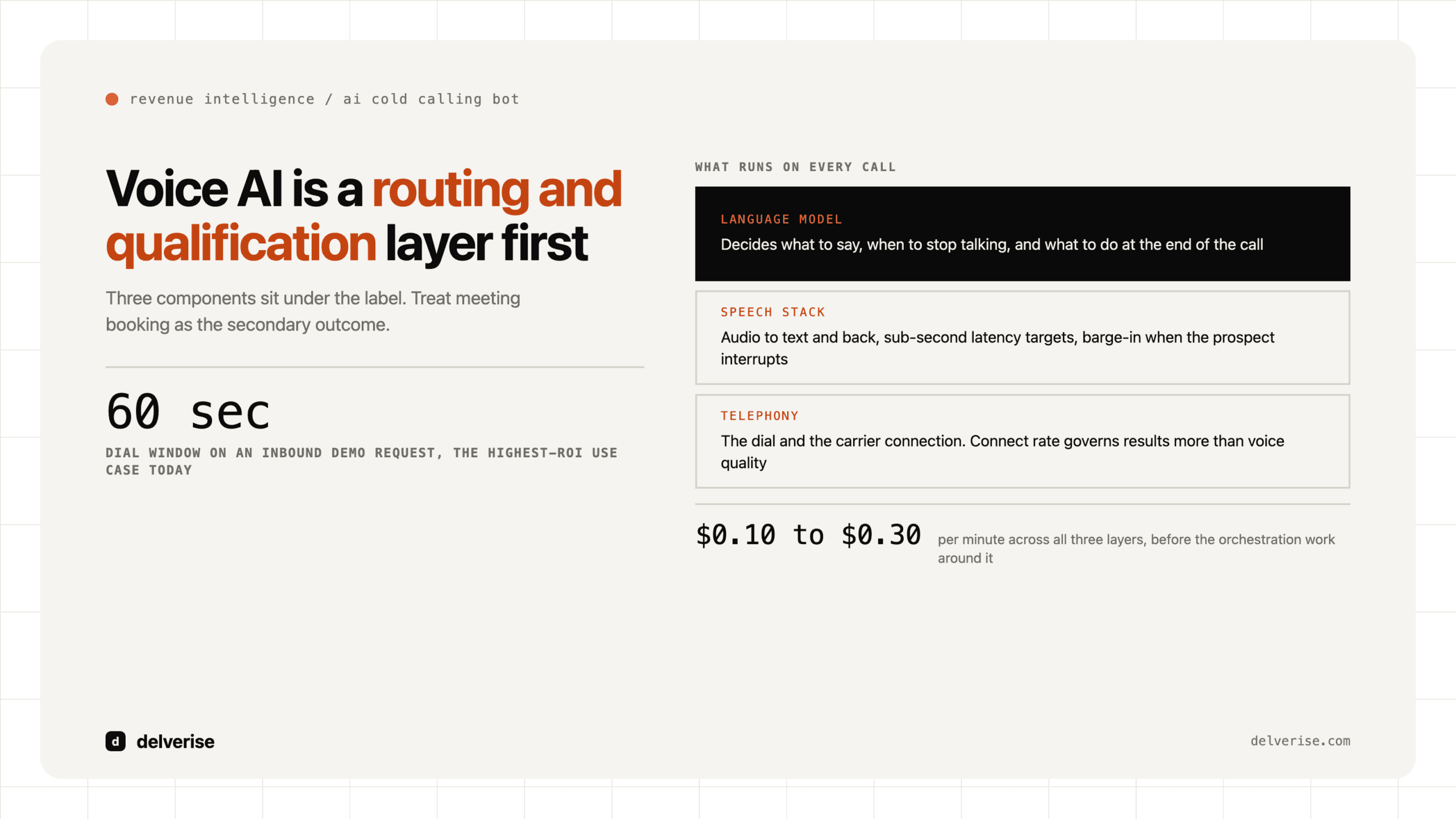
- Voice AI is a routing and qualification layer first. Treat meeting-booking as a secondary outcome, not the headline metric.
- Connect rate and data accuracy govern results more than voice quality. A bot dialing bad numbers fails no matter how human it sounds.
- Speed-to-lead on inbound and product signups is the highest-ROI use case available today, ahead of true cold outbound.
- Compliance is a real constraint. Disclosure rules, consent, and state-level restrictions apply to automated voice.
- Cost per conversation typically runs $0.10 to $0.30 per minute across telephony, speech, and model inference, before the orchestration work around it.
What is an AI cold calling bot, exactly?
Three components sit under the label. Telephony handles the dial and the carrier connection. A speech stack converts audio to text and back, usually with sub-second latency targets. A language model decides what to say, when to stop talking, and what to do at the end of the call.
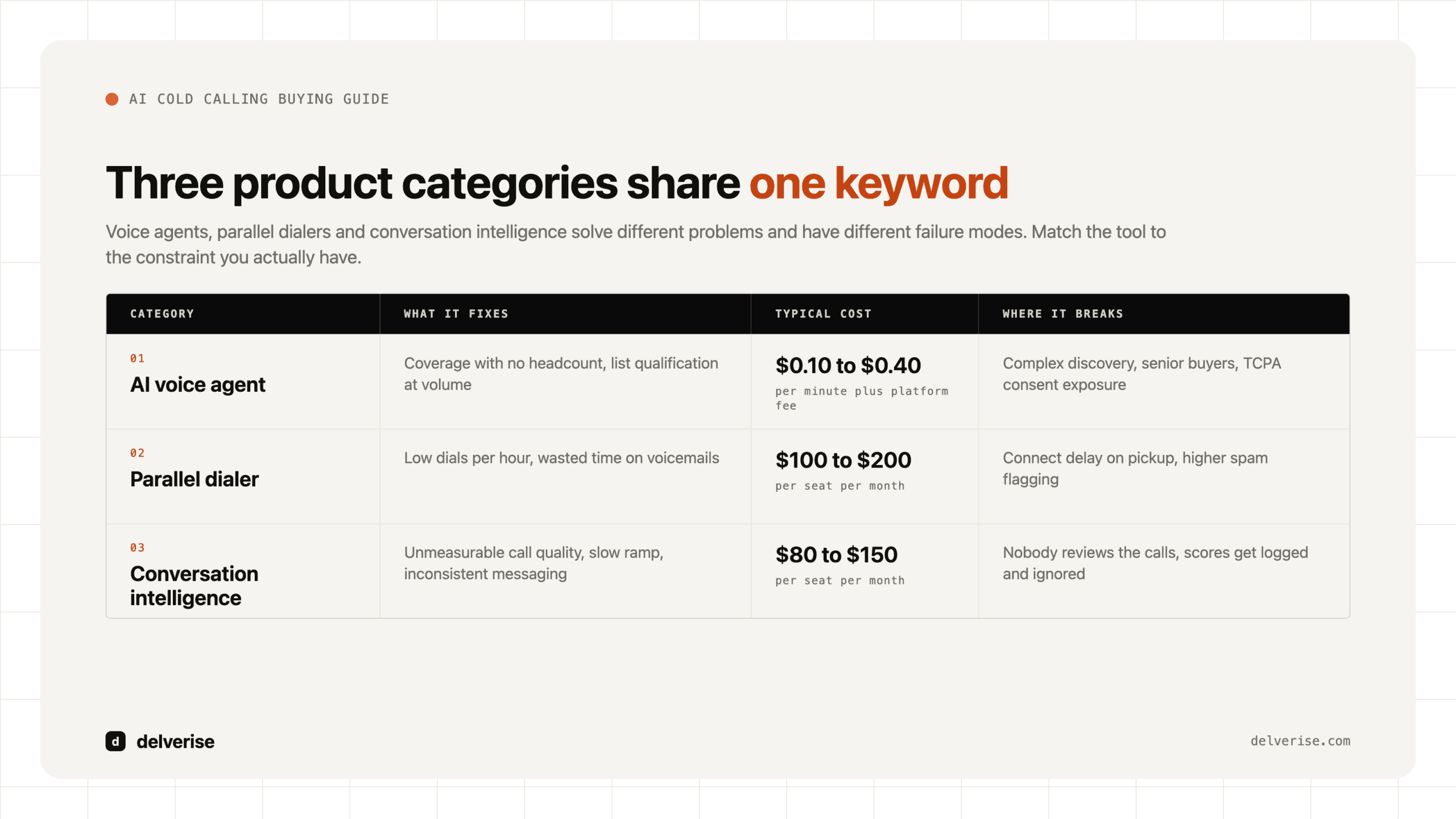
Vendors bundle these differently. Some sell a full agent with a builder interface. Others sell the voice infrastructure and expect you to bring the logic. The distinction matters at buying time: bundled platforms move faster to a first call, infrastructure plays give you control over prompts, guardrails, and CRM writeback. We cover the broader category in our guide to AI cold callers and where voice AI fits on the phones.
One term worth defining: barge-in is the bot’s ability to stop speaking when the prospect interrupts. Poor barge-in handling is the single most common reason a call feels robotic, and it is a spec you should test before you sign anything.
Where does voice AI actually work in B2B SaaS?
The honest answer is that voice AI performs on narrow, well-defined calls with a clear next action. Four use cases hold up under scrutiny.

Speed-to-lead. A demo request comes in, the bot dials within 60 seconds, confirms fit, and books directly on the rep’s calendar. Harvard Business Review’s widely cited study of lead response behavior found that firms contacting leads within an hour were dramatically more likely to qualify them than those waiting longer, and most companies were far slower than that. A bot never sleeps and never has a full calendar, which is exactly the gap that research exposes. More on the operating model in our breakdown of lead follow-up systems.
List validation and data hygiene. Confirming a title, checking whether someone still works at an account, and verifying direct dial accuracy. Low-stakes calls where a wrong answer costs nothing.
Reactivation of closed-lost and dormant accounts. Large lists, low expectations, high tolerance for imperfect conversations.
Pre-meeting confirmation and no-show reduction. Unglamorous, and often the fastest measurable payback in the whole category.
Where it struggles: multi-threaded enterprise deals, technical discovery, anything requiring a rep to read hesitation and change direction. Gartner has consistently reported that B2B buyers spend only a small fraction of the buying cycle with any one supplier’s sales team. That scarce time is worth spending on a human.
How does an AI cold calling bot compare to a human SDR?
| Dimension | AI cold calling bot | Human SDR |
|---|---|---|
| Cost per dial | Cents, mostly usage-based | Loaded cost of a headcount spread across dials |
| Ramp time | Days to first call, weeks to tuned | Typically 3 to 6 months to full productivity |
| Best call type | Scripted qualification, confirmation, reactivation | Discovery, objection handling, multi-threading |
| Consistency | Identical every call, including identical mistakes | Variable, but adapts within the call |
| Failure mode | Confidently wrong, at scale, silently | Slower, but usually self-correcting |
| Coverage | 24/7, unlimited concurrency | Business hours, finite capacity |
The comparison that matters is not bot versus rep. It is bot versus the calls that never got made. Most B2B SaaS teams have a long tail of leads nobody dials: trial signups from unfamiliar regions, content downloads, event scans, dormant accounts. That tail is where voice AI earns its keep, because the alternative is zero contact. The same logic applies to email, which we cover in what AI BDRs actually automate and where they break.

What does a working deployment look like?
Here is a concrete worked example from a common configuration. A Series A SaaS company has 2,000 dormant trial signups from the previous 12 months. Assume a 12 percent connect rate on mobile-verified numbers, which is realistic when the data is fresh and optimistic when it is not. That yields roughly 240 conversations. Of those, perhaps 15 percent are still in-market and agree to a call, giving about 36 meetings booked. Apply a 30 percent no-show rate and you have around 25 held meetings.

Total call cost at $0.20 per minute across an average two-minute call: roughly $800 for the campaign. Even at a modest ACV, the math works. What breaks the math is the connect rate. Drop from 12 percent to 4 percent because your phone data is stale and the same campaign produces eight held meetings instead of 25. The bot did not get worse. The data did.
This is why phone number accuracy dominates every other variable. Most teams need a chained provider approach, where a number that fails at one vendor gets retried at the next, rather than betting a whole campaign on a single source. We walk through the mechanics in the data enrichment waterfall, and the provider tradeoffs in our guide to contact data that converts.
What has to exist before the bot works?
Voice AI is the last mile of a system, and it fails loudly when the upstream layers are missing. Four things need to be in place.
- Verified phone data with a fallback chain, refreshed on a schedule rather than bought once
- Trigger logic that decides who gets dialed and when, based on intent or product signals rather than a static list
- CRM writeback that captures call outcome, transcript, and disposition on the right object without creating duplicates
- A human handoff path with a defined SLA for every outcome the bot cannot resolve
The orchestration layer that connects these is usually where teams stall. Building the trigger and enrichment logic in a platform like Clay lets you assemble the account list, run the enrichment waterfall, and fire the dial signal from one place, then push outcomes back into your CRM. If you want that built and maintained rather than assembled in-house, that is what our Clay implementation work covers.
Clarity on ownership matters as much as tooling. Somebody has to own dispositions, script iteration, and the compliance review. In most teams that sits with RevOps, not with the SDR manager. Our post on GTM operations covers how that ownership gets assigned.
What are the real risks?
Compliance. Automated outbound voice is regulated. In the US, TCPA rules govern prerecorded and artificial voice messages, and the FCC has ruled that AI-generated voices fall under existing restrictions. Several states impose additional consent and disclosure requirements. B2B calls have different exposure than consumer calls, but “different” is not “exempt.” Get counsel involved before launch, and disclose that the caller is an AI assistant at the start of every call.
Brand damage. A bot that mishandles an angry prospect does it to every angry prospect. Review transcripts weekly for the first quarter of any deployment.
Attribution confusion. If the bot books a meeting that a rep would have booked anyway, you have moved cost around rather than created pipeline. Hold out a control segment for the first 60 days.
Number reputation. High-volume dialing from a small pool of numbers gets you flagged as spam by carriers. Rotate numbers, register them properly, and monitor spam labeling. This is the voice equivalent of domain warmup.
How should a revenue leader evaluate vendors?
Run a structured pilot rather than a demo. Demos are recorded under ideal conditions with a cooperative counterpart.
- Call the bot yourself, interrupt it mid-sentence, and change the subject twice
- Ask for median end-to-end latency, not best-case, and test it on a mobile connection
- Confirm what happens on voicemail, IVR trees, and gatekeepers
- Verify CRM writeback depth: does it log a call, a transcript, a disposition, and a structured outcome field?
- Test with your worst list segment, not your best, so you see the real failure modes
- Get pricing in cost per connected conversation, not per minute or per seat
G2 reviews in the conversational AI and sales engagement categories are useful for spotting recurring support and reliability complaints, which rarely show up in a sales cycle. Read the three-star reviews. They contain the honest tradeoffs. For adjacent tooling decisions, our buyer’s guide to AI sales tools covers how these systems fit together.
Is voice AI worth it right now?
For most Seed to Series B B2B SaaS companies, yes, in a narrow scope. Start with speed-to-lead on inbound and a reactivation campaign against dormant accounts. Both have clear baselines, tolerate imperfection, and produce measurable results within a quarter. McKinsey’s research on B2B sales has repeatedly found that companies applying analytics and automation to commercial processes outperform peers on growth, and voice is simply the newest channel where that applies.
What does not work is buying a bot and pointing it at a cold list you have not validated, with no trigger logic and no CRM writeback. That produces expensive noise. The bot is a channel. The system around it decides whether the channel produces revenue.
Frequently Asked Questions
Can an AI cold calling bot legally call prospects in the US?
B2B calls to business lines have more latitude than consumer calls, but artificial and prerecorded voice is regulated under TCPA, and the FCC has confirmed AI-generated voices are covered. Several states add consent and disclosure requirements. Scrub against the national and state do-not-call lists, disclose the AI at the start of the call, and have counsel review your script and consent posture before launch.
What connect rate should I expect?
It depends almost entirely on data quality and number type. Mobile-verified direct dials against a recently enriched list can reach 10 to 15 percent. Stale or office-line data often lands in low single digits. Measure connect rate before you evaluate the bot’s conversation quality, because a low connect rate makes every downstream metric meaningless.
Will prospects hang up when they realize it is a bot?
Some will, and that is acceptable on qualification and reactivation calls. Response is noticeably better when the bot discloses upfront and gets to the point quickly. Attempting to pass as human is both a compliance risk and a trust risk if the prospect later discovers it.
Should this replace our SDR team?
No. Use it to cover the calls your team never gets to and to handle the repetitive parts of qualification, which frees rep hours for discovery and multi-threading. Teams that cut headcount and hand cold outbound entirely to a bot usually see pipeline quality fall within a quarter. The structure question is covered in our guide to GTM team structure.
How long until we see results?
Expect two to four weeks to a first meaningful campaign if your phone data and CRM writeback are already in order, and six to eight weeks if they are not. The bot configuration takes days. The data and orchestration work around it takes the rest, and that is where most of the timeline actually goes.
Read next