←Back to blog
Revenue Intelligence & Data ToolingGuideAugust 24, 20268 min read
Outreach vs Salesloft: Which Sales Engagement Platform Actually Fits Your Revenue System?
Outreach and Salesloft are both mature sales engagement platforms, and on core sequencing, dialing, and CRM sync they are near parity. Outreach leans deeper into forecasting and deal execution for process-heavy sales orgs. Salesloft leans toward buyer signal orchestration and faster adoption. Data quality underneath decides results more than either choice.
Outreach and Salesloft are both mature sales engagement platforms, and on core sequencing, dialing, and CRM sync they are near parity. Outreach leans deeper into forecasting and deal execution for process-heavy sales orgs. Salesloft leans toward buyer signal orchestration and faster adoption. Data quality underneath decides results more than either choice.
Key takeaways
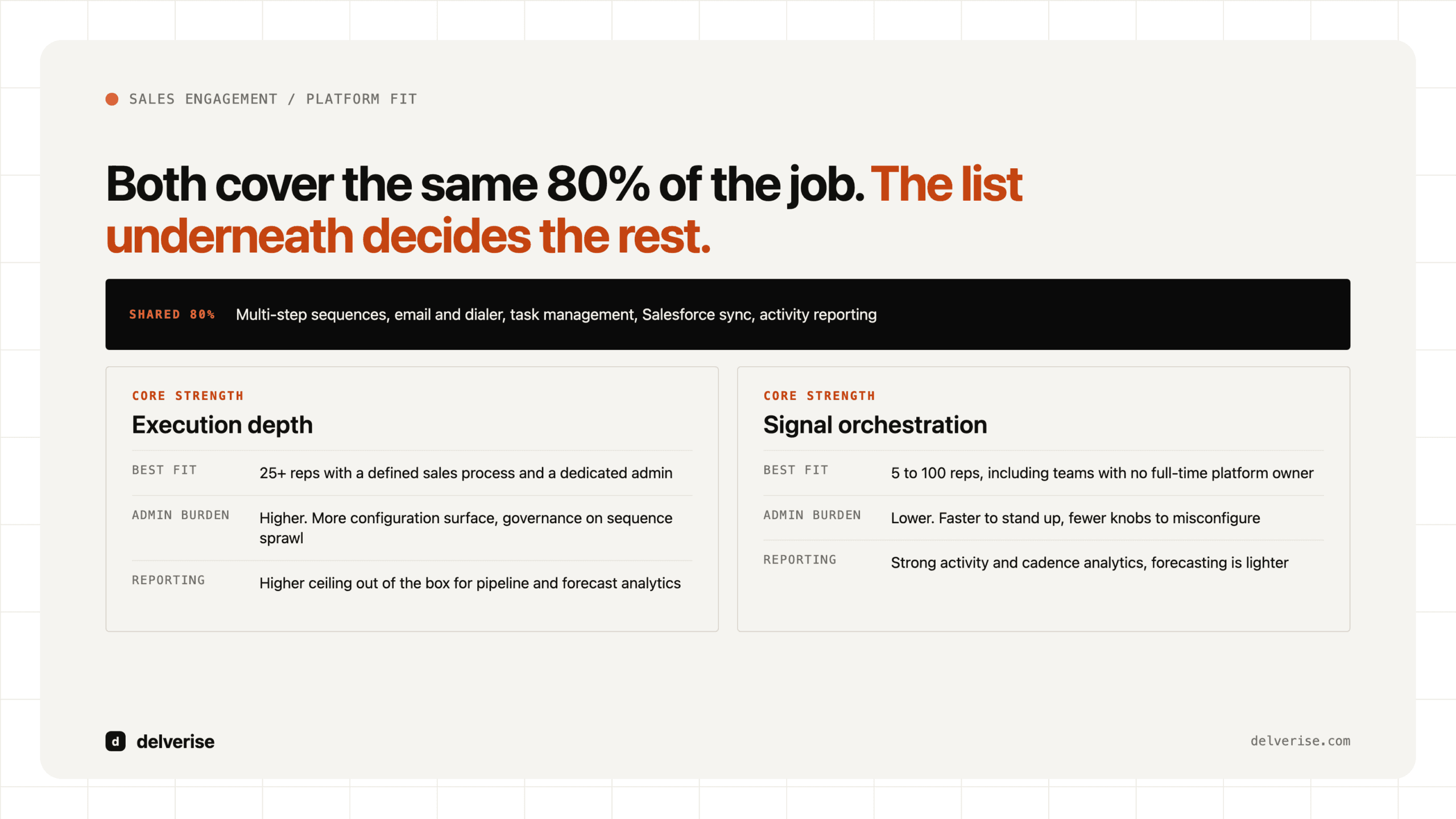
- Both platforms cover the same 80% of the job: multi-step sequences, email and dialer, task management, Salesforce sync, and activity reporting.
- Outreach tends to win with larger sales organizations that want forecasting, deal inspection, and rep coaching inside the same platform.
- Salesloft tends to win with teams that prioritize speed to adoption and signal-driven prioritization across the buyer journey.
- Pricing is quote-based on both sides and lands in a similar per-seat band, so the real cost difference is implementation, admin time, and seat sprawl.
- Neither platform fixes bad targeting or stale contact data. The engagement layer amplifies whatever list you feed it.
What do Outreach and Salesloft actually do?
A sales engagement platform is the execution layer between your CRM and your buyer. It sequences the touches (email, call, LinkedIn, task), logs the activity back to CRM, and gives managers a view of what reps did and what happened next. Outreach and Salesloft both invented and then refined this category over the last decade, and both consistently sit in the leader tier of G2’s sales engagement grid based on user reviews.
Outreach positions itself as a sales execution platform. Beyond sequencing, it carries conversation intelligence (Kaia), deal management, and forecasting, so a VP Sales can run pipeline reviews without exporting to a spreadsheet. Salesloft positions itself around the full revenue workflow, with Cadences for outbound, Conversations for call recording and analysis, Deals for pipeline, and Rhythm for turning buyer signals into a prioritized rep task list. Salesloft’s 2024 acquisition of Drift added buyer-side conversational engagement to that stack.
Both are owned by private equity (Salesloft by Vista Equity Partners, Outreach venture-backed with a long runway), and both have shipped AI agents for research, email drafting, and reply handling. Feature-by-feature comparison decays fast because parity restores itself within a couple of quarters. The durable differences sit in architecture, admin burden, and fit with the rest of your stack.
Where do Outreach and Salesloft actually differ?
| Dimension | Outreach | Salesloft |
|---|---|---|
| Core strength | Execution depth: sequencing plus deal inspection and forecasting in one platform | Signal orchestration: prioritizing rep action based on buyer behavior across channels |
| Best-fit team size | 25+ reps with a defined sales process and a dedicated admin | 5 to 100 reps, including teams without a full-time platform owner |
| Admin burden | Higher. More configuration surface, more governance needed on sequence sprawl | Lower. Faster to stand up, fewer knobs to misconfigure |
| CRM fit | Deepest with Salesforce; HubSpot supported | Strong with both Salesforce and HubSpot |
| Conversation intelligence | Kaia, native | Conversations, native |
| Buyer-side engagement | Meeting and mutual action plan features | Drift-powered chat and buyer conversations |
| Reporting ceiling | Higher out of the box for pipeline and forecast analytics | Strong activity and cadence analytics; forecasting is lighter |
| Pricing model | Quote-based, per seat, annual, tiered by module | Quote-based, per seat, annual, tiered by module |
On price, both vendors publish little. Publicly reported deals for both cluster in a similar per-seat, per-month band with annual commitments and a platform or onboarding fee on top. Treat any quoted list price as a starting position. The negotiable levers are term length, seat count tiers, module bundling, and the onboarding fee.

Which one should you pick for your situation?
Here is the practical decision logic, based on what your revenue org actually looks like today.

Pick Outreach if: you have 25 or more quota-carrying reps, a defined multi-stage sales process, Salesforce as the system of record, and someone who owns the platform as part of their job. You want forecast rollups, deal risk scoring, and rep coaching in the same place as sequencing. You are willing to spend six to ten weeks on a real implementation.
Pick Salesloft if: you are between 5 and 60 reps, want reps productive inside two weeks, and care more about prioritizing the right accounts today than about forecast modeling. You run HubSpot or a mixed CRM environment. You want inbound chat and outbound cadences under one vendor relationship.
Pick neither yet if: your ICP is still moving, your contact data comes from one provider with unverified emails, or you have fewer than five reps. At that stage the constraint is targeting and data, and a $40k platform commitment will not move it. Fix the input layer first, then buy the execution layer. Our guide to the data enrichment waterfall covers how to chain providers so coverage and accuracy stop being the bottleneck.
A worked example: what the platform choice is really worth
Take a Series A SaaS company with 12 AEs and 6 SDRs, $18k average contract value, and a 4% meeting-to-close rate on outbound. The team sends 6,000 sequenced emails a month and books 40 meetings.

Switching from Outreach to Salesloft, or the reverse, might change reply rates by a fraction of a percent. Changing the list quality, though, changes the denominator. If verified, correctly-targeted contacts take the bounce rate from 8% to 2% and the reply rate from 1.5% to 3%, that same volume produces roughly twice the meetings with no additional seats, no new sequences, and no migration project. At a 25% close rate, that is roughly $180k in additional annual contract value from the data layer, against a platform decision that changes maybe a tenth of that.
This is why the sequencing tool rarely deserves to be the first conversation. Gartner’s widely cited research on B2B buying found that buyers spend only about 17% of their purchase journey meeting with potential suppliers, and when several vendors are in play, roughly 5 to 6% of total time with any single sales rep. Your engagement platform controls a thin slice of the buyer’s attention. What you say, to whom, and when carries far more weight, and those are functions of data and orchestration.
What has to be true before either platform pays off?
The teams that get real return from Outreach or Salesloft have four things in place before the contract starts.
A defined ICP with tiering. Accounts segmented by fit, with different motions for each tier. Without this, both platforms become high-volume spray machines with excellent reporting on how badly it went.
An enrichment layer that runs before sequencing. This is where a workflow tool like Clay earns its place: it sits upstream of the sequencer, chains multiple data providers for waterfall enrichment, runs research on each account, and pushes only qualified, verified, personalized records into Outreach or Salesloft. The engagement platform then does the one job it is genuinely good at, which is reliable multi-channel execution at scale. If you want that layer built rather than assembled over six months of nights and weekends, delverise builds Clay systems as production infrastructure.
Signal-triggered entry, not calendar-triggered entry. Sequences that start because a job change, funding event, hiring signal, or product usage threshold fired will outperform sequences that start because it is Monday. Both platforms support API-triggered enrollment. Most teams never wire it up. Our breakdown of speed and context in lead follow-up goes deeper on the timing mechanics, including HBR’s well-known finding that firms responding to online leads within an hour were dramatically more likely to qualify them than those that waited even a few hours.
Ownership. Someone accountable for sequence hygiene, deliverability, CRM field mapping, and reporting definitions. This is a GTM operations function, and leaving it unowned is how a $50k platform turns into a shared inbox with automation.
How should you run the evaluation?
Run both trials against the same list, the same offer, and the same reps. Anything else measures enthusiasm rather than platform capability.
- Define one segment of 300 accounts and split it evenly across both trials
- Test bidirectional CRM sync with your actual custom fields, not a demo instance
- Measure time from signed contract to first rep-sent sequence, including admin setup
- Send a real volume test to check deliverability behavior and inbox placement
- Have one non-technical rep build a sequence unaided and time it
- Pull the reports your board actually asks for and see if the platform produces them natively
- Price a 24-month term and a 12-month term separately, then compare total cost including onboarding
- Confirm what happens to your data and recordings at contract end
Teams evaluating whether AI agents should handle part of this motion should read our assessment of what AI BDRs automate and where they break before adding another line item. The failure pattern is consistent: automation applied to an unvalidated motion scales the error.
Frequently Asked Questions
Is Outreach or Salesloft better for a Series A SaaS company?
Salesloft, in most cases. Below roughly 25 reps, the extra forecasting and deal inspection depth in Outreach goes unused while the admin overhead is fully felt. Salesloft gets a small team executing faster, and the switching cost later is manageable if you outgrow it. If you already run Salesforce with heavy customization and have an ops hire, Outreach becomes reasonable earlier.
Can we replace Outreach or Salesloft with HubSpot Sales Hub or Apollo?
Partly. HubSpot Sequences and Apollo both handle basic multi-step outreach, and for teams under about eight reps they are often sufficient. What you give up is dialer depth, sequence governance, deliverability controls, and manager-level analytics. Our Apollo.io guide covers where that tradeoff makes sense and where it starts costing pipeline.
How long does migration between the two actually take?
Plan on six to twelve weeks end to end for a 30-rep team: field mapping, sequence rebuild, integration reconfiguration, deliverability rewarming on new sending infrastructure, and rep retraining. Sequences do not port cleanly between platforms. Budget rebuild time rather than assuming an export and import.
Does either platform improve email deliverability on its own?
No. Both give you sending controls, throttling, and warm-up integrations, and both will happily send garbage at scale if you configure them to. Deliverability comes from domain and inbox infrastructure, list verification, sending volume discipline, and content quality. The platform is the throttle, and your data and infrastructure are the engine.
Should we buy the conversation intelligence module from the same vendor?
Only if your call volume justifies it and your reps will use the coaching workflow. Native modules from either vendor reduce integration work and consolidate the vendor relationship. Standalone tools generally offer deeper analytics. For teams under 20 reps, the native module is usually the better economic call. Above that, evaluate on analysis quality and manager adoption rather than on bundling.
The larger point holds regardless of which logo you sign. Sales engagement platforms execute a motion, and they cannot invent one. If your targeting, data, and signal layer are strong, both Outreach and Salesloft will perform well enough that the difference is a rounding error. If those layers are weak, neither purchase changes the number. That upstream system is what GTM engineering builds, and it is where the compounding returns actually live.
Read next