←Back to blog
Revenue Intelligence & Data ToolingGuideAugust 29, 20268 min read
Cold Call Practice AI: What It Actually Improves and Where It Breaks
Cold call practice AI is software that simulates a live prospect so reps can rehearse openers, discovery, and objection handling before dialing real accounts. It scores each attempt against a rubric and returns feedback in seconds. Used well, it shortens ramp time and standardizes what good sounds like across a sales team.
Cold call practice AI is software that simulates a live prospect so reps can rehearse openers, discovery, and objection handling before dialing real accounts. It scores each attempt against a rubric and returns feedback in seconds. Used well, it shortens ramp time and standardizes what good sounds like across a sales team.
Key takeaways
- Cold call practice AI is a rehearsal layer, and its value depends entirely on how closely the simulated buyer matches your real ICP.
- The strongest use case is ramp: getting a new AE or SDR to competent-sounding in two weeks instead of two months.
- Generic persona libraries produce generic reps. Personas built from your own call recordings and CRM data produce reps who survive a real gatekeeper.
- Scores from a practice bot are a leading indicator, never the KPI. Tie the program to connect-to-meeting rate and meeting-to-opportunity rate.
- Most teams should buy the simulator and build the persona pipeline, since the persona data is the defensible part.
What is cold call practice AI, exactly?
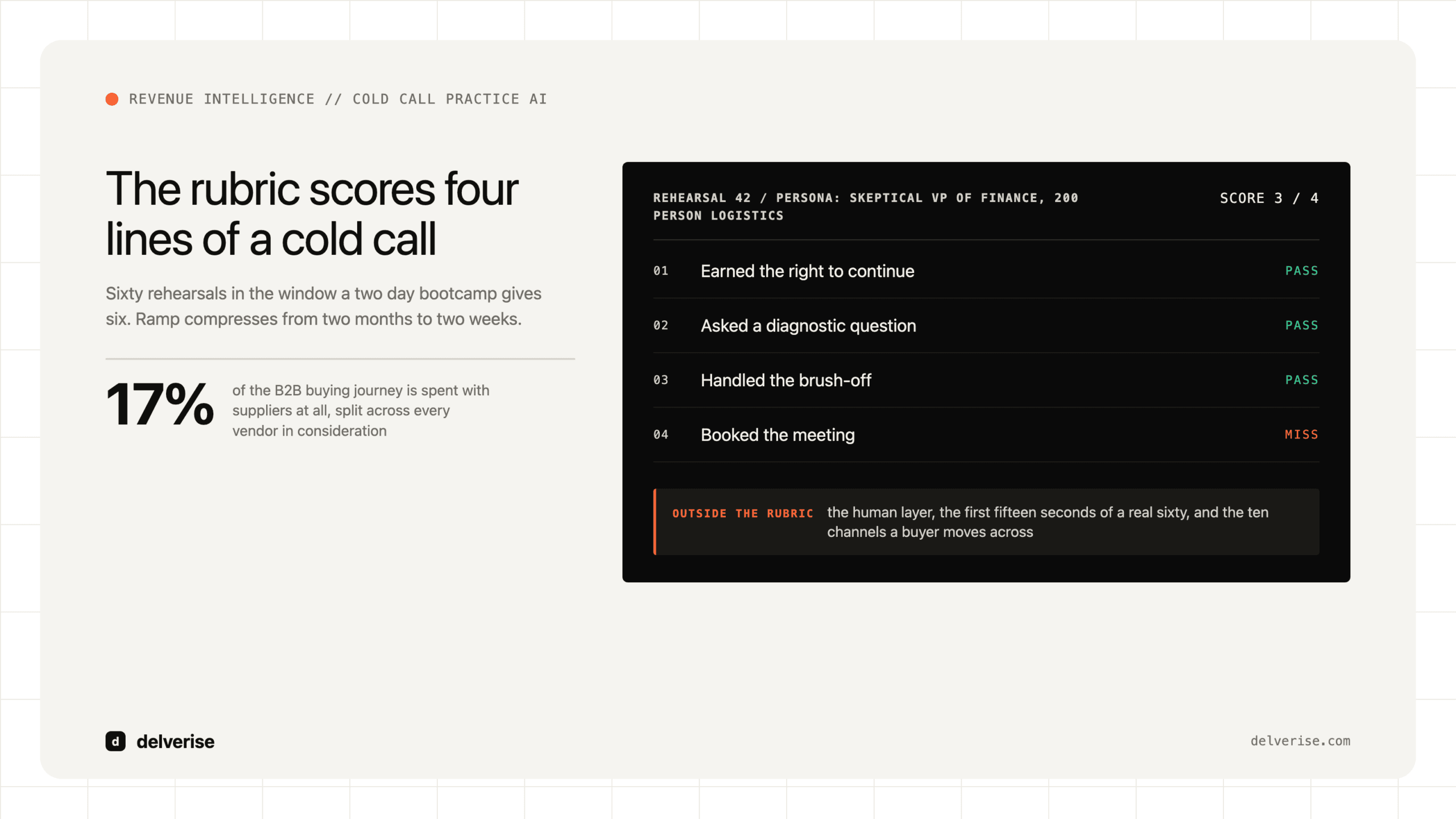
A cold call practice AI is a voice agent that plays the buyer while your rep plays the rep. The rep dials into a simulated persona (say, a skeptical VP of Finance at a 200-person logistics company), the AI responds in real time with objections and tone, and at the end the system grades the call against a rubric: did the rep earn the right to continue, did they ask a diagnostic question, did they handle the brush-off, did they book.
Two things make this different from the old approach of role-playing with a manager. First, it is available at 6am on a Tuesday, so practice volume is no longer capped by manager calendars. Second, the scoring is consistent, so a rep in Austin and a rep in Lisbon are measured against the same bar. The category overlaps with, and is often confused with, the AI cold calling agent that dials real prospects. Practice AI points inward at your team. Dialing agents point outward at the market, and they carry very different risk profiles.
Why does classic sales training stop working two weeks after the offsite?
Because skill decays without repetition. The forgetting curve research going back to Ebbinghaus is one of the most replicated findings in cognitive science: without spaced retrieval, most of what someone learns in a workshop is gone within days. A two-day bootcamp gives a rep maybe six live role-play reps total. A practice bot gives them sixty in the same period.

The stakes are higher than they used to be. Gartner’s research on B2B buying found that buyers spend only about 17% of their purchase journey meeting with potential suppliers at all, and that time is split across every vendor in consideration. Any individual rep is working with a sliver of attention. McKinsey’s B2B Pulse work found buyers now move across roughly ten channels in a single decision journey, which means the phone call is one moment inside a much larger sequence. When a rep gets sixty seconds, the first fifteen have to land.
Gong’s published analysis of cold call recordings has consistently found that successful calls run meaningfully longer than unsuccessful ones and that how a rep opens changes the odds of the call continuing at all. Openers are learnable and testable. That is exactly the kind of narrow, repeatable skill a simulator is good at drilling.
What does it simulate well, and where does it break?
Simulators are strong on the mechanical layer of a call and weak on the human layer. Knowing the split keeps expectations honest.

| Practice method | Best at | Weak spot | Cost profile |
|---|---|---|---|
| AI practice bot | Volume reps on openers, objections, qualification frameworks; consistent scoring; ramp acceleration | Emotional realism, genuine hostility, silence, the unscripted tangent that decides real deals | Per-seat SaaS, low marginal cost per rep |
| Manager role-play | Judgment, nuance, deal-specific coaching, credibility with senior reps | Does not scale; quality varies by manager; consumes the most expensive calendar on the team | High opportunity cost |
| Recorded call review | Real buyer language, actual objections, pattern-finding across the team | Backward-looking; a rep only reviews calls they already lost | Included in most conversation intelligence tools |
| Live dialing only | Nothing beats reality for feedback | Burns real accounts while reps learn; damages territory quality during ramp | Highest hidden cost |
Where these tools break most often: the AI buyer is too agreeable. Vendors tune personas to be conversational because a bot that hangs up in four seconds feels broken to a buyer evaluating the product. Real prospects hang up in four seconds. If your practice environment never lets a rep fail hard, it teaches confidence that reality will remove. Push vendors to show you their hostile persona settings during evaluation, and test them yourself.
How do you build practice personas that match your actual pipeline?
This is the part that separates a program that works from a subscription nobody uses. A persona is only useful when it argues the way your real buyers argue. That means pulling from three sources: your closed-lost reasons in the CRM, the objection transcripts sitting in your conversation intelligence tool, and firmographic reality about who actually answers the phone in your segment.

Practically, that looks like a data pipeline feeding the simulator. Teams building this with Clay can assemble account and contact records, enrich them with headcount, tech stack, funding stage, and hiring signals, then generate persona briefs that reflect the accounts currently in territory rather than a generic library persona. When your pipeline shifts from mid-market to enterprise, the personas shift with it. delverise builds these pipelines as part of a broader GTM tech stack, and the same enrichment layer that powers AI outbound sequencing feeds the practice environment. If you want implementation help specifically on the data side, our Clay partner page covers scope.
One honest tradeoff: this adds real work. A team of six reps can get most of the benefit from three hand-written personas built off their last twenty lost deals. Build the pipeline when you are past twenty reps or running multiple segments.
What does a working 30-day rollout look like?
A concrete example. Say you are a Series A SaaS company with eight SDRs, a 4.2% connect-to-meeting rate, and a new-hire ramp of eleven weeks to first consistent quota month.
Week 1: Pull the last 200 recorded cold calls. Tag the five objections that appear most often. Write three personas from them, each with a defined temperature (cold brush-off, curious skeptic, warm referral).
Week 2: Certification gate. Every rep must pass a scored call on each of the three personas before the next real dialing block. Managers review the failures, not the passes.
Week 3: Daily 15-minute practice block before the first dial session. Two reps minimum. Publish a leaderboard on objection handling only, since a leaderboard on total reps just produces button-mashing.
Week 4: Compare connect-to-meeting rate for the cohort against the prior 30 days and against a holdout group that did not practice. If you cannot run a holdout with eight reps, compare the same reps period-over-period and accept the noise.
Realistic outcome for a team this size: ramp compression of two to three weeks, and a connect-to-meeting improvement in the tenths of a percentage point that compounds across thousands of dials. Anyone promising a doubled connect rate from practice software alone is selling you something.
Should you buy a platform or build the loop yourself?
Buy the simulator. Voice latency, interruption handling, and speech quality are genuinely hard engineering problems, and the specialist vendors have spent years on them. Build the persona pipeline and the scoring rubric, because those encode what your company knows about your buyers. This mirrors the broader buy-versus-build calculus covered in our guide on hiring a GTM consultant versus building in-house.
Use this checklist when evaluating vendors:
- Can you upload your own transcripts and generate personas from them, or are you locked into a library?
- Does the rubric map to your actual sales methodology, with editable weights?
- Does it write scores back to your CRM or sales engagement platform so coaching sits where managers already work?
- Can you configure a genuinely hostile persona that hangs up early?
- Is pricing per seat or per practice minute, and what happens to cost when adoption succeeds?
- Who owns the recordings and transcripts, and can you export them if you switch?
That last one matters more than teams expect. Your practice corpus becomes training data for how your company sells. Keep it portable.
How do you know it worked?
Track three numbers. Time-to-first-meeting for new hires, measured in business days from start date. Connect-to-meeting conversion rate, segmented by rep tenure. Meeting-to-opportunity rate, which catches the failure mode where reps get better at booking meetings that never qualify.
Speed matters alongside skill. The Harvard Business Review study on the short life of online sales leads found that firms attempting contact within an hour of an inbound inquiry were dramatically more likely to qualify that lead than those waiting even an hour longer. Practice quality and response speed multiply each other. A well-drilled rep who calls back in six hours still loses. Pair your practice program with the routing and alerting work covered in how to use AI in sales, and make sure the phone effort is sequenced against email properly, as covered in B2B prospecting.
Frequently Asked Questions
Is cold call practice AI the same as an AI cold calling bot?
No. Practice AI simulates a buyer so your human reps can rehearse. An AI cold calling bot places calls to real prospects on your behalf. Practice AI carries almost no brand risk. Autonomous dialing carries significant brand, compliance, and deliverability risk, and belongs in a different part of your evaluation.
How much does cold call practice AI cost?
Most platforms price per seat per month, commonly in the range of a mid-tier sales tool, with enterprise tiers adding custom personas and CRM write-back. Some price by practice minute. Model the per-minute options carefully, because a successful rollout increases usage and can change your bill materially in quarter two.
Will experienced reps actually use it?
Usually less than new hires, and that is fine. Adoption among tenured reps improves when practice is tied to a specific change, such as a new product line, a new segment, or a repositioned pitch. Mandating daily reps for a rep who has been closing for six years tends to produce compliance theater.
Can it replace manager coaching?
It replaces the repetitive part: drilling openers and objections until they are automatic. Managers then spend their coaching time on deal strategy and judgment, which the simulator handles poorly. Teams that cut manager coaching entirely after buying a practice tool generally see the gains fade within a quarter.
What data do I need before rolling this out?
At minimum, 50 to 100 recorded cold calls and a documented list of your top five objections with the responses that currently work. Without that, you are training reps against a vendor’s generic persona library, which produces reps who sound polished on calls your buyers never make. Clean account and contact data helps too, as covered in lead gen data.
Read next