←Back to blog
Revenue Intelligence & Data ToolingPlaybookMay 20, 202623 min read
Clay Email Enrichment Mastery: Advanced Waterfall Strategies & AI Automation for Revenue Teams [2026]
Build Clay email enrichment with waterfall logic, deliverability checks, CRM sync, AI research, cost controls, and outbound activation.
What a High-Performing Email Enrichment System Looks Like
Email enrichment is a system design decision before it is a tooling decision, and the quality of that system determines how much pipeline your data spend actually produces. An effective Clay enrichment setup performs on three measurable fronts: coverage (the share of target accounts where you reach a verified, deliverable address), accuracy (how often that address belongs to the right person in the right role), and cost efficiency (the price per usable contact across a stacked set of data providers). Use those three metrics to judge your own setup, or to judge a partner building it for you, because they reveal whether the system is generating revenue or quietly draining credits.
Direct answer: Clay email enrichment works best when it is designed as a waterfall system: define the target contact, query data providers in the right order, verify deliverability, score confidence, sync clean fields into the CRM or sequencer, and monitor cost per usable contact. delverise builds this as part of a broader Clay system, CRM enrichment workflow, and AI outbound motion, so enrichment turns into pipeline execution instead of another data export.
Teams evaluating Clay for the first time can compare implementation patterns on our Clay systems page or review Clay directly here.
The Hidden Cost of Poor Data Quality on Revenue Performance
The impact of inadequate data quality extends far beyond simple bounce rates and delivery failures. Research from leading sales organizations reveals that poor data quality costs companies an average of $15 million annually in lost revenue, decreased productivity, and missed opportunities. For B2B companies specifically, the consequences are even more severe, with studies showing that organizations with poor data quality experience 35% lower conversion rates and 42% longer sales cycles compared to their data-driven competitors.
Gartner puts a sharper edge on the number: ‘The average financial impact of poor data quality on organizations is $12.9 million per year.’ At delverise we treat that figure as the floor, not the ceiling — once you factor in the downstream pipeline that never gets built because reps are working stale records, the real drag on revenue is materially larger.
The traditional approach to data enrichment often creates a false sense of security. Many revenue teams rely on basic tools that provide surface-level information (company names, job titles, and generic email addresses) without understanding the deeper context that drives purchasing decisions. This superficial data layer leads to generic outreach campaigns, missed personalization opportunities, and ultimately, lower response rates that compound over time.
Consider the cascading effect of incomplete prospect data: sales development representatives spend 40% of their time researching prospects manually, marketing teams create broad-brush campaigns that fail to resonate with specific buyer personas, and account executives enter discovery calls without the contextual insights needed to build immediate rapport and credibility. Companies that fail to implement comprehensive data enrichment strategies report 23% lower quota attainment and 18% higher customer acquisition costs.
Research from McKinsey reinforces the scale of this drag: ‘Sales reps spend less than 30 percent of their time actually selling, with the remainder consumed by administrative tasks, internal meetings, and research.’ That is the exact tax a well-designed Clay waterfall is meant to remove — every minute of manual lookup you automate is a minute returned to live conversations.
Why Basic Enrichment Tools Fall Short in Complex B2B Sales Cycles
The limitations of traditional data enrichment platforms become apparent when dealing with the complexity of modern B2B sales environments. Basic tools typically operate on a single-source model, pulling information from one database and presenting it as complete. This approach fails to account for the dynamic nature of business information, where company details, contact information, and organizational structures change rapidly.
Advanced B2B sales cycles require multi-dimensional data insights that go beyond basic firmographic information. Today’s buyers expect personalized interactions that demonstrate understanding of their specific challenges, recent company developments, technology stack, and competitive landscape. Basic enrichment tools cannot provide the depth of insight needed to create these meaningful connections.
Furthermore, traditional platforms often lack the flexibility to adapt to different market segments, geographic regions, or industry verticals. A technology startup in Silicon Valley requires different data points than a manufacturing company in the Midwest, yet most basic tools apply a one-size-fits-all approach that misses these crucial nuances.
Advanced Data Enrichment as a Competitive Advantage
Organizations that implement sophisticated data enrichment strategies create sustainable competitive advantages that compound over time. Companies using advanced data enrichment platforms report 47% higher lead-to-opportunity conversion rates and 31% shorter sales cycles compared to those using basic tools. These improvements stem from the ability to create highly targeted, contextually relevant outreach that resonates with prospects’ specific situations and needs.
Harvard Business Review frames the underlying mechanic plainly: ‘Companies that use data-driven sales processes are 5% more productive and 6% more profitable than their competitors.’ Enrichment quality is the upstream lever — the conversion and cycle-time gains delverise sees in client deployments are what happens when that data advantage actually reaches the rep at the moment of outreach.
The competitive advantage extends beyond immediate sales metrics. Advanced data enrichment enables predictive analytics, allowing revenue teams to identify buying signals, predict churn risk, and prioritize accounts based on propensity to purchase. This forward-looking capability transforms reactive sales processes into proactive revenue generation engines.
Modern data enrichment platforms like Clay leverage artificial intelligence to uncover insights that human researchers would miss or take hours to discover. This AI-powered approach scales personalization efforts while maintaining the quality and relevance that drives engagement and conversion.
ROI Framework for Enrichment Investments
Calculating the return on investment for advanced data enrichment requires a comprehensive framework that accounts for both direct revenue impact and operational efficiency gains. The primary revenue drivers include increased conversion rates, shorter sales cycles, and higher average deal values resulting from better qualification and personalization.

Direct revenue impact can be measured through improved lead scoring accuracy, which typically increases qualified lead volume by 25-40% while reducing time spent on unqualified prospects. Enhanced personalization capabilities drive 15-25% higher response rates in outbound campaigns, directly translating to more opportunities in the pipeline.
Operational efficiency gains include reduced manual research time, automated data validation processes, and streamlined workflow management. Sales development representatives using advanced enrichment platforms report 60% reduction in prospect research time, allowing them to focus on high-value activities like relationship building and qualification conversations.
The total economic impact also includes improved customer lifetime value through better initial qualification and more accurate ideal customer profile matching. Organizations with comprehensive data enrichment strategies experience 22% higher customer retention rates and 18% increased expansion revenue from existing accounts.
Clay Enrichment Fundamentals & Advanced Setup
Understanding Waterfall Enrichment Theory and Strategic Optimization
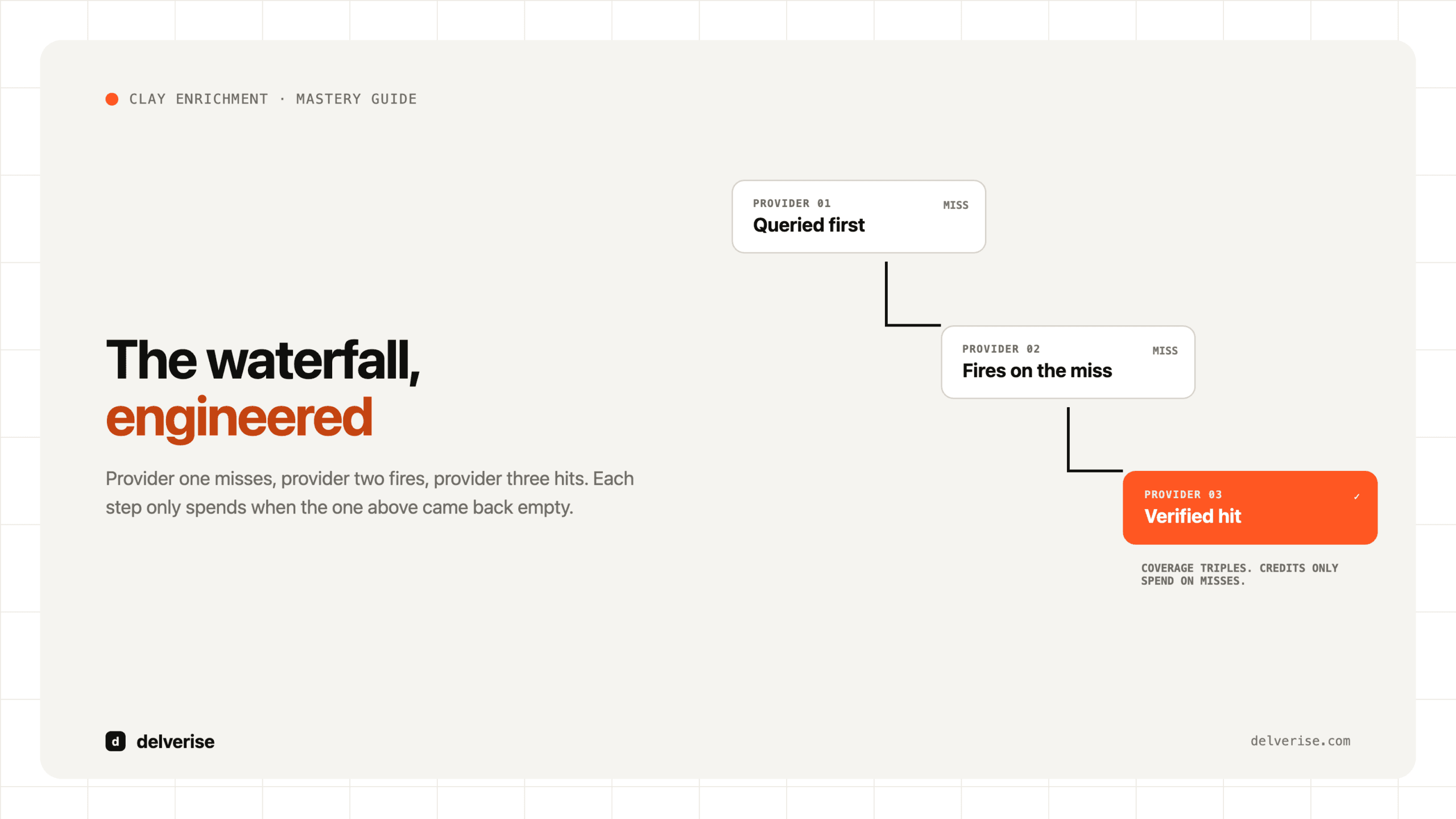
Waterfall enrichment represents a paradigm shift from traditional single-source data collection to a sophisticated, multi-provider approach that maximizes data coverage while optimizing cost efficiency. The fundamental principle behind waterfall methodology involves creating a sequential hierarchy of data providers, where each subsequent source is only queried if the previous providers fail to return the required information.

The strategic advantage of waterfall enrichment lies in its ability to balance data quality, coverage, and cost optimization simultaneously. Rather than relying on a single premium provider that may have gaps in specific geographic regions or industry verticals, the waterfall approach leverages the strengths of multiple providers while minimizing unnecessary credit consumption. This methodology becomes particularly powerful when dealing with diverse prospect lists that span multiple markets, company sizes, and industry segments.
Advanced waterfall configuration requires understanding the nuanced performance characteristics of different data providers across various dimensions. Provider A might excel at finding email addresses for technology companies in North America, while Provider B demonstrates superior performance for European manufacturing contacts. Clay’s waterfall system allows revenue teams to create sophisticated routing logic that automatically selects the optimal provider based on prospect characteristics, geographic location, and data requirements.
Advanced Credit Management and Cost Control Strategies
Clay’s credit-based pricing model requires strategic thinking to maximize value while controlling costs. Unlike subscription-based tools that encourage unlimited usage, the credit system demands careful optimization to ensure every credit spent generates maximum return on investment. Advanced users develop sophisticated credit allocation strategies that align spending with revenue potential and lead quality scores.

The most effective credit management approach involves implementing dynamic pricing thresholds based on lead scoring and qualification criteria. High-value prospects identified through initial screening processes warrant premium provider usage and comprehensive enrichment, while lower-scored leads receive basic enrichment through cost-effective providers. This tiered approach ensures that credit allocation directly correlates with revenue potential.
Understanding provider credit costs and performance metrics enables teams to create sophisticated cost-benefit analyses for different enrichment scenarios. Premium providers like ZoomInfo or Apollo might cost 3-5 credits per successful enrichment but deliver higher accuracy rates and more comprehensive data sets. Budget providers might cost 1-2 credits but require multiple attempts to achieve the same data quality level.
Provider Performance Analysis and Selection Criteria
Effective waterfall optimization requires continuous monitoring and analysis of provider performance across multiple dimensions. Success rates, data accuracy, geographic coverage, and industry specialization all factor into provider selection and sequencing decisions. Advanced Clay users implement systematic testing protocols to evaluate provider performance and adjust waterfall configurations based on empirical data rather than assumptions.

Geographic performance variations represent one of the most significant factors in provider optimization. European data providers like Icypeas often outperform North American providers for EU-based contacts, while specialized providers like FindyMail excel at mobile number discovery across specific regions. Understanding these geographic nuances allows teams to create location-aware waterfall configurations that maximize success rates while minimizing costs.
Industry vertical performance also varies significantly across providers. Technology-focused providers might maintain comprehensive databases for software companies but lack coverage in traditional manufacturing or healthcare sectors. Building industry-specific waterfall configurations ensures optimal provider selection based on prospect characteristics and improves overall enrichment success rates.
Data Quality Scoring and Validation Techniques
Advanced Clay implementations incorporate sophisticated data quality scoring mechanisms that evaluate enrichment results across multiple criteria. Email deliverability scores, data freshness indicators, source credibility ratings, and cross-validation results combine to create comprehensive quality assessments that guide subsequent workflow decisions.
Real-time validation processes can be implemented using Clay’s integration capabilities to verify email addresses, validate phone numbers, and confirm company information against authoritative sources. These validation workflows prevent poor-quality data from entering downstream systems and ensure that sales teams receive only verified, actionable prospect information.
Advanced Tool Integration Deep-Dive
HubSpot Advanced Property Mapping and Workflow Triggers
HubSpot’s integration with Clay extends far beyond basic contact creation and update functionality. Advanced implementations leverage custom property mapping to capture enriched data points that align with specific sales processes and qualification criteria. Custom properties for technology stack information, recent funding events, employee growth rates, and competitive intelligence can be automatically populated through Clay enrichment workflows.

Workflow automation triggers based on enrichment completion enable sophisticated lead routing and nurturing sequences. When Clay successfully enriches a contact with specific criteria, such as company size, technology usage, or recent expansion indicators, HubSpot workflows can automatically assign leads to appropriate sales representatives, trigger personalized email sequences, or update lead scoring models.
Salesforce Custom Field Architecture and Automation Rules
Salesforce integration with Clay requires careful consideration of custom field architecture and data governance policies. Advanced implementations create dedicated field sets for enriched data that maintain clear separation between manually entered information and automatically enriched details. This separation enables better data quality monitoring and prevents conflicts between different data sources.
Automation rules within Salesforce can leverage enriched data to trigger complex business processes, including territory assignment, lead scoring updates, and opportunity creation workflows. Process Builder and Flow configurations can incorporate enriched data points to create sophisticated routing logic that ensures leads reach the most appropriate sales resources based on comprehensive prospect profiles.
Apollo Data Combination and Deduplication Strategies
Apollo’s integration capabilities enable sophisticated data combination strategies that leverage both platforms’ strengths. Clay’s superior AI research capabilities can be combined with Apollo’s extensive contact database to create comprehensive prospect profiles that neither platform could achieve independently. Advanced users implement deduplication workflows that identify and merge overlapping data points while preserving the highest quality information from each source.
Attio Modern CRM Integration and Field Synchronization
Attio’s modern CRM architecture provides unique opportunities for advanced Clay integration through its flexible data model and API-first approach. Custom object creation, relationship mapping, and real-time synchronization capabilities enable sophisticated data architectures that adapt to complex sales processes and organizational structures.
Advanced Waterfall Engineering & Optimization
Building Custom Waterfall Sequences for Different Market Segments
Advanced waterfall engineering requires a deep understanding of how different market segments, geographic regions, and industry verticals respond to various data providers. Successful Clay implementations move beyond generic waterfall configurations to create highly specialized sequences that optimize for specific prospect characteristics and business objectives.
Geographic considerations play a crucial role in waterfall sequence design. European prospects require GDPR-compliant data providers with strong EU coverage, while Asia-Pacific markets might benefit from region-specific providers that understand local business structures and contact patterns. Building location-aware waterfall logic ensures optimal provider selection based on prospect geography and regulatory requirements.
Industry vertical optimization represents another critical dimension in advanced waterfall engineering. Technology companies often maintain comprehensive online presences that enable AI-powered research tools to gather extensive information, while traditional manufacturing companies might require specialized B2B databases with strong industrial coverage. Healthcare and financial services sectors demand providers with specific compliance certifications and industry expertise.
Provider Performance Optimization by Geography and Vertical
Systematic provider performance analysis reveals significant variations in success rates, data quality, and cost efficiency across different geographic regions and industry verticals. Advanced Clay users implement continuous monitoring systems that track provider performance metrics and automatically adjust waterfall configurations based on empirical results rather than static assumptions.
North American provider performance typically shows strong coverage for technology, professional services, and healthcare sectors, with premium providers like ZoomInfo and Apollo delivering high accuracy rates for enterprise contacts. European providers demonstrate superior performance for EU-based prospects, particularly in manufacturing, automotive, and financial services sectors where local market knowledge provides significant advantages.
Advanced Fallback Logic and Error Handling
Sophisticated waterfall configurations incorporate intelligent fallback logic that adapts to various failure scenarios and data quality issues. Rather than simply moving to the next provider when the primary source fails, advanced systems analyze failure reasons and select appropriate alternative strategies based on specific error conditions.
Email validation failures might trigger alternative email discovery methods, such as pattern-based generation or social media profile analysis. Company information gaps could activate AI-powered research workflows that gather missing data points from public sources and news articles. These adaptive fallback mechanisms ensure comprehensive data coverage while maintaining cost efficiency and processing speed.
Cost Optimization Strategies Across Data Providers
Advanced cost optimization requires understanding the nuanced pricing structures and performance characteristics of different data providers within Clay’s ecosystem. Provider cost analysis reveals significant variations in credit consumption, success rates, and data quality that impact overall return on investment calculations.
Dynamic cost optimization strategies adjust provider selection based on real-time credit availability, prospect value scores, and campaign objectives. High-value enterprise prospects might warrant premium provider usage regardless of cost, while volume prospecting campaigns require cost-effective providers that maximize coverage within budget constraints.
A/B Testing Waterfall Configurations
Systematic A/B testing of waterfall configurations enables data-driven optimization that improves performance over time. Testing methodologies compare different provider sequences, cost thresholds, and fallback strategies to identify optimal configurations for specific use cases and market segments.
Statistical significance testing ensures that configuration changes produce measurable improvements in key metrics such as enrichment success rates, data quality scores, and cost per successful enrichment. Long-term testing protocols account for seasonal variations, market changes, and provider performance fluctuations that might impact optimization decisions.
Provider-Specific Optimization Strategies
Prospeo vs. DropContact vs. Datagma Optimization
Each major provider within Clay’s ecosystem demonstrates unique strengths and optimal use cases that inform strategic waterfall positioning. Prospeo excels at email discovery for technology companies and startups, particularly in North American markets where its database coverage is most comprehensive. DropContact provides superior European coverage with strong GDPR compliance and local market expertise that benefits EU-focused campaigns.
Datagma offers cost-effective enrichment for volume campaigns where budget efficiency takes priority over premium data quality. Strategic provider positioning leverages these strengths by placing providers in waterfall sequences that align with their optimal performance characteristics and cost structures.
Hunter.io Integration Best Practices
Hunter.io’s domain-based email discovery capabilities complement Clay’s contact enrichment workflows by providing alternative email finding strategies when traditional providers fail. Integration best practices involve using Hunter.io as a specialized fallback provider for specific domains or company types where its pattern recognition algorithms demonstrate superior performance.
FindyMail Mobile Number Strategies
FindyMail’s specialization in mobile number discovery creates opportunities for multi-channel outreach strategies that extend beyond email communication. Optimal integration approaches position FindyMail strategically within waterfall sequences to capture mobile contact information for high-value prospects where phone outreach provides competitive advantages.
Icypeas European Market Optimization
Icypeas demonstrates exceptional performance for European B2B contacts, particularly in France, Germany, and the UK markets where its local database coverage exceeds global providers. European market optimization strategies leverage Icypeas as a primary provider for EU prospects while maintaining global providers as fallback options for comprehensive coverage.
Claygent AI Mastery & Custom Research
Advanced Prompt Engineering for Complex Research Tasks
Claygent’s AI research capabilities extend far beyond basic company information gathering to encompass sophisticated research workflows that uncover competitive intelligence, buying signals, and personalization opportunities that human researchers would miss or take hours to discover. Advanced prompt engineering transforms Claygent from a simple data collection tool into a strategic intelligence platform that drives revenue growth through actionable insights.

Effective prompt engineering for Claygent requires understanding the nuanced relationship between query specificity, data source availability, and output quality. Generic prompts like “find company information” produce surface-level results, while sophisticated prompts that specify research objectives, data sources, and output formats generate comprehensive intelligence reports that inform strategic decision-making.
Custom AI Research Workflows Beyond Basic Company Information
Sophisticated Claygent workflows incorporate conditional logic and branching research paths that adapt to different prospect characteristics and research objectives. Technology companies might trigger detailed analysis of their software stack, recent product launches, and engineering team growth, while manufacturing companies could activate research into supply chain partnerships, facility expansions, and regulatory compliance initiatives.
Intent signal extraction represents one of the most powerful applications of advanced Claygent workflows. AI-powered analysis of company websites, press releases, job postings, and social media activity can identify buying signals such as technology migration projects, expansion plans, or leadership changes that indicate potential sales opportunities.
Competitive intelligence workflows leverage Claygent’s ability to analyze public information and identify competitive threats, partnership opportunities, and market positioning insights that inform account strategy and messaging development. These workflows can automatically monitor competitor activities, pricing changes, and strategic initiatives that impact prospect engagement strategies.
Technology Stack Identification and Buying Signal Detection
Advanced technology stack analysis goes beyond simple tool identification to understand implementation patterns, integration challenges, and potential replacement opportunities. Claygent can analyze job postings, technical documentation, and company communications to identify what technologies companies use, how they use them, and what problems they might be experiencing.
Buying signal detection workflows monitor multiple data sources for indicators of purchasing intent, including budget allocation announcements, team expansion in relevant departments, technology evaluation projects, and vendor relationship changes. These signals enable proactive outreach that reaches prospects during active evaluation phases rather than cold prospecting periods.
Advanced Claygent Applications
SOC-II Compliance Verification Automation
Automated compliance verification workflows can research and verify SOC-II certifications, security frameworks, and regulatory compliance status for enterprise prospects where security and compliance represent critical evaluation criteria. These workflows save significant manual research time while ensuring accurate compliance information for security-conscious prospects.
Recent Funding and Growth Signal Detection
Funding analysis workflows automatically research recent investment rounds, valuation changes, and growth metrics that indicate company trajectory and purchasing power. This intelligence enables sales teams to tailor messaging around growth initiatives and budget availability while identifying optimal timing for outreach efforts.
Executive Change Monitoring and Alert Systems
Leadership transition monitoring provides early indicators of strategic changes, budget reallocations, and decision-maker accessibility that impact sales timing and approach strategies. Automated executive change detection enables proactive relationship building with new decision-makers before competitors identify these opportunities.
CRM Integration & Data Flow Architecture
Advanced HubSpot Workflow Automation with Enriched Data
HubSpot’s integration with Clay enriched data enables sophisticated automation workflows that respond dynamically to prospect characteristics and enrichment results. Advanced implementations create conditional workflow branches that trigger different nurturing sequences, lead routing rules, and follow-up activities based on enriched data points such as company size, technology stack, or recent funding status.
Enriched data integration with HubSpot’s lead scoring models creates more accurate qualification frameworks that incorporate external intelligence alongside traditional engagement metrics. Companies implementing advanced HubSpot-Clay integration report 34% improvement in lead qualification accuracy and 28% reduction in sales cycle length through better initial prospect assessment.
Salesforce Custom Objects and Complex Field Mapping
Salesforce integration with Clay requires sophisticated data architecture planning to accommodate enriched data while maintaining system performance and user experience. Custom object creation for enriched data enables comprehensive prospect intelligence storage without cluttering standard contact and account records with excessive fields.
Complex field mapping strategies preserve data lineage and enable audit trails that track enrichment sources, update timestamps, and data quality scores. These mapping strategies become critical for enterprise implementations where data governance, compliance requirements, and integration with other systems demand comprehensive data management frameworks.
Real-Time Synchronization Strategies and Conflict Resolution
Real-time data synchronization between Clay and CRM systems requires careful consideration of update frequency, conflict resolution protocols, and system performance impacts. Advanced synchronization strategies implement intelligent update logic that prioritizes high-value data changes while minimizing unnecessary system updates that could impact performance.
Conflict resolution protocols establish clear hierarchies for data source authority, ensuring that manual updates by sales representatives don’t get overwritten by automated enrichment processes, while still maintaining data accuracy and freshness through systematic validation and update cycles.
Multi-CRM Data Distribution and Management
Enterprise organizations often require data distribution across multiple CRM systems, marketing automation platforms, and sales tools. Advanced Clay implementations create centralized data distribution architectures that ensure consistent prospect information across all systems while maintaining appropriate access controls and data governance policies.
Data distribution strategies account for system-specific requirements, field mapping variations, and update frequency needs that vary across different tools and use cases. These strategies enable comprehensive prospect intelligence sharing while maintaining system performance and data integrity across complex technology stacks.
Quality Control & Validation Systems
Multi-Layer Email Deliverability Validation
Advanced quality control systems implement multiple validation layers that ensure enriched email addresses meet deliverability standards before entering outbound campaigns. Email validation workflows combine syntax checking, domain verification, mailbox existence confirmation, and reputation analysis to create comprehensive deliverability scores that guide campaign inclusion decisions.

Real-time validation processes integrate with Clay’s enrichment workflows to automatically flag questionable email addresses and trigger alternative discovery methods when primary addresses fail validation checks. These validation systems prevent bounce rates from damaging sender reputation while ensuring that sales teams receive only verified, deliverable contact information.
Data Freshness Monitoring and Automated Re-Enrichment
Data decay represents a significant challenge in B2B environments where contact information, job titles, and company details change frequently. Advanced Clay implementations establish automated monitoring systems that track data age and trigger re-enrichment workflows based on configurable freshness thresholds and prospect engagement patterns.
Intelligent re-enrichment strategies prioritize high-value prospects and active opportunities while managing credit consumption through strategic refresh scheduling. These systems ensure that sales teams always have current information for critical prospects while maintaining cost efficiency across large prospect databases.
Advanced Duplicate Detection and Deduplication Workflows
Sophisticated deduplication systems analyze multiple data points including email addresses, phone numbers, company affiliations, and social media profiles to identify potential duplicates that simple email matching might miss. Advanced deduplication workflows preserve the highest quality data from multiple sources while maintaining comprehensive audit trails that track merge decisions and data source preferences.
Compliance Monitoring for Data Privacy Regulations
GDPR, CCPA, and other data privacy regulations require comprehensive compliance monitoring systems that track data sources, consent status, and retention policies for enriched prospect information. Compliance frameworks integrate with Clay’s enrichment workflows to ensure that all data collection and processing activities meet regulatory requirements while maintaining operational efficiency.
Scaling & Enterprise Implementation
Bulk Processing Optimization for Large Datasets
Enterprise-scale Clay implementations require sophisticated bulk processing strategies that balance throughput, cost efficiency, and system performance. Large dataset processing involves careful orchestration of waterfall sequences, provider rate limits, and credit allocation to maximize enrichment success while maintaining predictable processing timelines.

Advanced bulk processing workflows implement intelligent batching strategies that group prospects by characteristics such as geography, industry, or company size to optimize provider selection and minimize processing time. These strategies enable enterprise organizations to process thousands of prospects efficiently while maintaining high data quality standards.
Multi-Team Workflow Management and Access Controls
Enterprise implementations require sophisticated access control and workflow management systems that enable multiple teams to leverage Clay’s capabilities while maintaining data governance and cost control. Team-based access controls ensure that different departments can access appropriate enrichment capabilities while preventing unauthorized credit consumption or data access.
Workflow management systems enable different teams to create specialized enrichment processes that align with their specific objectives and requirements while maintaining consistency in data quality and integration standards across the organization.
Advanced Automation Using Webhooks and APIs
Clay’s API and webhook capabilities enable sophisticated automation workflows that integrate enrichment processes with existing business systems and trigger enrichment based on specific events or conditions. Advanced implementations create event-driven enrichment workflows that automatically process new leads, update existing records, and trigger follow-up actions based on enrichment results.
Cost Allocation and Budget Management Frameworks
Enterprise cost management requires sophisticated allocation frameworks that distribute enrichment costs across departments, campaigns, or business units while maintaining visibility into usage patterns and ROI metrics. Budget management systems implement spending controls, usage monitoring, and cost optimization recommendations that ensure efficient resource utilization across large organizations.
Outbound Integration & Personalization
Smartlead and Instantly Advanced Data Synchronization
Integration with outbound platforms like Smartlead and Instantly enables sophisticated personalization strategies that leverage enriched data to create highly targeted messaging campaigns. Advanced synchronization workflows ensure that enriched data points are available for dynamic personalization tokens while maintaining data freshness and accuracy across platforms.

Real-time data synchronization enables outbound campaigns to incorporate the latest enrichment results, including recent company developments, technology changes, or personnel updates that inform personalized messaging strategies. These integrations transform generic outbound campaigns into highly targeted, contextually relevant communications that drive higher engagement rates.
LinkedIn Sales Navigator Enhancement Strategies
LinkedIn Sales Navigator integration with Clay enrichment creates powerful prospecting workflows that combine LinkedIn’s relationship mapping with Clay’s comprehensive data enrichment. Advanced implementations use enriched data to identify optimal connection paths, mutual connections, and shared interests that inform LinkedIn outreach strategies.
Enhanced prospecting workflows leverage enriched company information, technology stack details, and recent developments to create compelling LinkedIn messages that demonstrate research and understanding of prospect challenges and opportunities.
Multi-Channel Personalization Using Enriched Data
Comprehensive personalization strategies leverage enriched data across multiple communication channels including email, LinkedIn, phone, and direct mail to create cohesive, contextually relevant prospect experiences. Multi-channel personalization ensures consistent messaging while adapting content and approach to channel-specific best practices and prospect preferences.
Response Rate Optimization Through Enrichment Insights
Data-driven response rate optimization analyzes the relationship between enriched data points and campaign performance to identify the most effective personalization strategies and messaging approaches. Advanced analytics reveal which enriched data points drive the highest engagement rates, enabling continuous optimization of personalization strategies and content development.
Performance analysis workflows track response rates, meeting acceptance rates, and conversion metrics across different enrichment strategies to identify optimal approaches for different prospect segments and campaign objectives. These insights enable continuous improvement in outbound effectiveness while maximizing the value of enrichment investments.
Transforming Revenue Operations Through Advanced Clay Mastery
The strategies, frameworks, and optimization techniques outlined in this comprehensive guide represent the difference between organizations that struggle with basic data enrichment and those that leverage advanced Clay capabilities to create sustainable competitive advantages. Implementing these advanced methodologies transforms data enrichment from a tactical activity into a strategic revenue driver that impacts every aspect of the go-to-market operation.
The journey from basic Clay usage to advanced mastery requires systematic implementation of the frameworks presented in this guide. Organizations that commit to sophisticated waterfall optimization, advanced Claygent automation, and comprehensive CRM integration consistently outperform competitors who rely on surface-level enrichment strategies. The compound effect of these optimizations creates measurable improvements in lead quality, conversion rates, and revenue growth that justify the investment in advanced implementation.
Success with advanced Clay enrichment requires ongoing optimization, continuous learning, and adaptation to changing market conditions and platform capabilities. The most successful implementations treat Clay mastery as an evolving competency that requires regular refinement and optimization based on performance data and changing business objectives.
Frequently Asked Questions
What is waterfall enrichment in Clay?
Waterfall enrichment is a multi-provider approach that queries data sources sequentially in a hierarchy, where each subsequent provider is only used if the previous ones fail to return data. This differs from traditional single-source enrichment by maximizing data coverage while controlling costs. Instead of relying on one database that may have incomplete or outdated information, waterfall methodology layers multiple providers to fill gaps systematically, optimizing both match rates and spend per enriched record.
How much does poor data quality cost B2B companies?
Poor data quality costs companies an average of $15 million annually in lost revenue, decreased productivity, and missed opportunities. For B2B organizations, the impact is more severe, with 35% lower conversion rates and 42% longer sales cycles compared to data-driven competitors. Companies that fail to implement comprehensive enrichment strategies also report 23% lower quota attainment and 18% higher customer acquisition costs, compounding revenue losses over time.
Why do basic enrichment tools fail in B2B sales?
Basic enrichment tools operate on a single-source model, pulling from one database and presenting it as complete data. This fails to account for the dynamic nature of business information, where company details and organizational structures change rapidly. Traditional platforms also lack flexibility across market segments, geographic regions, and industry verticals, applying a one-size-fits-all approach. They cannot deliver the multi-dimensional insights modern B2B buyers expect, including technology stack, recent developments, and competitive context.
What ROI do advanced data enrichment platforms deliver?
Companies using advanced data enrichment platforms report 47% higher lead-to-opportunity conversion rates and 31% shorter sales cycles compared to those using basic tools. Enhanced personalization drives 15-25% higher response rates in outbound campaigns, while sales development reps see a 60% reduction in prospect research time. Organizations also experience 22% higher customer retention rates and 18% increased expansion revenue from existing accounts through better qualification and ideal customer profile matching.
How does advanced enrichment improve sales productivity?
Sales development representatives currently spend 40% of their time manually researching prospects, but advanced enrichment platforms cut that research time by 60%. This frees reps to focus on relationship building and qualification conversations rather than data gathering. Improved lead scoring accuracy increases qualified lead volume by 25-40% while reducing time spent on unqualified prospects. The combined effect transforms reactive sales processes into proactive revenue generation engines with measurable productivity gains across the team.
Build the Enrichment System Around Clay
Clay email enrichment becomes more valuable when it is connected to the full revenue workflow: field governance, deduplication, confidence scoring, CRM routing, outbound activation, QA, and reporting. That operating layer is where most teams need help.
delverise builds Clay systems, CRM enrichment workflows, GTM Engineering systems, Growth Engineering systems, and AI outbound infrastructure that can be maintained after launch. For definitions and comparison answers, use the answers hub. To scope the build, apply to work with us.
Read next