←Back to blog
Revenue Intelligence & Data ToolingGuideAugust 17, 20268 min read
Crunchbase Alternative: What B2B Revenue Teams Should Actually Buy
The best Crunchbase alternative depends on the job you are hiring it for. PitchBook, CB Insights, and Dealroom go deeper on funding and investor data. Apollo, ZoomInfo, and Cognism cover contacts and firmographics far better. Composable enrichment tools stitch several sources into one view. Crunchbase itself stays useful for quick company lookups and funding alerts.
The best Crunchbase alternative depends on the job you are hiring it for. PitchBook, CB Insights, and Dealroom go deeper on funding and investor data. Apollo, ZoomInfo, and Cognism cover contacts and firmographics far better. Composable enrichment tools stitch several sources into one view. Crunchbase itself stays useful for quick company lookups and funding alerts.
Key takeaways
- Crunchbase is a company discovery product. Most teams that outgrow it are actually asking it to be a prospecting database, a signal engine, and a CRM enrichment layer at the same time.
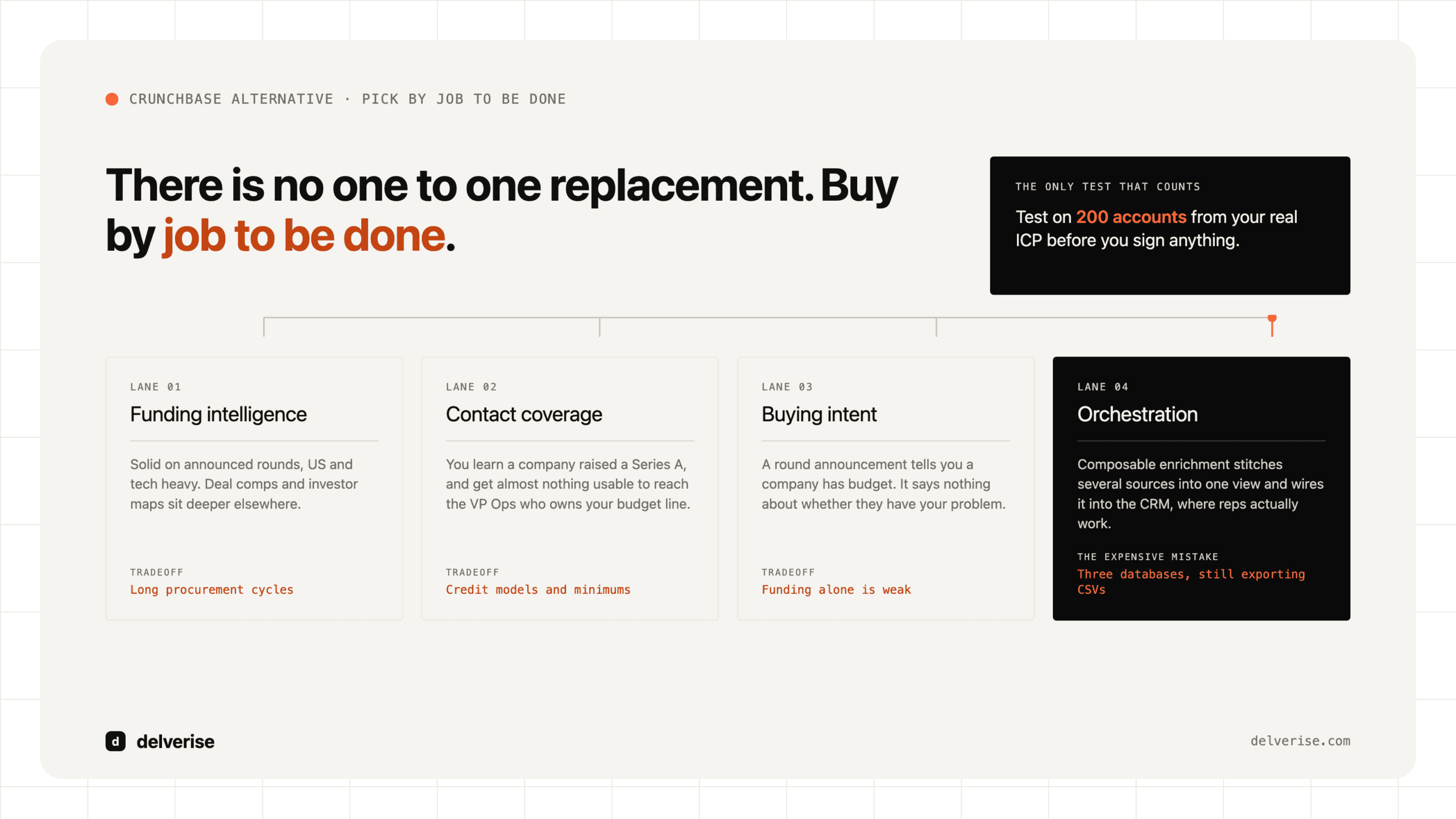
- There is no single one-to-one replacement. Pick by job to be done: funding intelligence, contact coverage, buying intent, or orchestration.
- Funding alone is a weak targeting signal. A round announcement tells you a company has budget, and says nothing about whether they have your problem.
- Coverage claims are the least reliable part of any vendor pitch. Test on 200 accounts from your real ICP before you sign anything.
- The expensive mistake is buying three overlapping databases and wiring none of them into the CRM, so reps still work off exports.
Why do revenue teams look for a Crunchbase alternative?
Crunchbase built its reputation on private company profiles and funding rounds, much of it crowd-sourced and news-sourced. That model has real strengths and predictable limits.
The complaints we hear from revenue leaders cluster into four buckets. Contact data is thin, so the tool tells you a company raised a Series A but gives you almost nothing usable to reach the VP Ops who owns your budget line. Coverage skews toward US venture-backed tech, which hurts if you sell into European mid-market, bootstrapped software, or non-tech verticals. Refresh timing depends on announcements and profile updates, so headcount, tech stack, and executive changes lag reality. And the API on lower tiers is restrictive enough that most teams end up exporting CSVs, which turns into the whole problem.
That last point matters more than the data quality debate. A list that lives in a spreadsheet decays from the moment it is created and never reaches the systems where reps actually work. If your account universe cannot refresh itself, you are rebuilding it every quarter. We cover the mechanics of building a live account view in how revenue teams turn scattered data into a buyable market.
What is Crunchbase genuinely good at?
Vendor-neutral means saying this plainly: Crunchbase is a strong, cheap starting point. Per-seat pricing sits in the low hundreds per month, which is an order of magnitude below enterprise deal-intelligence platforms. For a founder or a two-person GTM team doing manual research, it answers “who just raised, in what sector, backed by whom” faster than almost anything else.
Keep it if your use case is qualitative research, investor mapping, partnership scouting, or competitive tracking. Replace it if your use case is systematic pipeline generation at volume.
Which Crunchbase alternative fits which job?
| Job to be done | Where Crunchbase lands | Stronger fit | Honest tradeoff |
|---|---|---|---|
| Funding rounds, investors, deal comps | Solid on announced rounds, US and tech heavy | PitchBook, CB Insights, Dealroom, Tracxn | Enterprise pricing and annual seat contracts. Long procurement cycles. |
| Firmographics for TAM and ICP sizing | Usable for venture-backed tech, thin elsewhere | ZoomInfo, Apollo, Clearbit-style enrichment | Credit models and contract minimums. Coverage varies sharply by region. |
| Verified emails and direct dials | Limited, often not the buying committee | Apollo, Cognism, SignalHire, Prospeo | No single provider wins everywhere. You will need fallbacks. |
| Hiring, tech stack, and growth signals | Basic headcount and news only | Harmonic, Specter, PredictLeads, BuiltWith | Each covers one signal well. Stitching them together is your job. |
| Buying intent | Not offered | Bombora, G2 Buyer Intent, Intentsify | Account-level and noisy. Useless without routing rules. |
| Scoring, deduping, CRM delivery | API access on higher tiers, you build the rest | Clay and similar orchestration layers | You own the logic, so you need someone who can operate it. |
How do you replace Crunchbase without buying four tools?
Most teams do not need four subscriptions. They need one source of truth for accounts, a way to attach contacts to it, and a rule for when an account becomes worth working.


The practical pattern looks like this. Choose one primary company database that matches your ICP geography and segment. Add a contact layer that chains providers rather than betting on one, since coverage differs by region and seniority. That chaining approach is worth understanding before you buy anything, and we broke it down in the data enrichment waterfall. Then push the result into your CRM on a schedule, with clear field ownership and a re-enrichment cadence.
Orchestration tools are what make this affordable. Clay sits on top of dozens of providers, calls them in sequence, and only spends credits when the cheaper source fails. For a team currently paying for Crunchbase plus a contact database plus a manual research contractor, consolidating into one orchestration layer usually costs less and produces fresher data. The tradeoff is real: Clay is a build environment, and an unmaintained Clay table decays faster than a static list. Teams that want the system built and handed over with documentation can start on our Clay implementation page.
If you are still deciding whether you need a database, a signal tool, or a platform, the category definitions in our lead intelligence platform buying guide will save you a few vendor calls.
What does a funding-triggered workflow actually look like?
Say you sell a compliance product to fintech companies, ACV around $40,000, and your best-fit customers are Series A to Series B with a named risk or ops leader in place. Crunchbase gives you the round announcements. That is step one of six.

- Pull every fintech company that closed Series A or B in the last nine months, in your target geographies. Assume 400 to 700 accounts.
- Filter for headcount growth since the round, using hiring data. Companies that raised and did not hire are usually not deploying budget yet. This typically removes 40 percent.
- Check for a compliance, risk, or ops hire in the last two quarters. That is your real trigger, and the funding round is simply what made it possible.
- Enrich the buying committee, three to five people per account, through a provider chain rather than one vendor.
- Score and route. Accounts with the hire plus the growth signal go to outbound now. The rest go to nurture with a re-check in 60 days.
- Write back to the CRM with the trigger recorded as a field, so the rep opens the account and sees why it surfaced.
Step six is where most implementations fail. Gartner’s B2B buying research found buyers spend only about 17 percent of their purchase journey talking to any supplier’s sales team, and McKinsey’s B2B Pulse work has consistently shown buyers moving across roughly ten channels during a decision. You get very few touches, so every touch has to carry context a generic funding-round email cannot. Harvard Business Review’s research on purchase ease found that buyers who experienced an easy, well-informed buying process were dramatically more likely to close a high-quality deal, and that ease starts with your team knowing why this account, right now.
Layering third-party intent on top of this changes what “right now” means, and the honest limits of that data are covered in our breakdown of what buying intent data actually changes. For teams already running Apollo as the contact spine, the coverage and cost realities are in our Apollo.io guide for revenue leaders.
What should you test before you sign?
Vendor demos run on the vendor’s data. Run yours instead. G2 category reviews are a reasonable sanity check on support quality and billing behavior, and much less reliable on coverage, because coverage is always specific to your ICP.
- Export 200 real accounts from your closed-won list and ask each vendor to match them. Match rate on customers you already have is the only honest coverage test.
- Check contact coverage at the exact seniority you sell to, not company-wide contact counts.
- Ask when each field was last verified, and what happens to a record that fails verification.
- Confirm API access, rate limits, and credit costs on the tier you can actually afford.
- Test one non-US region if you sell internationally, including mobile number availability under local rules.
- Get the renewal terms in writing: credit rollover, seat reductions, and auto-renew notice periods.
- Name the person who owns re-enrichment cadence after purchase. If nobody owns it, the data problem returns in two quarters.
The tool decision is usually the smaller half of the work. The system around it, account definitions, scoring logic, CRM field ownership, and refresh schedules, determines whether any of this data reaches a rep in time to matter. That plumbing is what GTM engineering and CRM enrichment work covers, and it is where delverise spends most of its time with Seed to Series B teams.
Frequently Asked Questions
Is there a free Crunchbase alternative?
Partially. Crunchbase’s own free tier, LinkedIn Sales Navigator’s company filters, Dealroom’s public profiles, and SEC or Companies House filings cover a surprising amount for manual research. Free options break down at scale, because none of them export cleanly or refresh automatically. If you need more than a few dozen accounts a month, budget for a paid layer.
Is Crunchbase data accurate?
Funding rounds are generally reliable, since they come from announcements and filings. Headcount, tech stack, revenue estimates, and executive contacts are much softer, because they depend on profile updates and inference. Treat funding as fact and everything else as a hypothesis to verify against a second source.
Should we replace Crunchbase with Apollo or ZoomInfo?
Only if your primary use case is prospecting. Apollo and ZoomInfo have far better contact coverage and CRM integration, and weaker investor and round-level detail. Teams that need both funding intelligence and contact data usually keep a cheap Crunchbase seat for research and buy a contact platform for execution.
Is PitchBook worth it for a Series A SaaS company?
Rarely, for sales use. PitchBook is priced for investors and corp dev, and the depth you pay for is deal terms, cap tables, and comps that a sales team never opens. If your reason for wanting it is “we need funding triggers,” a signal tool plus an enrichment layer costs a fraction and delivers more usable output.
How do we get funding data into our CRM automatically?
Three components: a source with API access, an orchestration layer that normalizes and dedupes against your existing accounts, and a write-back job with clear field ownership so you do not overwrite rep-entered data. The dedupe step is the one teams skip, and it is why CRMs end up with four records for the same company. Decide upfront which system is authoritative for each field.
Read next