←Back to blog
Revenue Intelligence & Data ToolingGuideAugust 19, 20268 min read
PitchBook Alternative: What B2B Revenue Teams Should Buy Instead
A PitchBook alternative is any data source that delivers the specific job you bought PitchBook for: private company financials, funding events, investor relationships, or account research. For GTM teams chasing funded accounts, Crunchbase, Harmonic, Grata, or an enrichment layer like Clay usually costs less and pipes data straight into your CRM.
A PitchBook alternative is any data source that delivers the specific job you bought PitchBook for: private company financials, funding events, investor relationships, or account research. For GTM teams chasing funded accounts, Crunchbase, Harmonic, Grata, or an enrichment layer like Clay usually costs less and pipes data straight into your CRM.
Key takeaways
- PitchBook was built for investors doing deal diligence. Most B2B SaaS teams buy it for one narrow use case: finding recently funded accounts.
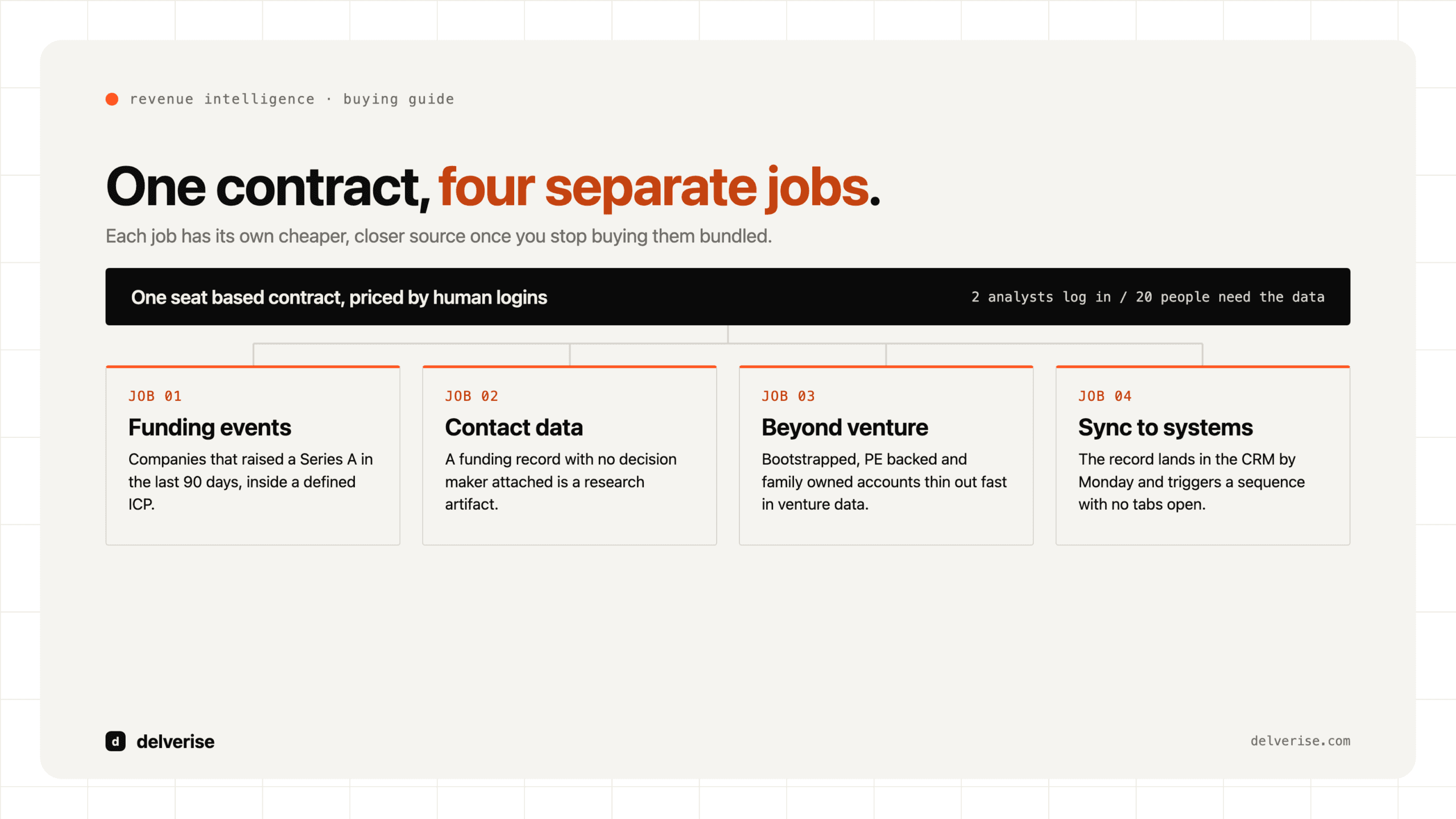
- Seat-based research platforms price by human logins. GTM teams need data flowing into systems, so the pricing model fights the use case.
- Crunchbase, Harmonic, Dealroom, Tracxn, and Grata each cover a different slice of the private market. Coverage depth varies sharply by geography and company stage.
- The cheapest path for most Seed to Series B teams is an API-first funding source plus an enrichment layer that writes to the CRM automatically.
- Data alone changes nothing. The value shows up when a funding event triggers a sequence, a territory reassignment, or a scoring change without anyone opening a tab.
What is PitchBook actually good at?
PitchBook is a private capital markets database: funding rounds, valuations, cap table detail, investor and limited partner relationships, M&A comparables, and fund performance. It is a genuinely strong product for the buyer it was designed for, which is an investment professional or corporate development team running diligence on a specific company or fund.
The friction starts when a revenue team buys it. A VP Sales rarely needs a post-money valuation or an LP breakdown. They need a list of companies that raised a Series A in the last 90 days, in a defined ICP, with contacts attached and the record sitting in Salesforce or HubSpot by Monday. PitchBook can answer the first half of that question well. The second half is where seat-based research tools stop being the right shape.
Why do revenue teams look for a PitchBook alternative?
Four reasons come up repeatedly in evaluations.

Pricing model mismatch. PitchBook does not publish rates publicly, and buyers consistently report annual contracts priced by seat and module. That structure rewards a small number of analysts doing deep manual research. It penalizes a GTM motion where the value comes from data moving into systems used by twenty people who will never log in.
Export and API limits. Research platforms protect their data. Row caps on exports and separately priced API access are standard, and both constrain the exact behavior a revenue team wants, which is programmatic sync.
Coverage gaps outside venture. If your ICP includes bootstrapped, PE-backed, or family-owned businesses, venture-centric databases thin out fast. That is the specific niche Grata and Sourcescrub were built to fill.
Contact data is missing. Company-level intelligence and person-level contact data are separate markets. A funding record without a decision maker attached is a research artifact, so most teams end up paying twice anyway. Our breakdown of what a lead intelligence platform actually covers walks through where those layers separate.
What are the best PitchBook alternatives by job?
There is no single replacement, because PitchBook bundles several jobs. Match the tool to the job you actually have.
| Option | Best job | Honest tradeoff |
|---|---|---|
| Crunchbase (Pro / Enterprise / API) | Funding events, company firmographics, straightforward list building | Shallower financial detail than PitchBook; strongest in North American tech |
| CB Insights | Market maps, emerging tech research, competitive intelligence | Priced near PitchBook; research-heavy rather than pipeline-ready |
| Dealroom / Tracxn | European and Asian private company coverage | Regional strengths vary; validate coverage in your exact geography |
| Harmonic / Specter | Early-stage signals: headcount growth, hiring velocity, product launches | Signal-rich but sparse on financials; best as a trigger source |
| Grata / Sourcescrub | Bootstrapped and PE-backed middle market sourcing | Weaker on venture rounds; built for deal sourcing workflows |
| ZoomInfo / Apollo | Contact data plus basic funding flags at GTM scale | Funding data is directional rather than authoritative |
| Clay + provider waterfall | Assembling several sources into one enriched, CRM-ready record | Requires someone to own the build; credit costs need monitoring |
Most teams landing here end up combining two: one authoritative funding or firmographic source, and one contact layer. Our guide to the data enrichment waterfall covers how to chain those providers so you pay the expensive one only when the cheap one misses.
What does the switch actually cost?
Work through a real scenario. A Series A SaaS company sells to venture-backed startups in North America and wants every company that raises a Seed or Series A in three target verticals, enriched with two decision makers, routed to a rep within 48 hours of the announcement. Volume runs roughly 250 to 400 qualifying companies per month.

The seat-based path: two research seats on a premium platform, plus an analyst spending six to eight hours a week exporting, deduping, and uploading. The data is excellent. The cycle time is a week, the export is capped, and the CRM record goes stale the moment someone changes jobs.
The systems path: a funding API or a mid-tier list source feeding a table that runs enrichment, waterfalls email and mobile across two or three providers, verifies deliverability, scores against ICP criteria, and writes to the CRM with an owner assigned. Typical spend lands in the low hundreds of dollars per month for data credits plus the build cost, which is one-time. Cycle time drops to hours.
The comparison that matters is not tool versus tool. It is dollars per routed, contactable, in-ICP account. Run that number on both paths before you renew anything.
Where does Clay fit?
Clay sits one layer above the data providers. Rather than replacing a funding database, it calls several of them per row, applies conditional logic, and produces one clean record. A practical setup looks like this: a funding trigger comes in from Crunchbase or Harmonic, Clay checks ICP fit against employee count and tech stack, finds the two most relevant titles, runs email through a waterfall until it gets a verified hit, then pushes to HubSpot with a funding-triggered sequence attached.

Teams evaluating that approach can start with Clay directly. The honest tradeoff: Clay is a build surface, so it rewards teams with someone who owns it and punishes teams who buy it and hope. Credit consumption also climbs quickly when tables run unfiltered, so the ICP gate needs to sit before the expensive enrichment steps rather than after. delverise is a Clay First 100 Solutions Partner and documents implementation patterns on the Clay partner page for teams who want the system built rather than staffed.
What breaks when you swap providers?
The swap itself is easy. The failure modes are downstream.
Field mapping drift. Each provider names and formats things differently. Without a normalization layer, your CRM accumulates three versions of company size and reporting stops being trustworthy.
Nobody owns the trigger. A funding alert with no defined follow-up action is a notification. Gartner’s research on B2B buying found that buyers spend only around 17 percent of their purchase journey meeting with suppliers, split across every vendor they consider. The window where a funding event creates attention is short, and it closes whether or not someone acted. Speed of response is the whole point, which is why lead follow up discipline decides whether the data investment returns anything.
Signal without context. A raise tells you a company has budget. It does not tell you they have your problem. McKinsey’s B2B Pulse research has consistently shown buyers moving across many channels before they ever talk to a seller, which means funding data works best combined with behavioral or intent signals rather than alone. Our look at buying intent data covers what that combination realistically changes.
Decay. Contact data degrades continuously as people change roles, and Forrester has long flagged data quality as a recurring drag on B2B marketing performance. A one-time import decays. A scheduled re-enrichment job does not.
How should you run the evaluation?
- Write down the one question you ask PitchBook most often, and count how many times per month you ask it
- Pull 100 known-good ICP accounts and test coverage and accuracy on each candidate source
- Confirm export limits and API pricing in writing before the demo ends
- Price both paths as cost per routed, contactable account rather than cost per seat
- Decide who owns the pipeline after go-live, by name
- Define the action that fires when a signal lands, before you buy the signal
That last item is where most evaluations quietly fail. Buying better data without an owner and a triggered action produces a more expensive version of the same result. If the ownership question is open on your team, the piece on GTM operations covers who should hold it, and delverise builds these pipelines end to end through GTM engineering engagements.
Frequently Asked Questions
Is Crunchbase a real PitchBook alternative?
For GTM use cases, usually yes. Crunchbase covers funding events, firmographics, and basic company profiles at a fraction of the cost, with API access built for programmatic use. For deep financials, cap table detail, or fund-level analysis, it does not match PitchBook. Investors should keep PitchBook. Revenue teams rarely need what it charges for.
What is the cheapest way to track funded companies?
An API-first funding source plus an enrichment layer, running on a schedule. Expect low hundreds of dollars per month in data credits for typical Seed to Series B volumes, plus a one-time build. The cost sits in engineering the pipeline once rather than paying per seat every year.
Does PitchBook offer an API?
PitchBook does offer API access, priced separately from standard seats. Confirm the specific endpoints, rate limits, and permitted use in your contract, since redistribution and CRM sync terms differ meaningfully between research platforms and GTM data vendors.
Should we use two data sources instead of one?
Most mature setups do. One source rarely wins on both company data and contact data, and coverage varies by region and company stage. Chaining providers in a waterfall, cheapest first, keeps cost down while raising match rates. The complexity is manageable once the logic lives in one place.
How long does it take to replace PitchBook with a pipeline?
A working version of funding trigger to enriched CRM record typically takes two to four weeks, including provider testing and CRM field mapping. Most of that time goes to validating data quality against known accounts and defining routing rules, rather than to the technical build itself.
Read next