←Back to blog
Revenue Intelligence & Data ToolingGuideAugust 20, 20268 min read
GTM Technologies: What They Are and How to Build a Stack That Compounds
GTM technologies are the connected systems a revenue team uses to find, reach, convert, and expand customers: CRM, data and enrichment, outbound, marketing automation, analytics, and the orchestration layer between them. Their value comes from how well they share data and trigger action, far more than from any single tool’s feature list.
GTM technologies are the connected systems a revenue team uses to find, reach, convert, and expand customers: CRM, data and enrichment, outbound, marketing automation, analytics, and the orchestration layer between them. Their value comes from how well they share data and trigger action, far more than from any single tool’s feature list.
Key takeaways
- A GTM technology stack is a data pipeline with a user interface bolted on. Judge it by what moves between tools, not by what each tool can do alone.
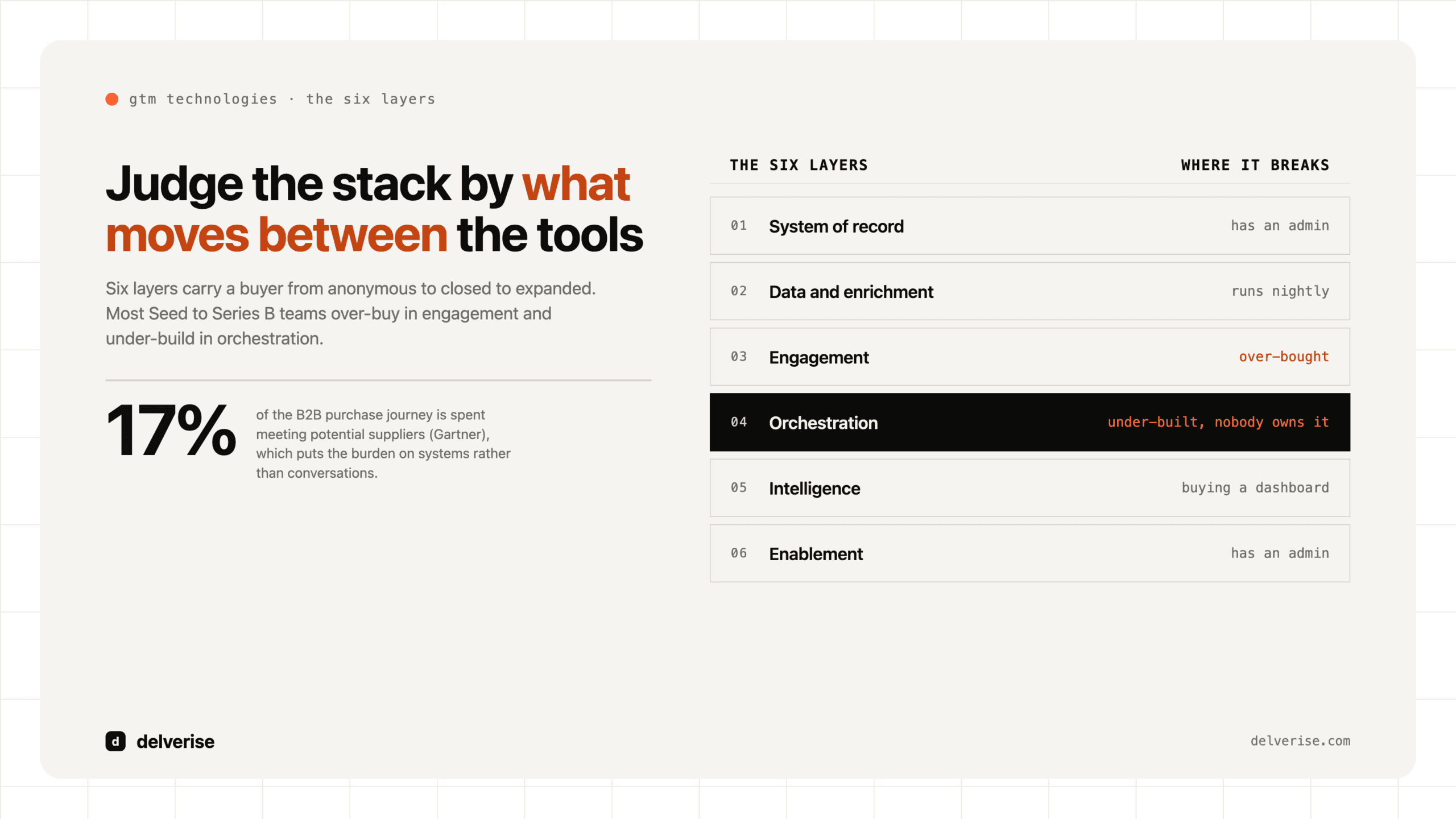
- Six layers matter: system of record, data and enrichment, engagement, orchestration, intelligence, and enablement. Most Seed to Series B teams over-buy in engagement and under-build in orchestration.
- Gartner’s B2B buying research found buyers spend only about 17% of their purchase journey meeting with potential suppliers, which puts most of the burden on systems rather than conversations.
- Tool count correlates poorly with revenue outcomes. Join quality, trigger latency, and field hygiene correlate strongly.
- Before you buy anything else, write down the specific decision or action each tool is supposed to trigger. If you cannot name it, you are buying a dashboard.
What are GTM technologies, exactly?
Go-to-market technologies are the software systems that carry a buyer from anonymous to closed to expanded. That includes the obvious names (Salesforce, HubSpot, Outreach, Apollo, Marketo) and the less obvious plumbing that connects them: reverse ETL, warehouse tables, enrichment waterfalls, webhook routers, workflow tools like n8n or Zapier, and whatever custom scripts your ops person wrote at 11pm.
Two definitions worth pinning down, because vendors use them loosely. Orchestration means deciding what happens next based on the current state of a record, then making it happen across systems. Enrichment means appending attributes (firmographics, technographics, contact details, intent) to a record you already have. Both sit underneath the tools your reps actually open, which is exactly why both get underfunded.
The practical framing for a revenue leader: your stack is a manufacturing line. Raw material (accounts and signals) enters, gets refined (enriched, scored, routed), gets worked (sequenced, called, nurtured), and exits as revenue. Every handoff between stations is a place where material gets dropped.
Why do most GTM stacks underperform their price tag?
Three patterns show up repeatedly in B2B SaaS teams between Seed and Series B.

Tools bought as answers to organizational questions. A team without a clear GTM team structure buys a sequencer to solve inconsistent outbound. The sequencer works fine. The inconsistency was about ownership, so it persists at higher software cost.
Data that arrives too late to matter. A signal is only worth what it is worth on the day it fires. If your enrichment runs nightly, your routing runs hourly, and your rep checks the queue tomorrow morning, a 20-minute-old buying signal reaches a human two days cold. Speed of response is one of the most reliably measured advantages in B2B, and it is a systems property. We cover the mechanics in detail in our piece on lead follow up.
No owner for the joins. Every tool has an admin. The space between tools usually has nobody. That gap is where duplicate accounts, orphaned opportunities, and untraceable attribution live. Salesforce’s State of Sales research has consistently found that reps spend well under a third of their working time actually selling, and a large share of the remainder is spent compensating for systems that do not talk to each other.
What are the layers of a modern GTM technology stack?
| Layer | Job | Representative tools | Symptom when it is weak |
|---|---|---|---|
| System of record | One authoritative version of account, contact, and deal state | Salesforce, HubSpot | Two teams quote different pipeline numbers in the same meeting |
| Data and enrichment | Fill and refresh the attributes decisions depend on | Clay, Apollo, ZoomInfo, Clearbit, provider waterfalls | Reps manually research accounts before every call |
| Engagement | Deliver the touch: email, call, LinkedIn, ads, lifecycle | Outreach, Salesloft, Customer.io, Marketo | High activity volume, flat reply rates |
| Orchestration | Route, trigger, sync, and sequence work across systems | n8n, Workato, Tray, Census, custom services | Handoffs depend on someone remembering |
| Intelligence | Scoring, forecasting, attribution, conversation analysis | Gong, warehouse plus BI, forecasting tools | Forecast accuracy swings by more than 20% quarter to quarter |
| Enablement | Content, playbooks, and in-context guidance at the moment of work | CMS, Highspot, in-CRM guidance | Onboarding a new AE takes two quarters |
Most teams we assess have four or five tools in the engagement layer and nothing deliberate in orchestration. That ratio predicts the outcome fairly well. For a fuller treatment of who owns each of these functions day to day, see GTM operations.

How do you decide what to buy versus what to build?
The honest answer is that the buy-versus-build line has moved. Five years ago, custom orchestration meant engineering headcount. Today a competent ops person can compose data providers, enrichment logic, and routing rules in a spreadsheet-style environment. Clay is the clearest example: it lets you chain multiple data providers so that when one fails to return a verified email, the next one tries, which is the pattern we describe in our guide to the data enrichment waterfall. That composability changes the math on a lot of point solutions.

A workable test, applied per capability:
- Buy when the capability is a commodity with real switching costs to rebuild (email deliverability infrastructure, CRM, call recording, dialers).
- Build or compose when the capability encodes something specific to your market: your ICP definition, your scoring logic, your territory rules, your qualification thresholds.
- Neither when you cannot articulate the action the output triggers. Deferring is a legitimate choice and usually the cheapest one.
delverise stays vendor-neutral on this deliberately. Every tool in the table above has customers who love it and customers who ripped it out, and the difference is almost always fit and implementation rather than product quality.
What does a working stack look like in practice?
Here is a concrete chain for a Series A SaaS company selling to mid-market operations teams, with a target of 40 qualified meetings a quarter.
A prospect account posts a job listing for a role that implies the pain the product solves. A scheduled job detects the listing and writes a record with the signal type, date, and source. Enrichment runs immediately: firmographics, headcount trend, current tooling detected on the website, and two verified contacts in the buying group. A scoring rule checks the account against ICP thresholds. Accounts above the line get pushed into the CRM with the signal attached and routed to the owning AE. A sequence starts within the hour, referencing the specific listing. If nobody replies in twelve days, the record drops into a nurture track and the signal expires from the active queue.
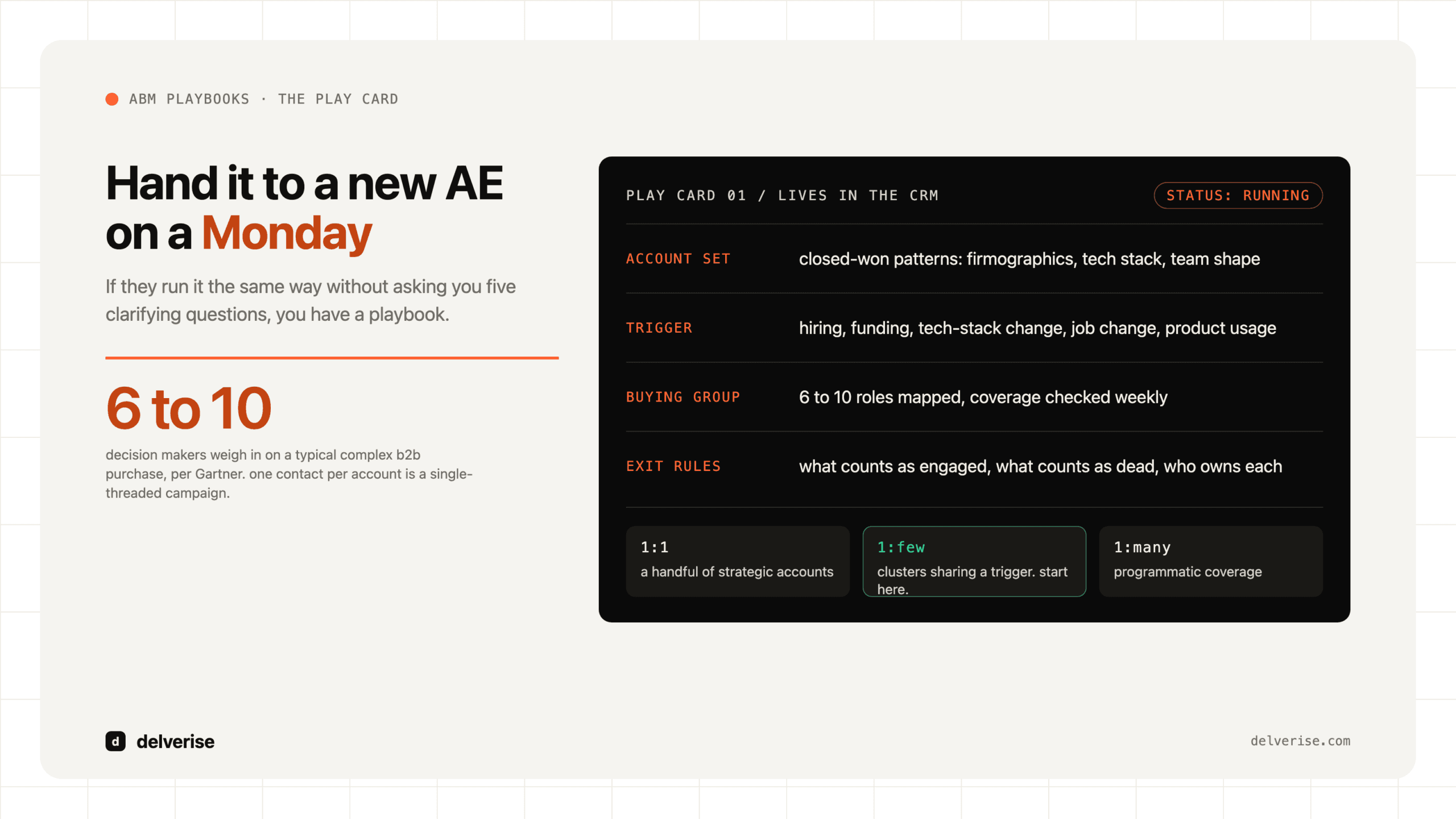
Total tools involved: four. Total custom logic: roughly a page of rules. What makes it work is that the signal reaches a human with context while the signal is still true. Gartner has also reported that B2B buying groups typically involve six to ten decision makers, so enriching a single contact and calling it coverage leaves most of the group untouched. Multi-contact enrichment on the same trigger costs marginally more and changes the hit rate meaningfully.
If you want help composing this kind of chain rather than assembling it yourself, delverise’s Clay implementation work and broader GTM engineering practice exist for exactly that.
How do you know whether your GTM technologies are earning their keep?
Four measurements, none of which appear on a vendor dashboard:
- Trigger latency. Median minutes from signal creation to first human or automated touch. Track it weekly.
- Field completeness on decision fields. Not every field. The five or six that routing, scoring, and forecasting actually read. Below 90% completeness, downstream logic is guessing.
- Manual step count per deal. Count the copy-paste operations a rep performs between first touch and closed won. Every one is a defect.
- Cost per qualified meeting, fully loaded. Software plus data credits plus the ops time to maintain it, divided by meetings that reach a second call.
Teams evaluating scoring and signal tooling should also read our guide to what a lead intelligence platform does and does not solve, since that category attracts more spend than it usually returns without a routing layer behind it.
What should you fix first?
In order, for a team under 50 people:
- Write down the five fields your routing and scoring logic depends on, then measure their fill rate today
- Instrument trigger latency for your top three signal types
- Kill or consolidate any tool nobody has opened in 30 days
- Assign one named owner to the joins between systems, with time protected for it
- Rebuild one high-value handoff (inbound to rep, or signal to sequence) end to end before touching anything else
- Re-measure cost per qualified meeting 60 days later and compare
That sequence produces compounding returns because each fix makes the next measurement more trustworthy. Buying a seventh tool before doing it produces a seventh set of fields nobody maintains.
Frequently Asked Questions
How many GTM tools should a Series A B2B SaaS company have?
Most teams at that stage operate well with six to ten, covering CRM, enrichment, engagement, orchestration, analytics, and call recording. The number matters less than whether each tool has a named owner and a documented trigger. If you cannot say in one sentence what action a tool causes, it is a candidate for removal regardless of the count.
What is the difference between a GTM tech stack and a sales tech stack?
A sales tech stack covers the tools reps use directly: CRM, dialer, sequencer, call recording. A GTM technology stack is broader and includes marketing automation, product analytics, data infrastructure, and the orchestration between all of it. The distinction matters at the point where marketing-sourced and product-sourced pipeline need to be measured on the same terms.
Do we need a data warehouse to run modern GTM technologies?
Not at Seed. A well-maintained CRM plus a composable enrichment layer covers most needs until you are running multiple motions or measuring product usage against sales activity. Once forecasting or attribution questions start producing conflicting answers from different tools, a warehouse becomes the cheapest way to settle them.
Where does AI genuinely help in a GTM stack today?
Research summarization, contact and account enrichment, call analysis, and first-draft personalization at volume are all working use cases. Fully autonomous prospecting remains uneven in practice, and the constraint is usually data quality upstream rather than model capability. Our breakdown of AI BDR tools covers what automates cleanly and where the failure points sit.
Who should own the GTM technology stack?
A single accountable owner in RevOps, reporting to whoever owns the revenue number. Splitting ownership between marketing ops and sales ops works only when one of them holds final authority over shared objects like accounts and lifecycle stages. Without that, the two teams will define the same field differently within a quarter.
Read next