←Back to blog
Growth & Demand GenerationGuideOctober 6, 20268 min read
Revenuecreations: What Revenue Creation Actually Means in B2B SaaS
Revenuecreations is a term buyers type when they are looking for help creating revenue: the discipline of building repeatable systems that convert market demand into booked ARR. In B2B SaaS it spans pipeline generation, routing, qualification, forecasting, and the data layer underneath. Done properly, revenue creation behaves like engineering work with measurable throughput.
Revenuecreations is a term buyers type when they are looking for help creating revenue: the discipline of building repeatable systems that convert market demand into booked ARR. In B2B SaaS it spans pipeline generation, routing, qualification, forecasting, and the data layer underneath. Done properly, revenue creation behaves like engineering work with measurable throughput.
Key takeaways
- Revenue creation is the full path from addressable market to signed contract, including the instrumentation that makes each step countable.
- At Seed to Series B, the usual failure is ownership split across marketing, sales, and ops, so no one can see the whole path.
- Buyers spend very little time with any single vendor, which means your system has to work when no rep is in the room.
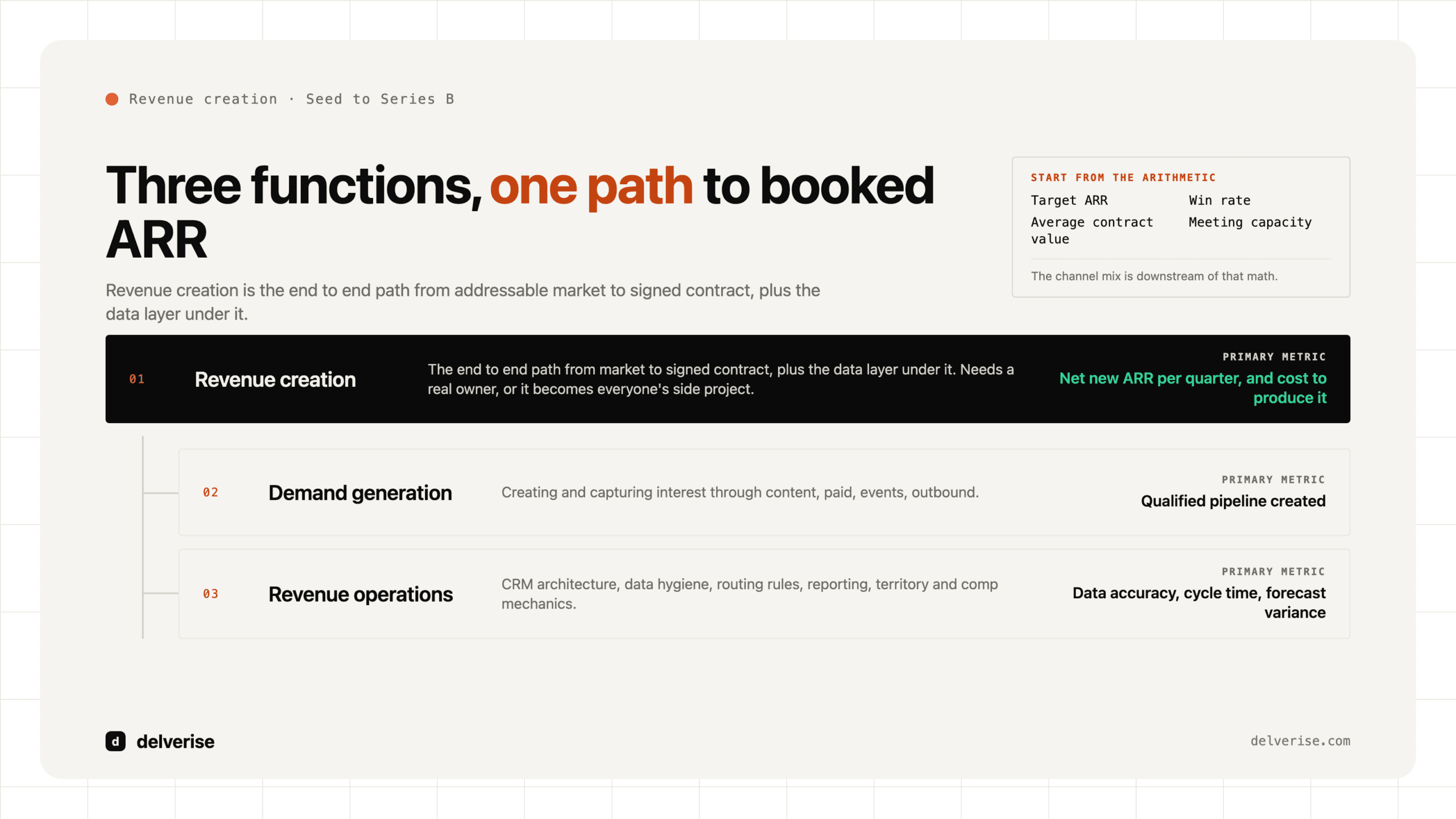
- Start from the arithmetic: target ARR, average contract value, win rate, and meeting capacity. The channel mix is downstream of that math.
- Most teams buy tools before they have a working model, then blame the tools when throughput stays flat.
What does “revenuecreations” actually refer to?
The query arrives as one word, usually from someone who either half-remembers a company name or is searching loosely for revenue creation help. Either way the buying question underneath is identical: who owns the job of creating revenue here, and what has to exist before it becomes repeatable?

Revenue creation, defined plainly, is the set of connected systems that move a company from total addressable market to closed contracts. That includes how you identify accounts, how you reach them, how interest gets captured and scored, how handoffs happen, and how every stage is measured. The measurement part matters more than most teams expect, because a revenue system you cannot instrument is a revenue system you cannot improve.
Three functions get confused with each other constantly. The distinctions are worth holding onto:
| Function | What it owns | Primary metric | Where it breaks on its own |
|---|---|---|---|
| Revenue creation | The end-to-end path from market to signed contract, plus the data layer under it | Net new ARR per quarter, and cost to produce it | Needs a real owner; otherwise it becomes everyone’s side project |
| Demand generation | Creating and capturing interest through content, paid, events, outbound | Qualified pipeline created | Produces volume that the downstream system cannot convert or route |
| Revenue operations | CRM architecture, data hygiene, routing rules, reporting, territory and comp mechanics | Data accuracy, cycle time, forecast variance | Optimizes a path that was never designed, so gains stay marginal |
A company that has all three, working against one model, has a revenue creation system. A company that has pieces of each, reporting to different leaders with different definitions of “qualified,” has a collection of activities. The difference shows up in the forecast. If you want the structural version of this argument, what a GTM function actually is covers how the pieces report to each other.
Why does revenue creation stall at Seed to Series B?
Four causes account for most of it.

Split ownership. Marketing owns the top, sales owns the bottom, and the middle belongs to nobody. Leads arrive, sit, and decay. Nobody is lying in the pipeline review; the handoff simply has no owner and therefore no SLA.
An absent data layer. The CRM was set up in week one by a founder who needed somewhere to put deals. Two years later it has four fields named some version of “source,” none of which agree. Every analysis turns into an argument about definitions. The foundation pieces under a revenue stack are boring and they gate everything above them.
Channel stacking without a model. The team adds outbound, then paid, then a partner motion, then an SDR, each in response to a flat quarter. Nothing gets removed. Cost per opportunity climbs and no single channel gets enough investment to prove itself.
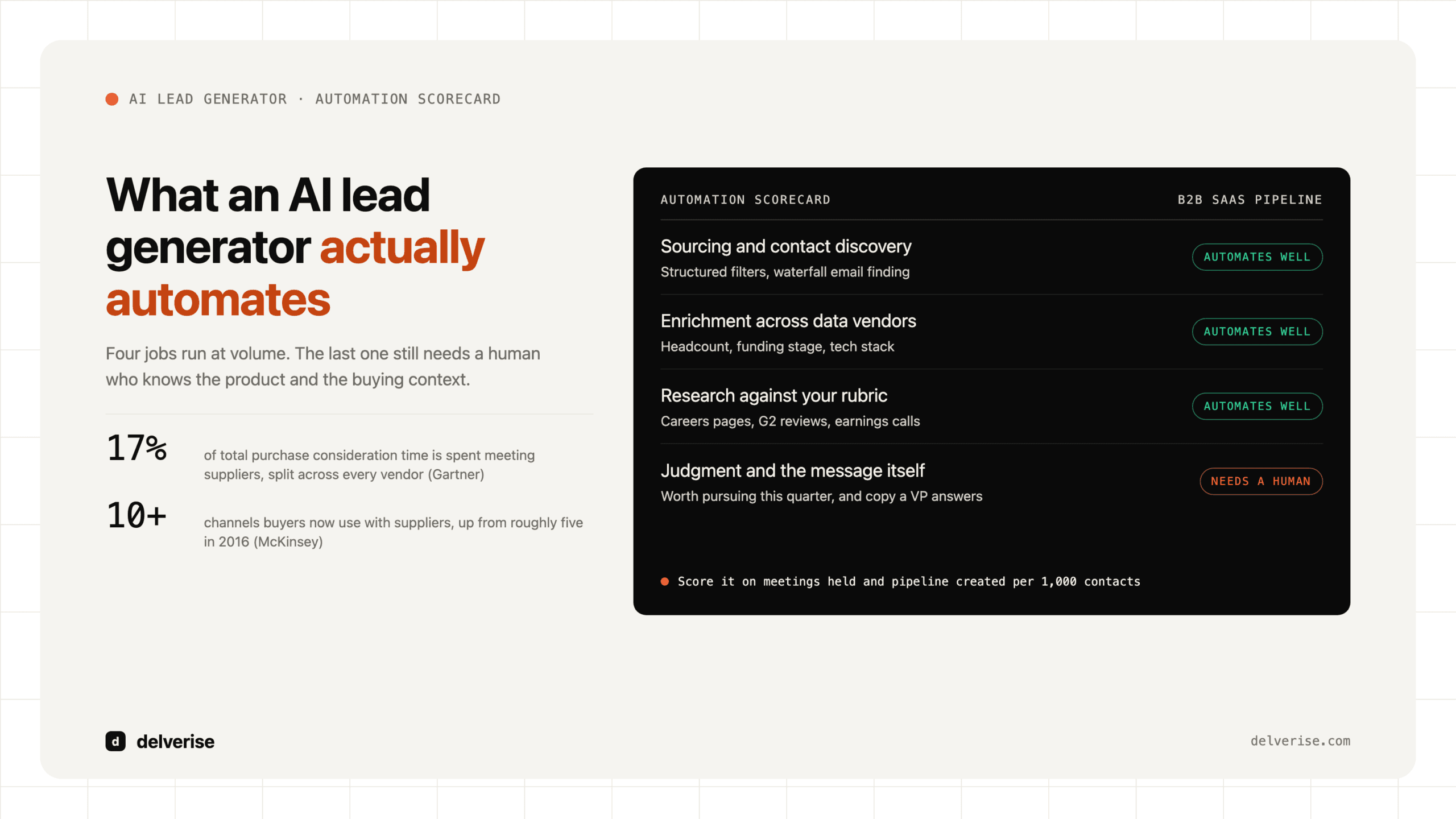
Designing for a buying process that no longer exists. Gartner’s research on B2B buying found that buyers spend only about 17 percent of their total purchase journey meeting with potential suppliers, and when several vendors are in play, any one vendor gets roughly 5 percent of that time. Gartner also puts the typical buying group at six to ten decision makers. McKinsey’s work on B2B buying points the same direction: buyers move across many channels before they ever talk to a seller. Practically, your system has to inform and de-risk a committee that is mostly deciding without you.
What does the math behind revenue creation look like?
Here is the arithmetic for a B2B SaaS company at $4M ARR that needs $2M in net new ARR over the next year.

- Average contract value: $18,000. So $2M requires about 111 new customers.
- Win rate from qualified opportunity: 22 percent. That means roughly 505 qualified opportunities.
- First meeting to qualified opportunity: 40 percent. That means about 1,263 first meetings, or 105 per month.
Now the capacity question. If inbound reliably produces 35 meetings a month and partner plus referral adds 15, outbound has to cover the remaining 55. A productive outbound rep books somewhere in the range of 12 to 15 qualified meetings a month once ramped, which puts you at four reps, hired and ramped before the quarter you need them in. See what one outbound SDR actually produces for the ramp assumptions that usually get skipped.
That single calculation tends to change the conversation. It exposes which lever is cheapest to move. Lifting win rate from 22 to 26 percent removes about 78 opportunities from the requirement, which is often less expensive than hiring a fourth rep. Lifting ACV by 15 percent removes 14 customers from the target. Most teams reach for volume first because volume is the most visible lever, and it is frequently the most expensive one. Building the model that makes these tradeoffs visible is the same work as building a forecast that holds.
Should you build revenue creation in-house, hire for it, or bring in outside help?
All three are legitimate. They fail in different ways.
Build in-house with your current team. Cheapest in cash, most expensive in calendar time. This works when you have someone technical who genuinely enjoys systems work and has the bandwidth to own it. It fails when the job lands on a VP who is already carrying a number, at which point the system gets built in fragments between pipeline reviews.
Hire a RevOps or growth leader. The right long-term answer for most companies past roughly $5M ARR. Recognize the lag: three to four months to hire, two to ramp, and the first ninety days usually go to cleaning data rather than creating pipeline. Strong candidates also want to inherit a strategy, not author one from nothing.
Bring in outside systems help. Fastest path to a working system and a clear diagnosis, and it transfers patterns your team has not seen yet. It fails when the engagement is scoped as activity instead of outcomes, or when nothing is documented and the knowledge leaves when the engagement ends. Ask directly what you own at the end, and who operates it. This is the work delverise does: designing the system, instrumenting it, and handing over something your team can run. Our GTM engineering work starts from that handover requirement.
A reasonable sequence for most Seed to Series B teams: get the model and the data layer right first, prove one channel to predictable output, then hire the permanent owner into a system that already works. Building the lead generation system in that order costs less than the reverse.
What should you check before investing in revenue creation?
- One written definition of a qualified opportunity that sales and marketing both signed off on
- A single source of truth for pipeline, with source attribution that survives a hard question
- Stage-by-stage conversion rates from the last four quarters, not estimates
- Documented routing and follow-up SLAs, with a report showing whether they are met
- Known cost per qualified opportunity for each active channel
- A named owner for the middle of the funnel
- A capacity model that ties your ARR target to reps, meetings, and ramp time
Fewer than four of these in place means your constraint is system design. More than five means your constraint is probably volume or message, which is a much better problem to have.
Frequently Asked Questions
Is revenuecreations a company or a concept?
The term gets searched both ways. Some people are looking for a specific provider whose name they half-remember; others are searching generically for revenue creation help. If you are evaluating a named provider, ask what you own at the end of the engagement and what their work looks like after they leave. If you are researching the concept, it refers to the connected systems that turn addressable market into booked ARR.
How is revenue creation different from lead generation?
Lead generation produces contacts and interest. Revenue creation covers everything from account selection to signed contract, including qualification, routing, sales process, and the reporting that tells you which stage is actually constraining growth. Plenty of companies generate leads well and still miss their number because the stages after the lead were never designed.
How long does it take to build a working revenue creation system?
For a Seed to Series B company, expect six to eight weeks to fix the data layer and define the model, then one full sales cycle to see whether the changes moved conversion. If your cycle is 60 days, you are four to five months from trustworthy evidence. Anyone promising a transformed pipeline in 30 days is describing activity rather than output.
What is the smallest useful first step?
Pull your last four quarters of closed deals and rebuild the funnel backward from revenue: contracts, opportunities, meetings, by source. Most teams discover at least one stage where their assumed conversion rate is off by half. That single exercise usually reprioritizes the next two quarters of spend, and it costs a week of analyst time.
Do we need a full RevOps hire before any of this works?
No. Below roughly $5M ARR, a well-designed system with clear ownership usually beats an early specialist hire operating inside a broken one. The sequence that tends to work is model first, data layer second, one proven channel third, permanent owner fourth. Hiring into an undefined system is how good operators end up doing CRM cleanup for two quarters.
Read next