←Back to blog
Growth & Demand GenerationGuideOctober 7, 20267 min read
AI Lead Generator: What It Actually Does and How to Build One That Produces Pipeline
An AI lead generator is software that uses machine learning and large language models to find, research, enrich, score, and contact potential buyers automatically. In B2B SaaS it compresses hours of manual list building and account research into minutes. Output quality depends almost entirely on the data sources and qualification rules feeding it.
An AI lead generator is software that uses machine learning and large language models to find, research, enrich, score, and contact potential buyers automatically. In B2B SaaS it compresses hours of manual list building and account research into minutes. Output quality depends almost entirely on the data sources and qualification rules feeding it.
Key takeaways
- An AI lead generator is a category, not a single product. It spans data platforms, research and workflow tools, sequencers, intent providers, and on-site conversion tools.
- The reliable gains come from research and enrichment at volume, where AI reads public sources and applies your qualification logic consistently across thousands of accounts.
- Message generation is the weakest link. Fully automated copy tends to converge on the same generic patterns every other tool produces.
- Your CRM data model and ICP definition determine the ceiling. A messy account object means the AI qualifies against noise.
- Measure the system on meetings held and pipeline created per 1,000 contacts, not on volume of leads generated.
What is an AI lead generator, exactly?
The term covers any tool that applies AI to one or more steps of lead generation: sourcing accounts, finding contacts, enriching records with firmographic and technographic data, researching each account against a qualification rubric, scoring fit and intent, drafting outreach, and routing the result to a rep or a sequence.
A useful distinction: enrichment means appending known facts to a record (headcount, funding stage, tech stack). Research means having a model read unstructured sources such as a careers page, a G2 review, or an earnings call and answer a specific question you defined, like “does this company run a self-serve motion alongside sales-led?” Most of the commercial value in modern AI lead generation sits in that second category, because it is the work that never scaled with humans.
What does an AI lead generator actually automate?
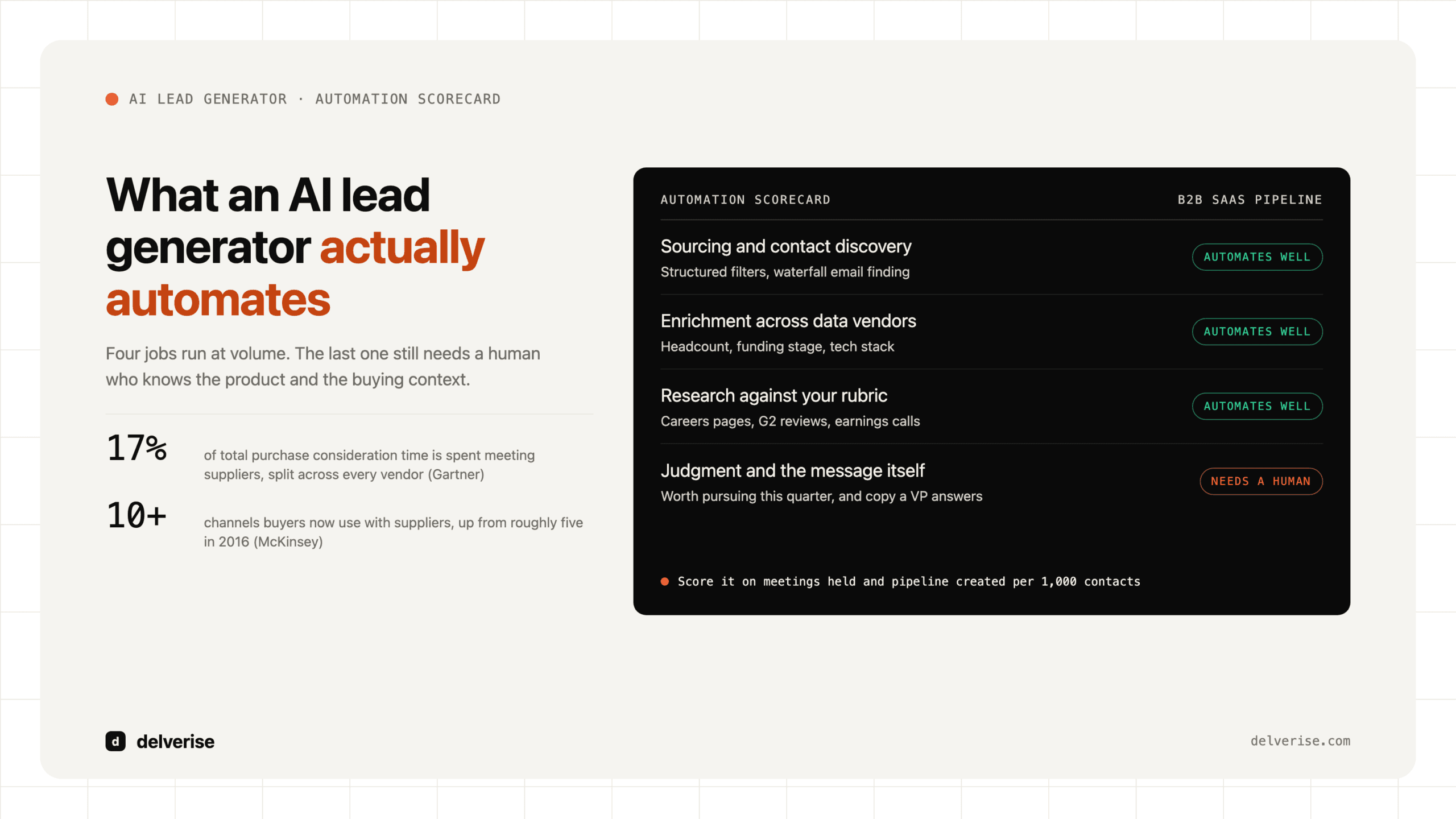
Broken down honestly, four jobs automate well and two do not.

Automates well: account sourcing from structured filters, contact discovery and waterfall email finding, enrichment across multiple data vendors, and account research against a defined rubric. These are high-volume, rules-bounded tasks with verifiable outputs, which is exactly where current models perform.
Automates poorly: judgment about whether a specific account is worth pursuing this quarter, and writing outreach that earns a reply. AI can draft a first line from a research field. Turning that into a message a VP of Engineering answers still needs a human who understands the product and the buying context. We covered the practical boundary in more depth in outbound sales automation: what to automate and what to keep human.
This matters because buyers have less patience than ever for generic contact. Gartner’s research on B2B buying found that buyers spend only about 17% of their total purchase consideration time meeting with potential suppliers, split across every vendor they evaluate. McKinsey’s B2B Pulse research found buyers now use ten or more channels when interacting with suppliers, up from roughly five in 2016. Attention is thin and spread across surfaces, so a message that reads like a template gets deleted without cost to the buyer.
What are the different types of AI lead generators?
| Category | What the AI does | Best fit | Main tradeoff |
|---|---|---|---|
| Data and contact platforms (Apollo, ZoomInfo, Clearbit) | Matches records, predicts emails, scores fit from firmographics | Teams needing broad coverage fast | Everyone buys the same list; differentiation has to come from elsewhere |
| Research and workflow platforms (Clay, n8n-based builds) | Runs agents across the web, applies custom qualification prompts per row, orchestrates multi-vendor waterfalls | Teams with a specific ICP thesis and signals worth chasing | Requires an owner; credits burn fast without discipline |
| Engagement and sequencing (Outreach, Salesloft, Smartlead) | Drafts variants, optimizes send timing, classifies replies | Teams already running structured outbound | AI copy quality degrades at scale without human editing |
| Intent and signal providers (G2 Buyer Intent, Bombora, 6sense) | Models account-level buying signals from third-party behavior | Larger ACVs and longer cycles | Signal is probabilistic and often late; easy to over-trust |
| On-site conversion (chat agents, adaptive forms) | Qualifies and routes inbound visitors in real time | Sites with meaningful traffic already | Only works on demand you have already generated |
Most teams need two or three of these connected, not all five. If you are evaluating the research and workflow layer, Clay is the clearest starting point for seeing what per-account AI research looks like in practice, because it makes the enrichment waterfall and the prompt logic visible rather than hiding both behind a score. For a broader buying framework across the category, see our guide to picking an AI prospecting tool.

Where do AI lead generators break?
Your ICP is a description, not a filter. “Mid-market B2B SaaS with a sales-led motion” cannot be executed by software. A filter can: headcount 50 to 400, raised a Series A or B in the last 24 months, has at least two open AE roles, uses a CRM you integrate with. Teams that skip this step get high volume and low conversion, then blame the tool.

The CRM cannot hold the output. If accounts are duplicated, ownership rules are ambiguous, or there is no field to store a research answer, the AI output has nowhere to live and nothing downstream can act on it. This is the most common failure we see, and it is addressed before tooling. Our breakdown of the six foundation pieces under every revenue stack covers what has to exist first.
Scoring drifts without feedback. A fit score built once and never retrained against closed-won data becomes a confident guess. Build the loop that compares scored leads to actual outcomes quarterly. See AI lead qualification for how to structure the scoring model itself.
Deliverability quietly collapses. AI makes it trivial to send far more email than your domain infrastructure can carry. Volume without warmed domains, verified addresses, and sending caps produces a spam reputation that takes months to repair.
What does a working system look like end to end?
Here is the arithmetic for a single quarterly motion at a Series A SaaS company with a $32,000 average contract value. The numbers are illustrative, and they show where the leaks actually are.
- Start with 5,000 accounts matching hard firmographic filters.
- Run an AI research pass against a three-question rubric (relevant trigger, relevant tech, relevant team structure). 740 accounts pass all three.
- Find contacts across the buying group. Gartner’s work on complex B2B purchases puts the typical buying group at six to ten people, so targeting a single champion under-covers the decision. At 3.2 contacts per account, that is 2,368 contacts.
- Verify emails. Roughly 14% fail, leaving about 2,036 sendable contacts.
- Send over six weeks within deliverability limits. At a 6% reply rate, that is 122 replies.
- 34% of replies are positive: 41 meetings booked. At a 70% show rate, 29 meetings held.
- 35% convert to qualified opportunities: 10 opportunities, roughly $320,000 in new pipeline.
Notice what moved the outcome. The research pass cut 5,000 accounts to 740, which is what protected the reply rate. Doubling send volume without that filter would have produced more replies in absolute terms and fewer meetings held, while burning the domain. The full sequencing of this motion is laid out in our guide to building the B2B lead generation system.
How should you evaluate one before you buy?
- Write your ICP as executable filters, with thresholds, before any demo
- Define three qualification questions the AI must answer per account, and what a passing answer looks like
- Run a 200-account paid pilot and manually grade 25 outputs against your own judgment
- Confirm the CRM has fields to store research answers, scores, and the source of each
- Check credit or usage economics at your real monthly volume, not the demo volume
- Agree the single metric you will judge it on: pipeline created per 1,000 contacts touched
Teams that want the research and enrichment layer built properly rather than assembled in pieces can see how delverise approaches it on our Clay implementation page, or review the broader AI outbound system we build around it.
Frequently Asked Questions
Can an AI lead generator replace an SDR?
It replaces the research and list building portion of the role, which is typically 40% to 60% of an SDR’s week. Reply handling, objection navigation, and multithreading into a buying group still need a person. The realistic outcome is fewer SDRs producing more qualified meetings, with the saved hours moved into conversations.
How much does an AI lead generator cost?
Budget three layers: a data or research platform ($350 to $2,000 per month at Seed to Series B volumes), a sequencing tool ($80 to $150 per seat per month), and email infrastructure including domains and verification ($150 to $400 per month). Implementation is the larger and more variable cost, because the qualification logic and CRM plumbing are custom to your motion.
Do AI-generated leads actually convert?
They convert at the rate your qualification logic earns. Leads sourced from a filter plus a verified trigger convert comparably to manually researched leads at a fraction of the cost per account. Leads sourced from broad firmographic filters alone convert poorly regardless of how sophisticated the tool is. We unpack the difference in AI generated leads: how to make them convert.
What is the first thing to fix before buying a tool?
Your account data model. Decide what an account record must contain, how duplicates are resolved, who owns routing, and where AI research answers are stored with their source. Without that, every tool you connect writes into a system that cannot act on the output.
How long until it produces pipeline?
Expect four to six weeks to first meetings if domains are already warm, and eight to ten weeks if you are building sending infrastructure from scratch. The first meaningful read on conversion quality comes at roughly 1,500 to 2,000 contacts touched, which is when reply and meeting rates stop being noise.
Read next