←Back to blog
Revenue Intelligence & Data ToolingGuideAugust 31, 20268 min read
What Is a GTM Function? How B2B SaaS Companies Actually Build One
A GTM function is the coordinated system a company uses to acquire, convert, and expand customers: the people, processes, data, and tooling spanning marketing, sales, customer success, and revenue operations. In B2B SaaS it operates as one accountable unit with shared definitions, a shared pipeline model, and a single source of revenue truth rather than four teams reporting separately.
A GTM function is the coordinated system a company uses to acquire, convert, and expand customers: the people, processes, data, and tooling spanning marketing, sales, customer success, and revenue operations. In B2B SaaS it operates as one accountable unit with shared definitions, a shared pipeline model, and a single source of revenue truth rather than four teams reporting separately.
Key takeaways
- A GTM (go-to-market) function covers the entire revenue chain, from demand creation through expansion, under one operating model.
- Most Seed to Series B companies have GTM teams without a GTM function: the headcount exists, the shared definitions and data layer do not.
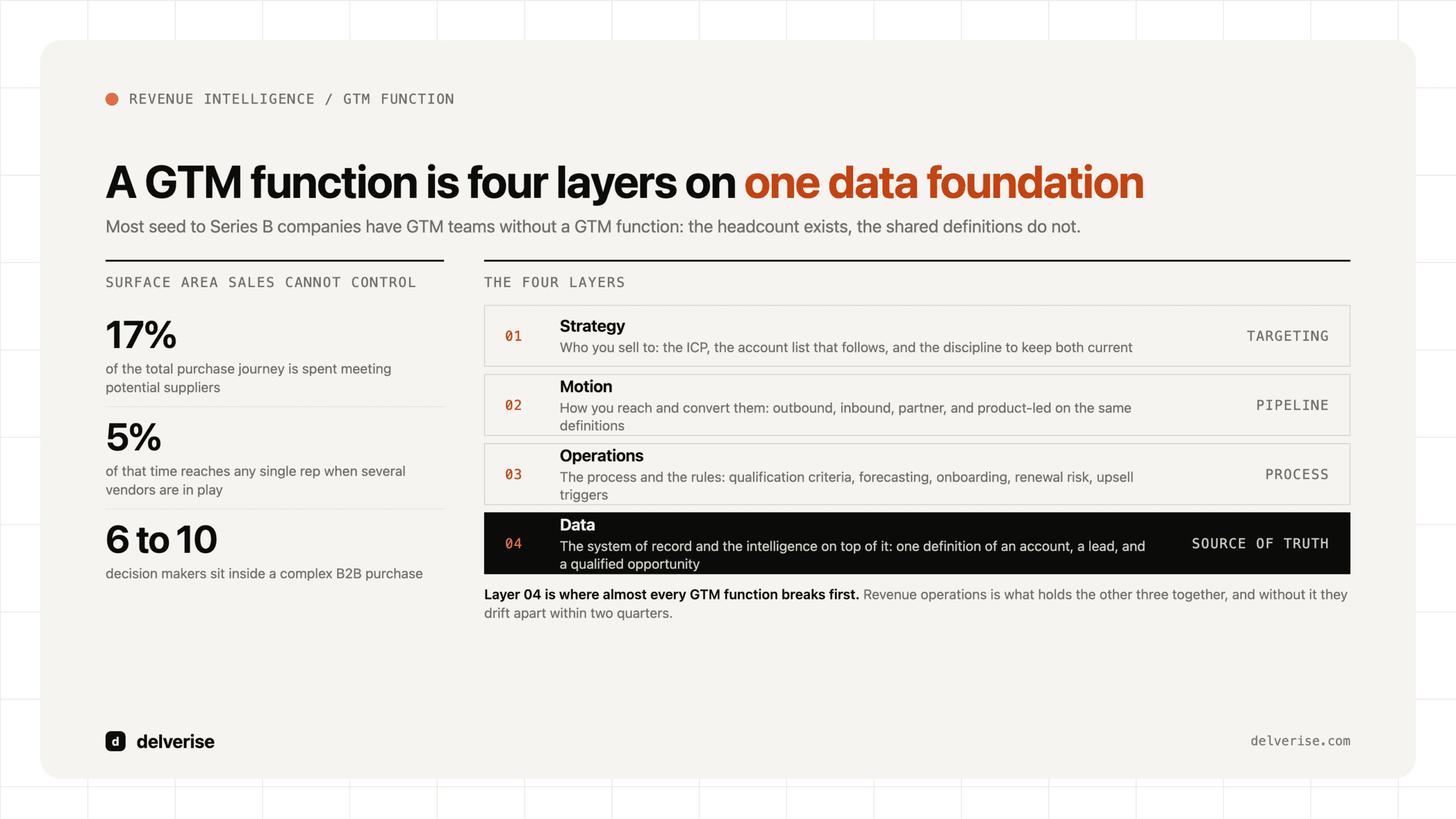
- The function has four layers: strategy (who you sell to), motion (how you reach and convert them), operations (the process and rules), and data (the system of record and the intelligence on top of it).
- Almost every GTM function breaks at the same place first: inconsistent definitions of an account, a lead, and a qualified opportunity across the tools.
- Stage matters. At $1M ARR the function is two people and a CRM. At $10M it is a defined operating cadence with dedicated RevOps ownership.
What does a GTM function actually own?
A useful way to think about it: the GTM function owns everything between “we have a product someone will pay for” and “revenue compounds predictably.” Concretely, that means five surfaces.

- Segmentation and targeting. The ideal customer profile (ICP), the account list that follows from it, and the discipline to keep both current.
- Demand and pipeline creation. Outbound, inbound, partner, and product-led sources, measured on the same definitions.
- Conversion. Sales process, qualification criteria, forecasting, and the enablement behind them.
- Retention and expansion. Onboarding, adoption signals, renewal risk, upsell triggers.
- Revenue operations. RevOps is the discipline that owns the process, systems, and data connecting the four surfaces above. Without it, the others drift apart within two quarters.
Note that only two of those five are what most founders picture when they say “we need to hire GTM people.” The other three are systems work, and they are usually the reason the hires underperform.
How is a GTM function different from having a sales team?
A sales team owns conversion of the opportunities it receives. A GTM function owns whether those opportunities exist, whether they match the ICP, whether the data behind them is accurate, and what happens to the customer after the close.

The distinction matters more than it used to because buyers spend so little time with sellers. Gartner’s B2B buying research found that buyers spend roughly 17 percent of the total purchase journey meeting with potential suppliers, and when they’re weighing several vendors, any single rep may get about 5 percent of that time. McKinsey’s B2B research puts buyers across roughly ten channels in a single purchase decision, roughly double what it was a decade ago. Gartner has also found that complex B2B purchases typically involve six to ten decision makers.
Read those three findings together and the implication is direct: most of your revenue outcome is determined outside of sales conversations, by channels and signals your sales team does not control. That surface area is what the GTM function exists to manage.
What does a GTM function look like at each stage?
| Stage | What the function looks like | What breaks first |
|---|---|---|
| Pre-seed to ~$1M ARR | Founder-led sales, one CRM, manual list building, no formal handoffs | Nothing is written down, so the first AE hire cannot reproduce the founder’s motion |
| $1M to $3M ARR | 2 to 4 reps, a marketing hire, sequencing tool, first attempt at reporting | Definitions diverge. Marketing’s “lead” and sales’ “qualified” stop matching, and the funnel numbers stop reconciling |
| $3M to $10M ARR | Segmented roles (SDR, AE, CS), dedicated RevOps owner, enrichment and routing automation | Tool sprawl and data debt. Five systems each hold a partial version of the account |
| $10M+ ARR | Formal GTM operating cadence, forecast discipline, territory and capacity planning, attribution model | Change management. The system works, but nobody can safely modify it |
The pattern worth internalizing: the function does not get more sophisticated because the company gets bigger. It gets more sophisticated because the cost of ambiguity rises with headcount.

What data and systems does a GTM function run on?
Four layers, in dependency order. Each one is only as good as the layer beneath it.
System of record. The CRM. HubSpot or Salesforce for most B2B SaaS, with the object model (account, contact, opportunity) defined once and enforced. Everything downstream inherits its errors, so this is where discipline pays the most. If you are on a relationship-driven motion, the tradeoffs of alternatives like Affinity are worth understanding before you commit.
Data and enrichment. Firmographic, technographic, and contact data, plus the signals that make targeting timely: hiring, funding, product usage, job changes. Buying a single vendor’s database and calling it done is the common mistake. Coverage varies enormously by segment and geography, which is why the honest answer usually involves waterfall enrichment across multiple providers. Our breakdown of what GTM data actually needs to contain covers the evaluation criteria.
Orchestration. The layer that turns data into action: scoring, routing, sequencing, and the automation between systems. Clay has become the common choice here for list building and enrichment orchestration, because it lets a revenue team compose data sources and AI research steps without engineering tickets. The tradeoff is real: it is powerful enough to encode bad process very efficiently, and credit costs climb fast if nobody owns the table design. Teams that want the architecture set up correctly the first time can see how we approach Clay implementation.
Reporting and intelligence. Pipeline coverage (open pipeline divided by the quota it needs to cover), conversion by stage, cycle length, and cohort retention. This layer is where broken integrations surface, and the sync between engagement tools and the CRM is a frequent culprit. See our teardown of the Salesloft to Salesforce sync for what “connected” actually means in practice.
The full picture of how these fit together is in our guide to the GTM tech stack.
What does a broken GTM function cost? A worked example
Take a $4M ARR company with four AEs carrying $700K quotas each. Sales cycle is 60 days, average contract value is $24K, and win rate from qualified opportunity is 22 percent. To cover $2.8M in quota, they need roughly 530 qualified opportunities a year, or about 44 a month.
Now introduce one common defect: the enrichment data has 30 percent inaccuracy on company size, so roughly a third of accounts entering sequences fall outside the ICP. Those accounts still consume SDR capacity, still get worked, and convert at maybe a third of the normal rate.
The visible symptom is a rep problem: reply rates fall, the team asks for more headcount, and the founder considers hiring a fifth AE at roughly $180K fully loaded. The actual cause is a data layer producing a third of its output as waste. Fixing the enrichment logic recovers that capacity for a fraction of the cost of the hire, and the recovered capacity converts at the normal rate rather than the depressed one.
This is the specific reason GTM functions are worth treating as engineering problems. The failure modes look like people problems and are usually system problems. The same logic applies further up the funnel, which is why prospecting that compounds depends on data quality before it depends on volume.
Should you build the GTM function in-house or bring in outside help?
Build in-house when the motion is already working and needs scaling, when you have a RevOps owner with capacity, and when the institutional knowledge matters more than speed. That last point is real: a GTM function encodes your specific understanding of your buyer, and outsourcing that understanding wholesale creates a dependency you will regret.
Bring in outside help when you need the systems layer built faster than you can hire for it, when you have tried twice internally and the same problems recur, or when the work is architectural and short-duration. Building a waterfall enrichment pipeline, restructuring a CRM object model, or instrumenting attribution are projects with a beginning and an end, and hiring a permanent employee for a three-month build is expensive in both directions. We laid out the decision framework in building in-house versus bringing in outside help, and what the systems-depth version of this work involves on our GTM engineering page.
Forrester’s research on revenue operations has consistently found that companies aligning marketing, sales, and service operations under shared governance grow faster than peers running them separately. Gartner made a similar call several years ago, predicting that the majority of the highest-growth B2B organizations would adopt a unified revenue operations model. Both point the same direction: the coordination layer is where the compounding happens.
How do you know your GTM function is actually working?
Run this audit. Any unchecked box is a specific project.
- Marketing, sales, and CS use the same definition of an account, and the CRM enforces it
- You can trace any closed-won deal back to its original source without manual reconstruction
- Pipeline coverage is measured weekly against a known target ratio, not eyeballed
- Data accuracy on your core enrichment fields has been sampled and measured in the last 90 days
- Handoffs between stages have defined criteria and an owner, written down
- One named person owns the GTM systems, even if it is 30 percent of their role
- Your forecast from 90 days ago landed within 15 percent of actual
- Adding a new channel or segment takes weeks rather than quarters
Frequently Asked Questions
Is a GTM function the same as revenue operations?
RevOps is one layer inside the GTM function. RevOps owns the process, systems, and data infrastructure. The GTM function also includes the customer-facing teams and the strategy that directs them. Every GTM function needs RevOps, and RevOps alone will not produce pipeline.
At what stage should a B2B SaaS company formalize its GTM function?
When the second or third revenue hire joins, typically somewhere between $1M and $2M ARR. Before that, the founder is the function. The signal to formalize is when two people can look at the same pipeline and reach different conclusions about its health.
Who should own the GTM function?
At Seed, the founder or CEO. At Series A, usually a VP Sales or a Head of Revenue with a RevOps owner reporting in. Splitting ownership across a VP Sales and a VP Marketing with no shared operating model is the most reliable way to produce two funnels that disagree with each other.
How much of the GTM function should be automated?
Automate anything deterministic: enrichment, routing, data hygiene, list building, reporting. Keep judgment work human: qualification calls, pricing conversations, expansion strategy. The dividing line is whether a rule can produce the right answer every time. Our guide on using AI in sales goes deeper on where that line currently sits.
What is the first thing to fix in an underperforming GTM function?
Definitions, then data quality, then process, then tooling. Teams almost always attempt that order in reverse, buying a new platform to solve a problem that originates in disagreeing definitions. New tooling on top of ambiguous definitions produces faster, more expensive confusion.
Read next